

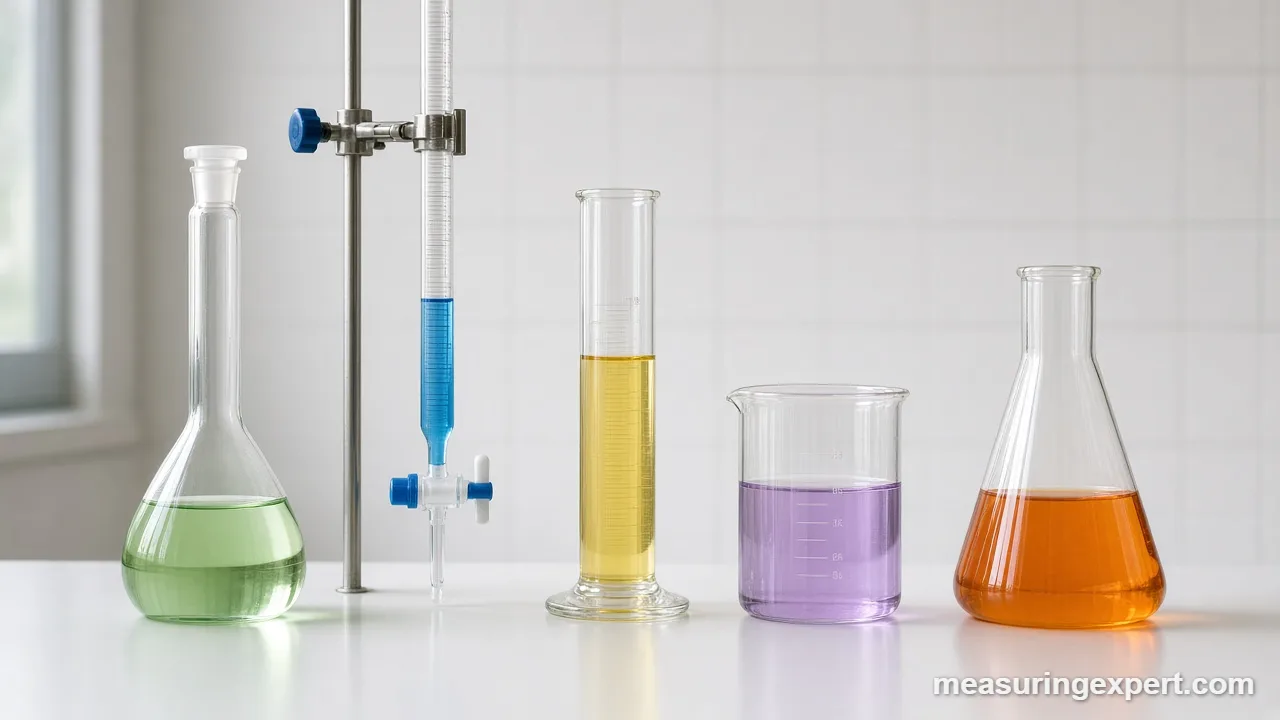
The best glassware to measure volume depends on the job. For one exact volume, use a Class A volumetric pipette (to deliver) or volumetric flask (to contain), accurate to about 0.1 percent. For variable amounts, use a buret. A graduated cylinder is good to about 0.5 percent, while beakers and Erlenmeyer flasks are only rough guides.
At first glance, lab glassware looks alike on the shelf, yet the error you get from it ranges from a few hundredths of a milliliter to several milliliters. For example, a 100 mL Class A volumetric flask is allowed to be off by 0.08 mL, while the printed 100 mL line on a beaker can easily be off by 5 mL. In other words, that is a 60-fold difference for the same nominal volume.
So choosing the right glassware to measure volume is really a matching exercise. First, decide whether you need one fixed volume or a variable one. Next, decide whether you will keep the liquid in the vessel (to contain) or pour it out (to deliver). Finally, decide how much error your work can tolerate.
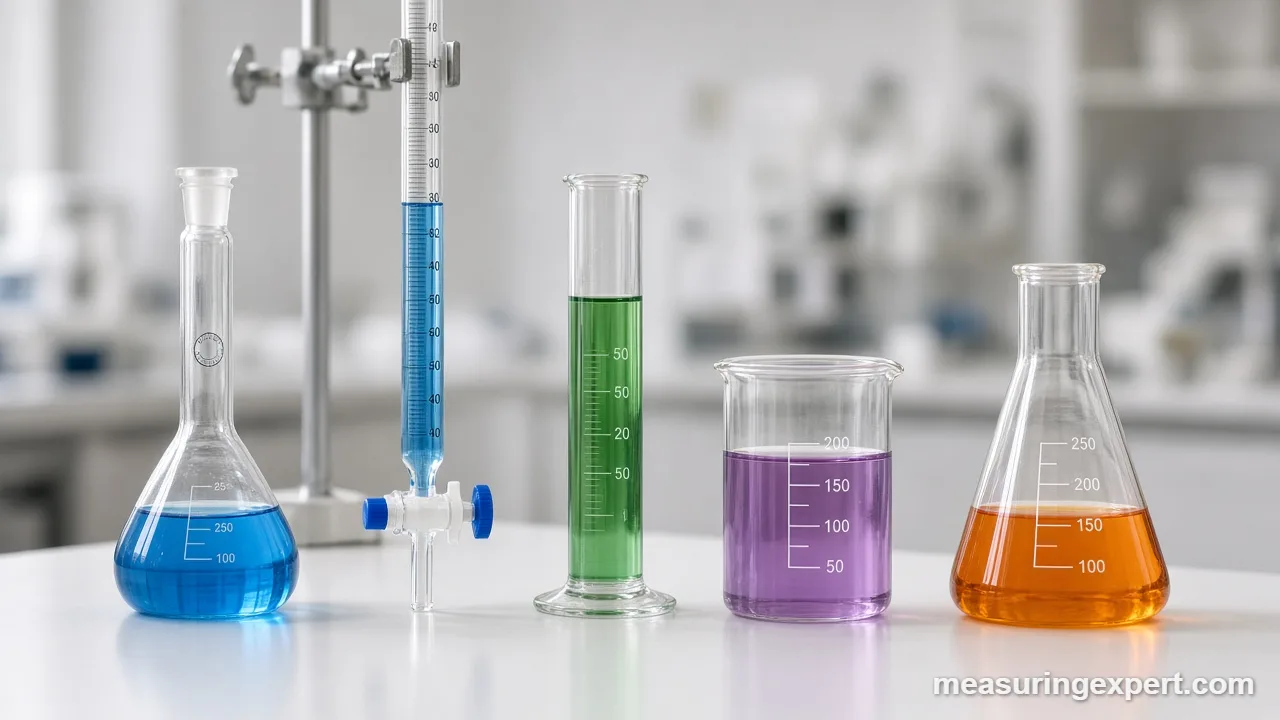
In short: fixed volume to contain means a volumetric flask; fixed volume to deliver means a volumetric pipette; variable delivery means a buret; quick everyday measuring means a graduated cylinder; mixing and holding means a beaker or Erlenmeyer flask.
The tolerances on this page come from the ASTM standards that US labs buy against: E288 for volumetric flasks, E969 for volumetric pipettes, E287 for burets and E1272 for graduated cylinders. In each standard, Class B tolerances are twice as wide as Class A, and all of them assume a temperature of 20 degrees C (68 degrees F).
Convert a Glassware Reading to US Units
Most lab glassware is marked in milliliters, so conversions come up often. If you need the same amount in fluid ounces, cups or spoons, type your reading below. Also note that the converter uses the exact US definition of 1 fl oz = 29.5735 mL.
Recommended Glassware to Measure Volume Accurately
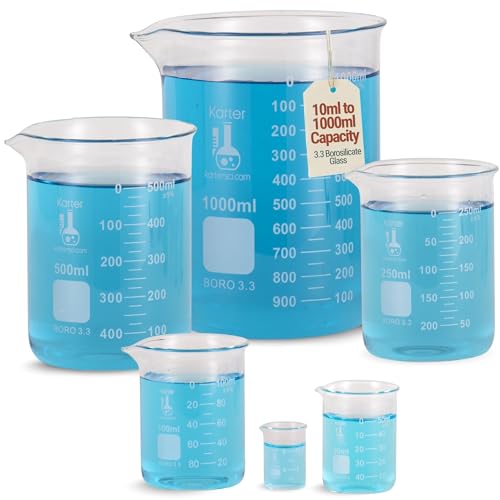
These picks cover each job in this guide: Class A volumetric flasks for solutions, a Class A buret for titration, Class A transfer pipettes, a Class A cylinder set for everyday measuring, and a plain beaker set for holding and mixing. Also look for “Class A” and the ASTM number printed on the glass itself, because that marking is what ties the item to a tolerance.



As an Amazon Associate, Measuring Expert earns from qualifying purchases.
- Volumetric flasks and pipettes measure one fixed volume and are the most accurate common glassware.
- A buret is the best choice when the volume you need changes, as in titration.
- Graduated cylinders are fine for most routine work, at roughly 0.5 to 1 percent.
- Beaker and Erlenmeyer flask lines are approximate; never use them for a final measurement.
- Class A glassware has half the tolerance of Class B under the same ASTM standard.
- “TC” means calibrated to contain; “TD” means calibrated to deliver.
- Always read the bottom of the meniscus at eye level, near 20 degrees C.
Which Glassware to Measure Volume Fits Which Job?
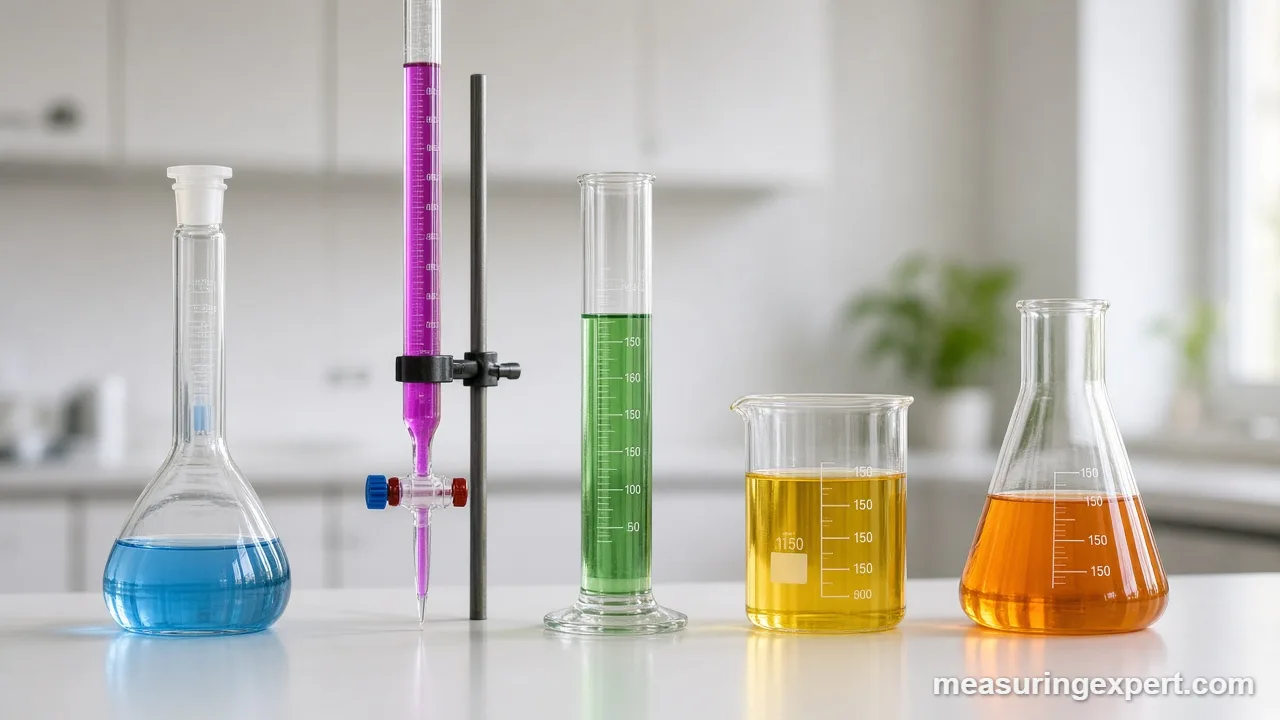
Always start with the task, not the shelf. For that reason, the table below pairs common lab and classroom jobs with the glassware that fits them, along with a typical Class A error for a mid-size piece.
| Job | Best glassware | Typical Class A error | Why |
|---|---|---|---|
| Make a solution of exact molarity | Volumetric flask (TC) | 100 mL ±0.08 mL (0.08%) | One etched line on a narrow neck |
| Transfer an exact aliquot | Volumetric (transfer) pipette (TD) | 10 mL ±0.02 mL (0.2%) | Fixed volume, drains by gravity |
| Titration or any variable amount | Buret (TD) | 50 mL ±0.05 mL (0.1%) | Fine 0.1 mL graduations and a stopcock |
| Routine measuring, reagents, media | Graduated cylinder | 100 mL ±0.5 mL (0.5%) | Fast, many sizes, readable to a fraction of a line |
| Mixing, heating, holding, rough estimates | Beaker or Erlenmeyer flask | Not rated; lines are approximate | Wide body makes small errors invisible |
For a ranking of the most precise options overall, including weighing, see our guide to the most accurate volume measurement tool. By contrast, if you just want to know what each piece of equipment is called and looks like, our overview of lab equipment to measure volume covers all six main types.
Volumetric flask: exact solutions
A volumetric flask has a pear-shaped body, a long narrow neck, and a single ring etched on that neck. Because the neck is so narrow, a small change in liquid height is a tiny change in volume. As a result, a 250 mL Class A flask is allowed only ±0.12 mL, which is under 0.05 percent. For this reason, use it whenever you dissolve a solid and fill “to the mark” to get a known concentration.
Volumetric pipette: one exact transfer
A transfer pipette also has one mark, but it is calibrated to deliver. To use one, you draw liquid above the line with a pipette bulb, let it fall to the mark, and then let it drain freely into the receiving vessel. Do not blow out the small drop left in the tip; the calibration already allows for it. For step-by-step technique, see how to use a pipette.
Buret: variable amounts with high precision
Similarly, a buret is a long graduated tube, but it has a stopcock at the bottom. First you read the level before the titration, and then after it; the difference is the volume delivered. Therefore a 50 mL Class A buret, marked every 0.1 mL and read to about 0.02 mL, is the standard choice for titrations.
Graduated cylinder: the everyday workhorse
A graduated cylinder is the most versatile glassware to measure volume when you need “about right” quickly. However, its wide bore limits accuracy. Under ASTM E1272, a 10 mL Class A cylinder allows ±0.10 mL (1 percent), and a 100 mL cylinder allows ±0.5 mL.
Beakers and Erlenmeyer flasks: approximate only
Beakers and Erlenmeyer flasks do have graduations, but manufacturers label them as approximate, often within about 5 percent. For example, on a 250 mL beaker, that is roughly 12.5 mL either way. So use them to hold, mix, heat and swirl, then measure with something else.
Class A vs Class B Glassware to Measure Volume: Tolerance Tables
Of the two grades, Class A is the precision grade. By contrast, Class B is the general-purpose grade, and its tolerance is twice the Class A value for the same capacity. In addition, Class A pieces are usually individually or batch certified, while Class B pieces are not.
| Capacity | Volumetric flask, Class A (E288) | Volumetric pipette, Class A (E969) | Buret, Class A (E287) | Graduated cylinder, Class A (E1272) |
|---|---|---|---|---|
| 10 mL | ±0.02 mL | ±0.02 mL | ±0.02 mL | ±0.10 mL |
| 25 mL | ±0.03 mL | ±0.03 mL | ±0.03 mL | ±0.17 mL |
| 50 mL | ±0.05 mL | ±0.05 mL | ±0.05 mL | ±0.25 mL |
| 100 mL | ±0.08 mL | – | ±0.10 mL | ±0.50 mL |
| 250 mL | ±0.12 mL | – | – | ±1.0 mL |
| 500 mL | ±0.20 mL | – | – | ±2.0 mL |
| 1000 mL | ±0.30 mL | – | – | ±3.0 mL |
To get Class B, double the number. For instance, a Class B 100 mL volumetric flask is ±0.16 mL, and a Class B 100 mL cylinder is ±1.0 mL. Even so, a Class B volumetric flask still beats a Class A graduated cylinder of the same size. The tolerance values for flasks match published teaching material such as the LibreTexts glassware worksheet.
Even so, relative error matters more than the raw number. A 1000 mL flask at ±0.30 mL is only 0.03 percent off, while a 1 mL pipette at ±0.006 mL is 0.6 percent off. In other words, small glassware is harder to use precisely.
To Contain vs To Deliver Markings
In practice, every precision piece is calibrated one of two ways, and the marking is printed on the glass.
| Marking | Meaning | Found on | What it implies |
|---|---|---|---|
| TC (to contain), also “IN” | Holds the stated volume when filled to the line | Volumetric flasks, most cylinders | If you pour it out, a film stays behind, so you deliver slightly less |
| TD (to deliver), also “EX” | Delivers the stated volume when drained correctly | Pipettes, burets, some cylinders | The film left behind is already accounted for |
How to Pick the Right Size of Glassware to Measure Volume
Size changes accuracy as much as type does. Therefore, here are the practical rules that most lab manuals agree on:
- Use the smallest piece that holds the whole amount. Measuring 8 mL in a 10 mL cylinder (±0.10 mL) beats measuring it in a 100 mL cylinder (±0.5 mL).
- Measure in one fill when you can. Each refill adds its own error, so five fills of a 10 mL pipette add up to more error than one 50 mL pipette.
- Avoid the bottom 10 percent of a cylinder’s scale. After all, readings near the base are the least reliable part of the scale.
- Match the buret to the titrant volume. Aim to use most of a 25 mL or 50 mL buret rather than a few milliliters of it.
How to Measure Volume Accurately With Lab Glassware
- Pick the glassware for the job. Use the job table above to choose a flask, pipette, buret or cylinder.
- Check the markings. Look for Class A or B, TC or TD, and the calibration temperature, usually 20 degrees C.
- Clean and rinse. Rinse with distilled water, then with a little of the liquid you will measure, so drops on the wall do not dilute it.
- Bring liquids to room temperature. Warm or cold liquid takes up a different volume than it will at 20 degrees C.
- Fill slowly near the line. Then add the last milliliter dropwise with a dropper or the stopcock.
- Read the meniscus at eye level. For clear liquids, read the bottom of the curve; a white card behind the glass makes it easier to see.
- Record the reading with one estimated digit. On a buret marked every 0.1 mL, record to 0.01 mL, such as 23.46 mL.
Do and Don’t With Measuring Glassware
Do
- Choose one-mark glassware for exact volumes.
- Read at eye level against a white background.
- Use TD glassware for transfers.
- Keep certificates for Class A pieces.
- Let pipettes drain fully, then touch the tip to the wall.
Don’t
- Trust beaker lines for a final measurement.
- Measure hot or cold liquids in calibrated glass.
- Blow out a pipette marked TD unless it says “blow out”.
- Use chipped or etched glassware for precise work.
- Dry volumetric glass in a hot oven.
Honest Limits of Any Glassware to Measure Volume
The tolerances above describe new glassware used correctly at 20 degrees C. In practice, real results depend on you as much as on the glass. For example, a parallax error from reading slightly above the meniscus can shift a cylinder reading by a few tenths of a milliliter. Similarly, a dirty wall that leaves droplets behind changes what a pipette delivers. Temperature also matters: water expands by roughly 0.02 percent per degree C near room temperature, and the glass itself expands a little too. Finally, viscous liquids such as glycerol or syrups drain slowly and leave thicker films, so TD calibrations made with water do not fully apply to them. For the most demanding work, labs weigh the liquid on an analytical balance and convert mass to volume with the liquid’s density.
When to Call a Calibration Lab
Generally, for classrooms and home labs, Class A glassware used carefully is more than enough. However, regulated labs (pharmaceutical, clinical, environmental and food testing) usually must show traceable calibration. In that case, an accredited calibration lab can verify glassware gravimetrically and issue a certificate. Also call one if glassware has been heated, scratched or chemically etched, or if your results drift for no clear reason.
Frequently Asked Questions
What is the most accurate glassware to measure volume?
A Class A volumetric flask or volumetric pipette is the most accurate common glassware. A 100 mL Class A flask is accurate to 0.08 mL, about 0.08 percent.
Is a graduated cylinder more accurate than a beaker?
Yes. A Class A 100 mL graduated cylinder is accurate to 0.5 mL, while beaker graduations are approximate and are often only within about 5 percent.
What glassware to measure volume should I use for a solution of known molarity?
Use a volumetric flask. Dissolve the solute in part of the solvent, then fill to the etched mark at 20 degrees C and mix well.
Is a buret or a pipette more accurate?
For a single fixed volume, a volumetric pipette is usually slightly more accurate. For variable volumes, such as titrations, a buret is the better tool.
What is the difference between Class A and Class B glassware?
Class A is precision grade and Class B is general purpose. Under the same ASTM standard, the Class B tolerance is twice the Class A tolerance.
Which glassware to measure volume is best for large amounts?
For an exact large volume, use a 1000 mL volumetric flask, accurate to 0.30 mL in Class A. For approximate large volumes, a 1000 mL graduated cylinder is accurate to 3 mL.
Why are beakers not used to measure volume accurately?
Beakers have a wide body, so a small height error is a big volume error. Their lines are also printed as approximate guides, not calibrated marks.
What do TC and TD mean on glassware?
TC means calibrated to contain the stated volume. TD means calibrated to deliver the stated volume when drained correctly.
Does temperature affect glassware to measure volume?
Yes. Most volumetric glassware is calibrated at 20 degrees C. Liquids that are much warmer or colder occupy a different volume, so let them reach room temperature first.
How many mL is a fluid ounce?
One US fluid ounce is 29.5735 mL by definition. So a 100 mL reading is about 3.38 fl oz.
Bottom Line on Glassware to Measure Volume
To sum up, there is no single best piece of glassware, only the best one for the job. Use a volumetric flask for exact solutions, a volumetric pipette for exact transfers, a buret for variable amounts and a graduated cylinder for everyday measuring. Meanwhile, keep beakers and Erlenmeyer flasks for holding and mixing.
Next, buy Class A where accuracy matters and read every meniscus at eye level near 20 degrees C. If you need the result in US units, the converter near the top of this page turns any milliliter reading into fluid ounces, cups or spoons.
1 thought on “Best Glassware to Measure Volume: Which Lab Glassware Is Most Accurate for Each Job”