

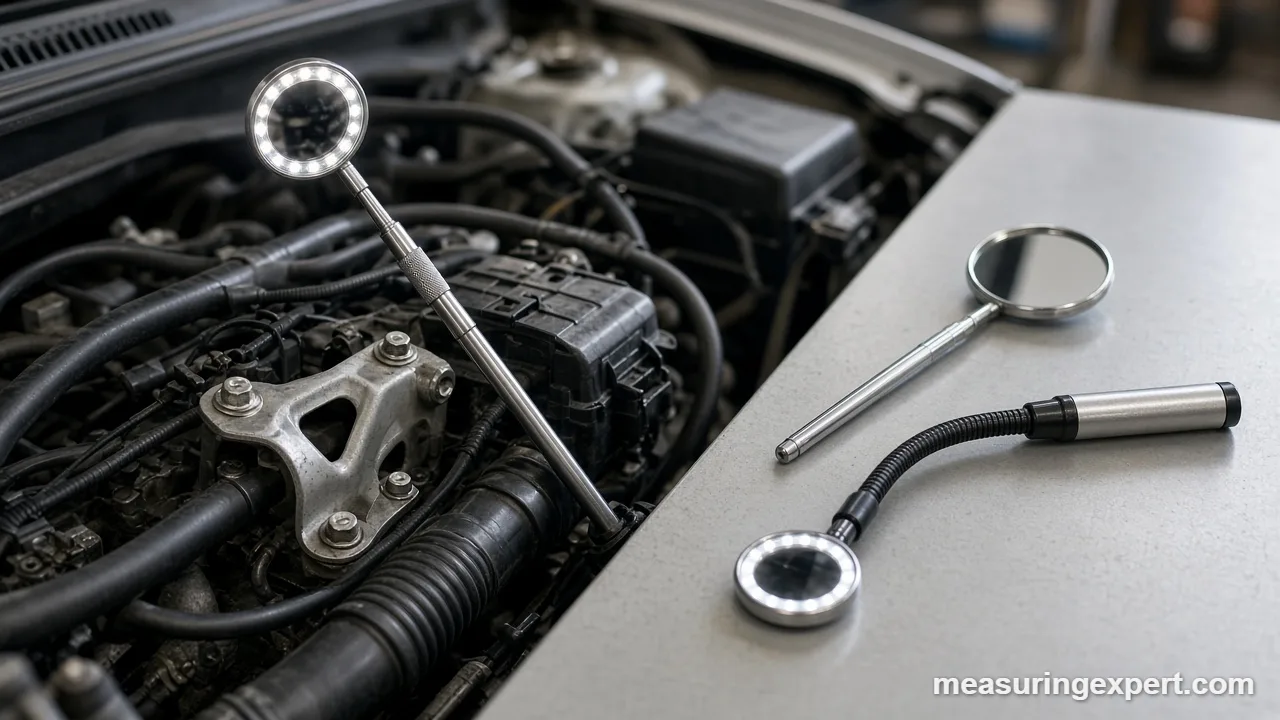
The best inspection mirror for most mechanics is the Ullman HTK-2LT, a lighted telescoping mirror with a 2-1/4 x 3-1/2 in head and 11 to 30 in of reach. However, the right pick depends on two numbers: how small the opening is, and how far the view must reach.
In short: get the HTK-2LT for daily shop work, the NoCry 360inspect for a big mirror on a budget, and the Steelman 05180A to bend around hoses.
As an Amazon Associate, Measuring Expert earns from qualifying purchases. Our picks are based on research, specifications and owner feedback, not paid placement.
Best Overall

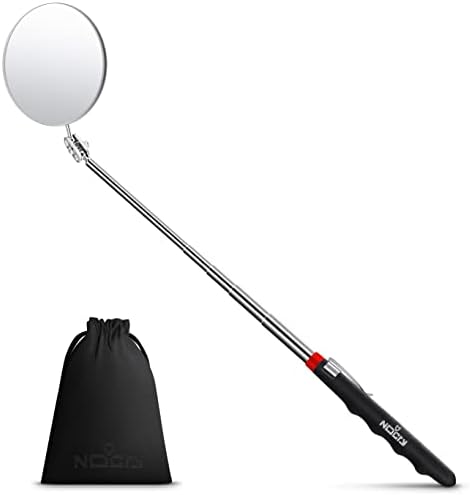
Best Budget
Best Flexible Lighted

Quick Answer: The Best Inspection Mirror by Job
- Everyday shop use: Ullman HTK-2LT, lighted 2-1/4 x 3-1/2 in head, 11 to 30 in.
- Big view, simple tool: NoCry 360inspect, 3.23 in round, 7 to 30 in.
- Around hoses and wires: Steelman 05180A, 18 in flexible shaft with a 4X mirror.
- Small access holes: Ullman HTE-2LT, 1-3/8 in lighted head, up to 36 in.
- Close bench work: General Tools 560, glass head on an 11-1/2 to 16 in arm.
- Under the car: Steelman 41820, 3.25 in round that folds to about 7 in.
- Both hands free: General Tools MB560 on a magnetic base.
On This Page
- Comparison table
- The 7 picks, reviewed
- How we chose
- Mirror size and reach
- Mirror or inspection camera?
- Size converter
- How to use an inspection mirror
- Care and storage
- Honest limits
- FAQ
- Bottom line
Best Inspection Mirror Comparison Table
First, find the job that matches yours. Next, check the standout feature, then jump to the full review below.
| # | Product | Best For | Standout Feature | Amazon |
|---|---|---|---|---|
| 1 | Ullman HTK-2LT | All-round shop use | Rectangular lighted head, 11 to 30 in reach | View |
| 2 | NoCry 360inspect | Large view on a budget | 3.23 in round mirror, 7 to 30 in reach | View |
| 3 | Steelman 05180A | Bending around obstructions | Flexible shaft, 90-degree thumb tilt, 4X | View |
| 4 | Ullman HTE-2LT | Small access holes | 1-3/8 in lighted head, 8-3/4 to 36 in reach | View |
| 5 | General Tools 560 | Short, controlled reaches | Glass mirror, 11-1/2 to 16 in arm | View |
| 6 | Steelman 41820 | Under-vehicle scans | 3.25 in round, folds to about 7 in | View |
| 7 | General Tools MB560 | Hands-free viewing | Magnetic base, two universal joints | View |
The 7 Best Inspection Mirror Picks, Reviewed
First, we cover the lighted all-rounder, then move to budget, flexible, small-hole, short-reach, under-car and hands-free styles. Every reach and mirror size below comes from the maker of each best inspection mirror pick, and we added the metric value in brackets.
Best Overall
1. Ullman HTK-2LT (2-1/4 x 3-1/2 in, LED)
Best for: Mechanics who want one lighted mirror for engine bays, brake work and under-dash checks.
The Ullman HTK-2LT is our pick as the best inspection mirror for most mechanics. First, it pairs a rectangular 2-1/4 x 3-1/2 in (57 x 89 mm) mirror with a built-in LED head, so the light points where the mirror looks. As a result, you can read a part number on the back of an engine block without holding a flashlight in your other hand.
Also, Ullman lists a telescoping range of 11 in collapsed to 30 in extended (27.9 to 76.2 cm). In addition, the cushioned, non-slip grip is made for wet or oily hands. Also, two CR2032 coin cells come in the box. However, the head has no magnifier and no magnetic tip, so it does one job. See the Ullman HTK-2LT spec page for the full list.
- Mirror: rectangular, 2-1/4 x 3-1/2 in (57 x 89 mm)
- Reach: 11 to 30 in (27.9 to 76.2 cm)
- Light: built-in LED head
- Power: two CR2032 coin cells, included
- Grip: cushioned, non-slip for oily hands
Pros
- Light and mirror move together
- Large rectangular viewing area
- Grip stays secure with greasy gloves
Cons
- No magnifying option
- Coin cells cost more than AA
- Shorter reach than 36 in models
Skip it if: You mostly peek into narrow holes under 2 in wide, because the HTE-2LT head fits where this one cannot.
Best Budget
2. NoCry 360inspect (3.23 in Round)
Best for: DIYers and new techs who want a big, clear round mirror without paying for a light.
The NoCry 360inspect is the best inspection mirror for a large view on a budget. For example, NoCry lists a 3.23 in (82 mm) round mirror, which it says is up to 50 percent larger than average. So you see more of the area behind a bracket in one look, and you spend less time hunting with the head.
Next, the handle runs from 7 in collapsed to 30 in extended (17.8 to 76.2 cm). Also, a reinforced ball joint lets the mirror turn to almost any angle. In addition, the kit adds a pen-style pocket clip and a microfiber pouch that doubles as a cleaning cloth. Still, there is no built-in light, so plan to pair it with a work light.
- Mirror: 3.23 in (82 mm) round
- Reach: 7 to 30 in (17.8 to 76.2 cm)
- Joint: reinforced all-angle ball joint
- Extras: pocket clip, microfiber pouch and cleaning cloth
Pros
- One of the largest round heads here
- Collapses to a pocket-friendly 7 in
- Pouch protects the glass between jobs
Cons
- No light
- Large head will not fit small openings
- Glass type not listed
Skip it if: You work in dark engine bays all day, because a lighted mirror saves a hand.
Best Flexible Lighted
3. Steelman 05180A (18 in Flexible, Lighted, 4X)
Best for: Snaking around hoses and wiring where a straight telescoping rod cannot reach.
The Steelman 05180A is a different style of inspection mirror. Instead of a telescoping rod, it uses a flexible shaft that you bend around hoses and brackets. Then a thumb wheel on the handle tilts the mirror head up to 90 degrees, so you can aim the view after the head is already in place.
Also, Steelman lists an overall length of 18 in (45.7 cm) and a 4-power mirror, which helps you read small stampings. In addition, a built-in bulb lights the mirror, and two AA batteries are included. Because the light runs on AA cells, spare power is easy to find. See the Steelman 05180A product page for details.
- Length: 18 in (45.7 cm) overall, flexible shaft
- Mirror: 4X magnifying
- Tilt: thumb wheel, up to 90 degrees
- Power: two AA batteries, included
- Weight: 0.48 lb (about 218 g)
Pros
- Bends around obstacles
- Head tilts from the handle
- 4X helps read small markings
Cons
- Fixed 18 in length
- Magnified view has a smaller field
- Mirror size not listed
Skip it if: You need more than 18 in of reach. Steelman also sells a 42 in version (05420).
Best for Tight Openings
4. Ullman HTE-2LT (1-3/8 in Round, LED)

Best for: Small access holes, bell housings and tight gaps behind components.
The Ullman HTE-2LT is the best inspection mirror for tight openings, because it trades mirror size for access. In fact, its round head is only 1-3/8 in (34.9 mm) across, so it slips through openings the bigger mirrors here cannot. Also, it still carries a built-in LED, which matters most in those deep, dark holes.
Meanwhile, the reach is the longest in this group at 8-3/4 to 36 in (22.2 to 91.4 cm). In addition, two CR1220 coin cells are included. However, a small mirror shows a small patch at a time. So expect to sweep the head slowly across the area.
- Mirror: 1-3/8 in (34.9 mm) round
- Reach: 8-3/4 to 36 in (22.2 to 91.4 cm)
- Light: built-in LED
- Power: two CR1220 coin cells, included
- Grip: heavy-duty non-slip
Pros
- Fits small openings
- Longest reach in this list
- Lighted despite the tiny head
Cons
- Small field of view
- CR1220 cells are less common
- No pocket clip
Skip it if: You mostly look under cars or behind large panels, where a bigger mirror is faster.
Best Short Reach
5. General Tools 560 (2 x 3-1/2 in Glass)

Best for: Close bench work, under-sink checks and short reaches where a long rod gets in the way.
In contrast, the General Tools 560 is a compact glass mirror for close work. Its rectangular head measures 2 x 3-1/2 in (51 x 89 mm), and the arm runs from 11-1/2 to 16 in (29.2 to 40.6 cm). As a result, it feels steady, because a short rod flexes less than a fully extended long one.
Also, a ball and socket joint holds the head, and the knurled handle has a cushioned grip. In addition, General Tools sells a replacement mirror with frame (560RMF), so a cracked glass does not end the tool. See the General Tools 560 page for specs.
- Mirror: 2 x 3-1/2 in (51 x 89 mm) glass
- Reach: 11-1/2 to 16 in (29.2 to 40.6 cm)
- Joint: ball and socket
- Spare: 560RMF replacement mirror with frame
Pros
- Steady at full length
- Replaceable mirror head
- Glass gives a clean reflection
Cons
- Only 16 in of reach
- No light
- Glass can crack if dropped
Skip it if: You need to see deep into an engine bay or under a vehicle.
Best Large Round
6. Steelman 41820 (3.25 in Round, 29 in)

Best for: Under-vehicle checks for leaks, rust and damage where a wide view helps.
Similarly, the Steelman 41820 puts a 3.25 in (82.5 mm) round mirror on a steel telescoping handle. Also, Steelman says the tool folds to about 7 in (17.8 cm) for storage. Unfolded, it measures 10.75 in and extends to about 29 in (27.3 to 73.7 cm).
Next, a double-ball joint lets the mirror swivel 360 degrees, and a contoured grip helps you hold the angle. Because the head is large, it suits quick scans for oil leaks or a torn boot. However, it has no light, so pair it with a flashlight under the car.
- Mirror: 3.25 in (82.5 mm) round
- Reach: 10.75 to about 29 in (27.3 to 73.7 cm)
- Storage: folds to about 7 in (17.8 cm)
- Joint: double-ball, 360-degree swivel
- Body: stainless steel finish
Pros
- Large viewing area
- Folds short for a drawer
- Double-ball joint holds angles
Cons
- No light
- Big head for tight holes
- Glass type not listed
Skip it if: You want a lighted mirror. The HTK-2LT covers that.
Best Hands-Free
7. General Tools MB560 (Magnetic Base)

Best for: Watching a part while both hands do the work, such as aligning a bolt you cannot see.
Finally, the General Tools MB560 is not telescoping at all. Instead, it clamps to any ferrous metal with a magnetic base and holds a 3-1/2 x 2 in (89 x 51 mm) mirror on two universal joints. So you set the angle once and keep both hands free for the wrench.
For example, this style shines when you thread a hidden bolt or route a hose behind a bracket. Also, it works as a second mirror next to a telescoping one. However, it needs a steel surface nearby, and it cannot reach into a cavity.
- Mirror: 3-1/2 x 2 in (89 x 51 mm)
- Mount: magnetic base for ferrous metal
- Adjustment: two universal joints
- Size: about 2 x 4 x 4.5 in overall
Pros
- Frees both hands
- Holds a set angle
- Pairs well with a handheld mirror
Cons
- Needs a steel surface
- No reach into cavities
- Magnet strength not listed
Skip it if: You need to look into a hole or around a corner far from steel.
How We Chose the Best Inspection Mirror Picks
We did not run hands-on tests. Instead, we built this list from research. First, we read the spec pages from Ullman Devices, Steelman and General Tools, along with the NoCry listing. Next, we compared owner feedback for common complaints, such as loose joints, dim lights and cracked glass. Finally, we checked that each pick still renders as a current Amazon listing.
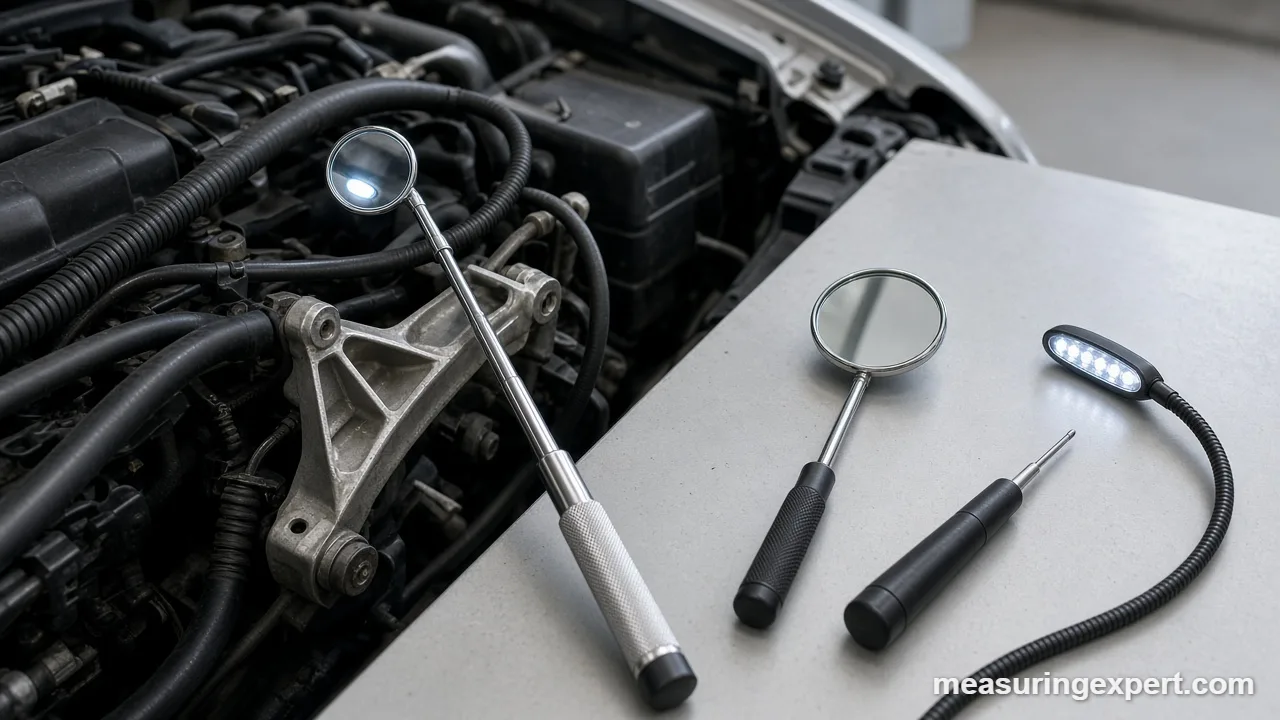
- Reach: the maker must list the collapsed and extended length, or the overall length for flexible tools.
- Mirror size: the maker must list the head diameter or width and height.
- Light: we noted the light type and battery, because coin cells and AA cells differ in cost and runtime.
- Grip and joint: we favored non-slip grips and joints that hold an angle.
- Brand support: we skipped unbranded multi-packs and limited each brand to two picks.
In addition, we chose seven different styles rather than seven similar mirrors, because the best inspection mirror for a brake job is not the best one for a bell housing. That way, each pick solves a different access problem.
Mirror Size and Reach: The Numbers That Matter
Two measurements decide which is the best inspection mirror for you. First, the mirror size sets how much you see at once. Second, the reach sets how far in you can look. However, the two pull in opposite directions, because a bigger head fits fewer openings.
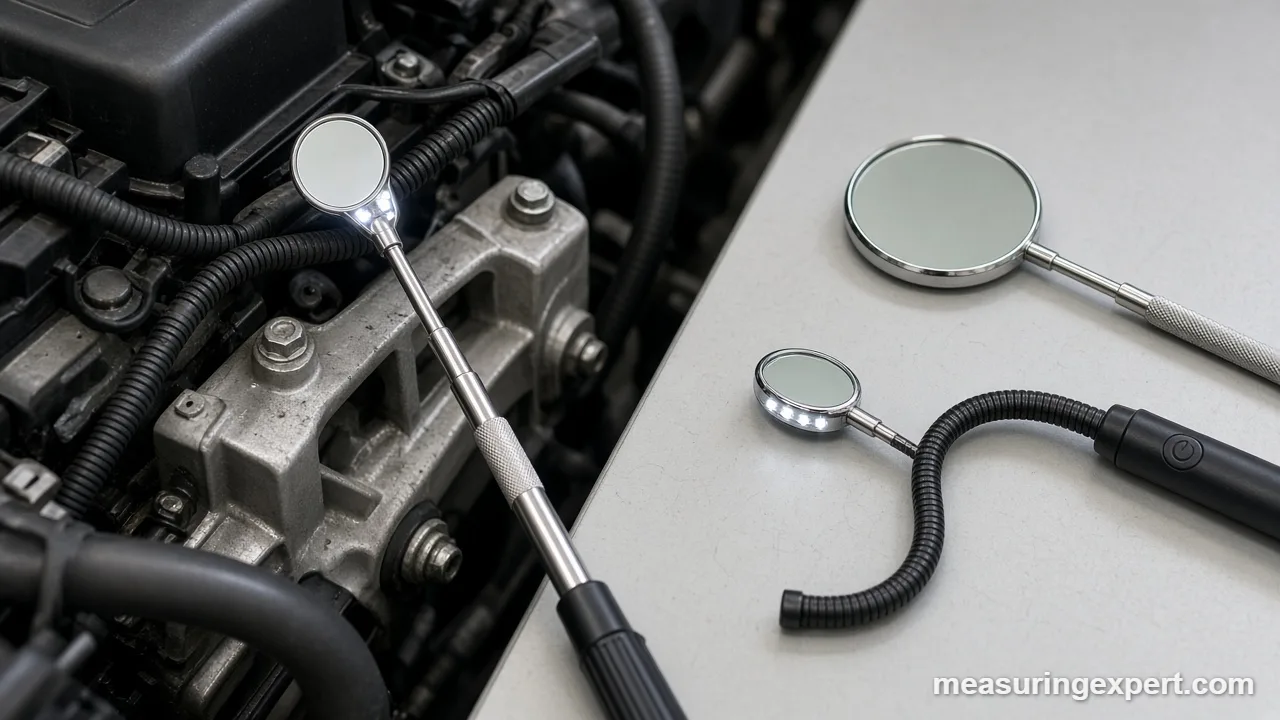
Mirror size and viewing area
First, a round mirror’s area grows with the square of its diameter. So a 3.25 in mirror shows about 5.6 times the area of a 1-3/8 in mirror, not 2.4 times. The table below uses the maker sizes from our picks.
| Mirror (pick) | Size | Metric | Viewing area |
|---|---|---|---|
| Round (HTE-2LT) | 1-3/8 in | 34.9 mm | 1.5 sq in (9.6 sq cm) |
| Rectangle (General Tools 560) | 2 x 3-1/2 in | 51 x 89 mm | 7.0 sq in (45.2 sq cm) |
| Rectangle (HTK-2LT) | 2-1/4 x 3-1/2 in | 57 x 89 mm | 7.9 sq in (50.8 sq cm) |
| Round (NoCry 360inspect) | 3.23 in | 82.0 mm | 8.2 sq in (52.9 sq cm) |
| Round (Steelman 41820) | 3.25 in | 82.5 mm | 8.3 sq in (53.5 sq cm) |
As a rule, measure the smallest gap first. Then choose the largest head that still passes through it with room to tilt. For example, a 1.5 in hole rules out every telescoping mirror here except the HTE-2LT.
Reach and stiffness
Next, think about reach. Of course, a longer handle sees deeper, but it also flexes and shakes more at full length. Therefore, a 16 in tool like the General Tools 560 feels steadier than a 36 in tool at full stretch. In general, most engine bay work needs about 20 to 30 in (51 to 76 cm). Meanwhile, under-vehicle checks from the side often benefit from 30 in or more.
| Pick | Collapsed | Extended | Light |
|---|---|---|---|
| Ullman HTK-2LT | 11 in (27.9 cm) | 30 in (76.2 cm) | LED, 2 x CR2032 |
| NoCry 360inspect | 7 in (17.8 cm) | 30 in (76.2 cm) | None |
| Steelman 05180A | 18 in (45.7 cm) flexible, fixed length | Bulb, 2 x AA | |
| Ullman HTE-2LT | 8-3/4 in (22.2 cm) | 36 in (91.4 cm) | LED, 2 x CR1220 |
| General Tools 560 | 11-1/2 in (29.2 cm) | 16 in (40.6 cm) | None |
| Steelman 41820 | 10.75 in (27.3 cm) | about 29 in (73.7 cm) | None |
Joints, light and grip
Also, look at how the head attaches. A ball joint, or a double-ball joint, lets you set nearly any angle. In contrast, a thumb-wheel tilt like the Steelman 05180A lets you change the angle after the head is in place. For more on how angles are measured, see our guide to tools for measuring angles.
Lighting matters just as much when you pick the best inspection mirror. This is because a built-in LED points where the mirror looks, so you keep one hand free. However, coin cells such as CR2032 and CR1220 cost more and drain faster than AA cells. Finally, a non-slip grip helps when your gloves are oily.
Best Inspection Mirror or an Inspection Camera (Borescope)?
After all, a mirror only shows what sits in a straight line from its head. So when the view needs to bend more than once, even the best inspection mirror stops working. That is where an inspection camera, also called a borescope, takes over.
- Choose a mirror for quick line-of-sight checks: leaks, loose clips, part numbers and brake pads. Besides, it works instantly, needs no screen and costs little.
- Choose a camera to look inside a cylinder through a spark plug hole, down a pipe or into a wall cavity. A thin probe on a cable follows bends that no rigid mirror can.
- Choose a camera when you need a record. In addition, many models save photos or video, which helps with customer reports.
- Keep both if you work on engines daily. That way, the mirror handles most checks, and the camera covers the rest.
Also, a camera has its own limits. For example, the small lens distorts depth, and fog or oil on the lens blurs the view. For heat-related faults rather than visual ones, a thermal imaging camera is a better fit.
Best Inspection Mirror Size Converter (Inch to Metric)
Because makers list most inspection mirrors in inches, this converter turns a mirror diameter or a reach length into millimeters or centimeters. For a worked example, see our 10 cm to inches guide.
How to Use the Best Inspection Mirror Safely
Even the best inspection mirror only helps if you aim it well. So follow these steps on every check, especially on a hot engine.
- Turn off the engine and let hot parts cool before you reach in.
- Choose a head that fits the opening, with room left to tilt it.
- Set the mirror angle roughly by hand before you insert it.
- Extend the handle only as far as you need, because a shorter rod shakes less.
- Switch on the LED, or aim a work light at the mirror rather than at the part.
- Slide the head in, then rotate the handle slowly to sweep the area.
- Read or photograph what you see, then withdraw the mirror without forcing the joint.
Caring for the Best Inspection Mirror
Even the best inspection mirror needs care, and small habits keep it sharp for years. First, wipe the glass with a soft cloth after each job, because brake dust and oil film blur the view. Next, store the tool collapsed, so the thin inner tube does not bend in a drawer.
- Joints: if a ball joint gets loose, tighten its screw a little rather than forcing the head.
- Batteries: pull coin cells out before long storage, since a leaking cell can ruin the LED contacts.
- Glass: keep a spare head or refill when the maker sells one, such as the General Tools 560RMF.
- Heat: keep plastic heads and grips off exhaust parts, because hot metal can warp them.
Do and Don’t
Honest Limits of the Best Inspection Mirror
Even the best inspection mirror has limits. First, the image is reversed, so left and right swap. Second, a mirror shows only a straight line of sight, so it cannot follow a bend. Third, a magnified mirror trades area for detail. Finally, a mirror shows a part but does not measure it. So if you need a gap, a runout or a vibration level, reach for a gauge, as our guide on measuring vibration in mechanical systems explains.
Inspection Mirror FAQ
What is the best inspection mirror for mechanics?
For most mechanics, the best inspection mirror is a lighted telescoping model such as the Ullman HTK-2LT. It has a 2-1/4 x 3-1/2 in mirror, an LED head and an 11 to 30 in reach, so it covers most engine bay and brake jobs.
What size inspection mirror should I buy?
First, measure the smallest opening you need to pass. Then pick a head that fits with room to tilt. For example, a 1-3/8 in head fits small access holes, while a 3 in or larger head scans open areas faster.
How long should an inspection mirror extend?
Most mechanics do well with about 30 in (76 cm) of reach. However, under-vehicle checks and deep engine bays may call for 36 in (91 cm). Also, a shorter tool is steadier, so do not buy more length than you need.
Is a lighted inspection mirror worth it?
Yes, for most auto work. A built-in LED lights the area the mirror sees, so you keep one hand free. In contrast, an unlighted mirror needs a flashlight aimed at the same spot.
Round or rectangular inspection mirror: which is better?
Round heads turn easily in tight spaces and suit holes. Rectangular heads show a wider strip, which helps when you read part numbers or scan a long seam. So many techs keep one of each.
Does a magnifying inspection mirror help?
It helps when you read small stampings or look for hairline cracks. However, magnification shrinks the field of view, so you see less area at once. Therefore, a flat mirror is better for general scanning.
When is an inspection camera better than a mirror?
Choose a camera, also called a borescope, when you must see inside a cylinder, pipe or wall cavity, or around more than one bend. In addition, a camera can record images. A mirror is faster for quick line-of-sight checks.
How do I clean an inspection mirror?
First, wipe off loose grit with a dry soft cloth. Then use a little glass cleaner or isopropyl alcohol on the cloth, not on the mirror. Finally, avoid shop rags, because trapped metal chips can scratch the glass.
Can the best inspection mirror replace a borescope?
No. The best inspection mirror only shows what is in a straight line from the head, so it cannot see inside a cylinder or around several bends. However, it is cheaper, needs no screen and works instantly, so it handles most daily checks.
How do I convert inspection mirror sizes to metric?
Multiply inches by 25.4 to get millimeters. For example, a 2-1/4 in mirror is 57.15 mm and a 3-1/2 in mirror is 88.9 mm. For reach, multiply inches by 2.54 to get centimeters, so 30 in is 76.2 cm.
Bottom Line
For most garages, the Ullman HTK-2LT is the best inspection mirror, because its LED head and 11 to 30 in reach cover nearly every daily check. Also, add the Ullman HTE-2LT if you often work through small holes, or the Steelman 05180A if hoses block a straight path. Finally, keep a borescope in mind for jobs no mirror can see.
1 thought on “Best Inspection Mirror for Mechanics: 7 Telescoping and Lighted Picks”