

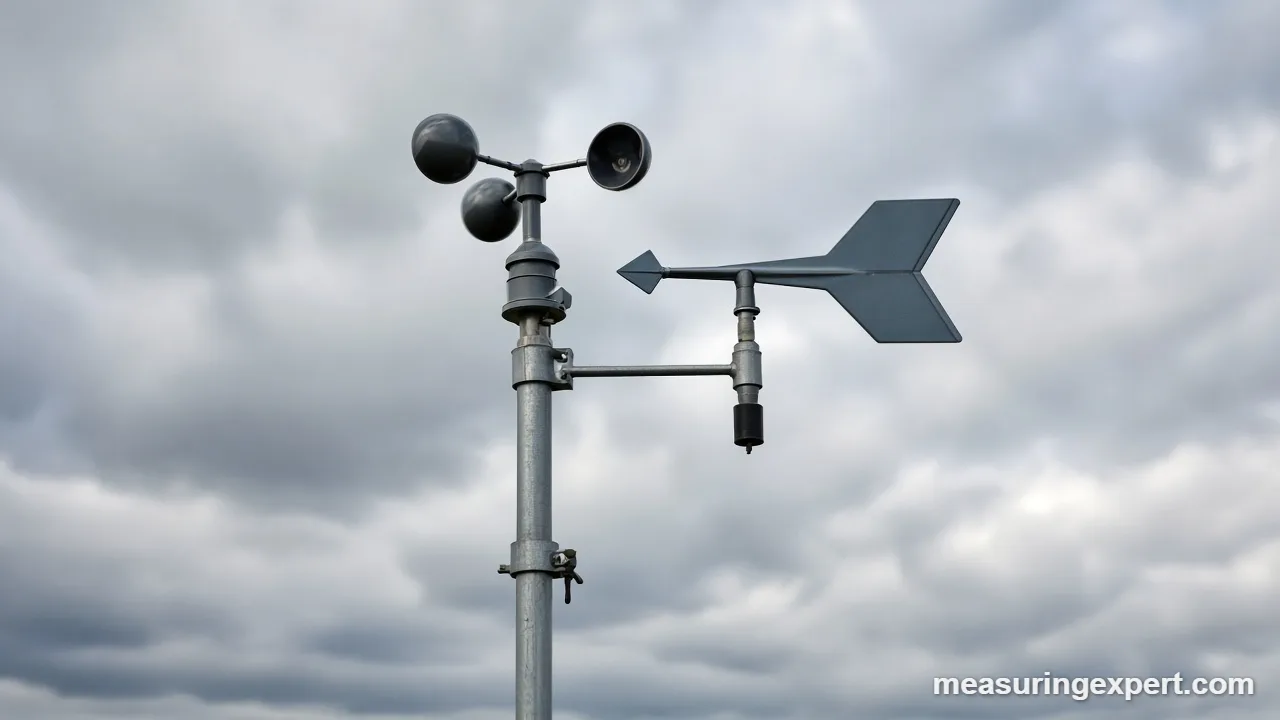
To use an anemometer, stand in open ground away from buildings, hold the sensor into the wind at arm’s length and above head height, and average the reading for at least 2 minutes. Weather services measure at 10 m (33 ft) and report a 2-minute (US) or 10-minute (WMO) average, plus the highest gust.
Wind looks simple until you try to put a number on it. For one thing, it speeds up, drops off, swirls around a house and changes from one second to the next. As a result, a single glance at a meter rarely tells you the real wind speed. An anemometer solves part of the problem, because it turns moving air into a number in mph, km/h, knots or meters per second (m/s). The other part, however, is how you use it: where you stand, how high you hold it and how long you average.
Here is the short version. First, pick the right type: a cup or vane anemometer for outdoor wind, a hot-wire anemometer for low airflow in ducts, and an ultrasonic anemometer for weather stations with no moving parts. Next, find open ground and face the sensor straight into the wind. Then hold it steady, wait for the number to settle and record the average over 2 minutes, along with the peak gust. Finally, remember that a hand-held reading near the ground will usually be lower than the official forecast wind, because official stations sit 10 meters up, above most of the drag from trees, fences and buildings.
In short: the meter gives you a number, but the method decides whether that number means anything. In other words, take a good reading in the open, hold the meter into the wind, and average it over time instead of reading one instant.
Where the Official Numbers Come From
Also, those methods are not guesswork. For example, the National Oceanic and Atmospheric Administration (NOAA) explains that surface winds are measured at 10 m (33 ft) in unobstructed exposure. It also notes that the National Weather Service uses a 2-minute average for sustained wind, while most other countries use a 10-minute average.
Below, you will find a wind speed converter, the four main anemometer types, a step-by-step routine for a hand-held meter, and the official rules on height, averaging and gusts. After that, there is a Beaufort scale table for estimating wind without any instrument at all.
Convert Your Anemometer Reading to mph, km/h or Knots
Most meters can switch units, but logs and forecasts often use different ones. So type the number from your display below and pick the unit it shows. In addition, the converter uses exact definitions: 1 mile is 1,609.344 m and 1 knot is 1,852 m per hour.
Recommended Anemometer Models for Wind and Airflow
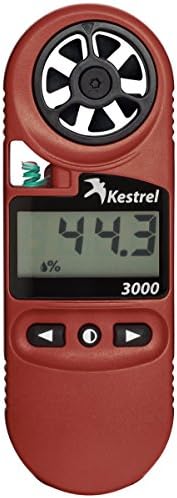
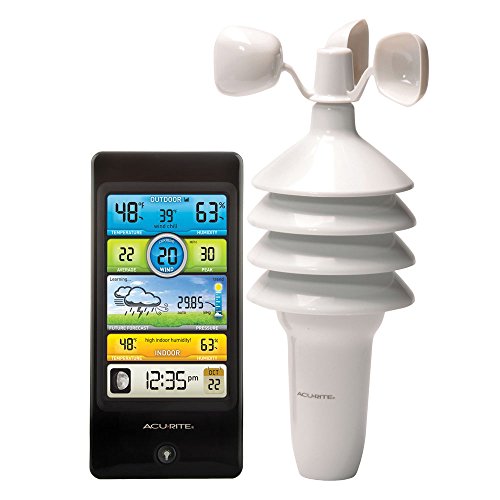
First, for outdoor wind, a pocket vane meter is the easiest place to start. The Kestrel models suit hikers, firefighters and shooters, while the HoldPeak and BTMETER meters are simple choices for drones, sailing and HVAC checks. In addition, a hot-wire probe helps with slow air inside ducts, and a home weather station logs wind all day from a mast. In any case, these picks come from established brands, based on manufacturer specs and buyer reports.


As an Amazon Associate, Measuring Expert earns from qualifying purchases.
Key Takeaways
- Cup and vane meters spin with the wind; hot-wire and ultrasonic meters have no spinning parts.
- Always face a vane meter straight into the wind, because angled air reads low.
- Official wind is measured at 10 m (33 ft) over open, flat ground.
- The US National Weather Service reports a 2-minute average; the WMO standard is 10 minutes.
- A gust is a peak lasting only a few seconds, so it is always higher than the sustained wind.
- Also, 1 m/s equals about 2.24 mph, 3.6 km/h or 1.94 knots.
- Without a meter, the Beaufort scale lets you estimate wind from flags, trees and waves.
Four Types of Anemometer and How Each One Works
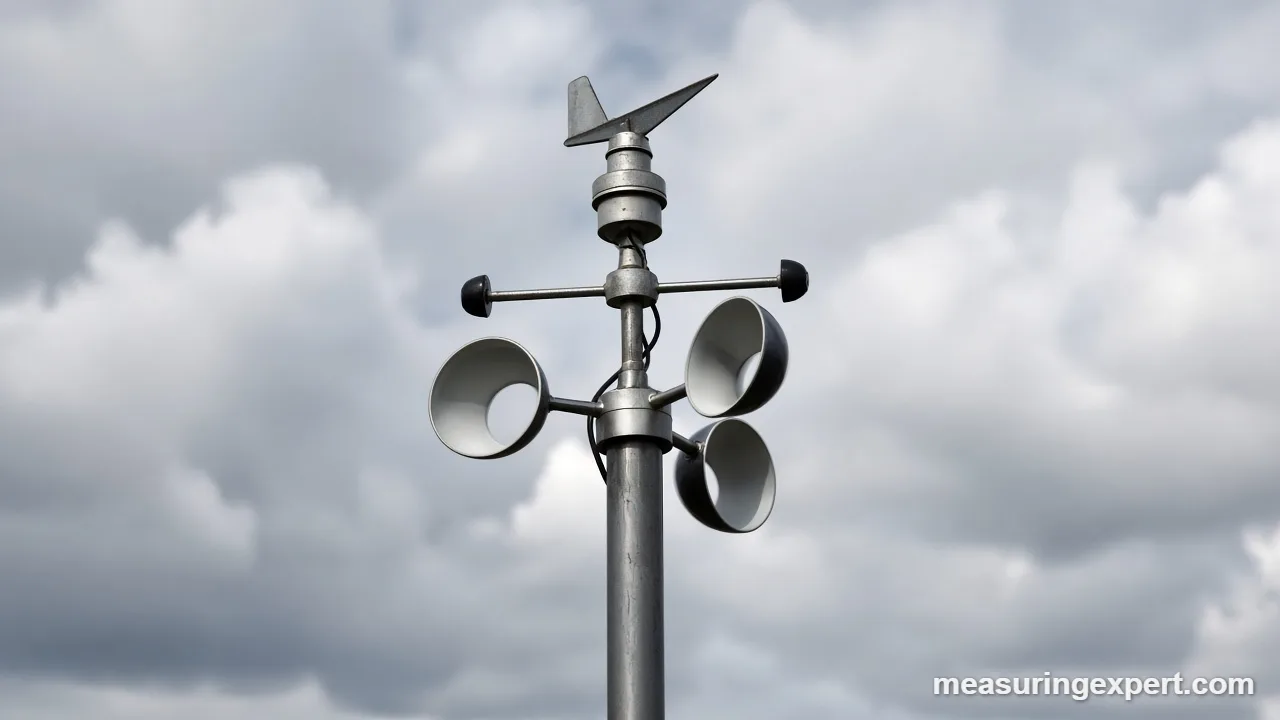
Of course, every anemometer measures the same thing, but the four common designs sense the air in very different ways. Therefore, the right choice depends on where you measure and how slow or fast the air moves.
| Type | How it senses wind | Best for | Weak spots |
|---|---|---|---|
| Cup | Three or four cups on arms spin around a vertical shaft; the spin rate tracks wind speed. | Weather masts, home stations, wind farm surveys | Needs a separate vane for direction; slow to stop after gusts |
| Vane (propeller) | A small fan turns when air flows along its axis. | Hand-held outdoor use, vents and HVAC grilles | Reads low if not pointed into the wind |
| Hot-wire (thermal) | Moving air cools a heated wire or bead; the power needed to keep it hot gives the speed. | Very slow airflow in ducts, fume hoods and labs | Fragile; not made for rain, dust or strong wind |
| Ultrasonic (sonic) | Sound pulses travel faster downwind than upwind; the time difference gives speed and direction. | Professional weather stations, research, turbines | Higher cost; heavy rain or ice can disturb the signal |
Inside the Cup and Ultrasonic Designs
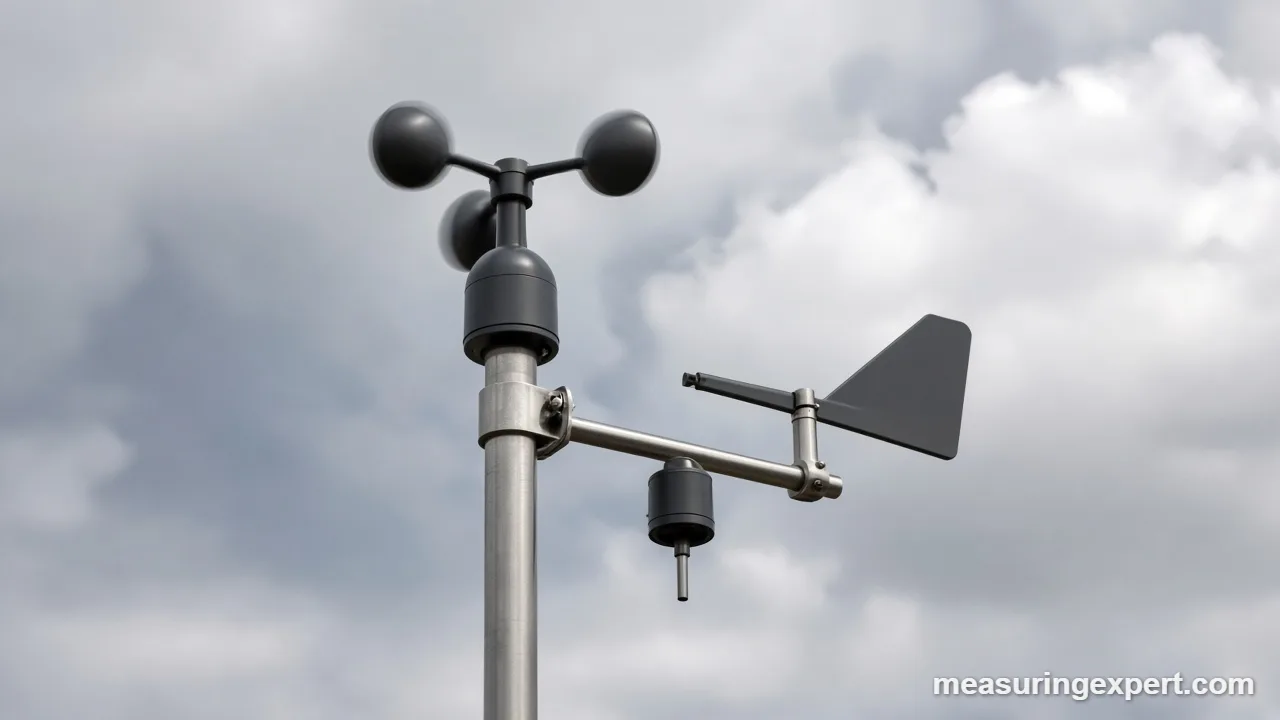
To begin with, the cup anemometer is the classic design. Its cups catch more wind on their open side than on their rounded back, so the rotor spins faster as the wind picks up. However, the cups move slower than the air itself, so each model uses a factory calibration to turn spins into speed.
By contrast, the ultrasonic anemometer works on a neat idea. Specifically, sound travels at roughly 343 m/s in air at 20 C, and wind adds to or subtracts from that speed. As a result, the meter compares travel times in opposite directions and cancels out the effect of temperature. For background, see our guide to the speed of sound in air.
How to Use a Hand-Held Anemometer Step by Step
In general, this routine works for vane and cup meters you hold in your hand. In addition, it gives you numbers you can compare with a forecast or with yesterday’s reading.
- Choose open ground. Stand at least 10 times as far from a building, tree or wall as that obstacle is tall, if you can.
- Check the meter. Spin the vane or cups gently to make sure they turn freely, then set your units and switch on averaging if the meter has it.
- Find the wind direction. Watch a flag, smoke or grass, or slowly turn until the reading is highest.
- Hold it high and steady. Raise the meter at arm’s length, above your head if possible, so your body does not block the flow.
- Face the sensor into the wind. Keep a vane meter’s fan square to the wind; a tilt of even 20 or 30 degrees lowers the reading.
- Average for 2 minutes. Read the average mode, or note a reading every 10 seconds and work out the mean.
- Record the gust and the details. Write down the maximum, the height, the time and the place, so later readings compare fairly.
Older cup meters without a display count rotations instead. In that case, count the turns over a set time and apply the maker’s calibration chart. Otherwise, modern digital meters do that math for you.
Example: 12 readings adding to 132 mph -> 132 / 12 = 11 mph average
Anemometer Height: Why Weather Stations Use 10 Meters
Wind slows down near the ground because grass, crops, fences and buildings drag on the air. So a reading at chest height can be far lower than the wind just a few meters up. For this reason, weather services agreed on one standard height. Specifically, an official anemometer sits 10 m (about 33 ft) above open, level ground, well clear of obstacles.
A hand-held reading at about 2 m will therefore often look calm next to the forecast. For a rough idea over open country, wind at 10 m is often about 25 percent faster than wind at 2 m. Still, that figure is only a rule of thumb, and it changes a lot with terrain, buildings and time of day.
| Where you measure | What to expect |
|---|---|
| 10 m mast in an open field | Matches official station practice |
| Rooftop mount | Often too high or too gusty, because the roof speeds up and twists the flow |
| Hand-held at 2 m in the open | Usually lower than the forecast wind |
| Backyard surrounded by houses | Much lower and very unsteady |
Averaging Time: 2-Minute vs 10-Minute Wind
Wind never holds still, so every official number is an average over a set period. However, not every agency uses the same period. As a result, two sources can report different speeds for the same storm.
| Who | Sustained wind averaging time | Typical use |
|---|---|---|
| US National Weather Service (ASOS stations) | 2 minutes | Airport and station reports |
| US National Hurricane Center | 1 minute | Hurricane intensity |
| World Meteorological Organization (most countries) | 10 minutes | International weather reports |
A shorter average catches more of the peaks, so it reads higher. For example, NOAA notes that the peak 1-minute wind is roughly 12 percent higher than the peak 10-minute wind. In short, always check the averaging time before you compare two wind numbers.
Gusts vs Sustained Wind on an Anemometer
First of all, sustained wind is the average. A gust, by contrast, is a short burst that lasts only a few seconds. Likewise, many meters show both as “AVG” and “MAX”. Meanwhile, the forecast might say “winds 20 mph, gusting to 30 mph”, which means the average is 20 and brief peaks reach 30.
In fact, US station reports list a gust as the highest speed in the last 10 minutes when the wind swings by 10 knots or more between peaks and lulls. In hurricanes, the 3-second gust is often about 30 percent above the 1-minute wind, according to NOAA. So when you log a reading, keep the average and the gust in separate columns.
Beaufort Scale: Estimating Wind Without an Anemometer
Before electronic meters, sailors estimated wind by its effects on the sea and the land. The Beaufort scale, created by Admiral Sir Francis Beaufort, is still used today. The National Weather Service Beaufort table lists the speed ranges below.
| Force | Name | Knots | mph | What you see on land |
|---|---|---|---|---|
| 0 | Calm | under 1 | under 1 | Smoke rises straight up |
| 1 | Light air | 1-3 | 1-3 | Smoke drifts; vanes stay still |
| 2 | Light breeze | 4-6 | 4-7 | Leaves rustle; you feel wind on your face |
| 3 | Gentle breeze | 7-10 | 8-12 | Light flags extend |
| 4 | Moderate breeze | 11-16 | 13-18 | Dust and loose paper lift |
| 5 | Fresh breeze | 17-21 | 19-24 | Small trees sway |
| 6 | Strong breeze | 22-27 | 25-31 | Large branches move; umbrellas are hard to use |
| 7 | Near gale | 28-33 | 32-38 | Whole trees move; walking is harder |
| 8 | Gale | 34-40 | 39-46 | Twigs break off trees |
| 9 | Strong gale | 41-47 | 47-54 | Slight damage to roofs |
| 10 | Storm | 48-55 | 55-63 | Trees uprooted |
| 11 | Violent storm | 56-63 | 64-72 | Widespread damage |
| 12 | Hurricane force | 64 and up | 73 and up | Severe, widespread damage |
Above all, the Beaufort scale is a useful cross-check. For instance, if your anemometer says 5 mph while small trees sway hard, your spot is probably sheltered, or the meter is not facing the wind.
Wind Speed Units and Air Pressure
To start, most meters offer m/s, km/h, mph, knots and ft/s. Sailors and pilots use knots, and one knot is one nautical mile per hour, or exactly 1.852 km/h. For a deeper look, read how fast a knot is in mph and km/h. Similarly, scientists and many weather stations prefer m/s, which is easy to convert: multiply by 3.6 for km/h.
Wind also links to air pressure. In short, air flows from high pressure toward low pressure, and a tight pressure difference over a short distance means strong wind. That is why a falling barometer often comes before a windy day. Our guide to air pressure and weather explains how to read those changes.
Do and Don’t When You Measure Wind
Do
- Measure in the open, clear of walls and trees.
- Point a vane meter straight into the wind.
- Use the average mode for at least 2 minutes.
- Log height, time and place with every reading.
- Keep the vane clean and spinning freely.
Don’t
- Trust a single instant reading.
- Stand upwind of the meter with your body.
- Compare a 2 m reading directly with a 10 m forecast.
- Expose a hot-wire probe to rain or dust.
- Climb onto roofs or ladders in strong wind.
Honest Limits of a Hand-Held Anemometer
A pocket meter is a good tool, but it is not an official weather station. First, it measures the wind at one point and one height, usually close to the ground. Second, cheap vane meters often struggle at very low speeds, because the fan needs a little push to start turning. Third, accuracy figures on the box apply only to air that hits the fan straight on. In addition, cup and vane rotors keep spinning for a moment after a gust, so they can blur rapid changes. Finally, meters drift with age, dirt and worn bearings. So treat your numbers as good local readings, not as a replacement for the forecast.
When to Call a Professional
On the other hand, some jobs need certified numbers. For example, crane and lift operations, wind turbine site studies, building ventilation balancing and insurance claims usually need calibrated instruments and trained staff. In those cases, use an HVAC test-and-balance technician, a meteorological consultant, or an accredited calibration lab that can certify your meter. Also, follow the wind limits in your equipment manual, not a hobby meter.
Frequently Asked Questions
How does an anemometer measure wind speed?
It turns moving air into a signal. Cup and vane models count how fast a rotor spins, hot-wire models measure cooling of a heated wire, and ultrasonic models time sound pulses between sensors.
How do I use an anemometer correctly?
Stand in open ground, hold the meter high at arm’s length, face the sensor into the wind and record the average over 2 minutes along with the highest gust.
What height should an anemometer be mounted at?
The standard height is 10 m (about 33 ft) over open, level ground. Home stations should be as clear of trees and buildings as possible.
Why is my anemometer reading lower than the forecast?
Forecasts describe wind at 10 m in open exposure. Readings near the ground or near buildings are usually lower, so compare readings taken the same way each time.
What is the difference between sustained wind and a gust?
Sustained wind is an average over 1, 2 or 10 minutes, depending on the agency. A gust is a short peak lasting a few seconds.
Which anemometer type is most accurate?
Ultrasonic sensors are common on professional stations because they have no moving parts. For hand-held use, a well-calibrated vane meter is accurate enough for most outdoor jobs.
Can an anemometer measure wind direction?
A cup anemometer alone cannot; it needs a wind vane beside it. Ultrasonic models measure both speed and direction. With a hand-held vane meter, you find direction by turning it.
What is a hot-wire anemometer used for?
It measures slow, steady airflow, such as air in ducts, fume hoods and clean rooms. Keep it out of rain, dust and strong outdoor wind.
How do I convert anemometer readings from m/s to mph?
Multiply m/s by about 2.237 to get mph. For example, 5 m/s is about 11.18 mph, 18 km/h or 9.72 knots.
How often should an anemometer be calibrated?
Follow the maker’s schedule. Many professional users send meters to a calibration lab about once a year, and sooner after a drop or heavy use.
The Bottom Line on Measuring Wind
In the end, an anemometer is only as good as the way you hold it. So pick the right type, stand in the open, face the sensor into the wind, and average for at least 2 minutes. Then keep the gust as a separate number, and remember that official winds come from 10 m masts with set averaging times.
Finally, if you just need a quick sense of the wind, the Beaufort table above works without any tools. For logs and reports, however, use the converter at the top of this page to switch between m/s, mph, km/h and knots.