

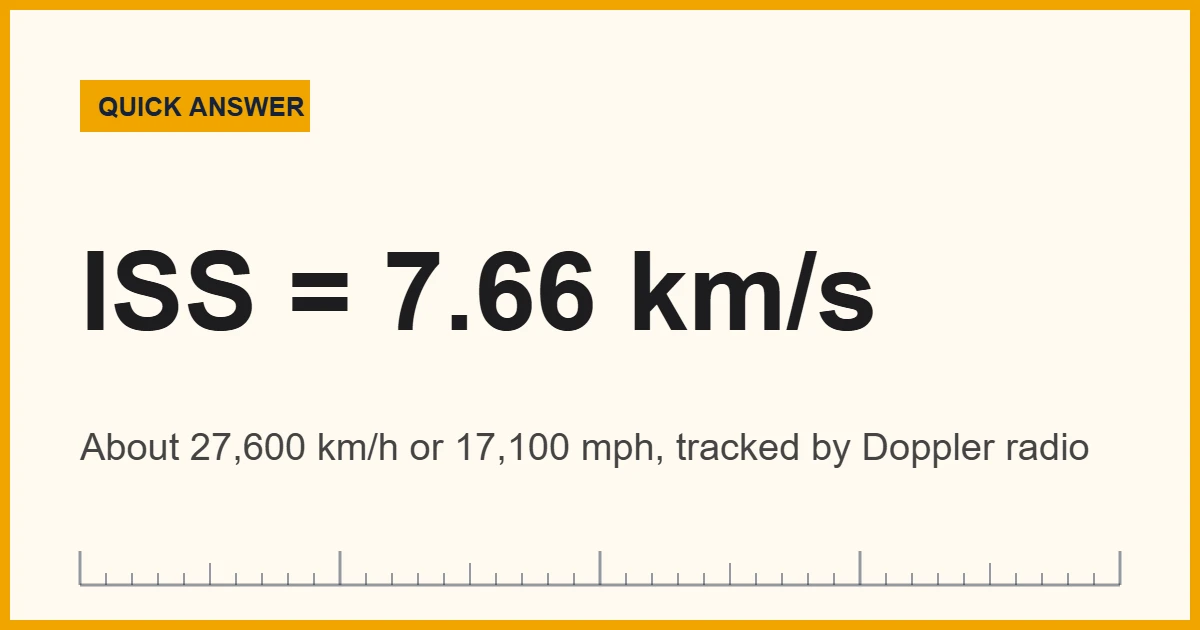
Speed in space is measured against a chosen reference, such as Earth’s center or the Sun. Mission teams mainly use Doppler tracking, which reads the frequency shift of a spacecraft’s radio signal, plus ranging and, near Earth, GPS. For example, the ISS moves about 7.66 km/s (17,100 mph).
There is no road, no air and no wheel to spin in orbit, so a spacecraft cannot carry a speedometer like a car. Instead, engineers measure motion from the outside. They send radio signals, time the echoes and compare frequencies. Finally, they combine those readings with physics to work out where a craft is and how fast it moves.
The first thing to know is that every number for speed in space is relative. For instance, the International Space Station races around Earth at roughly 7.66 kilometers per second. Measured against the Sun, however, it also shares Earth’s orbital speed of about 29.8 km/s. Both figures are correct, because they simply use different reference points. As a result, a speed figure without a reference frame tells only half the story.
In short: Doppler tracking measures how fast a craft moves toward or away from Earth, ranging measures how far away it is, and angle measurements fix its direction. Also, near Earth, GPS receivers do much of the same work onboard. Meanwhile, star trackers and accelerometers keep the craft pointed and record its engine burns.
NASA’s own navigation primer, Basics of Space Flight, explains that the Deep Space Network can measure a craft’s line-of-sight velocity to within hundredths of a millimeter per second. As a result, that precision lets probes thread gravity assists millions of miles from home.
Below, you can convert any spacecraft speed, see how each method works, and finally calculate an orbital speed yourself.
Convert Speed in Space Between Units
Space agencies usually quote speeds in kilometers per second, while news stories use miles per hour. So enter a value in meters per second below (7,660 m/s is the ISS) and read it in km/h, mph, feet per second and knots. To convert from km/s, first multiply by 1,000.
Recommended Tools for Measuring Speed on Earth
You cannot track a probe from your backyard, but you can try the same principles at home. For example, a sports radar gun uses the Doppler effect, exactly like the Deep Space Network, just with microwaves bouncing off a ball. Similarly, a handheld GPS receiver computes your speed from satellite signals, the same way a GPS unit on the space station does.


As an Amazon Associate, Measuring Expert earns from qualifying purchases.
Key Takeaways
- Every speed in space needs a reference frame: Earth-centered, Sun-centered or another body.
- Doppler tracking reads the radio frequency shift and gives line-of-sight speed.
- Ranging times a radio signal’s round trip at the speed of light to get distance.
- GPS works well for low Earth orbit and even somewhat above the GPS satellites.
- Star trackers measure orientation, not speed; accelerometers record speed changes during burns.
- The ISS moves about 7.66 km/s (about 27,600 km/h or 17,100 mph) relative to Earth’s center.
- Parker Solar Probe holds the record at about 692,000 km/h (430,000 mph) relative to the Sun.
Why Speed in Space Depends on the Reference Frame
On a highway, the road is the obvious reference. In orbit, though, nothing stands still. For example, Earth spins, it circles the Sun, and the Sun itself orbits the center of the Milky Way. Therefore navigators pick a frame that suits the mission and state every speed relative to it.
| Reference frame | Centered on | Typical use |
|---|---|---|
| Earth-centered inertial (ECI) | Earth’s center, axes fixed to distant stars | ISS, satellites, crew capsules |
| Earth-fixed (rotating) | Earth’s center, axes turn with the planet | Ground tracks, GPS positions |
| Heliocentric | The Sun | Parker Solar Probe, planetary cruise |
| Solar System barycenter | The Solar System’s center of mass | Voyager, New Horizons, deep space navigation |
The difference between the first two rows is not small. Because Earth’s equator turns at about 465 m/s, a rocket launched eastward gets that speed for free. Our guide to how fast Earth spins explains where that figure comes from.
Doppler Tracking: Measuring Speed in Space by Radio
Doppler tracking is the workhorse method. For example, you hear the same effect when an ambulance siren drops in pitch as it passes. Radio waves behave the same way: a craft moving away stretches the waves, so they arrive at a slightly lower frequency.
In two-way tracking, a Deep Space Network antenna sends a very stable signal up. Next, the spacecraft locks onto it and returns it on a related frequency. Finally, the ground station compares what came back with what it sent. Then the shift reveals the radial velocity, meaning the speed along the line between Earth and the craft.
two-way shift (Hz) = 2 x radial speed / c x transmitted frequency
At an X-band frequency of about 8.4 GHz, each meter per second of radial speed shifts the signal by about 56 Hz. Also, atomic clocks keep the reference frequency stable, so engineers can detect tiny shifts. In fact, that is why NASA quotes velocity accuracy in hundredths of a millimeter per second.
However, Doppler alone cannot see sideways motion. A craft moving across the sky, with no motion toward or away from Earth, shows almost no shift at that instant. Instead, navigators solve this by tracking for hours as Earth rotates, and by adding ranging and angle data.
Ranging: Timing Signals at the Speed of Light
Ranging answers a different question: how far away is the spacecraft? First, the ground station sends a coded signal, and the craft returns it immediately. Because radio travels at the speed of light, exactly 299,792,458 m/s, the round-trip time gives the distance.
For example, a craft one astronomical unit away (about 149.6 million km) returns the signal after about 16.6 minutes. Engineers then correct for delays in the spacecraft’s electronics and in Earth’s atmosphere and ionosphere. Similarly, if you repeat the measurement over time, the change in distance also gives a speed, which serves as a cross-check on the Doppler data.
In addition, a technique called delta-DOR uses two antennas on different continents. Both record the craft and a nearby quasar, and the timing difference fixes the craft’s direction on the sky. Together, these three data types give position and velocity in all three dimensions.
How GPS Measures Speed in Space Near Earth
For satellites in low Earth orbit, life is easier. The GPS constellation orbits at about 20,200 km altitude, so craft below it, like the ISS at roughly 400 km, can use ordinary GPS signals, much like a phone does.
A space-grade receiver works out position from signal timing. In addition, it measures speed from the Doppler shift of each GPS signal. At orbital speed that shift reaches roughly 40 kHz on the GPS L1 frequency, far more than a car ever sees. So space receivers use special software that can follow such large and fast-changing shifts.
GPS even works above the constellation in some cases. In that case, receivers catch weaker signals that spill past Earth’s edge from satellites on the far side. NASA’s Magnetospheric Multiscale mission, for instance, has navigated with GPS far above the GPS satellites themselves. For distant probes, however, Doppler and ranging from the Deep Space Network remain the main tools.
Star Trackers and Accelerometers: Onboard Speed in Space Clues
A common myth says star trackers measure speed. In reality, a star tracker is a small camera that photographs the star field and matches it to a catalog. In other words, it tells the craft which way it is pointing, which is attitude, not velocity. Still, accurate pointing matters, because thrusters must fire in the right direction.
Accelerometers do something else again. A coasting spacecraft is in free fall, so its accelerometers read almost zero even at 7.66 km/s. Instead, they only register a change in speed, such as an engine burn. As a result, flight computers integrate accelerometer data during maneuvers to estimate the delta-v, or change in velocity.
Gyroscopes complete the onboard set by sensing rotation. Along with star trackers and accelerometers, they form an inertial measurement unit. However, the catch is drift: small errors grow over time, so ground tracking regularly resets the onboard estimate.
Comparing the Methods for Measuring Speed in Space
| Method | What it measures directly | Where it works best | Main limitation |
|---|---|---|---|
| Doppler tracking | Line-of-sight velocity | Anywhere a big antenna can hear the craft | Blind to sideways motion at any instant |
| Ranging | Distance | Deep space | Needs careful delay and atmosphere corrections |
| Delta-DOR (VLBI) | Direction on the sky | Interplanetary cruise, landings | Needs two distant antennas at once |
| GPS receiver | Position and velocity | Low and medium Earth orbit | Weak or no signal far from Earth |
| Star tracker | Orientation | Every mission | Gives no speed at all |
| Accelerometer | Change in velocity | Engine burns, reentry | Reads near zero while coasting; drifts |
So no single sensor gives a complete answer. Instead, navigation teams blend every source in a statistical filter that predicts the orbit and then corrects it with each new measurement.
How to Calculate Orbital Speed Yourself
For a circular orbit, physics gives a neat shortcut. In fact, the speed depends only on the central body’s mass and your distance from its center:
v = sqrt(GM / r)
- Find the gravitational parameter. For Earth, GM is about 398,600 km3/s2 (3.986 x 10^14 m3/s2).
- Add the altitude to Earth’s radius. Use a mean radius of about 6,371 km, so a 420 km orbit gives r = 6,791 km.
- Convert to meters. Multiply by 1,000 to get r = 6,791,000 m, which keeps the units consistent.
- Divide and take the square root. GM / r is about 58.7 million, and its square root is about 7,661 m/s.
- Convert the result. Enter 7,661 m/s in the converter above to see about 27,580 km/h or 17,140 mph.
- Check the orbital period. Divide the orbit’s circumference (2 x pi x r) by the speed to get about 93 minutes.
That result matches NASA’s description of the station circling Earth about every 90 minutes and making about 16 orbits a day, as listed in its space station facts and figures.
Famous Examples of Speed in Space
Here are a few well-known figures, each with its reference frame. The mph and km/h values come from the km/s figure.
| Object | Speed | km/h | mph | Measured relative to |
|---|---|---|---|---|
| Earth’s equator (rotation) | about 0.465 km/s | about 1,674 | about 1,040 | Earth’s axis |
| International Space Station | about 7.66 km/s | about 27,600 | about 17,100 | Earth’s center |
| Earth escape speed (surface) | about 11.19 km/s | about 40,300 | about 25,000 | Earth’s center |
| Voyager 1 | about 17 km/s | about 61,000 | about 38,000 | The Sun |
| Earth’s orbit | about 29.8 km/s | about 107,000 | about 66,600 | The Sun |
| Parker Solar Probe (record) | about 192 km/s | about 692,000 | about 430,000 | The Sun |
Parker Solar Probe first hit its record speed during its closest pass to the Sun on December 24, 2024, according to NASA’s mission page. Its later close passes on the same orbit reach about the same speed, and as of October 2026 no spacecraft has gone faster.
Do and Don’t When Reading Speed in Space Figures
Do
- Check the reference frame before comparing two speeds.
- Convert km/s to km/h by multiplying by 3,600.
- Remember that orbits are ellipses, so speed changes along the path.
- Look for the date, since a probe’s speed changes during its mission.
Don’t
- Add an Earth-relative speed to a Sun-relative one.
- Assume a star tracker or accelerometer shows how fast a craft moves.
- Treat rounded headline figures as exact measurements.
- Forget Earth’s rotation when you compare launch speeds.
Honest Limits
The figures on this page are rounded. Real orbits are slightly elliptical, so the ISS speeds up a little at its lowest point and slows a little at its highest. In addition, its altitude drops slowly from air drag until a reboost raises it. Therefore any single “ISS speed” is an average, and so is our 7.66 km/s.
The circular orbit formula also ignores Earth’s slightly flattened shape and the pull of the Moon and Sun. Even so, it gets you within a fraction of a percent for a quick estimate. For mission work, however, navigators use far more detailed gravity models. Likewise, record figures such as Parker’s depend on the exact frame and moment, which is why sources quote slightly different numbers.
When to Rely on Official Data
For schoolwork, curiosity or a quick check, the formula and converter here are enough. But if you need precise positions, for example for satellite tracking, amateur radio contacts or research, use official sources. NASA, space agency ephemeris services and published orbital element sets give current, verified data that accounts for drag and maneuvers.
Frequently Asked Questions
How do scientists measure speed in space?
They mostly use Doppler tracking, which reads the frequency shift of a craft’s radio signal. Ranging, angle measurements and, near Earth, GPS fill in distance and direction.
Is speed in space always relative?
Yes. Every speed needs a reference, such as Earth’s center or the Sun. The same craft can have very different speeds in different frames.
How fast does the ISS travel?
About 7.66 km/s relative to Earth’s center, which is roughly 27,600 km/h or 17,100 mph. It circles Earth about every 90 minutes.
What is the fastest spacecraft ever?
Parker Solar Probe, at about 192 km/s (692,000 km/h or 430,000 mph) relative to the Sun, first reached on December 24, 2024.
Does a spacecraft have a speedometer?
Not in the car sense. Accelerometers sense only changes in speed, so the true speed comes from ground tracking or GPS combined with an orbit model.
Can star trackers measure speed?
No. A star tracker measures which way the craft points. Speed comes from Doppler tracking, ranging or GPS.
What units are used for speed in space?
Agencies usually use kilometers per second or meters per second. News reports often convert to miles per hour or kilometers per hour.
How accurate is Doppler tracking?
NASA says the Deep Space Network can measure line-of-sight velocity to within hundredths of a millimeter per second.
Does GPS work in space?
Yes, especially in low Earth orbit below the GPS satellites. Special receivers can also use weaker signals above them, but distant probes rely on radio tracking from Earth.
How do you calculate orbital speed in space?
For a circular orbit, use v = sqrt(GM / r). For a 420 km Earth orbit, that gives about 7.66 km/s.
The Bottom Line
To sum up, nobody reads speed in space off a dial. Instead, mission teams measure it from Earth with Doppler tracking and ranging, add GPS near home, and use onboard sensors for pointing and burns. Above all, every figure only makes sense next to its reference frame.
So the next time you see a spacecraft speed, check what it is measured against. Then use the converter at the top of this page to turn km/s into the mph or km/h figure you want.