

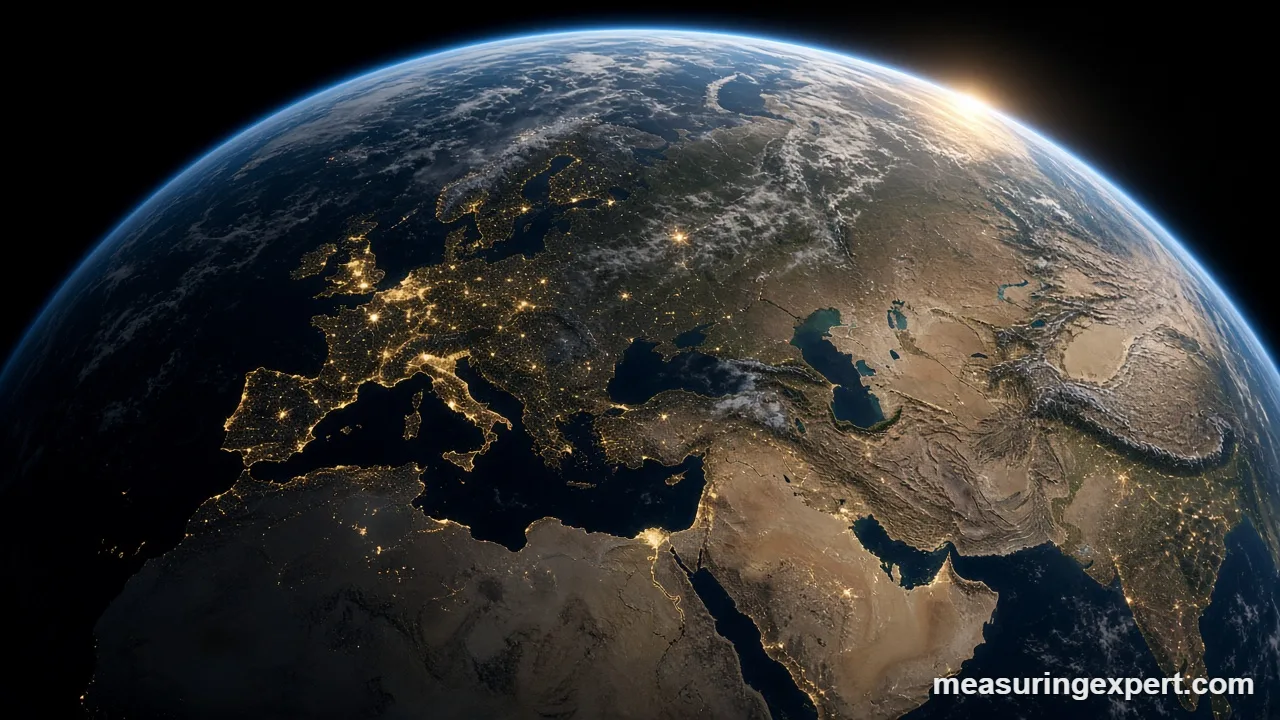
Earth spin speed at the equator is about 1,670 km/h (1,037 mph), the figure you get from a 24-hour day. Measured against the stars, one turn takes 23 h 56 min 4.1 s, so the true equator speed is 1,674.4 km/h (1,040 mph). At any latitude, the speed is 1,674.4 x cos(latitude) km/h, falling to zero at the poles.
Convert Earth Spin Speed to Other Units
First, the converter starts at the equator value in km/h. Type the speed for your own latitude (see the table below), and it instantly shows the same speed in mph, meters per second, knots and feet per second.
Right now you are moving east at hundreds of miles per hour, and you cannot feel a thing. At first, that sounds strange. However, it follows from basic physics: you, the air, the oceans and the ground all move together at a steady speed, so nothing pushes against you.
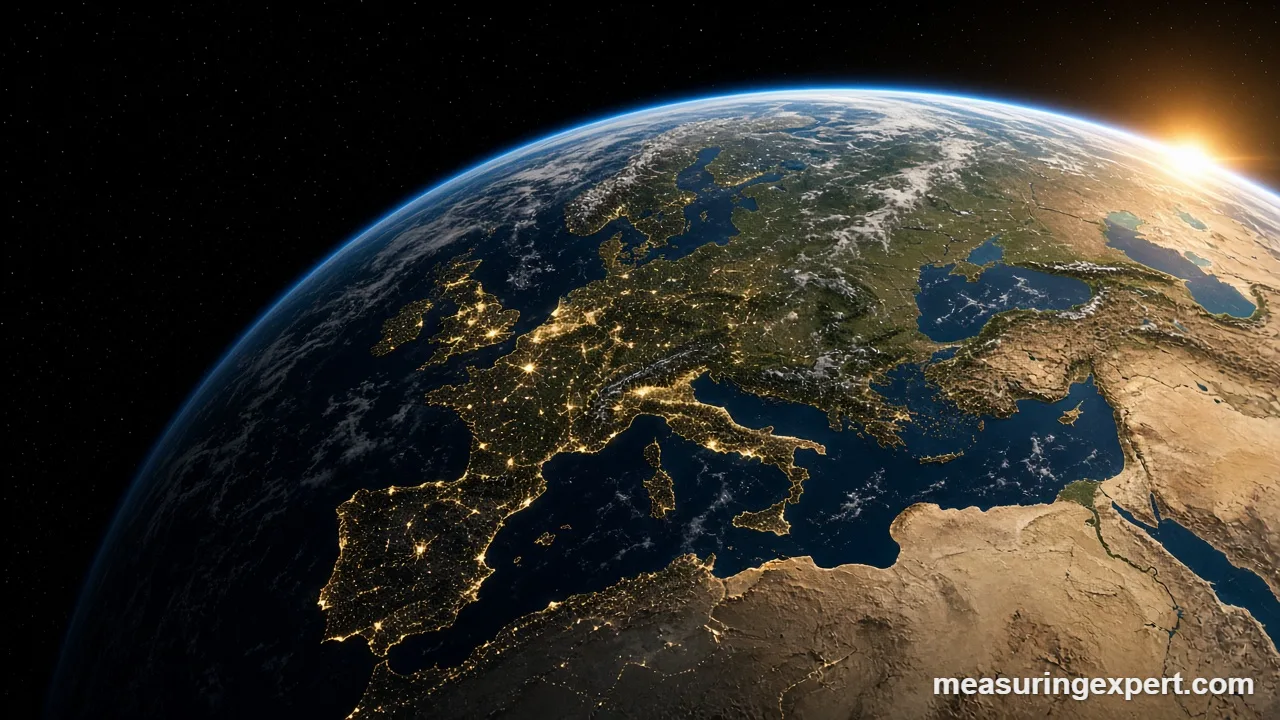
The number most people quote, about 1,000 mph, is a rounded version of the equator value. In fact, the speed depends almost entirely on how far you are from the equator. For example, a point on the equator has to travel the full 40,075 km (24,901 mi) circumference in one turn. By contrast, a point near the North Pole only traces a tiny circle. According to the NASA Earth fact sheet, the equatorial radius is 6,378.137 km and the sidereal rotation period is 23.9345 hours, and those two numbers give every figure on this page.
Below, you will find the speed for your latitude, the formula behind it, the difference between the solar and the sidereal day, and finally how fast Earth moves around the Sun, which is a much bigger number.
Earth Spin Speed by Latitude
Because the ground at higher latitudes circles a shorter path in the same time, it moves more slowly. Also, the table uses the sidereal day and the WGS84 equatorial radius, rounded to one decimal.
| Latitude (example) | km/h | mph | m/s |
|---|---|---|---|
| 0° (Quito, Singapore, equator) | 1,674.4 | 1,040.4 | 465.1 |
| 15° | 1,617.3 | 1,005.0 | 449.3 |
| 25.8° (Miami) | 1,508.0 | 937.0 | 418.9 |
| 28.5° (Kennedy Space Center) | 1,471.5 | 914.3 | 408.7 |
| 34.1° (Los Angeles) | 1,387.3 | 862.0 | 385.4 |
| 40.7° (New York City) | 1,269.2 | 788.6 | 352.6 |
| 45° | 1,184.0 | 735.7 | 328.9 |
| 51.5° (London) | 1,042.3 | 647.7 | 289.5 |
| 60° (Anchorage area, Oslo) | 837.2 | 520.2 | 232.6 |
| 70° | 572.7 | 355.8 | 159.1 |
| 80° | 290.8 | 180.7 | 80.8 |
| 89° | 29.2 | 18.2 | 8.1 |
| 90° (North or South Pole) | 0 | 0 | 0 |
Notice, therefore, that the speed drops slowly at first and then quickly. For example, at 30 degrees you still keep about 87% of the equator speed, while at 60 degrees you keep exactly half. So most of the populated world moves somewhere between 700 and 1,050 mph.
The Earth Spin Speed Formula
Speed is simply distance divided by time, so the math has only two parts. First, find the distance: the circle your latitude traces is 2 x pi x R x cos(latitude), where R is 6,378.137 km. Next, divide by the time for one turn, 23.9345 hours. As a result, the equator works out to 40,075.0 km / 23.9345 h = 1,674.4 km/h.
After that, multiplying by cos(latitude) handles everything else. Therefore, the whole method fits on one line: speed = 1,674.4 x cos(latitude) km/h, or 1,040.4 x cos(latitude) mph. In addition, the same rotation can be written as an angle: Earth turns about 15.04 degrees per hour, or 7.292 x 10^-5 radians per second, and that angular rate is the same everywhere on the planet.
In other words, every place on Earth turns through the same angle in the same time, but places far from the axis cover more ground. For the same reason, the outside lane of a running track is longer than the inside lane.
Earth Spin Speed: Solar Day vs Sidereal Day
Two numbers circulate for the equator; however, both are right for their own reference point. The table below therefore explains which day each one uses.
| Measured against | Time per turn | Equator speed | Where you see it |
|---|---|---|---|
| The Sun (solar day) | 24 h 0 min 0 s | about 1,669.8 km/h (1,037.6 mph) | Most textbooks and quick answers |
| Distant stars (sidereal day) | 23 h 56 min 4.1 s | 1,674.4 km/h (1,040.4 mph) | Astronomy, physics, satellite work |
Why the gap of almost 4 minutes? Because Earth moves while it turns, it also travels about 1/365 of the way around the Sun. So it has to rotate roughly one extra degree before the Sun returns to the same spot in the sky. Physically, then, the true spin is the sidereal one; meanwhile, the solar day is what our clocks track.
How to Calculate Your Own Earth Spin Speed
- Find your latitude. For example, read it from a map app or GPS in decimal degrees, such as 40.7 for New York City.
- Take the cosine. Use any scientific calculator in degree mode; for instance, cos(40.7) is about 0.758.
- Multiply by the equator speed. Use 1,674.4 for km/h or 1,040.4 for mph; here, 1,040.4 x 0.758 is about 789 mph.
- Convert if you need other units. Enter the km/h result in the converter above to get m/s, knots or ft/s.
- Round sensibly. In practice, three significant figures are plenty, because the formula treats Earth as a sphere.
Why You Do Not Feel Earth Spinning
First of all, your body only senses changes in motion, not steady motion. On a smooth flight at 550 mph, for example, you can pour a drink without spilling it. Similarly, the ground carries you at a nearly constant speed, so there is nothing to feel.
The rotation does have small effects, though. At the equator it creates an outward push of about 0.034 m/s^2, roughly 0.35% of gravity, so you weigh very slightly less there than at the poles. Over time, it also flattened the planet: the equatorial radius is about 21 km larger than the polar radius. Finally, it deflects winds and ocean currents, the Coriolis effect, to the right in the Northern Hemisphere and to the left in the Southern Hemisphere.
Earth Spin Speed vs Orbital Speed
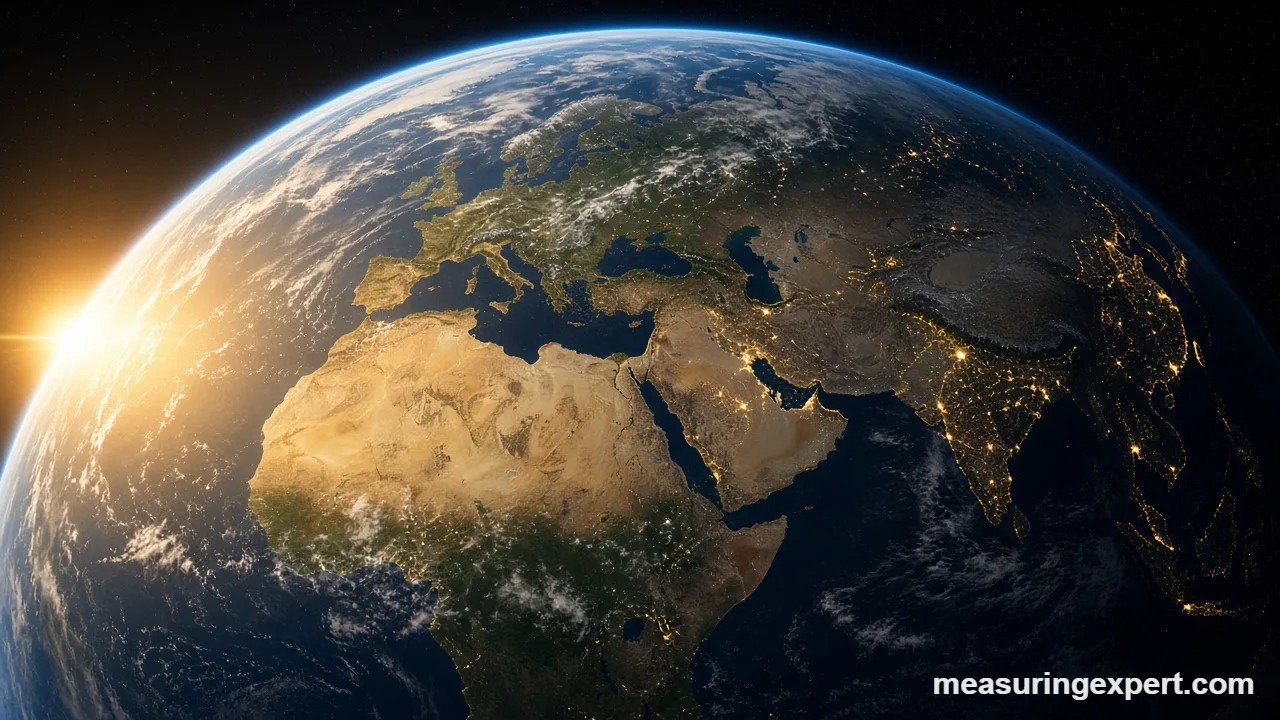
Of course, spinning on its axis is only one of Earth’s motions. Earth also orbits the Sun, and the Sun carries the whole solar system around the Milky Way. People often mix up these speeds, so here they are side by side.
| Motion | Typical speed | In mph | Source of the figure |
|---|---|---|---|
| Spin at the equator | 1,674.4 km/h (0.465 km/s) | 1,040 | Radius and sidereal day |
| Orbit around the Sun (mean) | about 107,000 km/h (29.78 km/s) | about 66,600 | NASA fact sheet |
| Orbit range (perihelion to aphelion) | 30.29 to 29.29 km/s | 67,800 to 65,500 | NASA fact sheet |
| Solar system around the galaxy | roughly 220 to 230 km/s | about 500,000 | Estimate; varies by study |
In short, Earth moves around the Sun about 64 times faster than the equator spins. For more context, sound in air travels at about 767 mph, so the equator turns faster than the speed of sound, yet light covers the distance from the Sun in about 8 minutes, as explained in our guide to the speed of light.
Earth Spin Speed in Everyday Life
To begin with, rotation is the reason the Sun rises, sets and moves about 15 degrees across the sky every hour. Because of this, time zones are about 15 degrees of longitude wide, and one degree of longitude equals 4 minutes of clock time. In addition, the spin decides how quickly the sky darkens: near the equator the Sun drops almost straight down, while at high latitudes it slides along the horizon. Our guide on how long after sunset it gets dark shows how much twilight changes with latitude.
Rocket launches also use the spin. A rocket launched east from Kennedy Space Center starts with about 409 m/s (914 mph) of free speed, which is why most launch sites sit as close to the equator as their country allows.
Recommended Tools for Seeing Earth’s Rotation
Of course, you cannot buy a speedometer for the planet. However, a globe with a tilted axis makes latitude and the cos(latitude) idea easy to see, and a planisphere lets you watch the stars swing around the pole as Earth turns. These picks are based on manufacturer descriptions and buyer reports.


As an Amazon Associate, Measuring Expert earns from qualifying purchases.
Do and Don’t When Quoting Rotation Speeds
Do
- Always say which latitude a speed applies to.
- Use the sidereal day for physics and launches.
- Also keep spin speed and orbital speed separate.
- Round to three significant figures.
Don’t
- Quote 1,000 mph for every city.
- Mix up km/h and mph, because readers notice.
- Blame the Coriolis effect for your sink.
- Claim the spin is perfectly constant.
Honest Limits of These Numbers
The formula treats Earth as a perfect sphere, but the real planet is a slightly flattened ellipsoid. As a result, the true speed at mid-latitudes runs about 0.2 to 0.3% higher than the simple cos(latitude) value, roughly 2 km/h at 45 degrees. Similarly, altitude adds a little: a mountain top 3 km up moves about 0.05% faster than sea level directly below it. Also, the day length itself drifts by milliseconds, which changes the speed far below the last decimal shown here. For everyday questions, then, none of this matters. For satellite orbits and precise timekeeping, however, scientists use the full ellipsoid model and daily measured rotation data from the International Earth Rotation and Reference Systems Service (IERS).
When Accuracy Really Matters
Even so, three fields need far more precision than this page offers. First, GPS receivers correct for Earth’s rotation during the short time a signal travels from the satellite, otherwise positions would be off by many meters. Next, launch planners also use the exact ellipsoid speed at the pad. Finally, atomic timekeepers compare the spin with atomic clocks to decide on leap seconds.
Frequently Asked Questions
How fast does the Earth spin in mph?
At the equator, about 1,037 mph using a 24-hour day, or 1,040 mph using the true sidereal day. The speed drops with latitude and reaches zero at the poles.
What is the Earth spin speed in km/h?
About 1,670 km/h at the equator in everyday terms, or 1,674.4 km/h measured against the stars. At 45 degrees latitude it is about 1,184 km/h.
How fast is Earth spinning where I live?
Multiply 1,040.4 mph by the cosine of your latitude. For example, New York City at 40.7 degrees moves about 789 mph, and London at 51.5 degrees about 648 mph.
How long does one full rotation take?
One rotation relative to the stars takes 23 hours, 56 minutes and 4.1 seconds. The 24-hour solar day is slightly longer because Earth also moves along its orbit.
Is the Earth spin speed slowing down?
Yes, very slowly. Tidal friction from the Moon lengthens the day, and ancient eclipse records show an average gain of about 1.8 milliseconds per century.
Why don’t we feel Earth spinning?
Because the motion is steady. After all, your body senses changes in speed or direction, and the ground, the air and you all move together at the same nearly constant speed.
Does the spin make you lighter at the equator?
Slightly. In fact, the rotation reduces your effective weight at the equator by about 0.35% compared with the poles, and the equatorial bulge reduces it a little more.
How fast does Earth move around the Sun?
About 29.78 km/s on average, which is roughly 107,000 km/h or 66,600 mph. As a result, it is about 64 times faster than the equator spins.
What would happen if Earth stopped spinning suddenly?
Everything not fixed to the bedrock, including the air and oceans, would keep moving east at up to 1,040 mph, causing catastrophic winds and waves. Fortunately, there is no known way for this to happen.
Which direction does Earth spin?
Earth spins from west to east, counterclockwise when viewed from above the North Pole. As a result, the Sun rises in the east and sets in the west.
Earth Spin Speed: The Bottom Line
To sum up, the equator turns at about 1,670 km/h (1,037 mph) by the clock and 1,674.4 km/h (1,040 mph) against the stars. Everywhere else, simply multiply by the cosine of your latitude, so the speed shrinks smoothly to zero at the poles.
For other units, the converter at the top of the page turns any km/h value into mph, m/s, knots or ft/s. Meanwhile, remember that the spin is only the slowest of Earth’s motions: the trip around the Sun is about 64 times faster.