

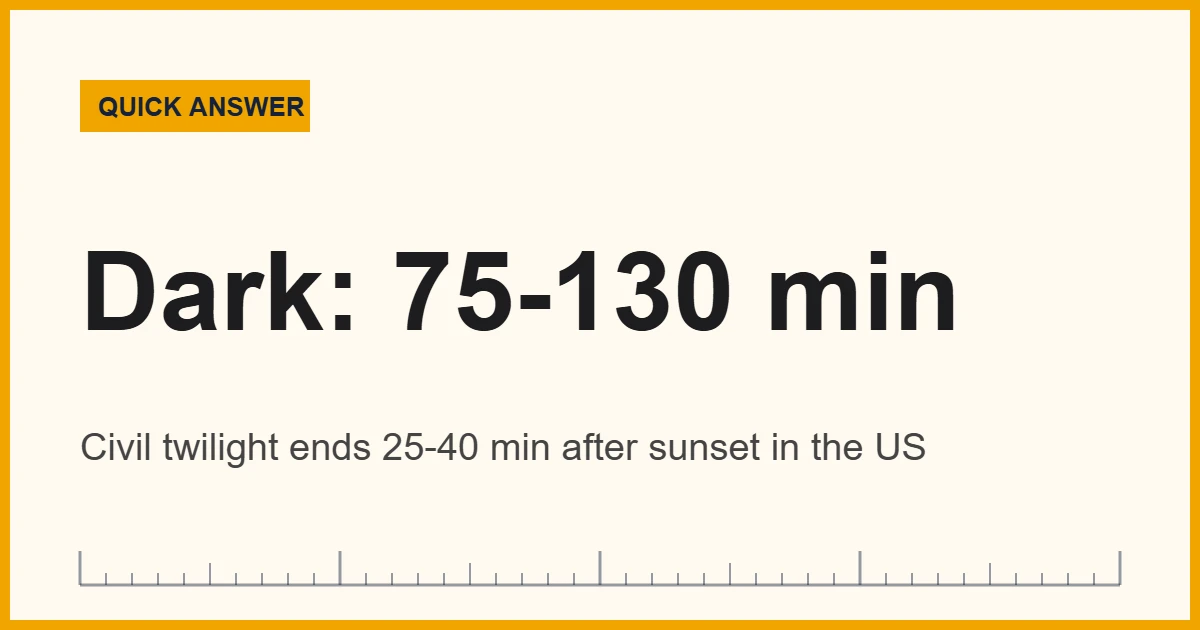
How long after sunset does it get dark? In most of the lower 48 states, civil twilight ends about 25 to 40 minutes after sunset, when you need lights outdoors. Full darkness, the end of astronomical twilight, usually arrives 75 to 130 minutes after sunset, and later in northern summers.
Sunset is not the moment the light switches off. Instead, the sky dims in stages as the sun sinks farther below the horizon, and scattered sunlight keeps the sky glowing for a surprisingly long time. As a result, the honest answer to how long after sunset it gets dark depends on what you mean by “dark” and on where and when you are standing.
Astronomers split the fading light into three stages, each tied to a fixed sun angle rather than a fixed number of minutes. Because the sun drops at different rates in different places, the same angle takes about 21 minutes to reach at the equator in March but more than 40 minutes in Seattle in June.
In short: plan on about half an hour of usable light after sunset, about an hour until the horizon fades at sea, and roughly one and a half to two hours before the sky is as dark as it will get.
The definitions come from the US Naval Observatory, which publishes official US sunrise, sunset and twilight times. In its rise, set and twilight definitions, sunset happens when the top edge of the sun touches the horizon, and each twilight stage ends when the center of the sun sits 6, 12 or 18 degrees below it.
Below, you will find a time converter, tables by latitude and season, a worked method for your own location, and finally the things that do (and do not) change the timing.
Twilight Time Converter: How Long After Sunset in Hours and Minutes
Use the tables further down to find your twilight length in minutes, then type it here. The converter turns minutes into hours and seconds, which also helps when you add the result to a sunset time on your phone.
Recommended Tools for Measuring Light After Sunset
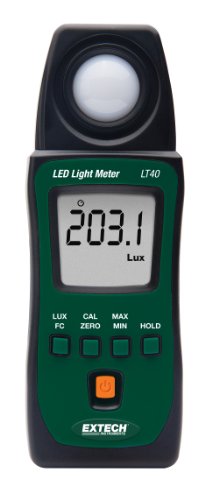
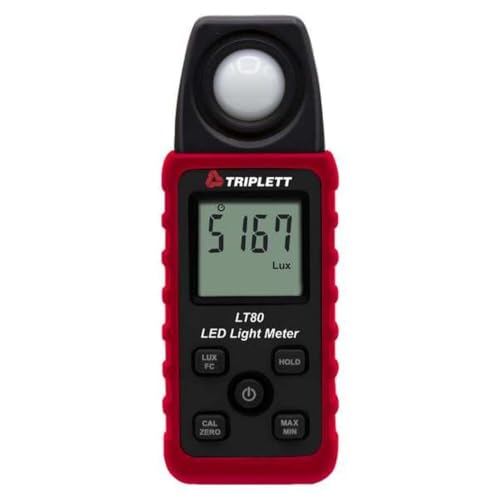
You do not need gear to watch dusk, but a few tools turn it into a real measurement. For example, a handheld lux meter shows how fast light levels fall after sunset, which is useful for photographers, gardeners and anyone setting up outdoor lighting. Meanwhile, a planisphere tells you which stars will appear as twilight deepens, and a headlamp with a red mode keeps your night vision intact once it is dark.



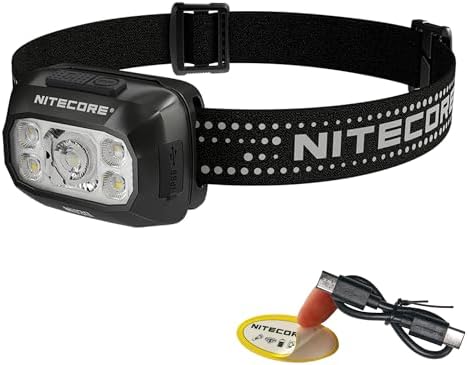
As an Amazon Associate, Measuring Expert earns from qualifying purchases.
Key Takeaways
- Civil twilight ends when the sun is 6 degrees below the horizon, usually 25 to 40 minutes after sunset in the US.
- Nautical twilight ends at 12 degrees, typically 50 to 80 minutes after sunset.
- Astronomical twilight ends at 18 degrees; after that, the sky is as dark as it gets.
- Twilight is shortest near the equator and lengthens as you travel toward the poles.
- Near the equinoxes dusk is quickest, while early summer brings the longest twilight.
- Clouds make it look darker sooner, but they do not change the official twilight times.
- Daylight saving time moves the clock, not the length of dusk.
The Three Stages of Twilight
Each stage starts where the previous one stops, so the evening runs sunset, civil dusk, nautical dusk and then astronomical dusk. The National Weather Service describes what you can see in each one in its guide to twilight types, and the table below sums it up.
| Stage | Sun below horizon | What you see |
|---|---|---|
| Civil twilight | 0.83° to 6° | Plenty of light for most outdoor tasks; the brightest planets and stars appear near the end. |
| Nautical twilight | 6° to 12° | The horizon is still visible at sea, so sailors could take star sights; on land you need lights for most tasks. |
| Astronomical twilight | 12° to 18° | Most people call it night, especially in cities; faint stars fill in, but the sky still holds a trace of sunlight. |
| Night | More than 18° | Scattered sunlight is fainter than starlight; this is the darkest the sky gets. |
Why does sunset sit at 0.83 degrees rather than zero? The sun’s disk has a radius of about 16 arcminutes, and the atmosphere bends light by about 34 arcminutes at the horizon. Together, they add up to 50 arcminutes, or 0.83 degrees, so the sun’s center is already below the true horizon when the top edge disappears.
How Long After Sunset Each Twilight Stage Ends
The table below gives the minutes from sunset to the end of each stage at the March or September equinox. We computed each value from the standard sun-angle formula, using the USNO definitions above, and rounded to the nearest minute.
| Latitude | Civil ends | Nautical ends | Astronomical ends |
|---|---|---|---|
| 0° (equator) | 21 min | 45 min | 69 min |
| 20° N (Hawaii) | 22 min | 48 min | 73 min |
| 30° N (Houston) | 24 min | 52 min | 80 min |
| 40° N (Denver, New York) | 27 min | 59 min | 91 min |
| 50° N (southern Canada) | 32 min | 70 min | 110 min |
| 60° N (Anchorage area) | 42 min | 92 min | 146 min |
Why Latitude Changes How Long After Sunset It Gets Dark
Earth turns 15 degrees every hour (360 degrees in 24 hours). At the equator on an equinox, the sun drops straight down, so it sinks those full 15 degrees per hour and reaches 18 degrees below the horizon quickly. That is why tropical dusk feels so abrupt.
Farther from the equator, however, the sun slides down at a slant. At latitude 40 degrees on an equinox, it descends at about 15 times the cosine of 40 degrees, or roughly 11.5 degrees per hour. Consequently, the trip from sunset to 18 degrees takes about 90 minutes instead of 69. Closer to the poles, the slant gets so shallow that summer twilight can last all night.
Speed of rotation has nothing to do with it, despite a common myth. Every place on Earth turns through the same 15 degrees per hour; only the angle of the sun’s path changes. If you like the geometry, our guide to tools for measuring angles shows how surveyors and astronomers measure angles like these.
Seasons: Why Summer Dusk Lingers
In the Northern Hemisphere, the sun sets far to the northwest in June and follows a long, shallow path below the horizon. As a result, twilight stretches out. In December, the path is steeper than in June but still not as steep as at the equinoxes, so the shortest twilight of the year falls near late March and late September.
| Latitude | Equinox (civil / full dark) | June solstice (civil / full dark) | December solstice (civil / full dark) |
|---|---|---|---|
| 30° N | 24 / 80 min | 27 / 97 min | 26 / 86 min |
| 40° N | 27 / 91 min | 33 / 123 min | 31 / 98 min |
| 50° N | 32 / 110 min | 45 min / never fully dark | 39 / 120 min |
So the old rule that “it gets dark fast in winter” holds only for the clock: winter sunsets come early, but dusk itself lasts a few minutes longer than in spring or fall. Above about 48.6 degrees north, astronomical night does not arrive at all around the June solstice, because the sun never sinks 18 degrees below the horizon.
How Long After Sunset It Gets Dark in US Cities
These city values use each city’s approximate latitude and the same method. Since local terrain and haze shift what you actually see, treat them as a good planning guide rather than an exact schedule.
| City | Equinox: civil / nautical / full dark | June: civil / nautical / full dark | December: civil / nautical / full dark |
|---|---|---|---|
| Miami (25.8° N) | 23 / 50 / 77 min | 26 / 57 / 90 min | 25 / 54 / 82 min |
| Los Angeles (34.1° N) | 25 / 54 / 84 min | 29 / 65 / 105 min | 28 / 59 / 90 min |
| New York (40.7° N) | 27 / 59 / 92 min | 33 / 76 / 126 min | 31 / 65 / 99 min |
| Chicago (41.9° N) | 28 / 60 / 94 min | 34 / 79 / 132 min | 32 / 67 / 101 min |
| Seattle (47.6° N) | 31 / 67 / 104 min | 41 / 97 / 188 min | 36 / 75 / 113 min |
| Anchorage (61.2° N) | 43 / 95 / 153 min | Civil twilight lasts all night | 62 / 122 / 176 min |
How to Work Out When It Gets Dark Where You Live
- Get today’s sunset time. Your phone’s weather app or the US Naval Observatory’s data service lists it for any US town.
- Find your latitude. A map app shows it when you drop a pin; round it to the nearest 5 degrees.
- Pick the season row. Use the equinox table for March and September, and the solstice columns for June and December; in between, estimate halfway.
- Choose the stage you care about. Civil for outdoor chores and driving, nautical for boating, and astronomical for stargazing.
- Add the minutes to sunset. Enter the minutes in the converter above if you want hours, then add them to the sunset time.
- Adjust for the sky. Add 15 to 30 minutes of patience for a bright moon or city lights, since both keep the sky from reaching true black.
Here is a worked example. Say sunset in Chicago on March 20 comes at 7:00 pm daylight time. Adding 28 minutes gives 7:28 pm for the end of civil twilight, and adding 94 minutes gives about 8:34 pm for full darkness.
What Does Not Change the Timing
Several popular explanations get twilight wrong, so it helps to separate what you see from what the sun is doing.
| Claim | What actually happens |
|---|---|
| Clouds make night come sooner | Thick clouds block light, so it looks dark earlier, but the sun-angle times stay the same. |
| Clouds or smog increase refraction | Refraction depends on air temperature and pressure near the ground, not on clouds; it shifts sunset by only about 2 to 3 minutes at mid-latitudes. |
| Daylight saving time shortens dusk | DST moves every clock time by an hour; the length of twilight does not change. |
| Faster rotation at the equator causes quick dusk | Rotation is 15 degrees per hour everywhere; the steep sun path at low latitudes causes quick dusk. |
Air pressure and temperature do matter a little, because they set how strongly the air bends light near the horizon. Our explainer on air pressure and weather covers how those readings work.
Do and Don’t for Planning Around Dusk
Do
- Plan to finish a hike before civil twilight ends.
- Check the moon phase before a stargazing night.
- Use the season row that matches the date.
- Carry a headlamp even on short evening walks.
- Give your eyes 20 minutes or more to adjust to the dark.
Don’t
- Assume 30 minutes after sunset means full darkness.
- Rely on equator times at higher latitudes.
- Look at a bright phone screen right before observing.
- Forget that hills to the west make dusk start earlier.
- Treat clouds as a change in the actual twilight times.
Honest Limits of These Twilight Times
The tables use a simple model: sea-level horizon, average refraction, and the sun’s position on the solstice or equinox date. Real dusk differs a little. For one thing, mountains or tall buildings to the west block the sun before the official sunset. Moreover, haze and wildfire smoke dim the glow, while snow cover makes twilight feel brighter. In addition, “dark” is partly a matter of perception; a city sky with heavy light pollution never gets as dark as the 18-degree definition implies. Finally, the minute values here are rounded, so treat a difference of one or two minutes as noise.
When an Official Time Matters
For casual plans, the tables are more than enough. Some rules, however, use exact definitions. For example, US aviation rules (14 CFR 1.1) define night as the time between the end of evening civil twilight and the start of morning civil twilight. Likewise, many state hunting and vehicle-lighting rules count from official sunset. In those cases, look up the exact time for your location and date from the US Naval Observatory or your state agency rather than estimating. If you want to know more about how official time itself is kept, see how clocks are measured.
Frequently Asked Questions
How long after sunset does it get dark?
In most of the US, you need lights about 25 to 40 minutes after sunset, and the sky reaches full darkness about 75 to 130 minutes after sunset, depending on latitude and season.
How long after sunset is civil twilight over?
Civil twilight ends when the sun is 6 degrees below the horizon. That takes about 21 to 23 minutes at the equator and about 27 to 33 minutes at 40 degrees north.
Is it fully dark 30 minutes after sunset?
No. Thirty minutes after sunset is roughly the end of civil twilight in much of the US. The sky still has a strong glow, and full darkness is about an hour or more away.
How long after sunset can you see stars?
The brightest planets and stars appear near the end of civil twilight, about 20 to 40 minutes after sunset. Fainter stars fill in during nautical and astronomical twilight.
Why does it get dark faster near the equator?
Near the equator the sun drops almost straight down, about 15 degrees per hour. At higher latitudes it sinks at a slant, so it takes longer to reach 18 degrees below the horizon.
How long after sunset does it get dark in summer?
Summer has the longest twilight. At 40 degrees north in late June, full darkness comes about 2 hours after sunset, and above about 48.6 degrees north the sky never gets fully dark.
How long after sunset does it get dark in winter?
At 40 degrees north in late December, civil twilight ends about 31 minutes after sunset and full darkness arrives about 98 minutes after sunset, a bit later than at the equinoxes.
Does daylight saving time change how long twilight lasts?
No. Daylight saving time moves sunset and twilight to a later clock time, but the minutes between sunset and darkness stay the same.
Do clouds make it get dark sooner?
Clouds make it look darker earlier because they block the remaining light. Even so, the official end of each twilight stage depends only on the sun’s angle.
How long after sunset does it get dark in Alaska?
It depends on the season. At Anchorage, civil twilight lasts all night in late June, while in late December it ends about an hour after sunset and full darkness takes nearly 3 hours.
Bottom Line: How Long After Sunset It Gets Dark
To sum up, twilight runs on sun angles, not a fixed clock. In most of the US, that means about half an hour of usable light, about an hour until the horizon fades, and roughly 75 to 130 minutes until the sky is fully dark. Latitude and season decide where in that range you fall.
So check your sunset time, pick the right row from the tables, and add the minutes. Then, if you want the result in hours, the converter at the top of the page does the math, and the night sky is yours once astronomical twilight ends.