

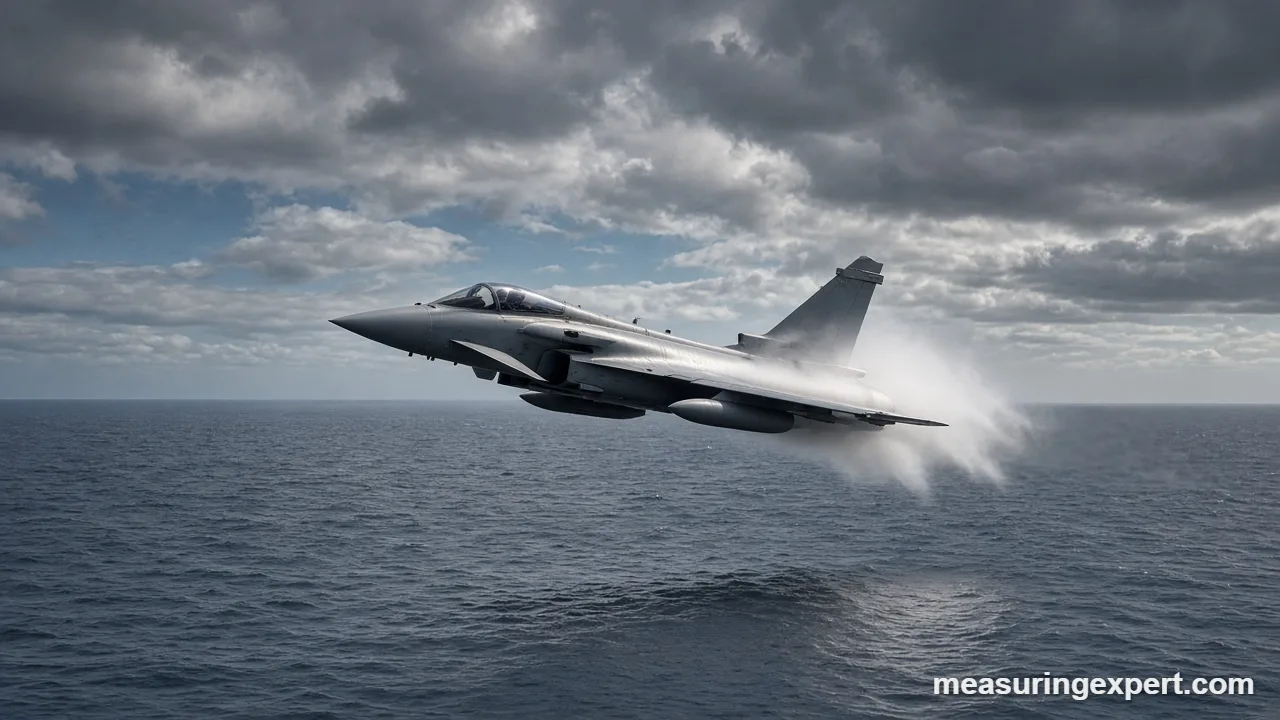
The speed of sound in dry air at 20 degrees C (68 degrees F) is about 343 meters per second. That equals roughly 1,235 km/h, 767 mph or 1,125 feet per second. However, it is not a fixed constant: sound moves faster in warm air, about 4.3 times faster in water, and roughly 17 times faster in steel.
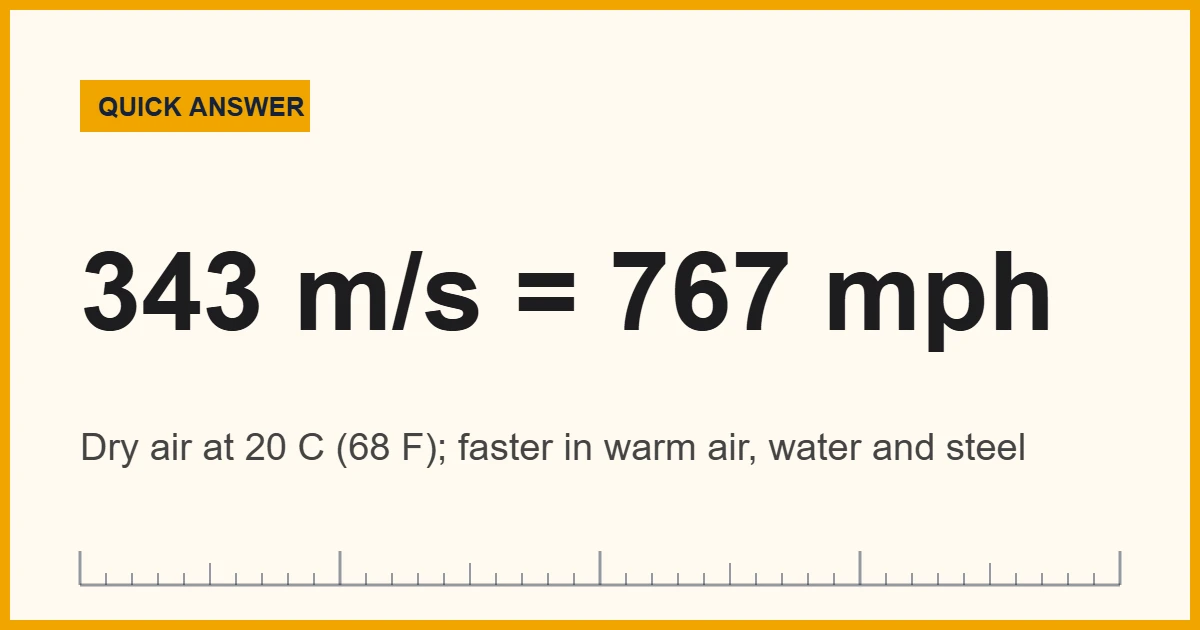
Speed of Sound Converter
First, enter a speed and pick its unit. The converter then shows the same value in km/h, mph, feet per second and knots, so you can check any figure on this page or convert a Mach speed you calculated yourself.
Sound is a pressure wave. For instance, a vibrating object pushes on the molecules next to it, those molecules push on their neighbors, and the disturbance spreads outward. So what we measure is really the speed at which a material passes that push along. In air, therefore, it depends almost entirely on temperature. In liquids and solids, by contrast, it depends on how stiff the material is compared with how dense it is.
That is also why you see slightly different numbers quoted. For example, NASA’s Glenn Research Center gives the standard sea-level value as about 761 mph, because the standard atmosphere uses 15 degrees C instead of 20. Both values are right, because they simply describe different air.
Below, you will find a unit chart, the temperature formula, values for water and metals, how Mach numbers work, and finally a simple way to measure sound speed yourself with a stopwatch and an echo.
Speed of Sound in mph, km/h, ft/s and Knots
All the values below also come from one number: 343 m/s for dry air at 20 degrees C. In addition, each conversion uses exact definitions: 1 mile is 1,609.344 m, 1 foot is 0.3048 m and 1 knot is 1,852 m per hour.
| Unit | Value (dry air, 20 °C) | Handy form |
|---|---|---|
| Meters per second | 343 m/s | about 1 km in 2.9 seconds |
| Kilometers per hour | 1,235 km/h | – |
| Miles per hour | 767 mph | about 1 mile in 4.7 seconds |
| Feet per second | 1,125 ft/s | about 1,000 ft in 0.9 seconds |
| Knots | 667 knots | – |
Meanwhile, light covers the same mile in about 5 millionths of a second. As a result, that huge gap explains why you see a firework before you hear it; our page on how fast the speed of light is covers the other side of that race.
How Temperature Changes the Speed of Sound
In a gas, first of all, molecules can only pass a push along as fast as they themselves move. Because warm molecules move faster, sound travels faster in warm air. Pressure, on the other hand, has almost no effect on its own, because denser air is also harder to push, and the two effects cancel out.
For an ideal gas, then, the speed follows a simple formula:
c = square root of (gamma x R x T)Here, for example, gamma is about 1.4 for dry air, R is the gas constant for air (about 287.05 J per kg per kelvin), and T is the absolute temperature in kelvins. In practice, a quicker rule works well between about -40 and +40 degrees C:
c (m/s) = 331.3 + 0.606 x T (degrees C)In other words, sound gains about 0.6 m/s for every degree Celsius, or about 1.1 ft/s for every degree Fahrenheit. The table, however, uses the full formula.
| Air temperature | m/s | mph | km/h | ft/s |
|---|---|---|---|---|
| -40 °C (-40 °F) | 306.1 | 684.7 | 1,102 | 1,004 |
| -20 °C (-4 °F) | 319.0 | 713.5 | 1,148 | 1,046 |
| 0 °C (32 °F) | 331.3 | 741.1 | 1,193 | 1,087 |
| 10 °C (50 °F) | 337.3 | 754.6 | 1,214 | 1,107 |
| 15 °C (59 °F) | 340.3 | 761.2 | 1,225 | 1,116 |
| 20 °C (68 °F) | 343.2 | 767.8 | 1,236 | 1,126 |
| 30 °C (86 °F) | 349.0 | 780.8 | 1,257 | 1,145 |
| 40 °C (104 °F) | 354.7 | 793.5 | 1,277 | 1,164 |
Humidity and Altitude Effects
Humidity also plays a small part. This is because water vapor is lighter than the nitrogen and oxygen it replaces, so humid air carries sound slightly faster than dry air at the same temperature. The difference, though, is usually well under 1 percent, so most charts simply quote dry air.
Speed of Sound in Water, Steel and Other Materials
Many people believe sound is faster in water simply because water is denser. In fact, density alone would slow sound down. Instead, water and steel win because they are far stiffer, meaning they resist compression much more strongly, and that stiffness outweighs their extra mass.
| Material | Approximate speed | Compared with air at 20 °C |
|---|---|---|
| Air, dry, 20 °C | 343 m/s (767 mph) | 1x |
| Helium, 20 °C | about 1,007 m/s | about 2.9x |
| Fresh water, 20 °C | about 1,481 m/s (3,313 mph) | about 4.3x |
| Seawater, typical | about 1,500 m/s | about 4.4x |
| Steel (longitudinal wave) | about 5,900 to 6,000 m/s | about 17x |
| Aluminum (longitudinal wave) | about 6,300 m/s | about 18x |
In the ocean, moreover, temperature, depth and salt all matter. According to the University of Rhode Island’s Discovery of Sound in the Sea tutorial, sound speed in seawater rises by about 4 m/s per degree C and by about 17 m/s for every kilometer of depth. Meanwhile, values for metals depend on the alloy and on the kind of wave, so treat the steel figure as a range.
Common Mix-Ups: Light, Mach, Loudness and Pitch
| Term | What it actually means |
|---|---|
| Speed of sound | How fast a pressure wave moves through a material; about 343 m/s in air at 20 °C |
| Speed of light | An exact constant, 299,792,458 m/s in a vacuum; roughly 874,000 times faster than sound in air |
| Mach 1 | A speed equal to the local speed of sound, so its mph value changes with temperature |
| Loudness (decibels) | How strong the wave is; it does not change how fast the wave travels |
| Pitch (frequency) | How often the wave repeats; high and low notes travel at the same speed |
The loudness point surprises many readers. For example, a whisper and a shout cross a room in the same time, because volume depends on amplitude rather than speed. Also, our guide to what determines the volume of a sound explains amplitude, decibels and distance in more detail.
Mach Numbers and the Speed of Sound Barrier
A Mach number is the ratio of an object’s speed to the local speed of sound. Thus Mach 1 means traveling exactly at the speed of sound, while Mach 2 means twice as fast. Similarly, NASA groups flight into subsonic (below Mach 1), transonic (near Mach 1), supersonic (Mach 1 to 5) and hypersonic (above Mach 5) regimes.
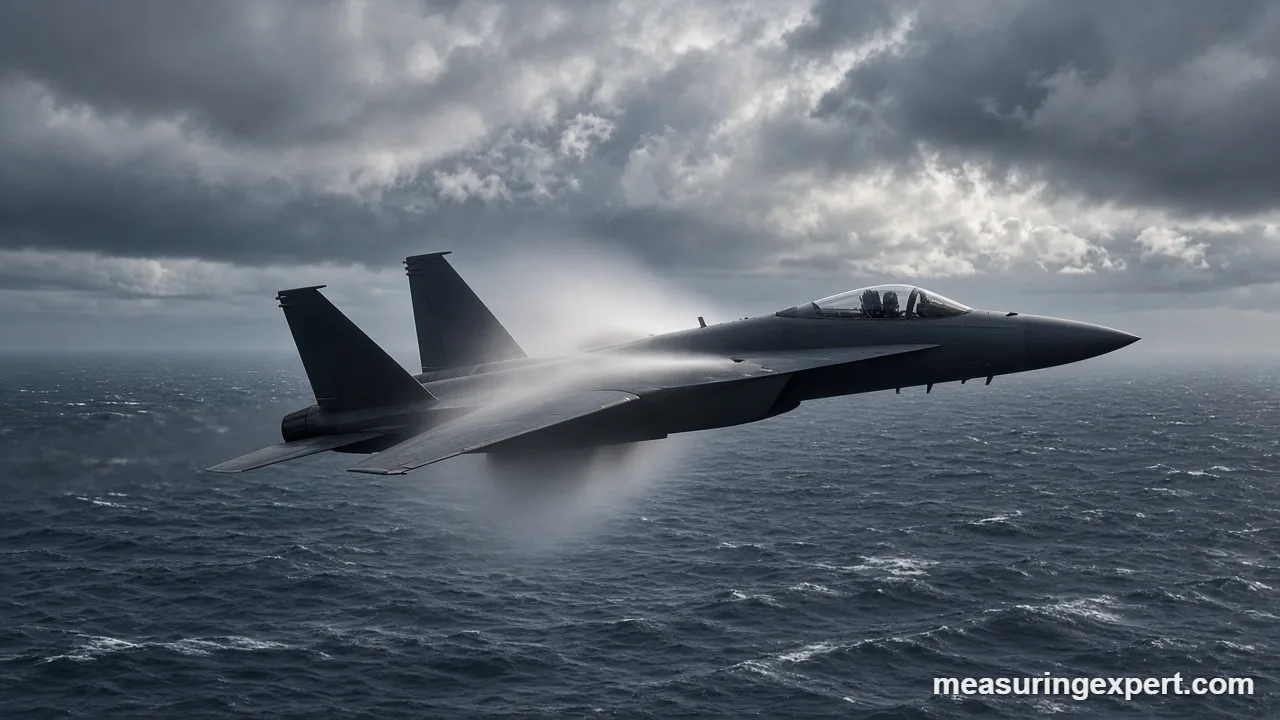
Because the speed of sound depends on temperature, a fixed Mach number is not a fixed mph value. For example, Mach 2 is about 1,522 mph in 15 degrees C air at sea level, but only about 1,320 mph in -56.5 degrees C air high in the stratosphere. As a result, pilots and engineers talk in Mach numbers near the sound barrier, and in knots or mph elsewhere. If you want typical cruising figures, see how fast planes fly.
When an aircraft flies faster than sound, the pressure waves it creates cannot move ahead of it. Instead, they pile up into a shock wave that trails behind the aircraft in a cone. Then, when that cone sweeps over the ground, people hear a sonic boom. Also, the boom is not a single event at the moment a jet “breaks” the barrier; it follows the aircraft for as long as it stays supersonic.
Recommended Tools for Timing Sound and Measuring Distance
Fortunately, you do not need a lab to measure sound speed. First, you need a reliable way to measure distance, such as a laser measure or a measuring wheel. Next, you need a way to time short intervals, from a sports stopwatch to a cheap ultrasonic sensor module. Finally, a sound level meter helps if you want to explore loudness alongside speed.


As an Amazon Associate, Measuring Expert earns from qualifying purchases.
How to Measure the Speed of Sound With an Echo
This classic experiment needs only a large flat wall, an open space in front of it and two people. Also, it works best on a calm day.
- Find a tall wall with open ground in front. A school building or a large warehouse wall works well; stand at least 50 m (about 165 ft) away.
- Measure the distance to the wall. Use a laser measure or a measuring wheel, and write the number down.
- Clap a steady rhythm. Adjust your pace until each clap lands exactly on the echo of the previous one.
- Time 20 claps. Your partner starts a stopwatch on clap 1 and stops it on clap 21.
- Work out the time per clap. Divide the total time by 20; this is the time sound takes to reach the wall and come back.
- Calculate the speed. Multiply the distance by 2 and divide by the time per clap, then compare the result with the temperature table above.
For example, if the wall is 85 m away and 20 claps take 9.9 seconds, each round trip takes 0.495 seconds. Therefore, the speed is 170 m divided by 0.495 s, or about 343 m/s.
Do and Don’t for Sound Timing Experiments
Do
- Note the air temperature next to any figure you quote.
- Use the full formula for very cold or hot air.
- Quote Mach numbers with the altitude or temperature.
- Repeat timing experiments several times and average them.
Don’t
- Treat 343 m/s as a universal constant.
- Assume louder sounds travel faster.
- Rely on one stopwatch reading for a short distance.
- Expect the steel or seawater figure to fit every sample.
Honest Limits of These Numbers
In practice, every value on this page is an approximation tied to stated conditions. First, the 343 m/s figure assumes dry air at exactly 20 degrees C; real air carries some water vapor, and that nudges the speed up slightly. Second, the simple formula treats air as an ideal gas, which is excellent near room temperature but drifts at extremes. Third, wind adds to or subtracts from the speed you measure outdoors, because sound rides along with the moving air. Finally, values for water and metals vary with salinity, depth, alloy and the type of wave, so the table gives typical figures rather than exact ones.
When Accuracy Really Matters
For a science class or a storm estimate, 343 m/s or “5 seconds per mile” is plenty. Some jobs, however, need exact values for the actual conditions. Ultrasonic distance sensors, for example, assume a sound speed, so a sensor calibrated at 20 degrees C reads distances about 3.6 percent long in air at 0 degrees C. Likewise, sonar and ocean mapping rely on measured sound speed profiles, and aircraft instruments compute Mach number from measured air data rather than from a table.
Frequently Asked Questions
What is the speed of sound in mph?
In dry air at 20 degrees C (68 degrees F), the speed of sound is about 767 mph. At the standard sea-level temperature of 15 degrees C, it is about 761 mph.
What is the speed of sound in km/h?
It is about 1,235 km/h in dry air at 20 degrees C. By contrast, it is about 1,193 km/h at 0 degrees C.
Is the speed of sound the same as Mach 1?
Yes. Mach 1 is defined as the local speed of sound, so its value in mph or km/h changes with air temperature.
Why does sound travel faster in water than in air?
Water is much stiffer than air. In other words, it resists compression strongly, and that stiffness outweighs its higher density, so sound moves about 4.3 times faster in fresh water.
How fast is the speed of sound in steel?
Longitudinal sound waves travel at roughly 5,900 to 6,000 m/s in steel, about 17 times faster than in air. However, the exact value depends on the alloy.
Does altitude change how fast sound travels?
Only indirectly. Pressure itself has little effect, but air gets colder as you climb, and colder air carries sound more slowly. As a result, at airliner cruising height it drops to about 295 m/s.
Can sound travel in space?
No. Sound needs a material to travel through. However, space is almost a perfect vacuum, so there is nothing to carry the pressure wave.
How far away is lightning if thunder comes 10 seconds later?
About 2 miles, or roughly 3.4 km. This is because sound covers about a mile every 5 seconds, or a kilometer every 3 seconds.
Do loud sounds travel faster than quiet ones?
No. For everyday sounds, loudness and pitch do not change the speed. However, only extremely strong blasts, such as explosions, briefly travel faster near their source.
What is the formula for how fast sound moves in air?
The full formula is c = square root of (gamma x R x T). Alternatively, a quick version is c = 331.3 + 0.606 x T, with T in degrees C and c in m/s.
The Speed of Sound: Bottom Line
In short, sound travels about 343 m/s, 1,235 km/h or 767 mph in dry air at 20 degrees C, and it gains about 0.6 m/s for every degree of warming. In water, by comparison, it is roughly 4.3 times faster, and in steel about 17 times faster.
So whenever you see a speed of sound figure, check the temperature and the material behind it. Finally, use the converter at the top of the page to turn it into whichever unit you need.
3 thoughts on “How Fast Is the Speed of Sound? 343 m/s, 767 mph and the Temperature Formula”