

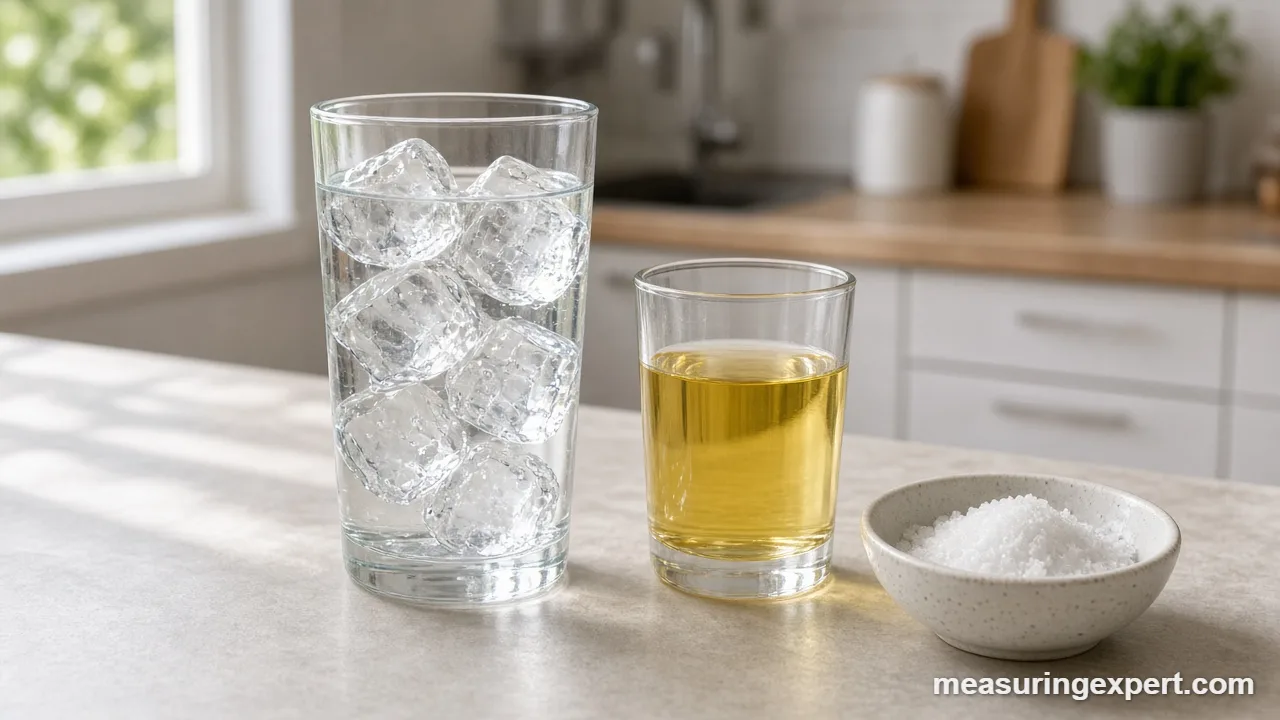
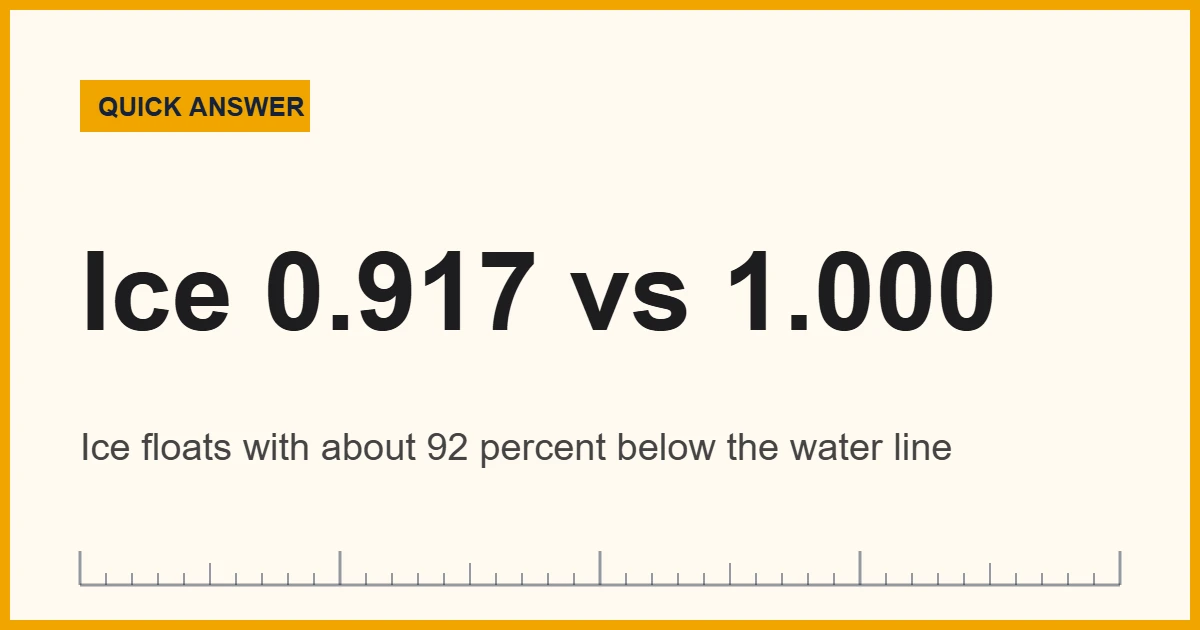
The easiest ice density experiment for a child is to drop an ice cube into a clear glass of water and watch it float. Ice has a density of about 0.917 g/cm3, while liquid water is about 1.000 g/cm3. So ice is roughly 8 percent less dense, and about 92 percent of the cube sits below the surface.
Kids love a question with a surprise answer. Most solids are denser than their own liquid, so a chunk of frozen candle wax or butter sinks in its melted form. Water breaks that rule, because solid water is less dense than liquid water. When it freezes, it takes up more room, and the same amount of stuff spread over more space is lighter for its size.
You can run this ice density experiment with things already in your kitchen: a clear glass, a few ice cubes, a plastic cup, a marker, a ruler and a kitchen scale. No special chemicals are needed. Also, every test on this page is safe for young children with an adult nearby, and most take less than five minutes of hands-on time.
In short: the same water takes up about 9 percent more space as ice, so a cup of ice weighs less than a cup of water. As a result, ice floats, lakes freeze from the top down, and a sealed bottle of water can crack in the freezer.
What the Science Says About Solid and Liquid Water
The US Geological Survey explains that freezing water molecules line up in a regular lattice and spread farther apart, which is why ice is less dense than liquid water. Similarly, the University of Illinois Physics Van lists 0.9167 g/cm3 for ice and 0.9998 g/cm3 for water at 0 degrees C.
Below, you will find a converter for the numbers, a step-by-step classic test, four bonus tests, and a kid-friendly way to explain the science.
Compare Ice and Water Density in Any Unit
First, type a density and choose its unit. For example, enter 0.917 in g/cm3 for ice, then try 1.000 for water. The converter shows the same value in kg/m3, g/mL, lb/ft3 and pounds per US gallon, so older kids can compare metric and US numbers.
Recommended Tools for an Ice Density Experiment
You can run the floating test with just a glass. However, a few simple tools turn it into real measuring. A kitchen scale proves the mass stays the same, and a clear measuring cup or graduated cylinder shows the volume change. Meanwhile, a flexible ice tray makes cubes that pop out cleanly. Finally, a beginner science set gives curious kids more density tests to try.



As an Amazon Associate, Measuring Expert earns from qualifying purchases.
- Ice is about 0.917 g/cm3; liquid water is about 1.000 g/cm3.
- Freezing makes water expand by about 9 percent, while its mass stays the same.
- About 92 percent of a floating ice cube hides under the water line.
- A marked cup in the freezer shows the expansion with a ruler.
- Ice floats higher in salt water and may sink in cooking oil.
- Never freeze water in a sealed glass jar or bottle.
Ice vs Liquid Water: The Numbers Side by Side
Density is mass divided by volume. So if two things weigh the same but one takes up more room, that one is less dense. Here is how ice and water compare, rounded for the kitchen.
| Property | Ice (0 °C, 32 °F) | Liquid water |
|---|---|---|
| Density | 0.917 g/cm3 (917 kg/m3) | 0.9998 g/cm3 at 0 °C; 0.9982 at 20 °C (68 °F) |
| US units | 57.2 lb/ft3; 7.65 lb per US gallon | 62.3 lb/ft3; 8.33 lb per US gallon at 20 °C |
| A 1-inch cube weighs | About 15.0 g (0.53 oz) | About 16.4 g (0.58 oz) |
| Volume of 100 g | About 109 mL | About 100 mL |
| 1 US cup of water, frozen | About 258 mL (1.09 cups) | 236.6 mL (1 cup) |
| Share of a floating cube below the surface | About 92 percent in fresh water; about 89 percent in seawater | |
For more detail on how water itself changes with temperature, see how dense water is at different temperatures. Water is densest at about 4 degrees C (39 degrees F), at about 0.99997 g/cm3.
How to Run the Classic Ice Density Experiment Step by Step
This version combines the floating test with the freezer test. It takes about 10 minutes of hands-on time, plus a night in the freezer. Kids from about age 5 can do most of it, and you can handle the marker and ruler for younger ones.
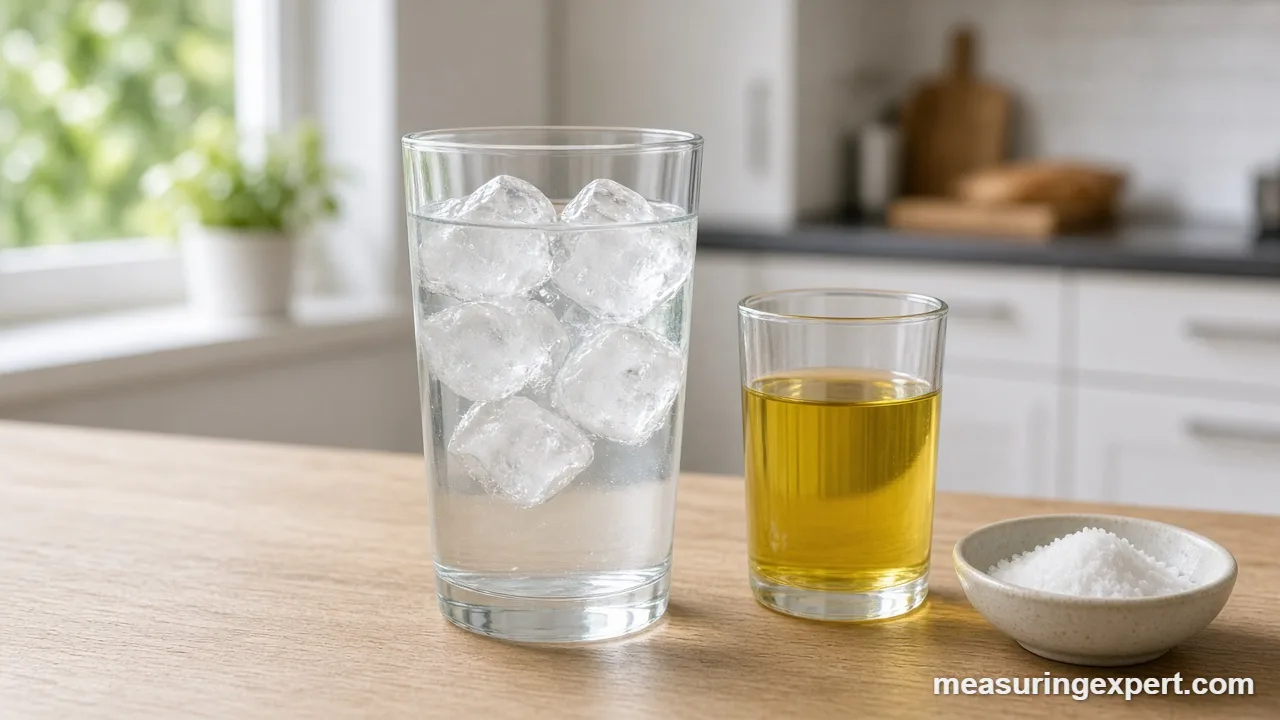
- Fill a clear glass with tap water. First, leave about an inch of space at the top so nothing spills.
- Ask for a prediction. Next, have your child guess whether an ice cube will sink or float, and write the guess down.
- Drop in one ice cube. Then look from the side at eye level. Most of the cube sits under the water, and only a small cap pokes out.
- Fill a straight-sided plastic cup halfway. After that, mark the water line on the outside with a marker.
- Measure the water height with a ruler. For example, write down 6.0 cm or 2 3/8 inches.
- Freeze the cup overnight. Set it level in the freezer, with no lid.
- Measure the ice height the next day. Finally, compare it with the mark. The ice usually sits about 9 to 10 percent higher, so 6.0 cm of water becomes roughly 6.5 cm of ice.
That rise is the whole ice density experiment in one line. The water did not gain any mass, because nothing went into the cup. Instead, the same water now fills more space, so its density dropped.
Four More Kitchen Tests That Show Ice Is Lighter
Once the classic ice density experiment clicks, these bonus tests add a scale, a measuring cup and a few pantry liquids. Each one shows the same idea from a new angle, so pick the ones that fit your child’s age.
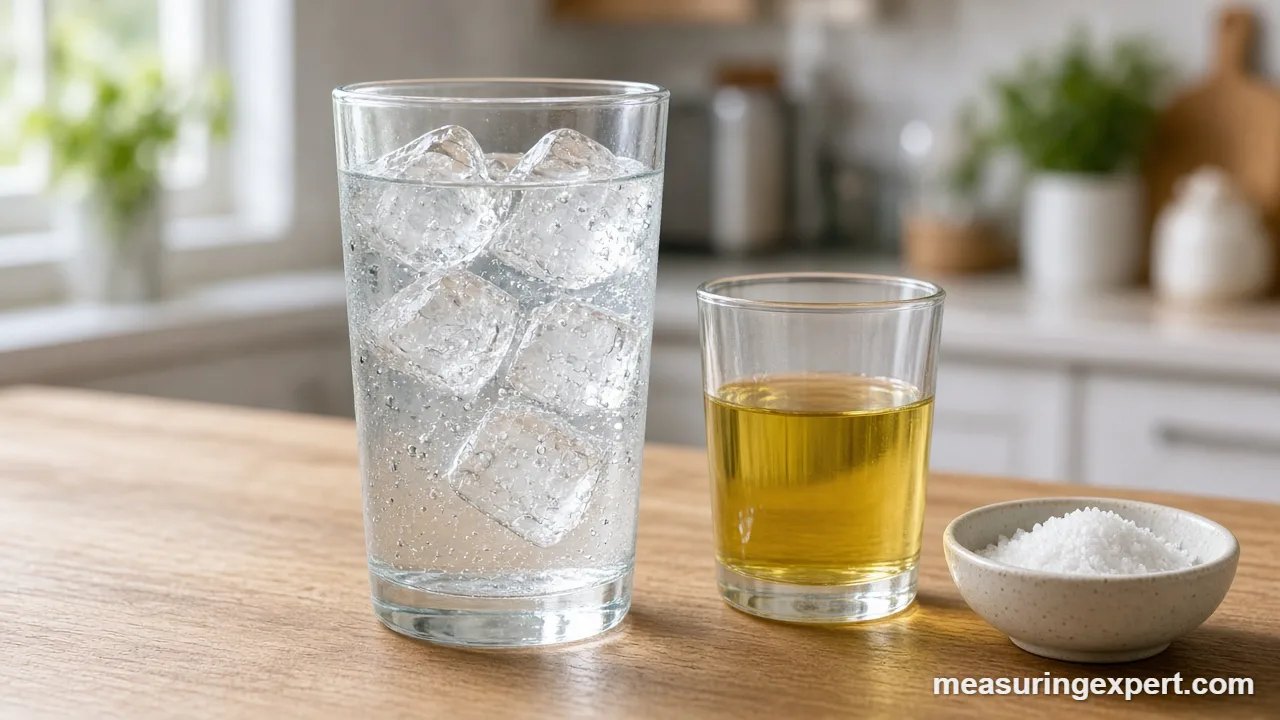
Ice density experiment with a kitchen scale (ages 7+)
Put a small plastic container on a kitchen scale and press tare. Add 100 g of water, then freeze it. Next day, weigh it again. The scale still reads about 100 g, because freezing does not change mass. However, the ice now fills about 109 mL instead of 100 mL. As a result, its density is about 100 / 109 = 0.917 g per mL.
Measure an ice cube by displacement (ages 9+)
Fill a clear measuring cup or graduated cylinder to a set line with very cold water. Then push a weighed ice cube fully under with a thin skewer, and read the new level quickly. The rise equals the cube’s volume. Divide its mass by that volume, and you get close to 0.92 g/cm3. Our guide to measuring the volume of an irregular object explains this water displacement method in more detail.
Ice density experiment with salt water (ages 4+)
Stir 3 to 4 tablespoons of salt into a glass of warm water until it dissolves, then let it cool. Put one ice cube in fresh water and one in the salt water. The cube in salt water rides a little higher, because salt water is denser. Seawater, at about 1.025 g/cm3, holds an iceberg with about 11 percent above the surface.
Watch melting ice in a glass of oil (ages 5+)
Pour about 2 inches of water into a tall glass, then add 2 inches of vegetable oil on top. Drop in an ice cube colored with a drop of food coloring. Because most cooking oils are about 0.91 to 0.93 g/cm3, the cube floats low or drifts down slowly. Then, as it melts, colored water drops sink through the oil and join the water below.
Why Ice Is Less Dense: How to Explain It to a Child
Water molecules are tiny, and in liquid water they tumble around and bump close together. When water freezes, however, each molecule links to four neighbors in a six-sided pattern. That pattern has open space built into it, so the molecules end up farther apart.
For a young child, try this picture. A crowd of kids running around a playground can squeeze close together. But if they all join hands in a big ring, they suddenly need more room. Ice is the “holding hands” version of water.
Older kids can connect it to density math. For instance, 1 cm3 of ice holds 0.917 g of water, while 1 cm3 of liquid water holds about 1.000 g. So ice packs about 8 percent less water into the same space. Therefore, the liquid pushes up on the ice more strongly than gravity pulls it down, and the ice floats.
This matters in nature too. Because ice floats, ponds freeze at the top first. The ice layer then shields the water below, so fish survive the winter in the liquid water near the bottom.
Float, Sink or Hover? Ice in Other Kitchen Liquids
Here is a quick guide for planning a comparison test. Densities are typical room-temperature values, so your results may differ a little.
| Liquid | Typical density (g/cm3) | What an ice cube (0.917) does | Kid-safe? |
|---|---|---|---|
| Fresh tap water | 0.998 | Floats, about 92% under | Yes |
| Salt water (strong) | about 1.03 to 1.10 | Floats higher | Yes |
| Sugar syrup | about 1.2 to 1.3 | Floats high, melts fast | Yes, sticky |
| Vegetable oil | about 0.91 to 0.93 | Hovers, floats low or sinks slowly | Yes, with care |
| Rubbing alcohol (91% or more) | about 0.79 to 0.80 | Sinks | Adult demo only |
Do and Don’t for Kitchen Ice Tests
Do
- Use clear plastic cups so little hands can’t break glass.
- Mark the water line before freezing.
- Let your child predict first, then test.
- Measure at eye level for an honest reading.
- Write results in a small notebook or chart.
Don’t
- Freeze water in a sealed glass jar or bottle.
- Let young kids handle rubbing alcohol.
- Read the ice height from above at an angle.
- Fill freezer cups to the brim; leave room to grow.
- Expect perfect numbers from cloudy, bubbly cubes.
Honest Limits of a Kitchen Ice Density Experiment
Home ice is not lab ice. For one thing, tap water carries dissolved air, which forms bubbles as it freezes. Those bubbles make cloudy cubes a little less dense than 0.917 g/cm3. Also, the top of frozen water often bulges or forms a small spike, so ruler readings can vary by a few millimeters.
In addition, a kitchen scale that reads to 1 g gives rough density values for a single small cube. A 15 g cube read as 14 g or 16 g shifts the answer by about 7 percent. So weigh several cubes together, or freeze a bigger block, for better numbers. Finally, very cold ice from a deep freezer is slightly denser than ice at 0 degrees C, but the difference is under 1 percent.
When to Call a Professional
The same 9 percent expansion that lifts ice in a cup can split metal pipes. If a water pipe in your home freezes, shut off the main water valve and call a licensed plumber rather than thawing it with an open flame. Likewise, for a graded science fair project, ask the teacher which method and units the judges expect.
Frequently Asked Questions
What is the simplest ice density experiment for a toddler?
Drop an ice cube into a clear cup of water and ask whether it sank or floated. Toddlers can watch and point, while you name the idea: ice is lighter than the same amount of water.
What is the density of ice compared with water?
Ice is about 0.917 g/cm3 and liquid water is about 1.000 g/cm3. In US units, that is about 57.2 lb/ft3 for ice and about 62.4 lb/ft3 for water.
How much does water expand when it freezes?
About 9 percent by volume. For example, 100 mL of water becomes about 109 mL of ice, and 1 US cup becomes about 1.09 cups.
Does water weigh less when it turns to ice?
No. The mass stays the same, so 100 g of water makes 100 g of ice. Only the volume grows, which is why the density drops.
How long does the freezer ice density experiment take?
About 10 minutes of setup and measuring, plus 4 to 8 hours of freezing. Leaving the cup overnight is the easiest way to be sure it froze all the way through.
Why does most of an ice cube stay under water?
A floating object sinks until it pushes aside its own weight of water. Ice is about 92 percent as dense as water, so about 92 percent of the cube sits below the surface.
Can I do an ice density experiment with oil?
Yes. Layer vegetable oil over water and add a colored ice cube. The cube floats low or sinks slowly in the oil, and melted drops fall through to the water layer.
Why does ice sink in rubbing alcohol?
Strong rubbing alcohol is only about 0.79 to 0.80 g/cm3, which is less dense than ice. Keep this one as an adult-only demo, because the alcohol is flammable and toxic.
What age is the ice density experiment best for?
The floating test works from about age 3. Marking and measuring suits ages 5 to 8, and calculating density with a scale suits ages 9 and up.
Why do lakes freeze from the top down?
Ice is less dense than water, so it forms and stays at the surface. The ice layer then insulates the water below, which helps fish survive the winter.
The Bottom Line on the Ice Density Experiment
To sum up, ice has a density of about 0.917 g/cm3 against about 1.000 g/cm3 for liquid water. That 8 percent gap is why an ice cube floats with most of its body under the surface, and why a cup of water rises about 9 percent when it freezes.
So start with the floating cube, then mark a cup and freeze it overnight. Add the scale or the salt water test when your child wants more, and use the converter above to turn the numbers into any unit.
1 thought on “How to Demonstrate to a Child That Solid Water Is Less Dense Than Liquid Water: 5 Kitchen Tests”