

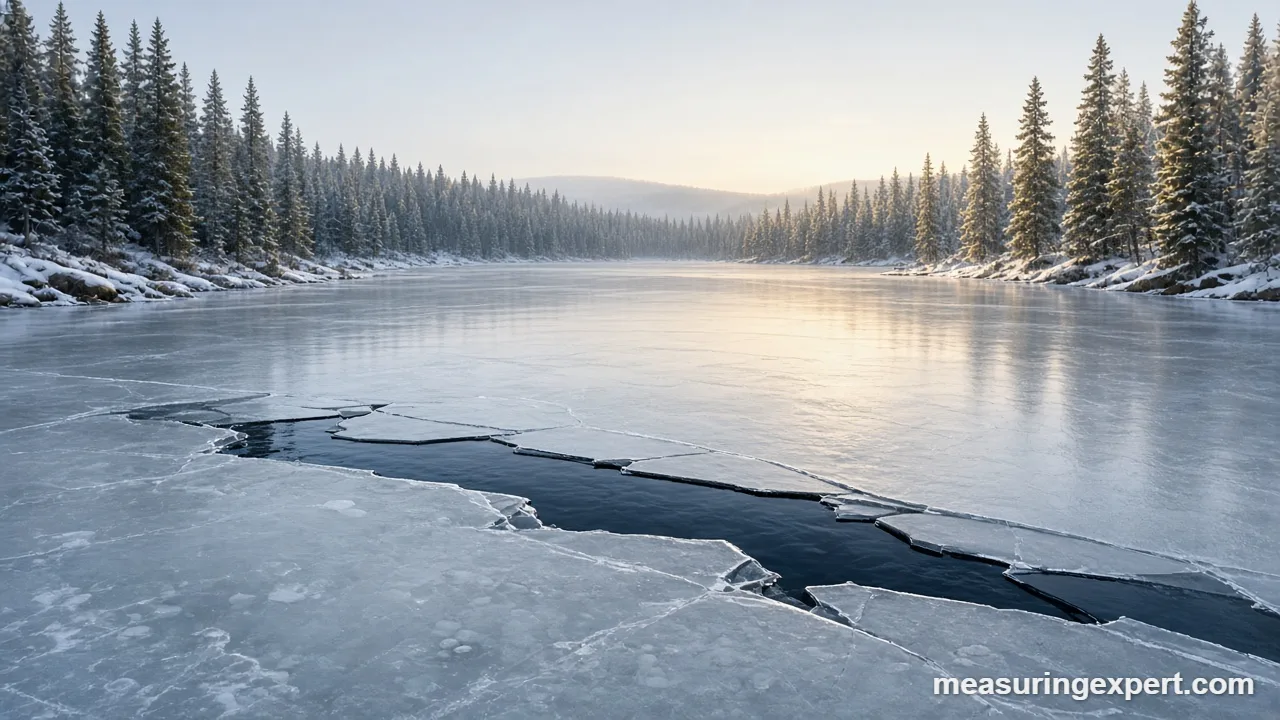
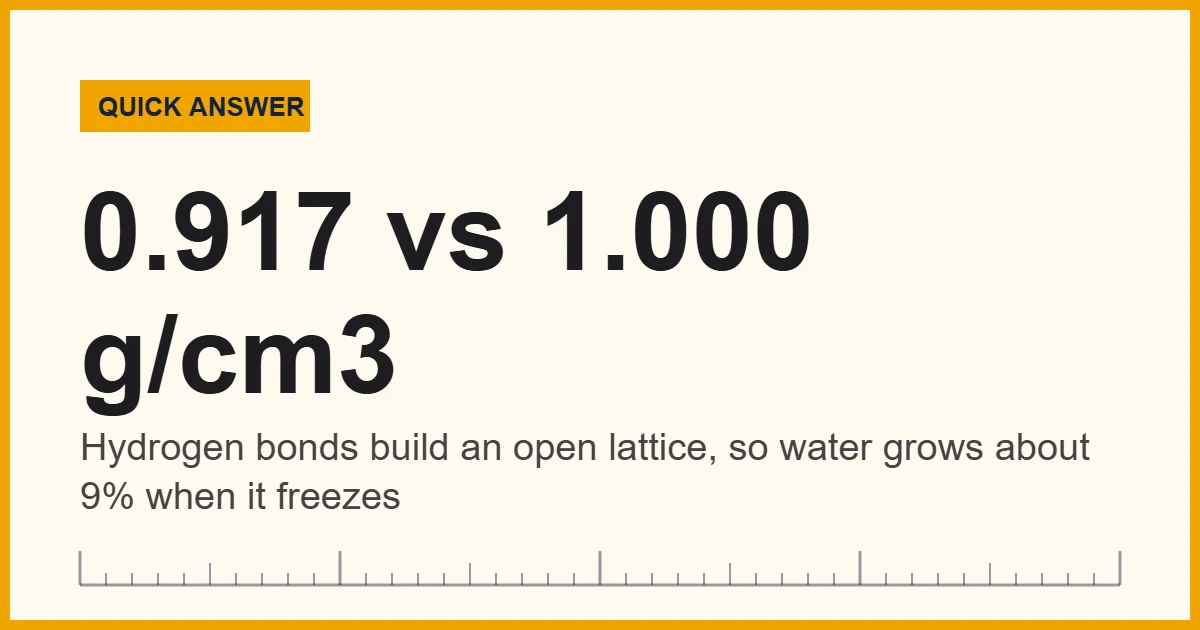
Why is ice less dense than water? When water freezes, hydrogen bonds lock each molecule to four neighbors in an open hexagonal lattice called ice Ih. That lattice holds molecules farther apart, so ice weighs about 0.9167 g/cm3 against 0.9998 g/cm3 for water at 0 C, and the same water takes up about 9% more space.
Almost every substance shrinks when it freezes. Solid wax sinks in melted wax, and a frozen block of olive oil sinks in liquid oil. Water does the opposite, and that one quirk shapes winter lakes, burst pipes, potholes and the way icebergs ride in the sea. So the question is not just a trivia point. Instead, it is one of the most important facts in physical chemistry.
This page is the science explainer: what happens to water molecules as they freeze, how big the density gap really is, why liquid water is densest near 4 C (39 F), and what that means for lakes and oceans. If you want hands-on tests for kids instead, see our kitchen ice density experiment with five safe activities.
In short: ice is less dense than water because freezing trades a crowded, constantly shifting liquid for a rigid, roomy crystal. The mass stays the same, while the volume grows, so the density falls by roughly 8 percent.
What Science Agencies Say About Ice and Water
The US Geological Survey puts it plainly in its Water Science School page on water density: ice density drops by about 9 percent on freezing, and water at about 4 C is denser than water at 0 C. As a result, cold water near the freezing point floats on slightly warmer water, which is why lakes freeze from the top.
Below, you will find a density converter, the numbers side by side, the molecular explanation, and finally the real-world effects, from fish under the ice to the 90 percent of an iceberg that sits below the waterline.
Convert Ice and Water Density to Any Unit
The converter starts at 0.9167 g/cm3, the usual figure for pure ice at 0 C. Type 0.9998 to see liquid water at the same temperature, or enter any other density and read it in kg/m3, pounds per cubic foot and pounds per gallon.
Recommended Tools for Measuring Ice and Water Density
To measure density yourself, you need two numbers: mass and volume. First, a 0.01 g scale weighs a small ice cube or a water sample precisely. Next, glass graduated cylinders give you volume by displacement. Finally, a thermometer matters more than most people expect, because water density changes with temperature.




As an Amazon Associate, Measuring Expert earns from qualifying purchases.
Key Takeaways
- Pure ice at 0 C has a density of about 0.9167 g/cm3 (57.2 lb/ft3).
- Liquid water at 0 C is about 0.9998 g/cm3 (62.4 lb/ft3).
- Freezing expands water by about 9%, so 1 liter of water becomes about 1.09 liters of ice.
- Hydrogen bonds hold ice in an open hexagonal lattice called ice Ih.
- Liquid water is densest at about 4 C (39 F), not at its freezing point.
- That 4 C peak is why lakes freeze from the top and stay liquid underneath.
- About 92% of a floating ice cube sits below the surface in fresh water.
What Makes Ice Less Dense: Hydrogen Bonds
A water molecule (H2O) is bent, with the oxygen atom at the corner and the two hydrogen atoms at an angle of about 104.5 degrees. Oxygen pulls electrons toward itself, so it carries a slight negative charge, while each hydrogen carries a slight positive charge. Because of this polarity, the hydrogen of one molecule is attracted to the oxygen of the next. That attraction is a hydrogen bond.
In liquid water, these bonds form and break trillions of times per second. Molecules tumble past each other, and many sit in irregular, partly bonded clusters. As a result, the liquid can pack some molecules into gaps that a perfect crystal would leave empty. On average, a molecule in cold liquid water has slightly more than four close neighbors.
When water freezes, however, the motion slows enough for every molecule to settle into four hydrogen bonds at fixed angles. Each molecule donates two bonds through its hydrogens and accepts two through its oxygen. The four bonds point toward the corners of a tetrahedron, about 109.5 degrees apart. Therefore, the molecules can no longer crowd into the gaps. That rigid geometry is exactly what makes ice less dense than the liquid it came from.
Inside Hexagonal Ice Ih: The Open Lattice
Ordinary ice, the kind in your freezer, on lakes and in snowflakes, is called ice Ih. The “I” means it is the first phase of ice scientists described, and the “h” stands for hexagonal. Its oxygen atoms form puckered sheets of six-sided rings, stacked so that the rings line up into open channels running through the crystal.
The spacing between bonded oxygen atoms is about 0.276 nanometers, and it stays almost constant through the crystal. Meanwhile, the hollow centers of the rings stay empty. Those channels are the “missing” mass that lowers the density. In addition, the hexagonal symmetry is why snowflakes grow with six arms.
| Feature | Liquid water near 0 C | Ice Ih at 0 C |
|---|---|---|
| Hydrogen bonds per molecule | Fewer than 4 on average, constantly changing | Exactly 4, fixed |
| Arrangement | Disordered, partly bonded clusters | Ordered hexagonal rings with open channels |
| Close neighbors | Slightly more than 4 on average | 4 |
| Density | 0.9998 g/cm3 | about 0.9167 g/cm3 |
| Volume of 1 kg | about 1.000 L | about 1.091 L |
How Much Is Ice Less Dense Than Water? The Numbers
Pure, bubble-free ice at 0 C has a density of about 0.9167 g/cm3. Published sources range from about 0.916 to 0.917, depending on the measurement method. Liquid water at the same temperature is 0.99984 g/cm3, which rounds to 0.9998. So ice has about 91.7% of the density of water, or roughly 8.3% less.
Seen from the other side, the same mass of ice takes up 0.99984 / 0.9167 = 1.0907 times the volume of the water it came from. In other words, water expands by about 9% when it freezes. For example, a 16.9 fl oz bottle of water becomes about 18.4 fl oz of ice, and 1 US cup (236.6 mL) of water becomes about 258 mL of ice.
| Quantity | Ice Ih (0 C) | Liquid water (0 C) |
|---|---|---|
| g/cm3 (same as g/mL) | 0.9167 | 0.9998 |
| kg/m3 | 916.7 | 999.8 |
| lb/ft3 | 57.23 | 62.42 |
| lb/US gal | 7.650 | 8.344 |
| Volume of 1 L of water after freezing | 1.091 L | 1.000 L |
Ice also gets slightly denser as it gets colder. According to the Engineering ToolBox ice property table, ice is about 921.6 kg/m3 at -50 C and about 925.7 kg/m3 at -100 C. Even so, that is still far below liquid water, so ice floats at any freezer or polar temperature. For the full temperature table of the liquid, see how dense water is.
Water Density From 0 to 100 C: The 4 C Peak
Most liquids get steadily denser as they cool. Water does too, but only down to about 4 C (39.2 F). Below that point, the molecules start forming more ice-like, open hydrogen-bonded patterns, even though the water is still liquid. Consequently, water between 4 C and 0 C actually expands a little as it cools.
| Temperature | Density (g/cm3) | Density (lb/ft3) |
|---|---|---|
| 0 C (32 F), liquid | 0.99984 | 62.42 |
| 4 C (39.2 F), maximum | 0.99997 | 62.43 |
| 10 C (50 F) | 0.99970 | 62.41 |
| 20 C (68 F) | 0.99821 | 62.32 |
| 25 C (77 F) | 0.99705 | 62.24 |
| 30 C (86 F) | 0.99565 | 62.16 |
| 100 C (212 F) | 0.95835 | 59.83 |
| Ice at 0 C, for comparison | 0.9167 | 57.23 |
The change from 4 C to 0 C is tiny, only about 0.013%. However, the jump at freezing is about 8%, more than 600 times bigger. That contrast shows how much the crystal structure matters compared with ordinary thermal expansion.
Why Lakes Freeze From the Top Down
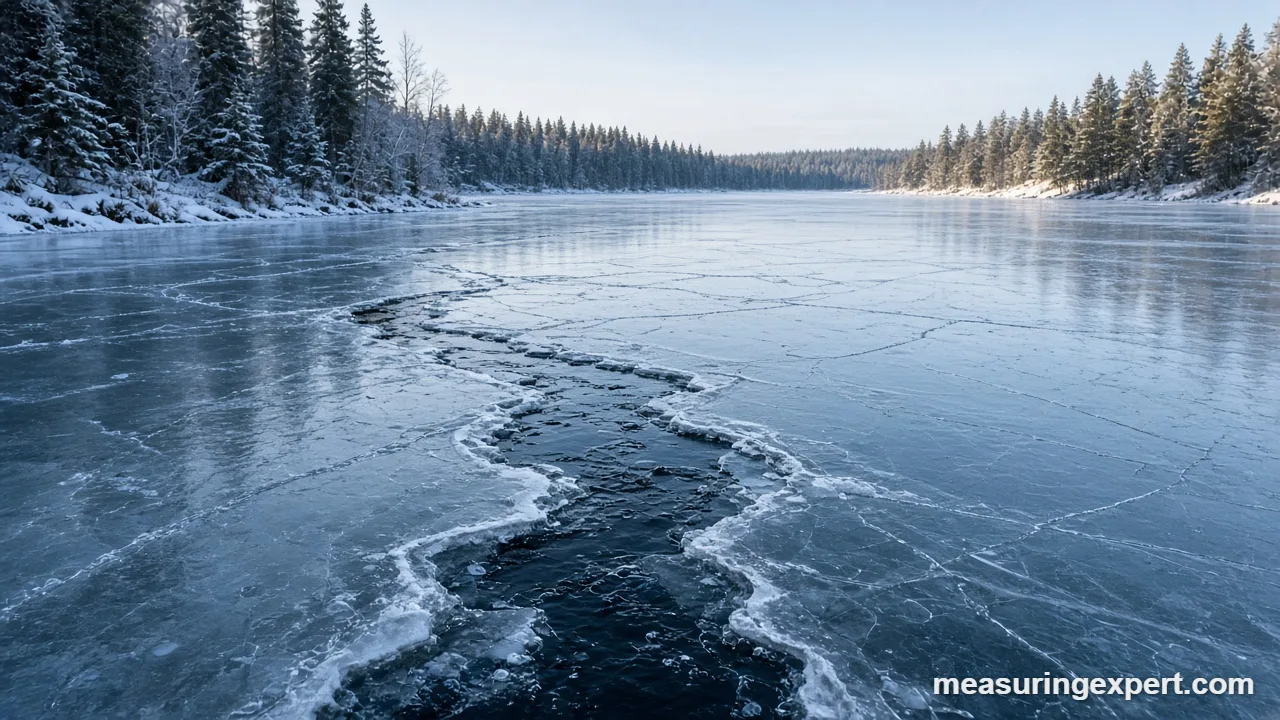
In autumn, the surface of a lake cools first. Because cooler water is denser, it sinks, and warmer water rises to take its place. This mixing, called fall turnover, continues until the whole lake reaches about 4 C.
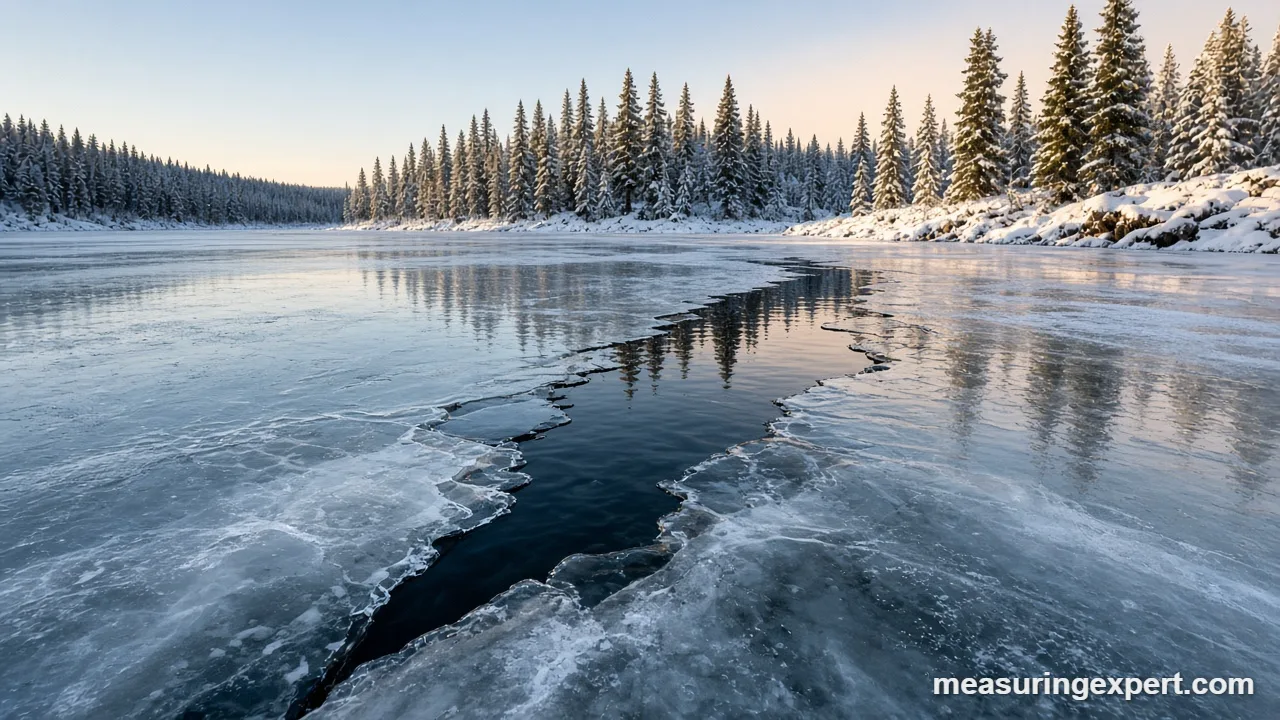
After that, the pattern flips. Surface water that cools below 4 C becomes lighter, so it stays on top instead of sinking. Next, that cold surface layer freezes, and the ice floats because ice is less dense still. The ice and any snow on it then insulate the water below. As a result, the bottom of a deep lake usually stays near 4 C all winter, and fish, plants and insect larvae survive.
If ice sank, each new layer would drop to the bottom, away from the sun. Over time, many lakes would fill with ice from the bottom up and might never fully thaw in summer. The USGS makes the same point: if water were densest at its freezing point, lakes could freeze from the bottom.
How to Measure Ice Density Yourself
You can check the textbook figure with a scale and a graduated cylinder. Expect about 0.90 to 0.92 g/cm3; trapped air in freezer ice pulls the number down. For a version built for children, use the step-by-step ice experiment for kids.
- Make clear ice. Boil and cool the water first, or freeze it slowly in an insulated cup, so fewer air bubbles get trapped.
- Weigh the cube. Tare a 0.01 g scale, set the cube on a small dish, and record its mass in grams quickly before it melts.
- Chill the cylinder water. Fill a graduated cylinder partway with ice-cold water so the cube melts slowly, and read the level at the bottom of the curve.
- Push the cube under. Hold the cube just below the surface with a thin wire or skewer, then read the new level right away.
- Find the volume. Subtract the first reading from the second; the difference in mL equals the cube’s volume in cm3.
- Divide mass by volume. Then enter the result in the converter above to see it in pounds per cubic foot or other units.
Is Ice Less Dense in Salt Water? Icebergs and Sea Ice
Yes, and by an even wider margin. Typical seawater is about 1.025 g/cm3, so pure ice floats higher in the ocean than in a lake. A floating object sinks until it displaces its own weight of liquid. Therefore, the fraction under water equals the ice density divided by the liquid density.
| Liquid | Density (g/cm3) | Share of pure ice below the surface |
|---|---|---|
| Fresh water at 0 C | 0.9998 | about 92% |
| Typical seawater | about 1.025 | about 89% |
| Vegetable oil | about 0.92 | about 100% (hovers or sinks slowly) |
| Rubbing alcohol (isopropyl) | about 0.79 | sinks |
That is where the phrase “tip of the iceberg” comes from: roughly nine-tenths of an iceberg is hidden. Real icebergs contain air bubbles from compressed snow, so they often float a little higher than the table suggests. In addition, sea ice that forms from seawater pushes most of the salt out as it freezes, leaving pockets of brine. For more on oils, see how dense oil is.
Can Ice Be Denser Than Water? Other Exceptions
Water is not the only substance that expands on freezing. Silicon, germanium, gallium and bismuth also do it, which is why a solid lump of gallium floats on liquid gallium. Even so, water is by far the most common example, and it is the only one that matters for weather and life.
Also, not every form of ice floats. Scientists have identified about 20 crystal phases of ice. Forms such as ice III, ice V and ice VI only exist at pressures thousands of times higher than the atmosphere, for instance deep inside icy moons. These high-pressure ices pack molecules more tightly, so they are denser than liquid water and would sink in it.
A related effect shows up on skates and glaciers. Because ice takes more space than water, squeezing it pushes it slightly toward melting. Pressure lowers the melting point by only about 0.0074 C per atmosphere, however, so it is not the main reason skates glide.
Do and Don’t: Living With Expanding Ice
Do
- Leave about 10% headspace when freezing liquids in jars.
- Insulate exposed pipes and drain outdoor hoses before frost.
- Let a faucet drip during hard freezes if your plumber advises it.
- Use freezer-safe containers with straight sides.
- Note the temperature when you measure water density.
Don’t
- Freeze full glass bottles or sealed cans of soda.
- Assume all ice floats the same; bubbles and salt change it.
- Walk on lake ice based on appearance alone.
- Pour water on a frozen car windshield to defrost it.
- Round water to exactly 1 g/cm3 for precise lab work.
Honest Limits of the Ice Less Dense Rule
The 0.9167 g/cm3 figure describes pure, bubble-free ice Ih at 0 C and normal pressure. Real ice rarely matches it. For example, cloudy freezer cubes, snow and glacier ice hold air, so their bulk density is lower. Sea ice holds brine, so its density varies. Also, the 9% expansion figure assumes pure water; salty or sugary liquids freeze differently and less completely.
Finally, the explanation on this page is simplified. Scientists still study exactly how many hydrogen bonds liquid water forms at each temperature, and models differ on the details. The core idea, an open crystal versus a denser, disordered liquid, is well established, however.
When to Call a Professional
Freezing expansion causes real damage. If a pipe has frozen, call a licensed plumber rather than thawing it with an open flame. Similarly, if frost heave is cracking a foundation, slab or retaining wall, a structural engineer can judge the risk. For lab-grade density values, a calibration lab or an accredited testing service is the right source.
Frequently Asked Questions
Why is ice less dense than water?
When water freezes, hydrogen bonds lock each molecule to four neighbors in an open hexagonal lattice. The molecules end up farther apart than in the liquid, so the same mass fills about 9% more space.
What is the density of ice?
Pure ice at 0 C is about 0.9167 g/cm3, or 916.7 kg/m3 and 57.23 lb/ft3. Ice with trapped air bubbles is lighter.
How much does water expand when it freezes?
About 9%. One liter of water becomes about 1.09 liters of ice, because 0.9998 divided by 0.9167 is about 1.091.
At what temperature is water densest?
Liquid water is densest at about 4 C (39.2 F), where it reaches 0.99997 g/cm3. It expands slightly as it cools from there to 0 C.
Is ice less dense in every liquid?
No. Ice floats in water and seawater, but it sinks in rubbing alcohol and hovers or sinks slowly in many vegetable oils, which are about as dense as ice.
Why do lakes freeze from the top down?
Water colder than 4 C is lighter than 4 C water, so it stays at the surface and freezes there. The floating ice then insulates the water below.
Does ice weigh less than the water it came from?
No. Freezing does not change mass, so 100 g of water makes 100 g of ice. Only the volume grows, which lowers the density.
Why is ice less dense than water but most solids are denser?
Most solids pack molecules more tightly than their liquids. Water is unusual because its hydrogen bonds force a fixed, open geometry that leaves empty channels in the crystal.
How much of an iceberg is under water?
About 89% of pure ice sits below the surface in typical seawater. Real icebergs contain air, so they often float slightly higher.
Is all ice less dense than liquid water?
No. Ordinary ice Ih is, but high-pressure forms such as ice III, V and VI are denser than liquid water. They only form at extreme pressures.
Ice Less Dense Than Water: The Bottom Line
To sum up, ice is less dense than water because hydrogen bonds hold frozen molecules in an open hexagonal lattice. Pure ice weighs about 0.9167 g/cm3 against 0.9998 g/cm3 for water at 0 C, so freezing makes water about 9% bigger, and ice floats with roughly nine-tenths below the surface.
Because liquid water is densest near 4 C, lakes freeze from the top and shelter life underneath. Meanwhile, the same expansion splits pipes and lifts roads. Use the converter above to compare any density in metric or US units, and try the kids’ experiment linked earlier to see the effect in a glass.