

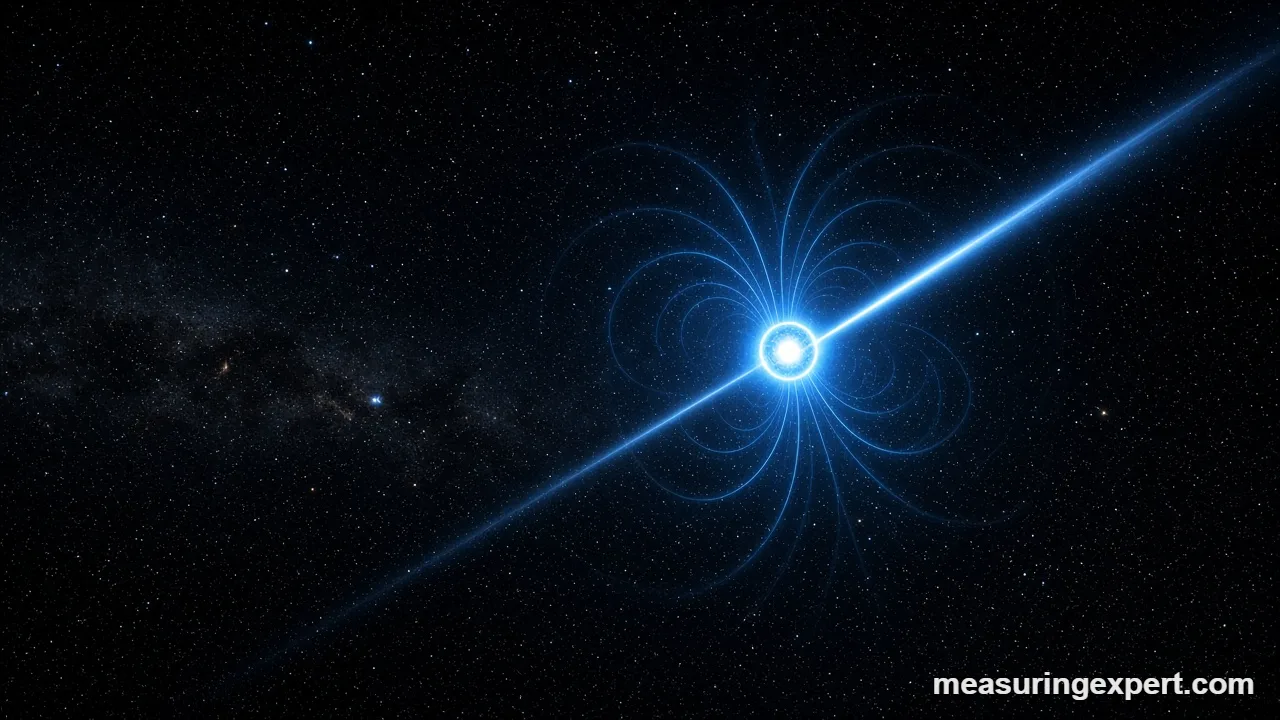
Neutron star density averages about 4 x 10^17 to 5 x 10^17 kg/m3 (roughly 4.4 x 10^14 g/cm3) for a typical star of 1.4 solar masses with an 11 to 12 km radius. That is a little above nuclear density, so one teaspoon would weigh about 2 billion metric tons (2.4 billion US tons).
Convert Neutron Star Density to Other Units
First, the converter starts at 4.37 x 10^17 kg/m3, the average for a 1.4 solar-mass star with an 11.5 km radius. Type any other value, for example 3.85e17 for a 12 km star, and pick your unit. It then shows the same density in grams per cubic centimeter, pounds per cubic foot and pounds per cubic inch.
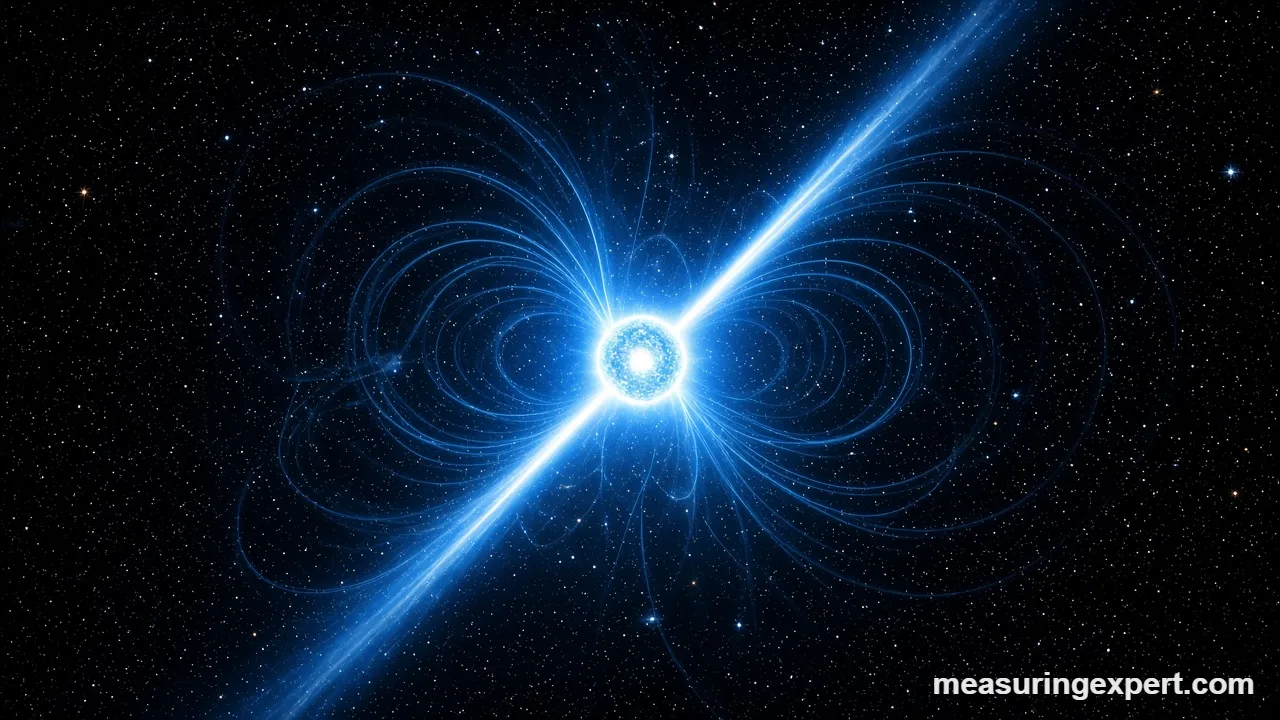
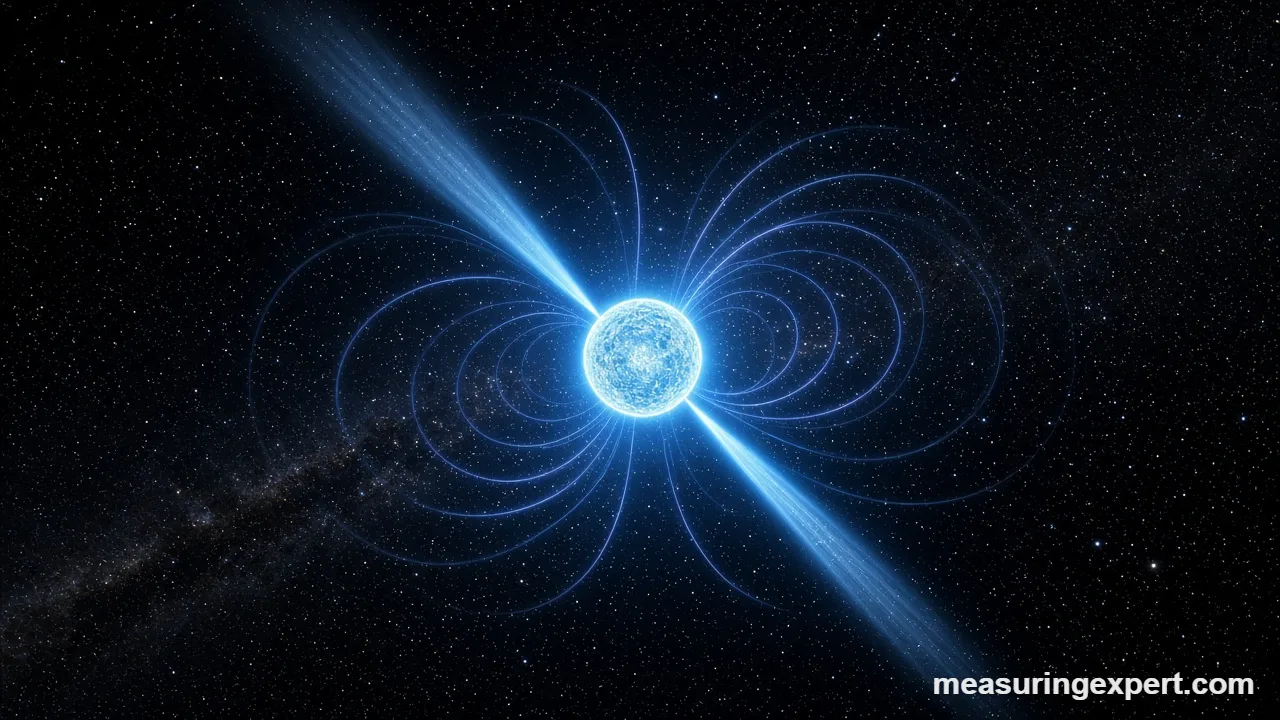
A neutron star is the collapsed core of a massive star that ended in a supernova. Then gravity squeezed the core so hard that electrons and protons merged into neutrons. As a result, the leftover object packs more mass than the Sun into a ball about 12 miles (20 km) across, the size of a city.
NASA, for example, describes that scale vividly. In its overview of the NICER mission, the agency says a teaspoon of neutron star matter would weigh about a billion tons on Earth. Our own math below lands on the same order of magnitude, about 2 billion metric tons.
In fact, density itself is simple: mass divided by volume. So the only hard part is knowing the mass and radius. Fortunately, astronomers now measure both for a few stars. Below, you will find the step-by-step math, a unit chart, a comparison with white dwarfs and black holes, and finally the limits of every figure.
Neutron Star Density: The Math Behind the Number
First, take a typical star of 1.4 solar masses. Because one solar mass is about 1.988 x 10^30 kg, so the star holds about 2.78 x 10^30 kg. Next, take a radius of 11.5 km. Then, the volume of a sphere is 4/3 x pi x r^3, which gives about 6.37 x 10^12 cubic meters, or roughly 6,370 cubic kilometers.
density = M / (4/3 x pi x R^3) = 2.78 x 10^30 kg / 6.37 x 10^12 m3 = 4.37 x 10^17 kg/m3
However, radius matters a lot, because volume grows with the cube of the radius. As a result, a star only 1 km smaller is noticeably denser. The table below shows how the average changes across realistic sizes.
| Mass | Radius | Average density (kg/m3) | Average density (g/cm3) |
|---|---|---|---|
| 1.4 solar masses | 10 km (6.2 mi) | 6.65 x 10^17 | 6.65 x 10^14 |
| 1.4 solar masses | 11 km (6.8 mi) | 4.99 x 10^17 | 4.99 x 10^14 |
| 1.4 solar masses | 11.5 km (7.1 mi) | 4.37 x 10^17 | 4.37 x 10^14 |
| 1.4 solar masses | 12 km (7.5 mi) | 3.85 x 10^17 | 3.85 x 10^14 |
| 1.4 solar masses | 13 km (8.1 mi) | 3.03 x 10^17 | 3.03 x 10^14 |
| 2.0 solar masses | 12 km (7.5 mi) | 5.49 x 10^17 | 5.49 x 10^14 |
In short, a heavy star of 2 solar masses still has a radius near 12 km. Therefore its average climbs to about 5.5 x 10^17 kg/m3, and the full realistic range runs from about 3 x 10^17 to 6 x 10^17 kg/m3.
Neutron Star Density in Every Unit
In practice, scientists use kg/m3, chemists prefer g/cm3, and US engineers often think in pounds per cubic foot. So here is the same 11.5 km example in each, together with familiar materials for scale.
| Unit | Neutron star (1.4 solar masses, 11.5 km) | Times denser than water |
|---|---|---|
| kg/m3 | 4.37 x 10^17 | about 4.4 x 10^14 (440 trillion) |
| g/cm3 (same as g/mL) | 4.37 x 10^14 | |
| kg/L | 4.37 x 10^14 | |
| lb/ft3 | 2.73 x 10^16 | |
| lb/in3 | 1.58 x 10^13 |
For comparison, water is 1,000 kg/m3, lead is about 11,340 kg/m3, and Earth averages about 5,513 kg/m3. Similarly, you can read how dense Earth is to see why our planet is the densest one in the solar system. By contrast, a neutron star is about 79 trillion times denser than Earth.
Recommended Tools for Measuring Density at Home
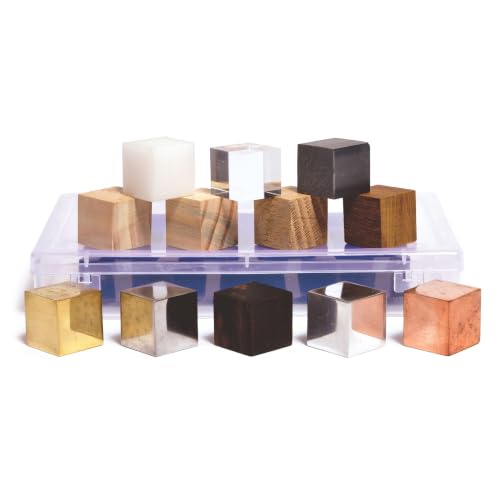
Of course, you cannot weigh a star, but the same mass-over-volume method works on your desk. First, a density cube set gives you known samples to practice on. Next, a glass graduated cylinder measures volume by water displacement. Finally, a 0.01 g pocket scale handles the mass side, so you can check a result against a reference table.


As an Amazon Associate, Measuring Expert earns from qualifying purchases.
How Much Does a Teaspoon of Neutron Star Weigh?
A US teaspoon holds 4.929 mL, which is 4.929 x 10^-6 cubic meters. Next, multiply that by the density, and the result is the mass of one spoonful.
| Amount of neutron star matter | Metric tons (at 4.37 x 10^17 kg/m3) | US short tons |
|---|---|---|
| 1 cubic centimeter (sugar cube) | about 437 million | about 482 million |
| 1 US teaspoon (4.93 mL) | about 2.15 billion | about 2.37 billion |
| 1 metric teaspoon (5 mL) | about 2.19 billion | about 2.41 billion |
Across the 11 to 12 km range, a teaspoon comes out between about 1.9 and 2.5 billion metric tons. So the popular phrase “a teaspoon weighs billions of tons” holds up. Similarly, for a human-scale picture, the combined mass of every person on Earth, about 5 x 10^11 kg, would fit in just over 1 cubic centimeter of this material.
Of course, the teaspoon is a thought experiment. After all, once removed from the star’s gravity, the matter would expand explosively, because only that crushing pressure holds it together.
Neutron Star Density vs Nuclear Density
For comparison, inside an atomic nucleus, protons and neutrons pack at about 0.16 particles per cubic femtometer. That works out to about 2.7 x 10^17 kg/m3, which physicists call nuclear saturation density. In other words, a neutron star behaves like one giant nucleus about 23 km wide.
Its average, however, hides a wide spread from surface to center:
- Outer crust: a lattice of iron-like nuclei and electrons, far below nuclear density near the surface.
- Inner crust: neutron-rich nuclei swim in free neutrons; density rises toward nuclear values.
- Outer core: a fluid of mostly neutrons, with some protons and electrons, at about 1 to 2 times nuclear density.
- Inner core: likely several times nuclear density; its exact makeup is still unknown.
So the average of about 1.4 to 1.8 times nuclear density falls between the thin crust and the much denser center.
Neutron Star Density Compared With White Dwarfs and Black Holes
All three objects are stellar remnants. Even so, people often lump them together. For that reason, the table separates them.
| Object | Typical mass | Typical radius | Average density (kg/m3) | What holds it up |
|---|---|---|---|---|
| Sun (for scale) | 1 solar mass | 695,700 km | about 1,410 | Gas pressure from fusion |
| White dwarf (Sirius B) | about 1.02 solar masses | about 5,840 km | about 2.4 x 10^9 | Electron degeneracy pressure |
| Neutron star | 1.4 solar masses | 11 to 12 km | about 4 x 10^17 to 5 x 10^17 | Neutron degeneracy and nuclear forces |
| Black hole, 10 solar masses | 10 solar masses | 29.5 km (event horizon) | about 1.8 x 10^17 (horizon average) | Nothing; it collapsed |
| Sagittarius A* | about 4 million solar masses | about 11.8 million km | about 1.2 x 10^6 | Nothing; it collapsed |
For instance, a typical white dwarf of 0.6 solar masses averages about 10^9 kg/m3. Neutron star density is therefore a few hundred million times higher. Meanwhile, a black hole has no surface, so its “density” usually means mass divided by the volume inside the event horizon. That average drops as mass grows, because the horizon radius grows in step with mass. For example, a 10 solar-mass black hole averages less than a neutron star, while the largest ones can average less than water. Our guide to black hole density explains that formula in detail.
How to Calculate Neutron Star Density Yourself
- Find the mass. Take the mass in solar masses from a study and multiply by 1.988 x 10^30 kg.
- Find the radius. Convert kilometers to meters by multiplying by 1,000.
- Work out the volume. Cube the radius, then multiply by 4/3 and by pi (about 4.18879 in total).
- Divide mass by volume. The answer comes out in kg/m3.
- Convert if needed. Divide by 1,000 for g/cm3, or enter the value in the converter above for US units.
- Sanity-check the result. A real neutron star should land between about 2 x 10^17 and 7 x 10^17 kg/m3.
How Astronomers Measure Mass and Radius
Mass is the easier half. In binary systems, for example, the orbit reveals it. For instance, radio timing of pulsars captures a delay as their signals pass the companion’s gravity. Radius, however, took longer. NASA’s NICER X-ray telescope, installed on the International Space Station in 2017, maps hot spots on spinning pulsars. Then the way those spots brighten and fade reveals how much gravity bends their light, and thus the star’s size.
For example, a team led by M. Coleman Miller used NICER and XMM-Newton data on the pulsar PSR J0740+6620. They reported a mass of about 2.08 solar masses and a radius of about 13.7 km, with a wide uncertainty. Plugging those numbers in, therefore, gives about 3.8 x 10^17 kg/m3. In addition, gravitational waves from the 2017 merger GW170817 limited how much neutron stars can stretch before they collide, which also points to radii near 11 to 13 km.
Do and Don’t When Quoting Density Figures
Do
- State the mass and radius behind any figure.
- Say “average” when you divide mass by volume.
- Write the unit every time: kg/m3 and g/cm3 differ by 1,000.
- Round to one or two significant figures.
- Note that cores reach several times nuclear density.
Don’t
- Claim one exact density for every neutron star.
- Say neutron stars trap light; that describes black holes.
- Treat a black hole’s “infinite density” as its average.
- Mix US tons and metric tons in one comparison.
- Quote a 10 km radius as settled fact.
Honest Limits of These Numbers
Above all, every value here is a model-based estimate, not a direct reading. First, radius measurements still carry error bars of roughly 1 km or more. Because density depends on the cube of the radius, a 1 km shift changes the average by 25 to 30 percent. Second, nobody knows the exact equation of state, the rule linking pressure and density deep inside. Third, our math uses flat-space geometry. In addition, general relativity adds subtleties, because the star’s gravity warps the space inside it. Even so, the order of magnitude, about 10^17 kg/m3, is solid. Finally, the teaspoon numbers are thought experiments; you cannot scoop out a stable sample.
When Precision Really Matters
For a school report or a science article, one significant figure is honest: about 4 x 10^17 kg/m3. However, research work needs the specific mass and radius from a cited paper, along with its uncertainty range. Also, check that every value uses the same unit system before you compare objects. If you want to see how the speed of light enters the black hole formula, see our explainer on the speed of light.
Frequently Asked Questions
What is the average neutron star density?
For a star of 1.4 solar masses and an 11 to 12 km radius, the average is about 3.9 x 10^17 to 5 x 10^17 kg/m3. A common midpoint is 4.4 x 10^17 kg/m3.
How many g/cm3 is a neutron star?
About 4 x 10^14 g/cm3, or roughly 400 trillion grams in every cubic centimeter. That equals about 440 million metric tons per cubic centimeter at 11.5 km.
How much does a teaspoon of neutron star weigh?
About 2 billion metric tons, or 2.4 billion US tons, at 4.37 x 10^17 kg/m3. NASA rounds it to about a billion tons.
Is neutron star density higher than nuclear density?
Yes, slightly on average. Nuclear density is about 2.7 x 10^17 kg/m3, so a typical star averages about 1.4 to 1.8 times that. The core goes several times higher.
How does neutron star density compare with a white dwarf?
A typical white dwarf averages about 10^9 kg/m3. So a neutron star is a few hundred million times denser.
Is a black hole denser than a neutron star?
It depends on the mass. A small black hole of a few solar masses averages more inside its event horizon, but a 10 solar-mass one averages less, and supermassive ones average far less.
How big is a neutron star?
In general, most have a radius of about 11 to 12 km (about 7 miles), so they measure about 22 to 24 km (14 to 15 miles) across.
Why are neutron stars so dense?
Gravity crushed the core of a massive star until electrons and protons merged into neutrons. As a result, neutrons can pack about as tightly as particles in a nucleus.
How strong is gravity on a neutron star?
At 1.4 solar masses and 11.5 km, surface gravity is about 1.4 x 10^12 m/s2, roughly 140 billion times Earth’s. Also, escape speed is about 60 percent of the speed of light.
What would Earth’s size be at neutron star density?
For example, Earth’s mass squeezed to 4.37 x 10^17 kg/m3 would form a ball only about 148 m (486 ft) in radius.
Neutron Star Density: The Bottom Line
To sum up, neutron star density averages about 4 x 10^17 to 5 x 10^17 kg/m3 for a 1.4 solar-mass star with an 11 to 12 km radius. That is slightly above nuclear density and about 440 trillion times the density of water. As a result, a teaspoon would weigh about 2 billion metric tons.
Finally, remember the caveat: each figure depends on the measured radius. Meanwhile, use the converter above to switch units, and quote the mass and radius whenever you share a number.