

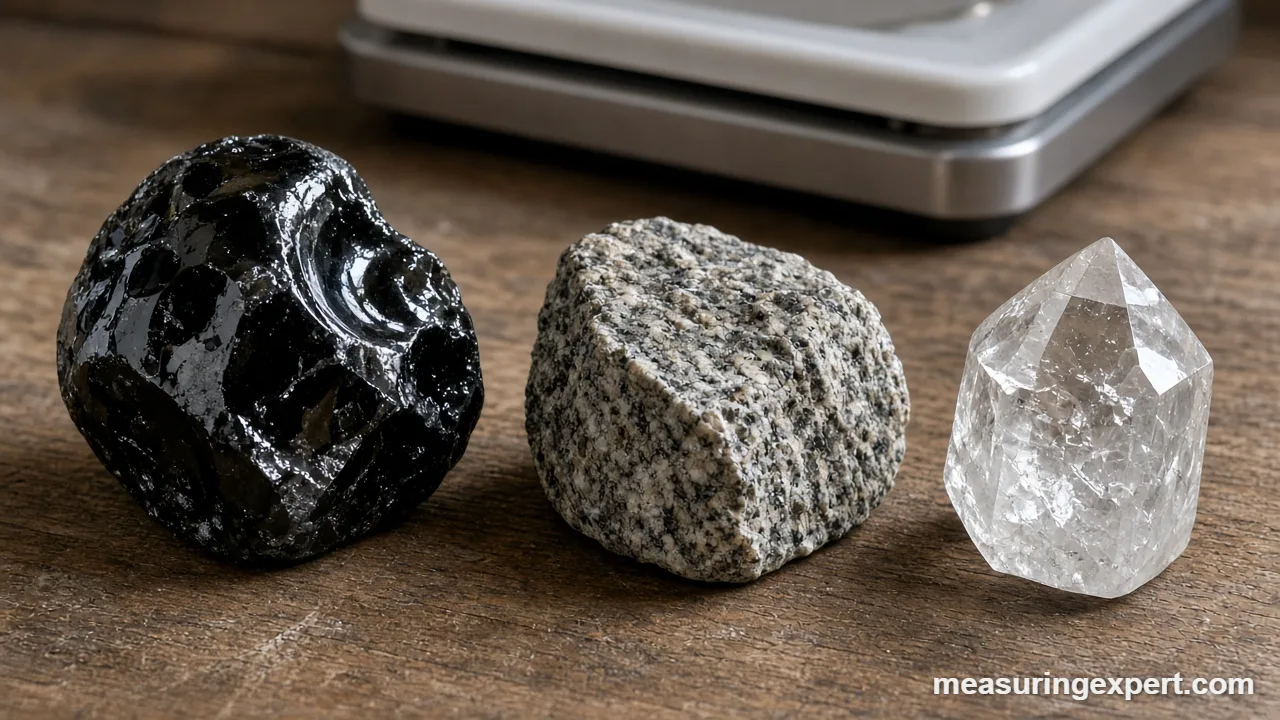
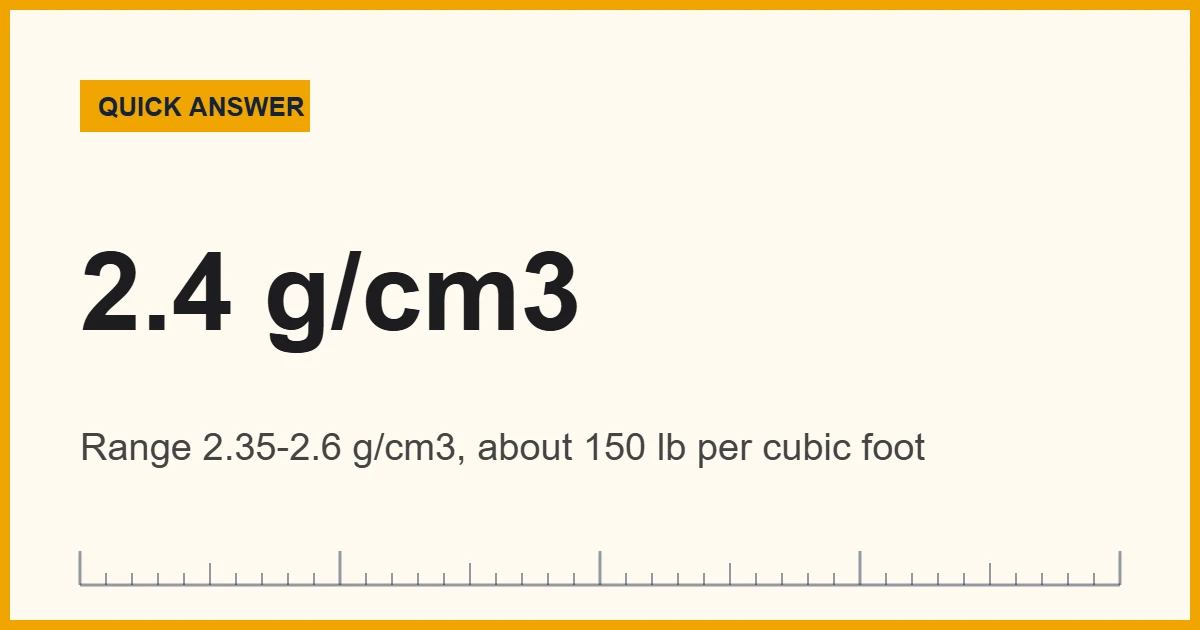
How dense is obsidian? Most obsidian has a density of about 2.35 to 2.6 g/cm3, and a typical piece is close to 2.4 g/cm3 (2,400 kg/m3, or about 150 lb/ft3). So this volcanic glass is roughly 2.4 times as dense as water, yet slightly lighter than granite, quartz and ordinary window glass.


As an Amazon Associate, Measuring Expert earns from qualifying purchases.
Convert Obsidian Density to Other Units
Gem books and geology tables list density in grams per cubic centimeter. In the US, however, stone carvers and landscapers often want pounds per cubic foot. So type 2.4 for a typical black obsidian, 2.35 for a light, bubbly piece, or the number from your own test, and the converter shows every common unit at once.
Put simply, density is mass divided by volume. For obsidian, therefore, it tells you how much a stone weighs for the space it takes up. As a result, you can turn a size into a weight, or check whether a “black glass” stone is likely to be the real thing.
Obsidian forms when silica-rich lava cools so fast that crystals have no time to grow. Instead of a rock made of interlocking minerals, you get a glass. According to the LibreTexts gemology reference on obsidian, it has a density of 2.35 to 2.60, a hardness of 5 to 5.5 and a refractive index of about 1.45 to 1.55.
In short, use 2.4 g/cm3 as a working figure unless you measure your own stone. Next, you will find the value in every unit, how it stacks up against similar materials, and a simple specific gravity test you can run in a kitchen.
How Dense Is Obsidian in Each Unit?
First, every row below starts from the same typical value, 2.4 g/cm3. Also, the conversions use the exact pound (453.59237 g) and the exact inch (2.54 cm). Because 1 g/cm3 equals 1 g/mL and 1 kg/L, the first rows share one number.
| Unit | Typical obsidian (2.4) | Full range (2.35 – 2.6) |
|---|---|---|
| g/cm3, g/mL, kg/L | 2.4 | 2.35 – 2.6 |
| kg/m3 | 2,400 | 2,350 – 2,600 |
| lb/ft3 | 149.8 | 146.7 – 162.3 |
| lb/in3 | 0.0867 | 0.0849 – 0.0939 |
| lb/gal (US) | 20.0 | 19.6 – 21.7 |
| Specific gravity (water = 1) | 2.4 | 2.35 – 2.6 |
For example, a 1 inch cube of typical obsidian weighs about 39 g (1.4 oz). Similarly, a ball 4 inches across weighs close to 1.3 kg, or 2.9 lb. Meanwhile, a solid cubic foot would weigh about 150 lb.
How Dense Is Obsidian Compared With Granite, Quartz and Glass?
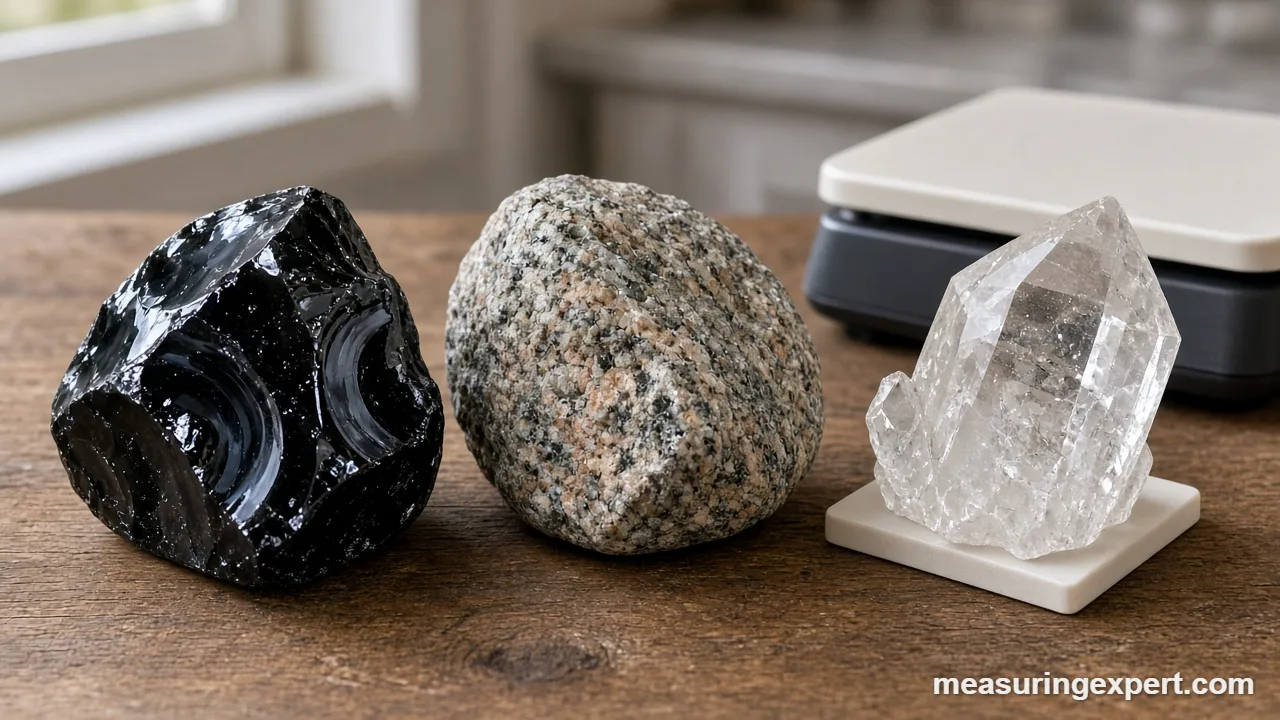
However, many websites claim obsidian is denser than granite. In fact, it is the other way around. This is because granite and quartz are crystalline, and their atoms sit in tighter, ordered patterns, so they come out a little heavier for the same size.
| Material | Density, g/cm3 | lb/ft3 | Compared with obsidian (2.4) |
|---|---|---|---|
| Pumice (with pores) | often under 1.0 | under 62 | Much lighter; it can float |
| Fused silica (pure glass) | 2.20 | 137.3 | About 8% lighter |
| Obsidian | 2.35 – 2.6 | 147 – 162 | – |
| Window (soda-lime) glass | about 2.5 | about 156 | About 4% denser |
| Quartz | 2.65 | 165.4 | About 10% denser |
| Granite | 2.6 – 2.8 (typical 2.7) | 162 – 175 | About 12% denser |
| Basalt | about 2.9 – 3.0 | 181 – 187 | About 20 – 25% denser |
| Diamond | 3.515 | 219.4 | About 1.46 times denser |
Our guide on how dense granite is explains why light and dark granites differ. Meanwhile, the page on how dense diamond is shows why that gem is one of the heaviest stones for its size. Obsidian, therefore, sits at the light end of solid, non-porous rock.
Why Obsidian Is Lighter Than Its Crystal Cousins
Most obsidian has roughly the same chemistry as granite and rhyolite, as Geology.com notes in its obsidian overview. So why the gap? Above all, the answer is structure. For example, when lava freezes into glass, its atoms lock in a jumbled arrangement with a bit of extra space between them. Granite, on the other hand, had time to grow quartz, feldspar and mica crystals, and some of those minerals, especially dark mica and hornblende, are fairly heavy.
Next comes chemistry. Obsidian, for instance, is rich in silica, which is a light compound. In contrast, darker volcanic glasses with more iron and magnesium, such as basaltic glass, come in heavier. In addition, tiny gas bubbles trapped during cooling lower the average density of a stone. For this reason, the lowest readings, around 2.35, usually come from bubbly or very pure, pale pieces.
How Dense Is Obsidian in Each Variety?
First of all, color comes from small inclusions, not from a different base material. As a result, most varieties fall inside the same range, and the color alone cannot tell you the density.
| Variety | What causes the look | Effect on density |
|---|---|---|
| Black obsidian | Tiny magnetite and other mineral specks | Typical, about 2.35 – 2.5 |
| Snowflake obsidian | White clusters of cristobalite crystals | Very small change; still in range |
| Mahogany obsidian | Iron-rich bands (hematite) swirled with black | Can read a little higher |
| Gold or silver sheen | Light reflecting off tiny bubbles or crystals in layers | Bubbles can pull it slightly lower |
| Rainbow obsidian | Thin layers of tiny inclusions | Typical range |
| Apache tears | Rounded nodules of black glass | Typical range |
Recommended Tools for Testing How Dense Obsidian Is
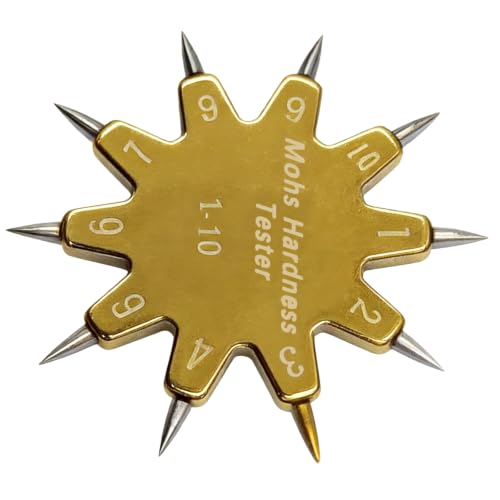
For a home density test, you therefore need two things: a good mass reading and a good volume reading. First, a pocket scale that reads to 0.01 g handles small tumbled stones and arrowhead flakes. Next, a graduated cylinder measures volume by water displacement. A caliper also helps with cut cubes or slabs, and a hardness pick set lets you confirm that a stone sits near 5 to 5.5 on the Mohs scale.
How to Test the Specific Gravity of a Stone at Home
The easiest home method weighs the stone twice: once dry, and once hanging in water. Because the water pushes up with a force equal to the weight of the water it moves, the second reading reveals the volume. Here is how to do it with a kitchen or pocket scale:
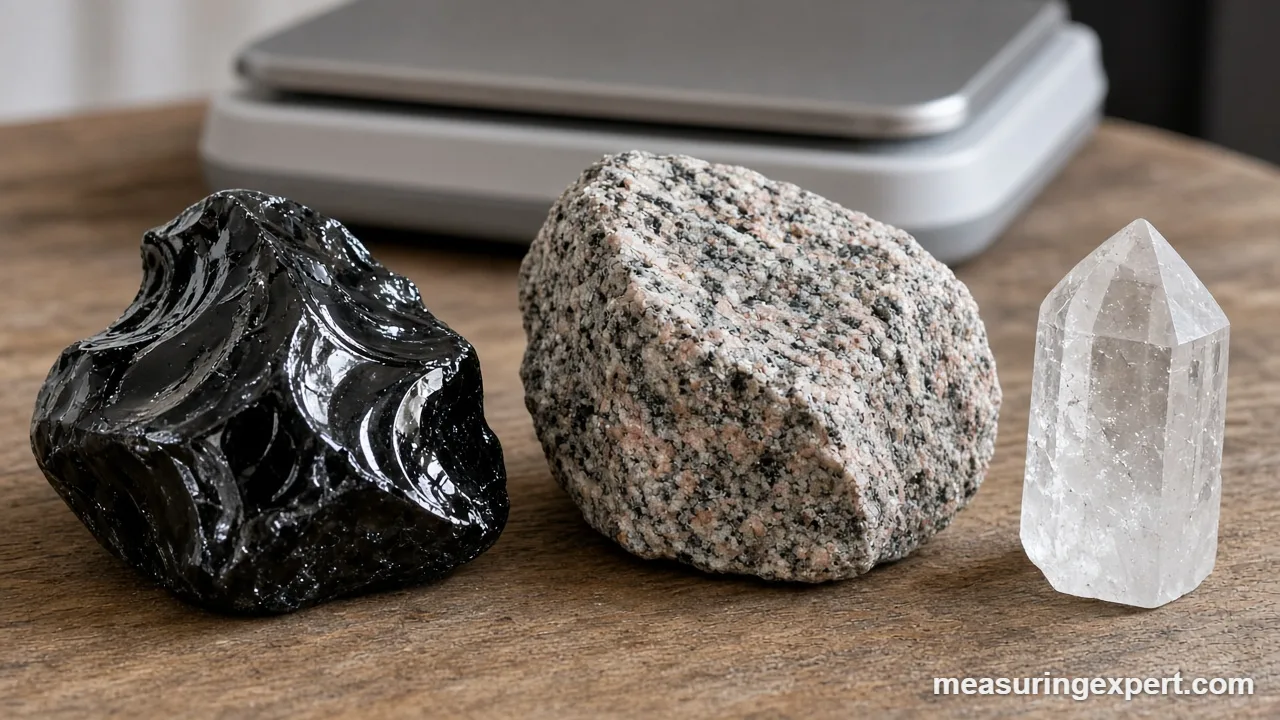
- Weigh the dry stone. Place the clean, dry stone on the scale and write down its mass in grams, for example 120.0 g.
- Set up a cup of water. Next, put a cup of room-temperature water on the scale and press tare so it reads zero.
- Hang the stone on a thread. Tie a thin thread or fishing line around the stone so you can hold it from above.
- Lower it fully under water. Then dip the stone until it is completely covered, without touching the sides or bottom of the cup.
- Read the scale. The new reading in grams equals the volume of the stone in cubic centimeters, for example 50.0 g means 50.0 cm3.
- Divide dry mass by that reading. In this example, 120.0 / 50.0 = 2.40, so the stone fits obsidian; finally, enter the result in the converter above for other units.
Alternatively, you can use a graduated cylinder. In that case, note the water level, slide the stone in, and read the rise in milliliters. For example, a 62.5 g stone that raises the water by 25.5 mL gives 2.45 g/cm3. Since cylinder marks are coarse, though, this method works best with stones of 50 g or more.
Do and Don’t for a Stone Density Test
Do
- Use the largest stone you have, since small errors matter less.
- Brush off air bubbles that cling to the stone under water.
- Also keep the stone hanging freely, clear of the cup walls.
- Repeat the test three times and average the results.
- Finally, compare against a range, not one exact number.
Don’t
- Test a stone with cracks or open pores that soak up water.
- Include a wire wrap, bail or glue in the weight.
- Trust a scale that only reads to 1 g with a tiny stone.
- Grip the stone with your fingers while it is in the water.
- Assume a dark, shiny stone is obsidian just from its color.
Honest Limits on How Dense Obsidian Is
Of course, a single figure hides real variation. Obsidian is a natural glass, so its makeup changes from one volcano to the next, and bubbles, crystals and banding shift the result by a few percent. Similarly, water temperature matters: at 25 C, water is about 0.3% lighter than at 4 C, which slightly lowers a home result. A kitchen scale that reads to 0.1 g also adds error when the stone is small. Because of all this, a home reading within about 0.05 of 2.4 is a good result. In short, density narrows down the options rather than proving what a stone is.
When Accuracy Really Matters
For a school project or a rock collection label, then, 2.4 g/cm3 is plenty. In contrast, a few cases call for more care. First, gem buyers who need to rule out glass imitations should rely on a gemologist, who can check refractive index and inclusions. Second, archaeologists source obsidian tools by chemistry, not by density, because many flows overlap. Third, anyone using obsidian blades for medical work must follow the instrument maker and a surgeon, never a home test.
Frequently Asked Questions
How dense is obsidian in g/cm3?
Most obsidian measures about 2.35 to 2.6 g/cm3, and a typical piece is close to 2.4 g/cm3. That equals about 2,400 kg/m3.
What is the density of obsidian in lb/ft3?
Typical obsidian weighs about 150 pounds per cubic foot. Across the full range, it runs from about 147 to 162 lb/ft3.
Is obsidian denser than granite?
No. Granite is usually 2.6 to 2.8 g/cm3, so it is about 12% denser than typical obsidian at 2.4 g/cm3.
How dense is obsidian compared with quartz?
Quartz is about 2.65 g/cm3, which makes it roughly 10% denser than typical obsidian. Quartz is also harder, at 7 on the Mohs scale versus about 5 to 5.5.
How dense is obsidian compared with window glass?
Slightly less dense, in most cases. Ordinary soda-lime window glass is about 2.5 g/cm3, so it is a little heavier than most obsidian, although the ranges overlap.
Can obsidian float on water?
No. At about 2.4 times the density of water, solid obsidian sinks. Pumice, which forms from similar lava full of gas bubbles, is the volcanic glass that can float.
What is the specific gravity of obsidian?
The specific gravity of obsidian is about 2.35 to 2.6. Because water is about 1 g/cm3, that is the same number as its density in g/cm3.
Does the color of obsidian change its density?
Only slightly. Color comes from tiny inclusions, so snowflake, mahogany and sheen obsidian all stay within the normal range.
How dense is obsidian compared with diamond?
Diamond is about 3.515 g/cm3, or about 1.46 times as dense as typical obsidian. So a diamond the same size as an obsidian bead weighs almost half again as much.
How much does a 1 inch cube of obsidian weigh?
At 2.4 g/cm3, a 1 inch cube holds 16.39 cm3 of glass and weighs about 39 g, or 1.4 ounces.
How Dense Is Obsidian? The Bottom Line
To sum up, obsidian has a density of about 2.35 to 2.6 g/cm3, with 2.4 g/cm3 (about 150 lb/ft3) as a good everyday value. As a result, it is a bit lighter than window glass, quartz and granite, and much lighter than diamond.
So to check a stone of your own, weigh it dry, weigh it hanging in water, and divide. Then use the converter at the top of the page to see your result in kilograms per cubic meter or pounds per cubic foot.
Black Friday is coming: shop the deals with Prime