

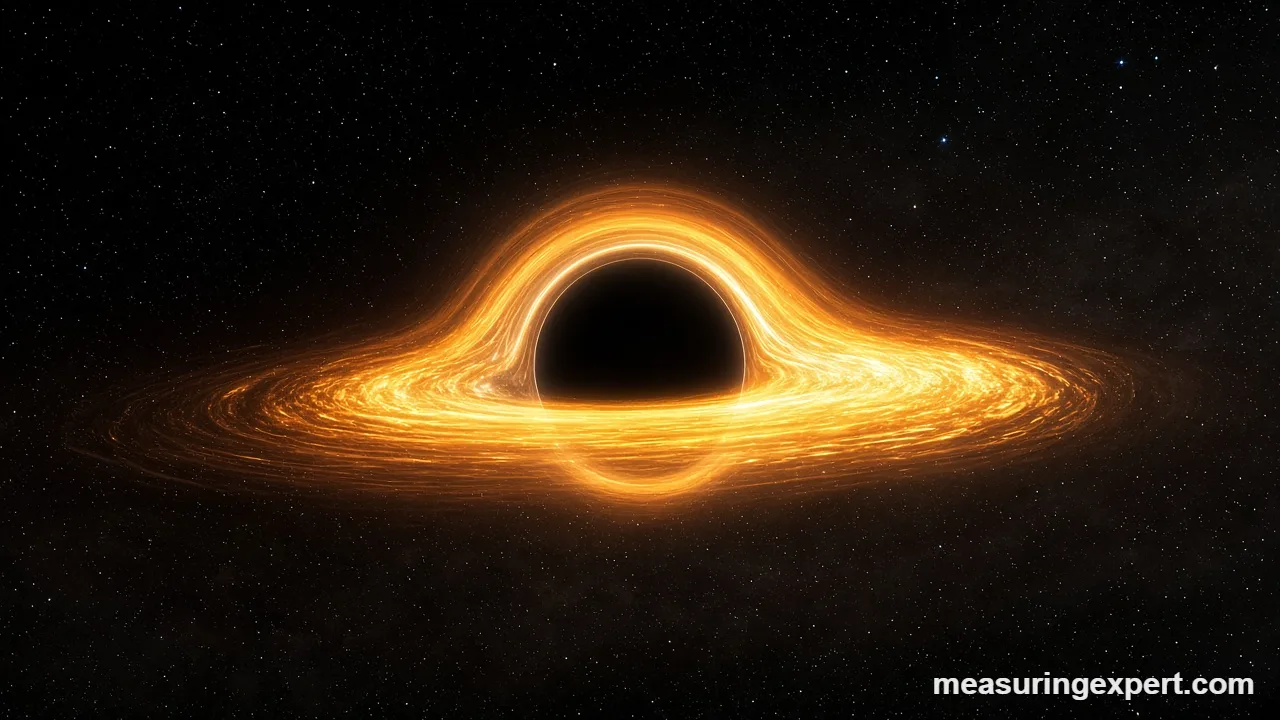
Black hole density depends on mass. If you divide a black hole’s mass by the volume inside its event horizon, a black hole as heavy as the Sun averages about 1.8 x 10^19 kg/m3 (1.8 x 10^16 g/cm3). However, a giant like M87* averages only about 0.44 kg/m3, which is thinner than air.
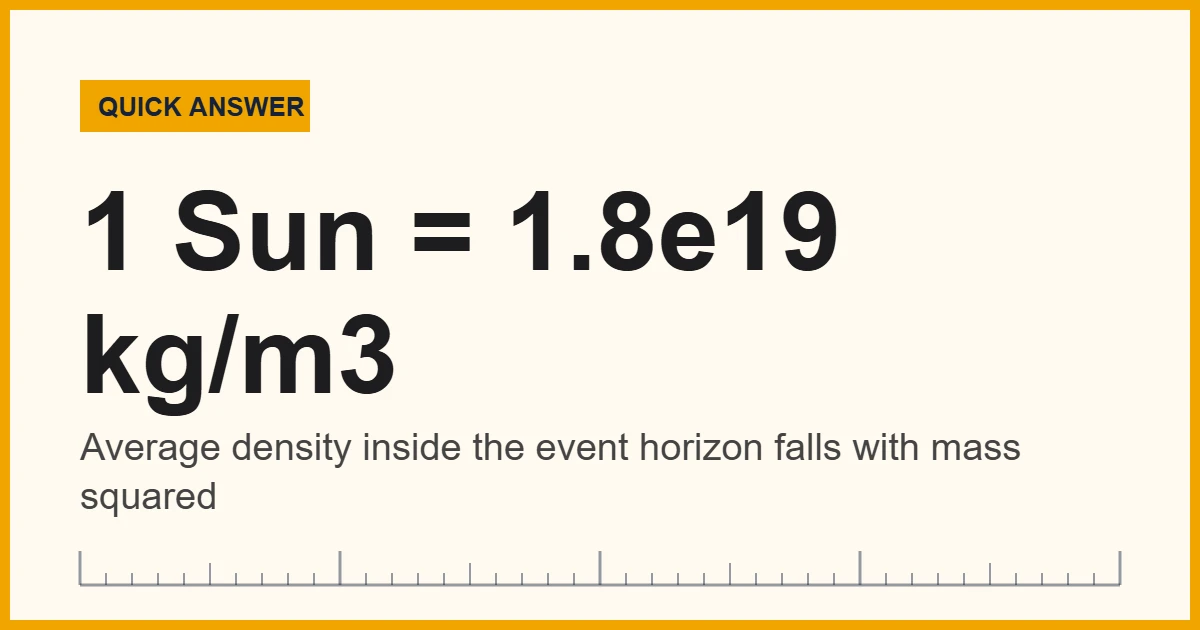
Convert Black Hole Density Units
The starting value below is the average density of a one-solar-mass black hole in kilograms per cubic meter. Paste any density from the chart further down, and the converter then shows it in grams per cubic centimeter, pounds per cubic foot and other units. For large numbers, type them in e-notation, for example 1.843e19.
Why the Question Has Two Answers
“How dense is a black hole?” sounds like it should have one answer. In fact, it has two. First, there is the singularity at the center, where general relativity predicts that matter is crushed to infinite density. Second, there is the average density inside the event horizon, which is a real, finite number you can calculate from mass alone.
That second number behaves in a surprising way. Because the event horizon grows in step with mass, its volume grows with the cube of mass. As a result, black hole density falls with the square of mass: double the mass and the average density drops to one quarter. So small black holes are denser than an atomic nucleus, while the biggest ones are less dense than the air you breathe.
NASA describes stellar-mass black holes as ranging from a few to hundreds of times the Sun’s mass, and supermassive ones as reaching billions of times the Sun’s mass. That span is why the densities on this page cover more than 20 powers of ten.
Black Hole Density Chart by Mass
Every row below uses the same method: the Schwarzschild radius for a non-spinning black hole, the volume of a sphere with that radius, and then mass divided by volume. For example, the Sun row means a black hole with the Sun’s mass, not the Sun itself. Also, values are rounded to three or four significant figures.
| Mass (Suns) | Example | Event horizon radius | Average density (kg/m3) | Average density (g/cm3) |
|---|---|---|---|---|
| 0.000003 (1 Earth) | Earth squeezed into a black hole | 8.87 mm (0.35 in) | 2.04 x 10^30 | 2.04 x 10^27 |
| 1 | Sun-mass black hole | 2.95 km (1.84 mi) | 1.84 x 10^19 | 1.84 x 10^16 |
| 10 | Typical stellar-mass black hole | 29.5 km (18.4 mi) | 1.84 x 10^17 | 1.84 x 10^14 |
| 100 | Heavy stellar-mass black hole | 295 km (184 mi) | 1.84 x 10^15 | 1.84 x 10^12 |
| 1,000,000 | Small supermassive black hole | 2.95 million km (1.84 million mi) | 1.84 x 10^7 | 18,430 |
| 4,000,000 | Sagittarius A* (Milky Way) | 11.8 million km (7.34 million mi) | 1.15 x 10^6 | 1,152 |
| 136,000,000 | Break-even with water | 401 million km (249 million mi) | 1,000 | 1.00 |
| 1,000,000,000 | Large quasar black hole | 2.95 billion km (1.84 billion mi) | 18.4 | 0.0184 |
| 6,500,000,000 | M87* (first black hole image) | 19.2 billion km (11.9 billion mi) | 0.436 | 0.000436 |
| 40,000,000,000 | Among the heaviest known | 118 billion km (73.4 billion mi) | 0.0115 | 0.0000115 |
Reading the Chart
The masses for Sagittarius A* (about 4 million Suns) and M87* (about 6.5 billion Suns) are the round figures quoted for the Event Horizon Telescope images. In short, a tenfold jump in mass always cuts the density by a factor of 100.
The Black Hole Density Formula
In general, density is mass divided by volume, just as it is for a rock or a glass of water. For a black hole, the “size” is the Schwarzschild radius, the radius of the event horizon of a non-spinning black hole:
Rs = 2GM / c^2
Here G is the gravitational constant (about 6.674 x 10^-11 m3 per kg per s2), M is the mass in kilograms, and c is the speed of light, exactly 299,792,458 m/s. Our guide to the speed of light explains why that value is exact by definition. Next, treat the horizon as a sphere, so the volume is 4/3 x pi x Rs^3. Finally, divide mass by that volume and simplify:
average density = 3c^6 / (32 pi G^3 M^2)
In other words, the M squared on the bottom is the whole story. Mass appears once on top, but the radius scales with mass, so the volume scales with mass cubed. Therefore black hole density shrinks with the square of mass.
How to Calculate Black Hole Density Step by Step
To begin with, you only need a calculator that handles scientific notation. For example, the worked numbers below use a 10-solar-mass black hole.
- Convert the mass to kilograms. Multiply the number of Suns by 1.989 x 10^30 kg. Thus, ten Suns is 1.989 x 10^31 kg.
- Find the Schwarzschild radius. Use Rs = 2GM / c^2. For 10 Suns, the radius comes out to about 29,530 m, or 29.5 km.
- Work out the volume. Use 4/3 x pi x Rs^3. This then gives roughly 1.08 x 10^14 cubic meters.
- Divide mass by volume. 1.989 x 10^31 kg / 1.08 x 10^14 m3 is about 1.84 x 10^17 kg/m3.
- Convert the units. Enter the result in the converter above to see it in g/cm3 or lb/ft3.
- Sanity-check with the shortcut. Divide 1.84 x 10^19 by the mass squared. Since 10 squared is 100, the answer again is 1.84 x 10^17 kg/m3.
Compared With Earth, Water and Air
Numbers like 10^19 are hard to picture, so it helps to set them next to things you know. Earth, for example, averages about 5,510 kg/m3 (5.51 g/cm3), as our article on how dense Earth is explains. Similarly, liquid water is about 1,000 kg/m3, and air at sea level is about 1.2 kg/m3.
| Object | Average density (kg/m3) | A black hole of equal density would weigh |
|---|---|---|
| Atomic nucleus | about 2.3 x 10^17 | about 9 Suns |
| Gold | 19,300 | about 31 million Suns |
| Earth (average) | about 5,510 | about 58 million Suns |
| Sun (average) | about 1,410 | about 114 million Suns |
| Water | 1,000 | about 136 million Suns |
| Air at sea level | about 1.2 | about 3.9 billion Suns |
Put another way, the Milky Way’s own black hole averages a little over 1,000 times the density of water. Meanwhile, M87* averages roughly a third of the density of sea-level air.
Spot the Difference: Average vs Central Values
Above all, most confusion online comes from mixing two different quantities. This table therefore separates them.

| Question | Average density inside the horizon | Density at the singularity |
|---|---|---|
| What it measures | Total mass divided by horizon volume | Density at the central point |
| Typical value | Finite: 10^19 kg/m3 down to below air | Infinite in general relativity |
| Depends on mass? | Yes, falls with mass squared | No, the prediction is the same for all |
| Can we check it? | Yes, from measured mass | No, it sits behind the horizon |
| Physics status | Simple arithmetic | A sign that theory breaks down |
What Happens at the Singularity
General relativity predicts that all the mass inside a black hole ends up at a singularity, a point (or, for a spinning hole, a ring) of zero size. Consequently, zero volume means infinite density. However, most physicists read that infinity as a warning light, not a physical value. Instead, it marks the place where general relativity stops working and a quantum theory of gravity, which nobody has finished yet, should take over.
So when a source says a black hole is “infinitely dense”, it is talking about the center. On the other hand, when it says supermassive black holes are less dense than water, it means the average inside the event horizon. Both statements can be true at once, because they answer different questions.
Recommended Tools for Measuring Mass and Volume at Home
Of course, you cannot weigh a black hole on a kitchen counter. Still, the method behind black hole density is the same one you can use at home or in a classroom: measure mass, measure volume, then divide. For that, a precise gram scale and a graduated cylinder are all you need. Then drop a small object into water, read the volume change on the cylinder, and divide its mass by that volume.

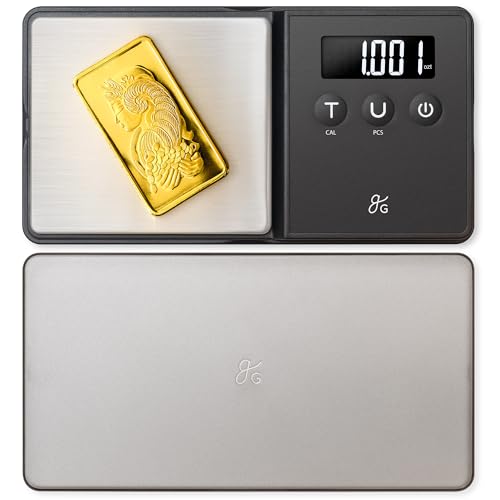


As an Amazon Associate, Measuring Expert earns from qualifying purchases.
Do and Don’t When Quoting These Numbers
Do
- Say whether you mean the average or the singularity.
- Give the mass along with the density.
- Show units, such as kg/m3 or g/cm3.
- Use the mass-squared rule as a quick check.
- Note that spin changes the horizon size.
Don’t
- Claim that bigger black holes are denser.
- Mix g/cm3 and kg/m3 (they differ by 1,000).
- Treat “infinite density” as a measured value.
- Round G or c too early in the math.
- Compare a density without naming the mass.
Honest Limits of Black Hole Density Numbers
First, the “volume” of a black hole is a convenient convention rather than a measured fact. After all, inside the horizon, space and time swap roles, so there is no single agreed volume. Even so, the 4/3 pi R^3 sphere gives a useful, widely used yardstick.
Second, real black holes spin. A fast-spinning black hole has a smaller event horizon than a non-spinning one of the same mass, so its naive average density comes out higher, by up to about 8 times at the maximum possible spin. Third, measured masses carry uncertainties of several percent or more, and every density figure inherits them twice, because mass is squared. Finally, the chart ignores the gas and dust swirling outside the horizon, since that material is not part of the black hole yet.
When the Numbers Really Matter
For a quick answer, two significant figures are plenty. However, homework, exams and science writing deserve more care. Specifically, use G = 6.674 x 10^-11, c = 299,792,458 m/s and a solar mass of 1.989 x 10^30 kg. In addition, state which definition of density you are using, and keep your units consistent from start to finish.
Black Hole Density FAQs
What is the average black hole density?
There is no single value, because it depends on mass. A one-solar-mass black hole averages about 1.8 x 10^19 kg/m3, while a 6.5-billion-solar-mass black hole like M87* averages about 0.44 kg/m3.
Is the center infinitely dense?
General relativity predicts infinite density only at the central singularity. The average density inside the event horizon, by contrast, is a finite number that you can calculate from the mass.
Why do bigger black holes have lower black hole density?
The event horizon radius grows in proportion to mass, so the volume grows with mass cubed. As a result, mass divided by volume falls with mass squared.
Are the biggest ones less dense than water?
Yes. Any black hole heavier than about 136 million Suns has an average density below 1,000 kg/m3, the density of water.
How dense is Sagittarius A*?
At about 4 million solar masses, Sagittarius A* averages roughly 1.15 x 10^6 kg/m3, or about 1,150 g/cm3. In other words, that is a little over 1,000 times the density of water.
Which formula gives the average density?
Average density equals 3c^6 / (32 pi G^3 M^2), where c is the speed of light, G is the gravitational constant and M is the mass in kilograms.
How does it compare with a neutron star?
For small black holes, yes. A black hole of a few solar masses averages more than an atomic nucleus. Supermassive black holes, however, average far less than a neutron star.
How small would Earth be if it collapsed?
Earth would need to shrink to an event horizon radius of about 8.87 mm (0.35 in), roughly the size of a marble. Its average density would then be about 2 x 10^30 kg/m3.
Does spin change black hole density?
Spin shrinks the event horizon for a given mass. So a simple average density for a fast-spinning black hole comes out higher, up to about 8 times the non-spinning value.
How do scientists measure the mass?
They track the orbits of nearby stars or gas, study gravitational waves from mergers, and model images such as those from the Event Horizon Telescope. Density then follows from the mass.
Black Hole Density: The Bottom Line
To sum up, black hole density has two answers. At the singularity, theory says infinite. Across the whole event horizon, however, the average is finite and falls with mass squared, from about 1.8 x 10^19 kg/m3 for a Sun-mass hole to less than air for the giants.
So whenever you see a density quoted for a black hole, look for the mass next to it. Then use the shortcut or the converter at the top of this page to check the number in the units you need.