

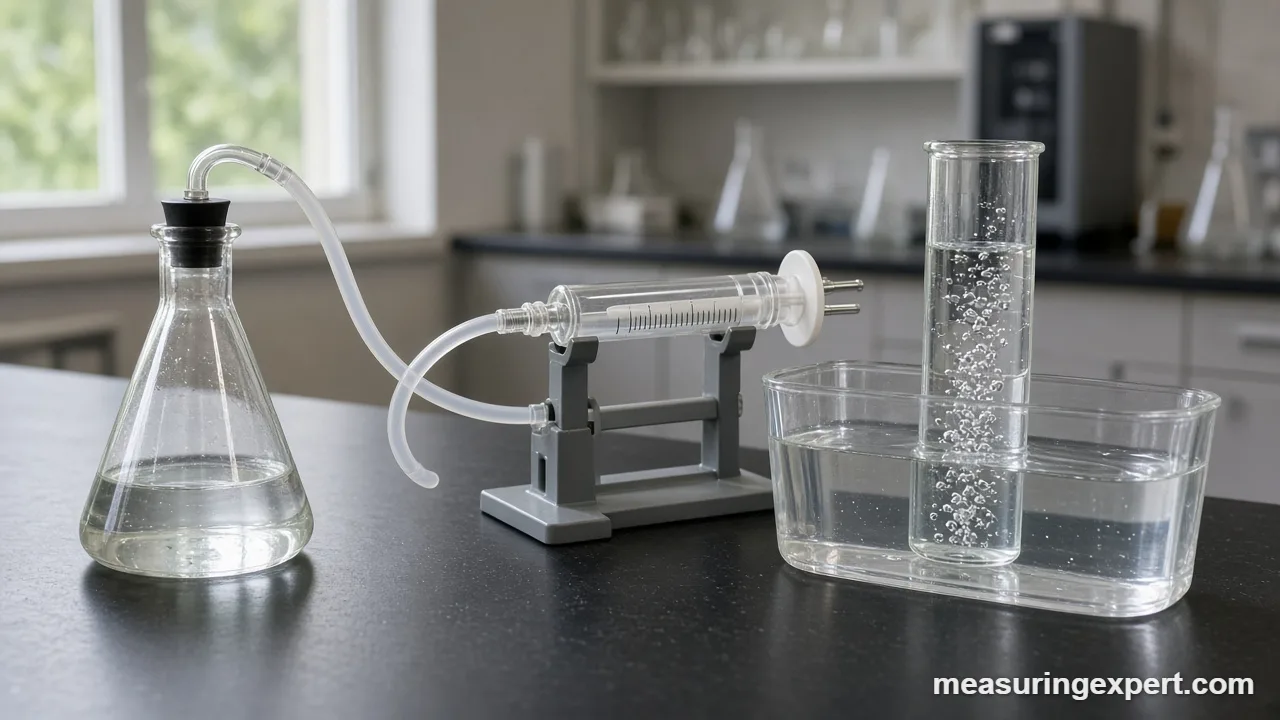
To measure the volume of gas, trap the gas in a graduated container and read the scale: a gas syringe, an inverted cylinder over water, or a gas meter. Then note the temperature and pressure, because gas volume changes with both. Finally, use PV = nRT to correct the reading to standard conditions.
Gas is awkward to measure because it has no fixed volume of its own. Instead, it spreads out to fill whatever holds it, and it swells when warmed or squeezed less. So a number such as “48 mL of hydrogen” means little unless you also know the temperature and pressure at the moment you read it.
In a school or university lab, you usually find the volume of gas in one of two ways. First, a gas syringe connected to the reaction flask pushes its plunger out as gas forms, and you read the volume straight off the barrel. Second, the water displacement method collects the gas in an upside-down graduated cylinder or eudiometer that starts full of water; the gas pushes water down, and the empty space at the top is the gas volume. At home and in industry, a gas meter counts volume as gas flows through it. In every case, you then record the temperature and barometric pressure, subtract water vapor pressure if the gas was collected over water, and use the ideal gas law to compare results.
In short: read the volume, write down the temperature and pressure, and correct the number before you compare it with anything else.
Why the Volume of Gas Needs Standard Conditions
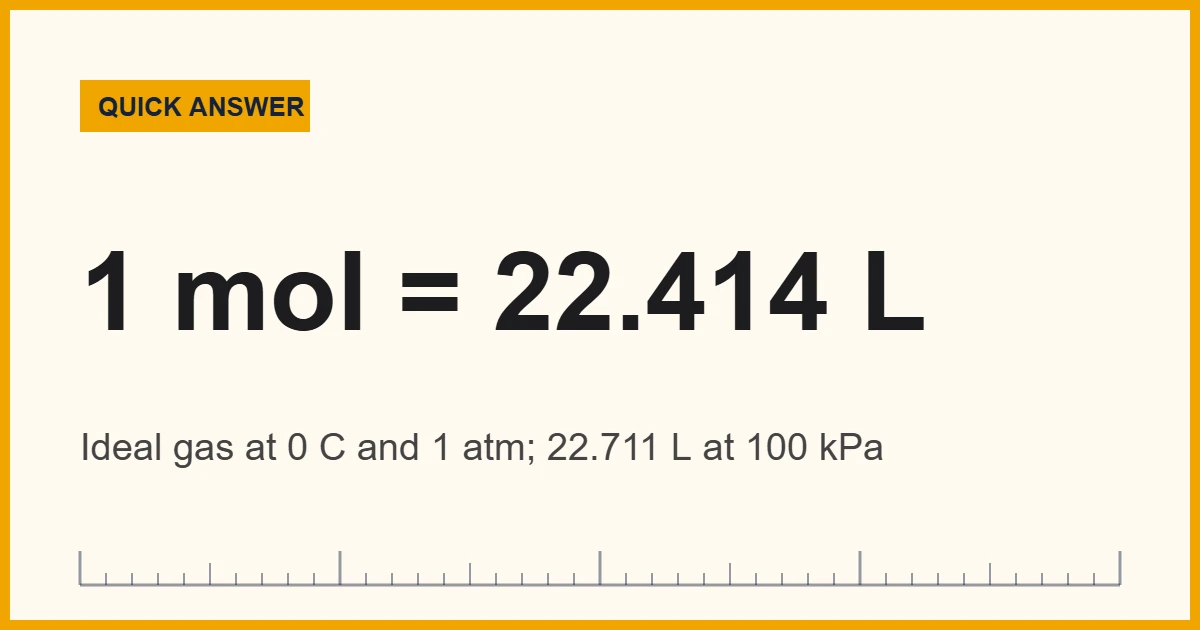
The constants behind those corrections are fixed by international agreement. For example, the US National Institute of Standards and Technology (NIST) lists the exact CODATA molar gas constant and molar volumes: R = 8.314462618 J per mol per kelvin, and one mole of ideal gas fills 22.414 L at 0 degrees C and 1 atm. Similarly, IUPAC defines its standard conditions for gases as 0 degrees C and exactly 100 kPa.
Below, you will find a pressure converter, the main methods step by step, the gas law math with worked examples, and the mistakes that most often spoil a reading.
Convert Your Barometer Reading Before Using PV = nRT
Most volume of gas calculations fail on units, not on chemistry. Because the gas constant you use must match your pressure unit, this converter turns atmospheres into kilopascals, psi and mmHg (torr). We chose a pressure converter over a volume converter for this reason: lab volumes are already in mL, while barometers report in inHg, mmHg, hPa or psi.
Weather reports give sea-level pressure. For gas law work, however, use the actual (station) pressure in the room, which is lower at altitude.
Recommended Tools for Measuring the Volume of Gas
For classroom and bench work, you need a graduated container for the gas and a way to keep it sealed. A glass gas syringe gives the quickest readings, while a eudiometer or graduated cylinder with a pneumatic trough suits the water displacement method. In addition, a gastight syringe helps when you need to take a small, exact sample. The picks below are based on manufacturer specs and buyer reports.


As an Amazon Associate, Measuring Expert earns from qualifying purchases.
Key Takeaways
- Gas has no fixed volume, so every reading needs a temperature and a pressure next to it.
- A gas syringe reads the volume directly; water displacement reads the space left above the water.
- Gas collected over water also contains water vapor, so subtract its vapor pressure (3.17 kPa at 25 degrees C).
- The ideal gas law, PV = nRT, links volume to moles, temperature and pressure.
- One mole of ideal gas fills 22.414 L at 0 degrees C and 1 atm, but 22.711 L at IUPAC STP (0 degrees C, 100 kPa).
- Home gas meters count in cubic feet (ccf = 100 ft3) or cubic meters.
- Always use kelvin in gas law math: K = degrees C + 273.15.
Methods to Measure the Volume of Gas Compared
Each method fits a different job. A syringe is fast and clean, while water displacement is cheap and works with simple glassware. A gas meter, by contrast, measures gas that keeps flowing rather than a single trapped sample.
| Method | How it works | Typical range | Best for | Watch out for |
|---|---|---|---|---|
| Gas syringe | Gas pushes a glass plunger out along a graduated barrel | Up to about 100 mL | Reaction rates, timed readings | Sticking plunger, leaks at joints |
| Inverted cylinder or eudiometer (water displacement) | Gas bubbles into a water-filled tube and pushes water down | 10 mL to about 500 mL | Gases that do not dissolve much in water (H2, O2, N2) | Water vapor in the gas; soluble gases such as CO2, NH3 |
| Gas meter (diaphragm, rotary, turbine) | Counts the volume that flows past | Liters to thousands of cubic feet | Natural gas billing, process lines | Readings are at line conditions unless corrected |
| Calculation (PV = nRT) | Converts known moles, temperature and pressure into volume | Any | Predicting or correcting a volume | Real gases deviate at high pressure |
For a wider view of volume tools, see our guide to what tools measure volume.
How to Measure the Volume of Gas by Water Displacement
This is the classic chemistry method, and it is the same idea as the displacement method for solids, just upside down.
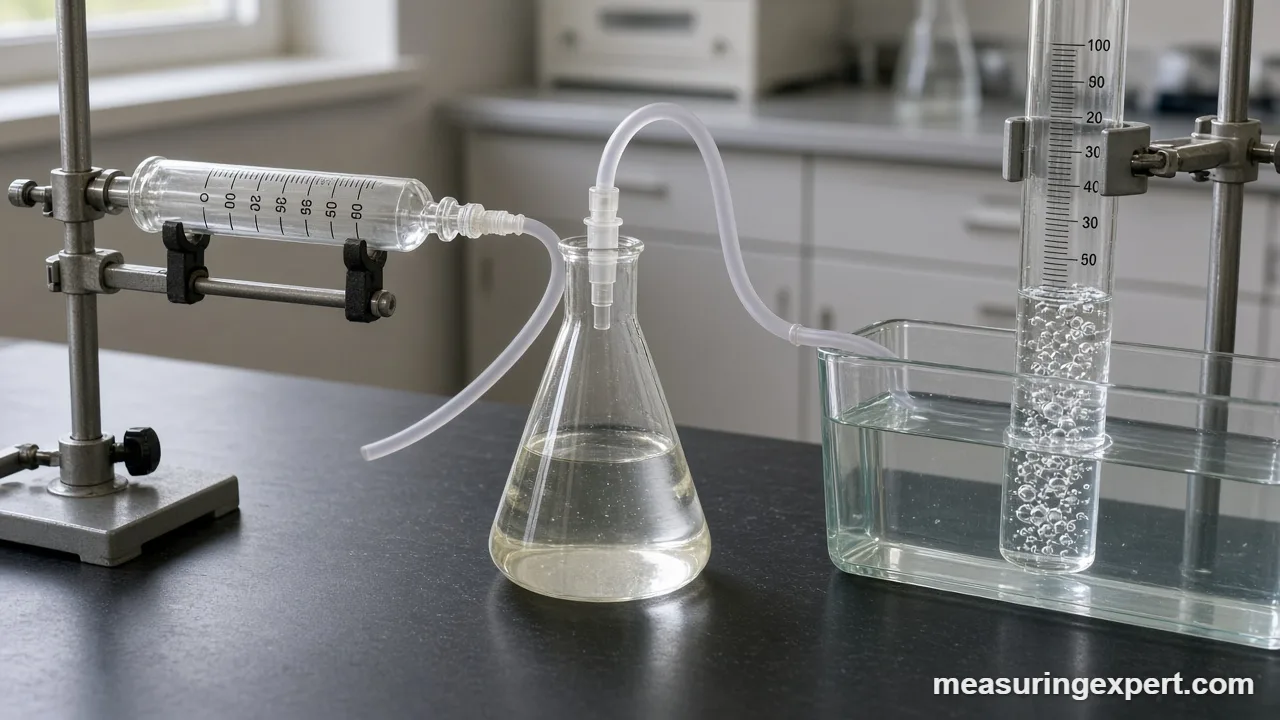
- Fill the collecting tube with water. Fill a graduated cylinder or eudiometer to the brim, cover the mouth, and turn it upside down in a trough of water so no air bubble remains.
- Connect the delivery tube. Run a tube from the sealed reaction flask so its end sits under the mouth of the inverted cylinder.
- Start the reaction. Add the reactant, then let the gas bubble up and push the water down.
- Equalize the levels. When bubbling stops, raise or lower the cylinder until the water inside matches the water outside, so the gas is at room pressure.
- Read the volume at eye level. Read the bottom of the meniscus; remember that the scale reads downward on an inverted cylinder.
- Record temperature and pressure. Note the water temperature and the barometric pressure in the room.
- Correct for water vapor. Subtract the vapor pressure of water at that temperature from the barometric pressure, then apply PV = nRT.
Using a Gas Syringe to Read the Volume of Gas
A gas syringe is the neatest option for reaction-rate experiments. Its glass plunger moves with very little friction, so the gas pushes it out at roughly room pressure. As a result, you can read the volume every 10 or 30 seconds and plot a curve.
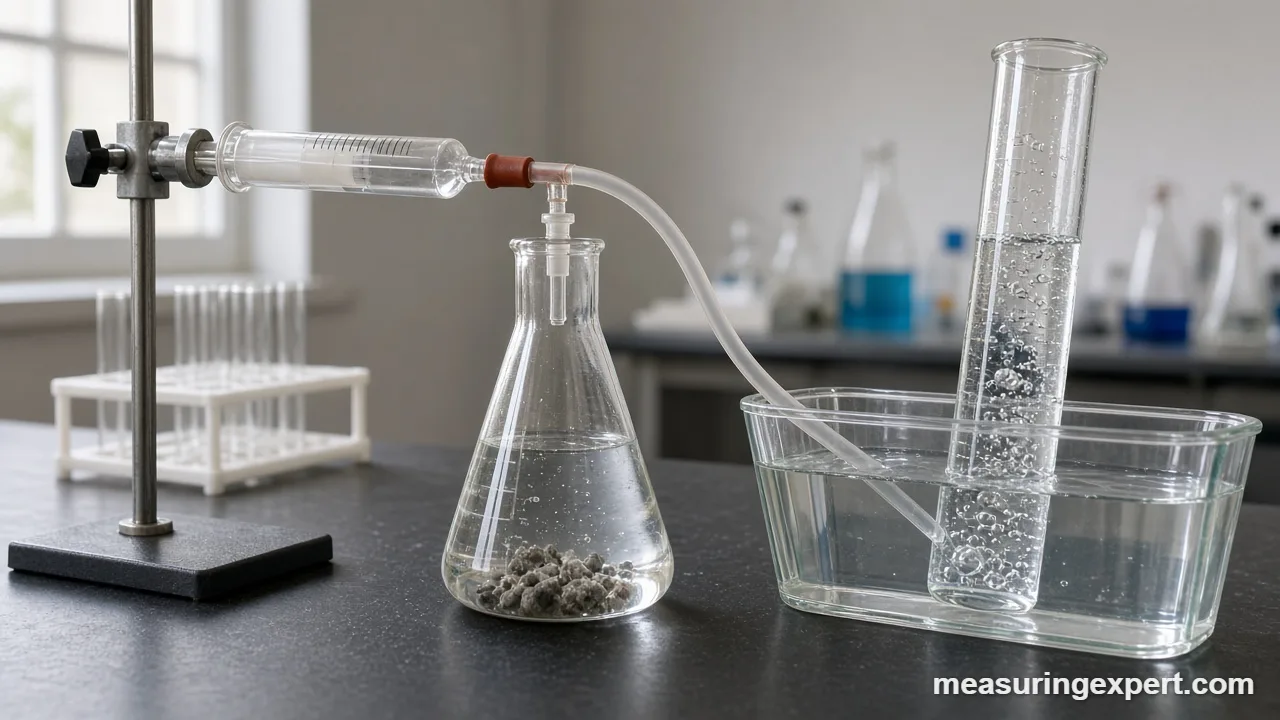
First, check that the plunger slides freely and starts at zero. Next, connect it to the flask with short, tight tubing, and add the reactant quickly before sealing the bung. Then take readings at fixed times. Finally, keep the syringe level and away from heat sources, because warming the barrel by hand expands the gas inside.
The Ideal Gas Law and the Volume of Gas at STP
The ideal gas law ties the four quantities together: PV = nRT. Here P is pressure, V is volume, n is the amount in moles, T is the temperature in kelvin, and R is the molar gas constant. So if you know three of them, you can find the fourth.
With R = 8.314462618 J per mol per K, pressure must be in pascals and volume in cubic meters. Alternatively, with kilopascals and liters, the same number works because the factors of 1,000 cancel. In atmospheres and liters, R is about 0.082057 L atm per mol per K.
To compare results from different days, chemists correct gas volumes to standard conditions. However, “STP” has two common meanings, and mixing them up causes a 1.3% error.
| Condition | Temperature | Pressure | Molar volume of ideal gas |
|---|---|---|---|
| Older STP (still common in US textbooks) | 0 °C (273.15 K) | 1 atm (101.325 kPa) | 22.414 L/mol |
| IUPAC STP (since 1982) | 0 °C (273.15 K) | 100 kPa (1 bar) | 22.711 L/mol |
| Room conditions often used in school | 25 °C (298.15 K) | 1 atm (101.325 kPa) | 24.465 L/mol |
For a quick comparison of two states of the same gas sample, use the combined gas law instead: P1V1/T1 = P2V2/T2. Because n stays the same, R drops out.
Worked Examples: Volume of Gas Calculations
All numbers below were computed with the exact CODATA value of R. Water vapor pressures come from the NIST Chemistry WebBook water data.
Example 1: volume of gas collected over water
You collect 48.0 mL of hydrogen over water at 25 degrees C. The barometer reads 101.0 kPa (757.6 mmHg), and water vapor pressure at 25 degrees C is 3.17 kPa. So the dry hydrogen pressure is 101.0 – 3.17 = 97.83 kPa. Next, n = PV/RT = 97.83 x 0.0480 / (8.3145 x 298.15) = 0.001894 mol. Finally, at 0 degrees C and 1 atm that gas would fill 42.46 mL; at IUPAC STP it would fill 43.02 mL. If you forgot the water vapor correction, you would report 43.83 mL instead, about 3% too high.
Example 2: correcting a gas syringe reading
A gas syringe reads 65.0 mL at 20 degrees C and 1 atm. Using the combined gas law, V2 = 65.0 x 273.15 / 293.15 = 60.57 mL at 0 degrees C and 1 atm. In other words, the same gas shrinks by about 7% when cooled by 20 degrees.
Example 3: predicting a volume from moles
How much space does 0.50 mol of gas take at 25 degrees C and 1 atm? V = nRT/P = 0.50 x 8.3145 x 298.15 / 101.325 = 12.23 L, or about 0.43 cubic feet.
Example 4: gas from a reaction
Magnesium reacts with hydrochloric acid to give one mole of hydrogen per mole of magnesium. Therefore, 0.10 g of magnesium (0.10 / 24.305 = 0.004114 mol) should make about 98.97 mL of hydrogen at 20 degrees C and 1 atm. That is very close to the limit of a 100 mL syringe, so 0.08 g of magnesium leaves safer headroom.
Gas Meters: Measuring the Volume of Gas That Flows
Outside the lab, the volume of gas is almost always measured as it flows. For example, the diaphragm meter on a house fills and empties small chambers and counts each cycle. Larger buildings use rotary or turbine meters instead, which count rotations of a rotor in the gas stream.
| Unit on the meter or bill | Equals | Metric |
|---|---|---|
| 1 cubic foot (ft3) | 1,728 cubic inches | 28.317 L |
| 1 ccf | 100 ft3 | 2.832 m3 |
| 1 mcf | 1,000 ft3 | 28.317 m3 |
| 1 cubic meter (m3) | 35.315 ft3 | 1,000 L |
Because utilities bill by energy, not just volume, your bill also shows a therm factor that converts the measured volume of gas into heat content. Meanwhile, the volume itself depends on line pressure and temperature, which is why large meters often include an electronic volume corrector.
Do and Don’t When You Measure a Gas
Do
- Record temperature and pressure with every reading.
- Convert degrees C to kelvin before any gas law math.
- Equalize water levels before reading an inverted cylinder.
- Check every joint for leaks with a small pressure test.
- Say which STP you used in your report.
Don’t
- Collect very soluble gases such as ammonia over water.
- Warm a gas syringe with your hand while reading it.
- Mix kPa with R in L atm per mol per K.
- Forget to subtract water vapor pressure.
- Exceed the syringe or cylinder capacity.
Honest Limits of Measuring the Volume of Gas
Every method has a built-in error. For instance, a school gas syringe is usually graduated in 1 mL steps, so readings carry at least half a division of uncertainty. Water displacement, meanwhile, loses some gas by dissolving it; carbon dioxide is the usual problem, so collect it in a syringe or over warm water instead. In addition, the ideal gas law assumes molecules take no space and do not attract each other. That works well near room conditions for gases such as hydrogen, oxygen and nitrogen. At high pressure or near condensation, however, real gases drift from it, and engineers use compressibility factors. In short, a careful school setup gets you within a few percent, which is fine for learning but not for billing or safety work. For air in rooms and ducts, see how to measure the volume of air.
When to Call a Professional
Lab glassware is safe to use for small, low-pressure samples. Still, a few jobs belong to trained people. Call your gas utility or a licensed plumber for any gas leak, meter problem or appliance connection. Similarly, use an accredited calibration lab when a flow meter or gas sampling device must meet a legal or quality standard. For compressed gas cylinders, follow the supplier’s safety data sheet and your workplace rules.
Volume of Gas FAQs
How do you find the volume of gas?
Trap the gas in a graduated container such as a gas syringe or an inverted cylinder over water, and read the scale. Then record the temperature and pressure, and correct the reading with PV = nRT.
What instrument measures the volume of gas?
In the lab, a gas syringe, a eudiometer or an inverted graduated cylinder. For flowing fuel gas, a gas meter measures the volume that passes through it.
What is the molar volume of a gas at STP?
One mole of ideal gas fills 22.414 L at 0 degrees C and 1 atm. At IUPAC STP, 0 degrees C and 100 kPa, it fills 22.711 L.
Why do you subtract water vapor pressure?
Gas collected over water is mixed with water vapor. The barometer reading is the total, so subtracting water vapor pressure gives the pressure of the dry gas alone.
Does temperature change the volume of gas?
Yes. At constant pressure, volume is proportional to kelvin temperature, so warming a gas from 0 to 20 degrees C makes it about 7% larger.
What units are used for gas volume?
Labs use mL and L, engineers use cubic meters, and US gas bills use cubic feet, ccf (100 ft3) or mcf (1,000 ft3).
Is a gas syringe more accurate than water displacement?
It is usually quicker and avoids water vapor and dissolving gas. Accuracy depends on the graduations and on leaks, so both can give good results with care.
Can you measure carbon dioxide over water?
Only roughly, because some carbon dioxide dissolves in water. A gas syringe gives a better reading for CO2.
What value of R should I use?
Use 8.314462618 J per mol per K with pascals and cubic meters, or with kPa and liters. Use 0.082057 with atmospheres and liters.
How do I convert a gas syringe reading to STP?
Use P1V1/T1 = P2V2/T2 with temperatures in kelvin. For example, 65.0 mL at 20 degrees C and 1 atm becomes 60.57 mL at 0 degrees C and 1 atm.
Volume of Gas: The Bottom Line
Measuring a gas is really two jobs: reading the volume and recording the conditions. A gas syringe or an inverted cylinder handles the first part, and a thermometer and barometer handle the second. Then the ideal gas law ties them together and lets you compare results.
So be clear about which STP you mean, subtract water vapor when you collect over water, and convert pressure units before you calculate. The converter at the top of this page takes care of that last step.
3 thoughts on “How to Measure the Volume of Gas: Syringe, Water Displacement and PV = nRT”