

Residual volume (RV) is the air still in your lungs after you breathe out as hard as you can. Spirometry only records air that moves in and out of the mouth, so it can never see this trapped air. Instead, labs find RV indirectly with helium dilution, nitrogen washout or body plethysmography.
Even after the longest, hardest breath out you can manage, your lungs are not empty. The airways and air sacs stay partly open, and a cushion of gas remains inside the chest. Physiologists call that leftover gas the residual volume. Because nobody can blow it out, a test that simply counts the air leaving the mouth has nothing to count.
That gap explains a classic exam question and a real lab problem. A spirometer works like a very precise flow meter at the mouth. It measures what you exhale, how fast you exhale it, and what you inhale back. However, it has no window into the chest, so the gas that stays behind is invisible to it.
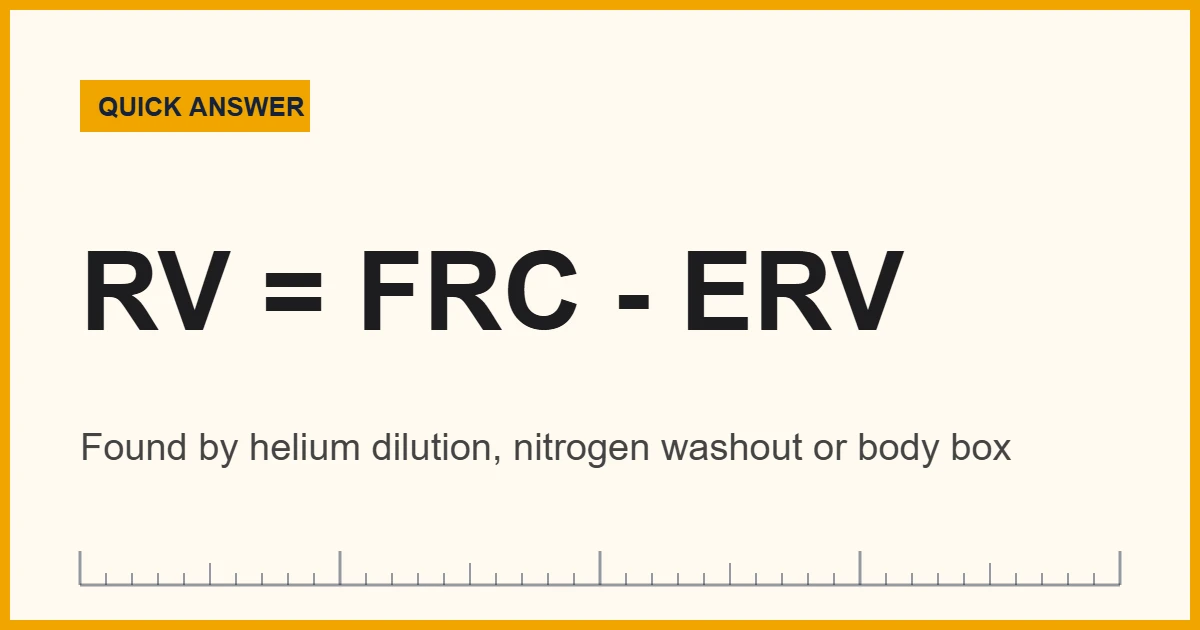
In short: spirometry measures changes in lung volume, while residual volume is a starting amount that never changes during the test. To find it, the lab first measures the gas in the lungs at the end of a normal breath, called the functional residual capacity (FRC). Next, it subtracts the part you can still breathe out.
What the Standards Say About Residual Volume
The joint European Respiratory Society and American Thoracic Society standard on lung volumes describes exactly this route. According to the ERS/ATS 2023 technical standard, labs derive RV from FRC plus spirometry, and they get FRC from plethysmography, washout or dilution. Similarly, the NIH-hosted StatPearls review of pulmonary function tests notes that spirometry alone cannot measure residual volume.
This guide explains the physics behind each method, with worked numbers you can check yourself. It is written for students and curious readers, so it explains how the measurement works rather than what any result means for your health.
Convert Lung Volumes Between Liters, Milliliters and Cups
Lung volume reports use liters, while some textbooks use milliliters. So type a value below to see it in other units. For example, enter a residual volume from a worked problem to picture it as a familiar amount of liquid.
One milliliter equals one cubic centimeter, so lab reports may also write cc. If that unit is new to you, see what cc stands for in measurement.
Recommended Study Tools for Respiratory Physiology
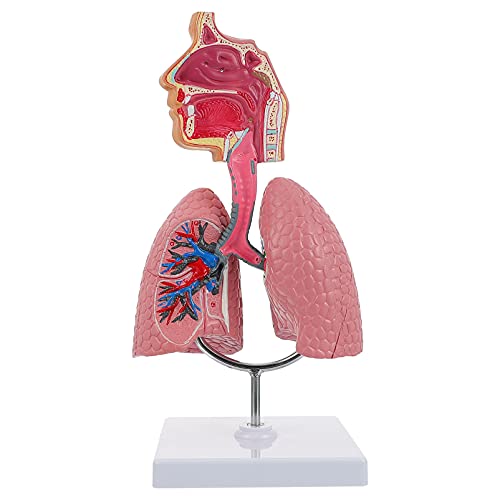
If you are learning lung volumes for a class, a clear textbook and a physical model help more than any gadget. First, pick a physiology text that walks through dilution and Boyle’s law with diagrams. Then, a lung model makes the idea of air that stays behind easier to picture.


As an Amazon Associate, Measuring Expert earns from qualifying purchases.
Key Takeaways
- Residual volume is the gas left in the lungs after a maximal breath out.
- Spirometry only sees air that moves, so it cannot measure RV or any capacity that contains RV.
- Labs measure FRC first, then calculate RV = FRC – ERV.
- Helium dilution and nitrogen washout track a tracer gas that mixes with lung air.
- Body plethysmography uses Boyle’s law and counts all gas in the chest, even gas behind narrowed airways.
- Gas methods can read low when air is trapped; the box method avoids that problem.
- Only a clinician can interpret a real test result.
What Residual Volume Is and Where It Fits
Physiologists split the air in the lungs into four basic volumes. Then they add some of them together to form capacities. Residual volume is the only basic volume you cannot move with your own breathing muscles.
| Term | What it describes | Can spirometry measure it? |
|---|---|---|
| Tidal volume (VT) | Air moved in one normal, relaxed breath | Yes |
| Inspiratory reserve volume (IRV) | Extra air you can breathe in after a normal breath in | Yes |
| Expiratory reserve volume (ERV) | Extra air you can push out after a normal breath out | Yes |
| Residual volume (RV) | Air left after a maximal breath out | No |
| Vital capacity (VC) | IRV + VT + ERV, the most air you can move in one breath | Yes |
| Functional residual capacity (FRC) | ERV + RV, the air in the lungs at the end of a quiet breath out | No |
| Total lung capacity (TLC) | All four volumes together | No |
Notice the pattern. Every row that includes RV gets a “No”. For a closer look at the movable parts, see how tidal volume is measured and what expiratory reserve volume measures. For scale, the NIH notes that healthy adults average about 6 liters of total lung capacity.
Why Spirometry Cannot Measure Residual Volume
A spirometer measures flow at the mouth and adds it up over time. As a result, every number it reports is a difference between two lung volumes, never an absolute amount. Think of a bucket with a fixed puddle at the bottom that you cannot pour out. You can measure every cup you pour in or out, yet those cups tell you nothing about the puddle.
Residual volume is that puddle. Several things hold it in place. First, the chest wall springs outward and resists squeezing further. Second, small airways narrow and close as the lungs empty, which traps gas behind them. Finally, the air sacs never fully collapse in healthy lungs, so some gas always stays.
So the question is not about a weak or cheap spirometer. Even a perfect one cannot record gas that never passes through it. Because of this, labs switch tactics. Instead of counting air that leaves, they either dilute a known gas inside the lungs or squeeze the chest gas and watch the pressure.
Residual Volume Methods Compared
All three methods find FRC first. Then the lab subtracts ERV, which a spirometer can measure, to get residual volume. Here is how they differ.
| Feature | Helium dilution | Nitrogen washout | Body plethysmography |
|---|---|---|---|
| Physical idea | Mixing a known amount of tracer gas | Washing out the nitrogen already in the lungs | Boyle’s law (pressure times volume stays constant) |
| Circuit | Closed (you rebreathe the same gas) | Open (you breathe 100% oxygen) | Sealed box around the person |
| What it counts | Gas that talks to the airways | Gas that talks to the airways | All compressible gas in the chest |
| End point | Helium level stops changing | Nitrogen falls to 1/40 of its start level | A few seconds of panting against a shutter |
| Trapped air | Can read low | Can read low | Includes it |
In other words, the gas methods measure the “ventilated” lung, while the box measures the whole chest. That difference becomes the main clue in obstructive lung disease, discussed later.
Helium Dilution: Measuring Residual Volume by Mixing
Helium works well as a tracer because it barely dissolves in blood or tissue. At the end of a normal breath out, a valve connects you to a spirometer that holds a known volume of gas with a known helium level. Then you breathe in and out of that closed system. Meanwhile, a carbon dioxide absorber removes the CO2 you exhale, and the system adds oxygen to replace what you use.
The helium spreads into your lungs until the level evens out. The AARC lab guideline treats mixing as complete when the helium reading holds steady for 2 minutes, or after 10 minutes. Because no helium leaves the circuit, the amount stays the same, so:
C1 x V1 = C2 x (V1 + FRC), so FRC = V1 x (C1 – C2) / C2For example, suppose the circuit holds 8.0 L at 10% helium, and the reading settles at 7.27%. Then FRC = 8.0 x (10 – 7.27) / 7.27 = 3.00 L. If spirometry showed an ERV of 1.1 L, the residual volume would be 3.00 – 1.1 = 1.9 L. These numbers are only a worked example, not typical values.
Nitrogen Washout: Counting the Gas You Already Carry
Room air is about 78% nitrogen, so your lungs already hold a built-in tracer. In this test, you switch at FRC to breathing pure oxygen. Each breath then carries some nitrogen out and brings none back. A fast gas analyzer at the mouth measures the nitrogen in every exhaled breath.
The test continues until the nitrogen falls very low. The ERS/ATS standard ends it once the end-of-breath nitrogen stays below 1/40 of its starting level for three breaths in a row. Next, the computer adds up all the nitrogen that came out and divides by the starting nitrogen fraction in the lungs:
FRC = total N2 washed out / starting alveolar N2 fractionAs an illustration, if the analyzer counts 2.25 L of nitrogen and the starting fraction was 0.75, then FRC = 2.25 / 0.75 = 3.0 L. Subtracting ERV then gives residual volume, exactly as in the helium example.
Body Plethysmography: Boyle’s Law in a Glass Box
For this test, you sit inside a sealed, clear cabinet about the size of a phone booth. At the end of a normal breath out, a shutter briefly closes the mouthpiece. Then you pant gently against it, at about 0.5 to 1 breaths per second according to the ERS/ATS standard.
Each pant squeezes and stretches the gas in your chest slightly. A sensor at the mouth reads the pressure change, and the box reads the tiny volume change. Boyle’s law links the two:
FRC = P x (change in volume) / (change in pressure)Here P is the barometric pressure minus water vapor pressure, about 969 cm H2O at sea level. For example, a 30 mL volume change with a 10 cm H2O pressure swing gives 969 x 0.030 / 10 = 2.91 L. So the box sees all gas that compresses, including pockets behind closed airways. StatPearls calls it the gold standard for lung volumes, especially when airflow is uneven. For the general physics, see how to measure the volume of a gas.
How to Calculate Residual Volume From Test Values
Students often get the pieces of a report and must assemble them. Follow these steps with any worked problem.
- Find FRC from the method used (helium, nitrogen or plethysmography).
- Read the expiratory reserve volume (ERV) from the spirometry maneuver.
- Subtract to get residual volume: RV = FRC – ERV.
- Add inspiratory capacity (IC) to FRC to get total lung capacity: TLC = FRC + IC.
- Check your work: TLC should equal RV plus vital capacity.
- Convert units with the converter above if the problem mixes liters and milliliters.
The 2023 standard actually prefers a slightly different order in the lab. It calculates TLC first, then subtracts the largest vital capacity to get RV. Either way, the arithmetic rests on the same identities.
Do and Don’t When Studying Lung Volumes
Do
- Remember that capacities are sums of volumes.
- Write RV = FRC – ERV on every exam sheet.
- Name the method when you compare two results.
- Keep liters and milliliters straight.
Don’t
- Say a spirometer measures FRC or TLC.
- Assume helium and box results always agree.
- Compare your numbers with someone else’s chart.
- Read a real report without a clinician.
Why Residual Volume Matters in Lung Function Testing
A spirometer can show that airflow is reduced, but it cannot always say why. Lung volumes fill that gap. For instance, StatPearls explains that a total lung capacity below 80% of predicted points to a restrictive pattern. Conversely, a raised residual volume can signal gas trapping in obstructive conditions.
The method also matters here. Gas methods may undercount FRC when air is trapped, because the tracer cannot reach the closed-off pockets. Meanwhile, the box counts those pockets. So when a lab runs both, the gap between them is itself useful information for the doctor.
Honest Limits of Residual Volume Measurement
No method is perfect, and each one has known weak spots.
- Gas dilution and washout can underestimate FRC with airflow limitation and air trapping, as both the AARC and ERS/ATS documents state.
- Plethysmography may overestimate FRC in severe obstruction if the person pants too fast; the 2023 standard flags rates above 1.5 per second.
- RV depends on effort, because a weaker final breath out leaves more air behind.
- Small errors add up, since RV is a difference between two measured numbers.
- Predicted values depend on age, height, sex and the reference equations a lab uses.
When to Talk to a Professional
If you have symptoms or a test result you do not understand, talk to your doctor or a pulmonologist. A pulmonary function lab can choose the right method and compare your values with proper reference equations. Also, your clinician can explain what the numbers mean in the context of your history.
Residual Volume FAQs
Why can’t residual volume be measured with spirometry?
Spirometry only measures air that moves in or out through the mouthpiece. Residual volume never leaves the lungs, so the spirometer has nothing to record. Labs therefore find it indirectly from FRC.
What is the formula for residual volume?
RV = FRC – ERV. You can also write RV = TLC – VC. Both come from the definitions of the lung capacities.
Which lung volumes can a spirometer measure?
It can measure tidal volume, inspiratory reserve volume, expiratory reserve volume and vital capacity. It cannot measure residual volume, FRC or TLC.
How does helium dilution find residual volume?
You rebreathe a known volume of helium mix until the level evens out. The drop in concentration gives FRC, and subtracting ERV gives RV.
How does nitrogen washout work?
You breathe pure oxygen until the nitrogen in your lungs is washed out. The total nitrogen exhaled, divided by the starting fraction, gives FRC.
Why is body plethysmography called the gold standard?
It uses Boyle’s law to count all compressible gas in the chest. As a result, it includes air trapped behind narrowed airways that gas methods can miss.
Why do gas methods read low in some people?
The tracer gas cannot reach trapped or slowly mixing air. So the method only measures the part of the lungs that is well ventilated.
Can residual volume ever be zero?
No. The chest wall resists further squeezing and small airways close as the lungs empty, so some gas always remains.
What is the difference between residual volume and FRC?
FRC is the air left after a normal breath out. Residual volume is the smaller amount left after a maximal breath out. FRC equals RV plus ERV.
Is residual volume measured in liters or milliliters?
Lab reports usually give lung volumes in liters. Textbooks sometimes use milliliters, and 1 L equals 1,000 mL.
Bottom Line
Residual volume stays in the lungs, so a spirometer, which counts only moving air, can never measure it. Instead, labs measure FRC with helium dilution, nitrogen washout or body plethysmography, then subtract the expiratory reserve volume.
Each method has trade-offs. Gas methods can miss trapped air, while the box counts it. For exams, remember RV = FRC – ERV. For real results, rely on a pulmonary function lab and your doctor.