

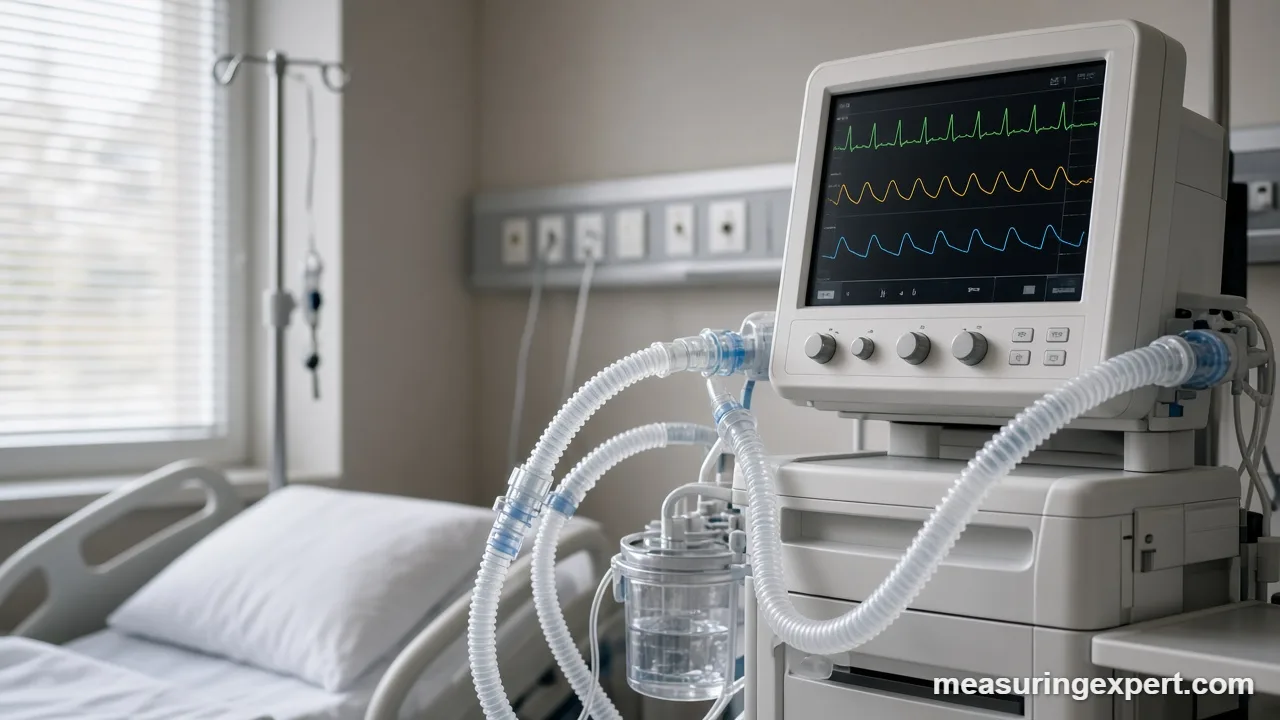
Tidal volume is the air you move in or out with one normal, relaxed breath. In a healthy adult at rest it is about 500 mL (roughly 17 US fl oz), or about 7 mL per kg of ideal body weight. Clinicians measure it with a spirometer or read it on a ventilator display.



As an Amazon Associate, Measuring Expert earns from qualifying purchases.
First, take a quiet breath while you read this sentence. That small, easy breath, not a deep gulp, is in fact your tidal volume. Also, the name comes from the way air flows in and out of the lungs like a tide. As a result, it is the starting point for almost every other lung measurement, from vital capacity to the settings on a hospital ventilator.
In short: you can estimate tidal volume from body size, but you need a spirometer, a ventilator or a lab plethysmograph to actually measure it. For example, a typical adult man moves about 500 mL per breath and a typical adult woman about 400 mL, according to clinical physiology references.
The US National Library of Medicine’s StatPearls review Physiology, Tidal Volume gives these figures, puts the healthy adult value at about 7 mL/kg of ideal body weight, and explains that minute ventilation equals respiratory rate times tidal volume. Meanwhile, for people on a ventilator, the landmark ARDS Network trial (New England Journal of Medicine, 2000) showed that smaller breaths of 6 mL/kg predicted body weight saved lives compared with 12 mL/kg.
Above all, this guide is educational. First, it shows the formulas with worked numbers. Next, it compares the ways clinicians measure a breath. Finally, it covers the limits of each method and why only a clinician should judge your own results.
Convert a Breath Volume to Other Units
Typically, spirometry reports and ventilator screens show tidal volume in milliliters or liters. So, if you want to picture a breath in fluid ounces or cups, enter the value below. Note, however, that the default of 500 mL is a typical resting adult figure, not a target for anyone.
For example, a 500 mL breath is about 16.9 US fluid ounces, or a little more than two US cups. Also note that 1 mL is the same as 1 cc, which is the unit some older respiratory charts still use.
Recommended Tools for Breathing Practice and Tracking at Home
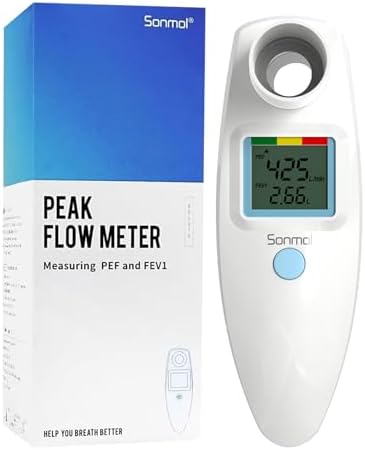
To be clear, home devices do not give a lab-grade tidal volume. However, a few tools are useful for students and for patients who follow a care plan. For example, an incentive spirometer shows how much air you can draw in on a slow, deep breath, and a peak flow meter tracks how fast you can blow out. Even so, use them only as your care team directs.
- Tidal volume (VT) is the air moved in one normal breath at rest.
- Also, healthy adults average about 500 mL for men and about 400 mL for women.
- For example, a common rule of thumb is about 7 mL per kg of ideal body weight.
- Minute ventilation = tidal volume x breaths per minute (500 mL x 12 = 6 L/min).
- In practice, spirometry measures it at a clinic; ventilators measure every breath in hospital.
- In addition, lung-protective ventilation uses about 6 to 8 mL/kg of predicted body weight.
- Therefore, only a clinician can judge whether a number is normal for you.
Tidal Volume Formulas and Worked Examples
In general, three simple equations cover most questions. First, the weight-based estimate gives a rough expected value. Next, minute ventilation shows how much air moves each minute. Finally, alveolar ventilation shows how much of that air actually reaches the gas-exchange areas of the lungs.
Estimated VT (mL) = 7 mL/kg x ideal body weight (kg) Minute ventilation (L/min) = VT (L) x respiratory rate (breaths/min) Alveolar ventilation (L/min) = (VT – dead space) x respiratory rateFor example, take a resting adult with an ideal body weight of 70 kg (about 154 lb). In that case, the estimate is 7 x 70 = 490 mL per breath. Then, at 12 breaths per minute, a 500 mL breath gives 0.5 x 12 = 6.0 L/min of minute ventilation. However, roughly 150 mL of each breath stays in the airways (the anatomic dead space) and never reaches the alveoli. As a result, alveolar ventilation is (500 – 150) x 12 = 4,200 mL, or 4.2 L/min.
| Breath size | Rate | Minute ventilation | Alveolar ventilation (150 mL dead space) |
|---|---|---|---|
| 500 mL | 12 /min | 6.0 L/min | 4.2 L/min |
| 400 mL | 15 /min | 6.0 L/min | 3.75 L/min |
| 300 mL | 20 /min | 6.0 L/min | 3.0 L/min |
| 600 mL | 16 /min | 9.6 L/min | 7.2 L/min |
Now notice the first three rows. In fact, each one moves the same 6 L every minute. Even so, the fast, shallow pattern sends much less fresh air to the alveoli, because the dead space is subtracted on every single breath. For this reason, clinicians look at breath size and rate together, not minute ventilation alone.
Tidal Volume Among the Other Lung Volumes
Of course, tidal volume is only one slice of the lungs’ total capacity. In addition, three other volumes stack around it, and adding them gives the capacities you see on a full lung function report. Note that the values below are typical textbook figures for a healthy young adult man; women and smaller or older adults usually have lower values.
| Volume or capacity | What it means | Typical adult value |
|---|---|---|
| Tidal volume (VT) | Air in one quiet breath | about 500 mL |
| Inspiratory reserve volume (IRV) | Extra air you can breathe in after a normal breath | about 3,000 mL |
| Expiratory reserve volume (ERV) | Extra air you can push out after a normal breath out | about 1,100 to 1,200 mL |
| Residual volume (RV) | Air left after the hardest possible breath out | about 1,200 mL |
| Vital capacity (VC) | VT + IRV + ERV | about 4,600 to 4,800 mL |
| Total lung capacity (TLC) | VC + RV | about 6,000 mL |
In other words, a quiet breath uses less than a tenth of total lung capacity. Residual volume, by contrast, cannot be blown out at all, so a spirometer cannot see it. For that reason, our guide on how residual volume is measured explains the gas dilution and body box methods used instead.
Ways to Measure Tidal Volume Compared
In practice, each method trades accuracy for convenience. For instance, a ventilator measures every breath but only for people on one, while a classroom water bottle is easy but rough.
| Method | Where it is used | How it works | Main limitation |
|---|---|---|---|
| Spirometry | Clinics, lung function labs | A flow sensor in the mouthpiece measures airflow; the software adds it up over time | However, the mouthpiece and nose clip can change how you breathe |
| Ventilator flow sensor | Intensive care, operating rooms | Measures inhaled (VTi) and exhaled (VTe) volume on every breath | Also, leaks around the tube or mask make readings drop |
| Body plethysmography | Lung function labs | You sit in a sealed box; pressure changes reveal lung volumes | However, it is expensive because it needs a lab and trained staff |
| Respiratory inductance bands | Sleep studies, research | Elastic bands around chest and belly track movement | Therefore, the bands must be calibrated against a spirometer |
| Water displacement bottle | Classroom experiments | You breathe out through a tube into an inverted, water-filled bottle | Rough, because people tend to breathe deeper than normal |
| Chest tape measure | Fitness and home tips | Measures chest size after a breath in and a breath out | Gives a length in inches or cm, not a volume; it cannot measure a breath |
| Weight-based estimate | Anywhere | 7 mL/kg x ideal body weight | Instead of a measurement, it is only an estimate |
How Spirometry Measures Tidal Volume
Here is what usually happens at a lung function test. Keep in mind that the steps are for understanding only; the technician guides every part of a real test.
- Sit upright and relax. You sit in a chair with your feet flat, and the technician explains the test.
- Put on the nose clip. Then a soft clip closes your nose so all the air goes through the mouthpiece.
- Seal your lips around the mouthpiece. After that, a tight seal stops air from escaping around the sides.
- Breathe normally. Then you take several quiet, relaxed breaths while the flow sensor records each one.
- Let the software average. Next, the computer integrates flow over time and averages several steady breaths into one tidal volume.
- Follow any extra maneuvers. Finally, the technician may ask for a full breath in and a hard breath out to measure vital capacity and other values.
Because one breath can be bigger or smaller than the next, the averaged value is more reliable than any single breath. In addition, people often breathe a little deeper with a mouthpiece in, so the result may read slightly high.
Tidal Volume on a Ventilator: The 6 to 8 mL/kg Rule
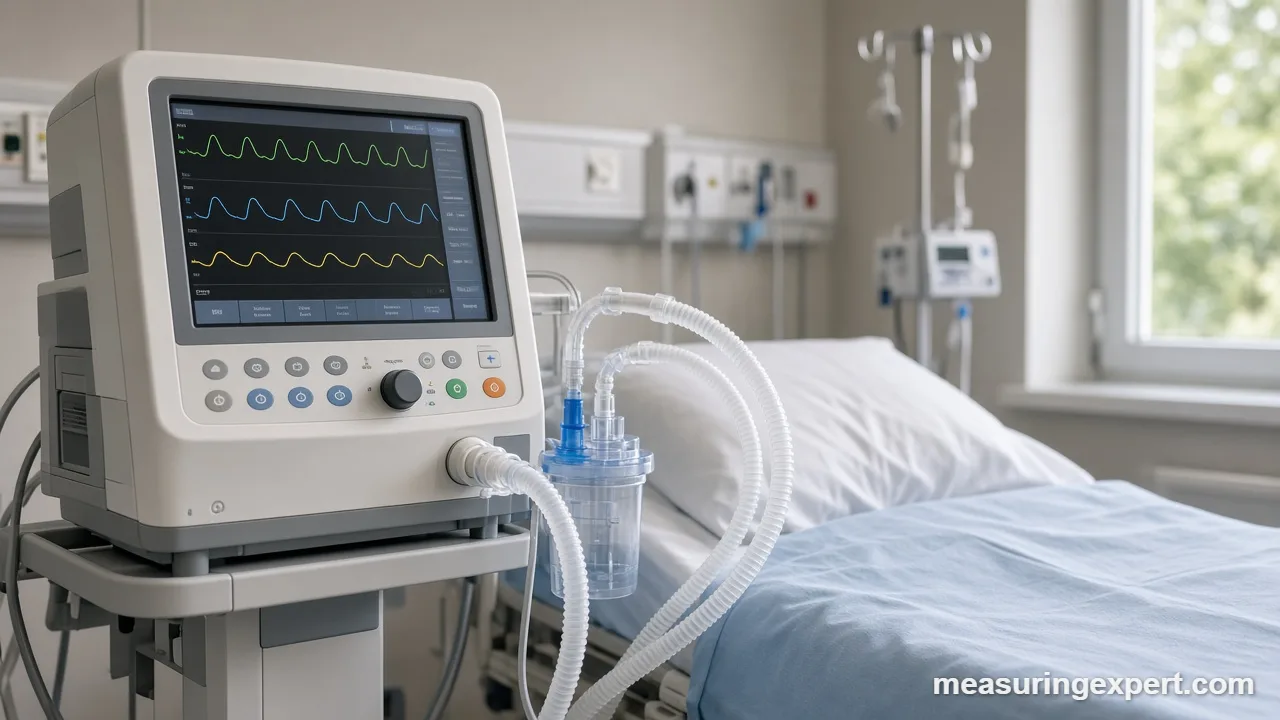
On a ventilator, by contrast, the machine delivers a set breath size. In the past, for instance, breaths of 10 to 15 mL/kg were common. However, the ARDS Network trial compared 6 mL/kg with 12 mL/kg of predicted body weight in 861 patients with acute lung injury or ARDS. As a result, the smaller-breath group had lower mortality, 31.0% versus 39.8%, and it also aimed to keep plateau pressure at or below 30 cm H2O.
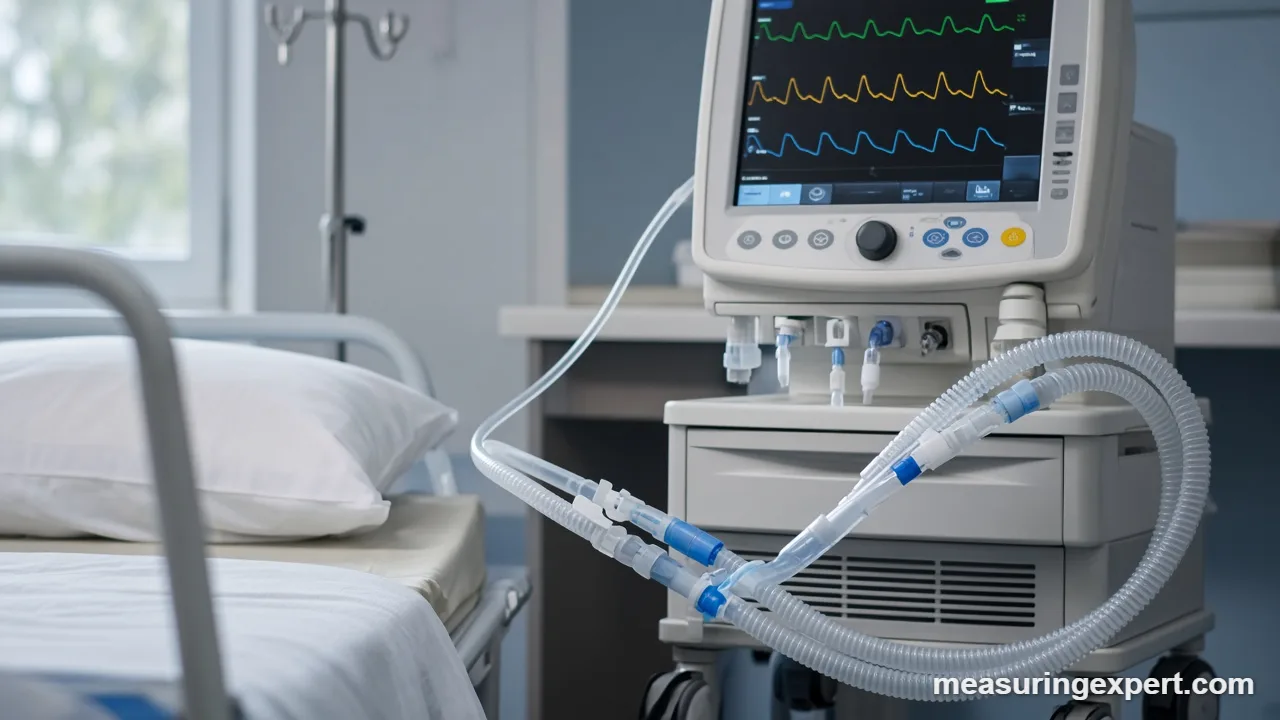
Today, therefore, lung-protective ventilation usually starts at about 6 to 8 mL/kg of predicted body weight (StatPearls). The key word, however, is predicted. That is because the calculation uses height and sex, not actual weight, since lung size tracks height. Therefore, a heavier patient does not get bigger breaths.
Male PBW (kg) = 50 + 2.3 x (height in inches – 60) Female PBW (kg) = 45.5 + 2.3 x (height in inches – 60)| Height and sex | Predicted body weight | 6 mL/kg | 8 mL/kg |
|---|---|---|---|
| 5 ft 0 in (152 cm), female | 45.5 kg (100 lb) | 273 mL | 364 mL |
| 5 ft 4 in (163 cm), female | 54.7 kg (121 lb) | 328 mL | 438 mL |
| 5 ft 6 in (168 cm), male | 63.8 kg (141 lb) | 383 mL | 510 mL |
| 5 ft 10 in (178 cm), male | 73.0 kg (161 lb) | 438 mL | 584 mL |
| 6 ft 0 in (183 cm), male | 77.6 kg (171 lb) | 466 mL | 621 mL |
In short, these numbers show how the formula works. However, they are not settings for any patient, because the care team adjusts the breath size to pressures, blood gases and the person’s condition.
What Changes Tidal Volume
Of course, breath size is not fixed. Instead, it rises and falls with what the body needs:
- Exercise. For example, hard exercise can raise breath size several times over, together with a faster rate.
- Body size and sex. In general, taller people have larger lungs, so their breaths tend to be larger.
- Sleep. Similarly, breathing usually becomes slightly shallower during sleep.
- Lung and chest conditions. Also, stiff lungs, weak breathing muscles or chest wall problems can make breaths smaller.
- Medicines. In addition, some sedatives and opioids can slow and shrink breathing.
Likewise, the heart has a matching idea. In other words, just as tidal volume is the air per breath, stroke volume is the blood per heartbeat. Accordingly, our guide on how to measure stroke volume covers that side of the picture.
Tidal Volume Do and Don’t
Do
- Average several quiet breaths, because one can mislead.
- Use predicted body weight for ventilator math.
- Look at breath size and also rate together.
- Keep units straight: 1 mL equals 1 cc.
- Bring questions about results to your clinician instead.
Don’t
- Treat a weight-based estimate as a measurement.
- Use actual body weight to size ventilator breaths.
- Read an incentive spirometer as a tidal volume, because it measures a deep breath.
- Adjust any breathing machine yourself.
- Compare your numbers with someone else’s, since bodies differ.
Honest Limits of Tidal Volume Numbers
First of all, every figure on this page is an average. For one thing, healthy people vary widely, and the 500 mL figure describes a typical adult man, not a target. Moreover, the act of measuring changes breathing: a mouthpiece and nose clip often make people breathe deeper. Similarly, ventilator readings have their own errors, because leaks lower the exhaled value and tubing can stretch slightly. Finally, the PBW formulas were built for adults and are not accurate for children or for very short adults. In short, these numbers help you understand a report, but they cannot replace a clinician’s reading of it.
When to See a Professional
Clearly, breath size on its own rarely tells the full story. Even so, some signs deserve prompt medical attention: shortness of breath at rest, breathing that feels fast and shallow, chest pain, lips or fingertips that look blue or gray, or confusion. In those cases, call your doctor or emergency services right away. Otherwise, for planned testing, a pulmonologist or a lung function lab can measure tidal volume and the other lung volumes properly.
Frequently Asked Questions
What is a normal tidal volume?
In healthy adults at rest, it is about 500 mL for men and about 400 mL for women, or roughly 7 mL per kg of ideal body weight.
How do doctors measure tidal volume?
Most often with a spirometer during a lung function test. In addition, in hospital, ventilators measure the volume of every breath, and labs can use body plethysmography.
What is the tidal volume formula for minute ventilation?
Minute ventilation equals tidal volume times respiratory rate. For example, 500 mL x 12 breaths per minute = 6 L per minute.
Why are ventilator breaths set at 6 to 8 mL/kg?
Smaller breaths protect the lungs from overstretching. In fact, a large trial found that 6 mL/kg of predicted body weight lowered mortality compared with 12 mL/kg in patients with ARDS.
What is predicted body weight?
In short, it is a weight estimated from height and sex: 50 kg for men or 45.5 kg for women, plus 2.3 kg for every inch over 5 feet.
Can I measure tidal volume at home?
Not accurately. For example, a classroom water bottle gives a rough idea, and an incentive spirometer shows a deep breath in, but neither replaces clinical spirometry.
Is tidal volume the same as vital capacity?
No. Vital capacity is the most air you can breathe out after the deepest breath in, about 4,600 to 4,800 mL in a young adult man. By contrast, a quiet breath is much smaller.
How many cups is a 500 mL breath?
About 2.11 US cups, or in other words 16.9 US fluid ounces.
What is the difference between VTi and VTe?
In short, VTi is the inhaled volume and VTe is the exhaled volume a ventilator measures. So if VTe is much lower than VTi, there may be a leak.
Does tidal volume increase during exercise?
Yes. During exercise, for example, both breath size and breathing rate rise, so minute ventilation can increase many times over.
Tidal Volume: The Bottom Line
To sum up, tidal volume is the air in one quiet breath, about 500 mL in a typical adult man and 400 mL in a typical woman. Then multiply it by the breathing rate and you get minute ventilation; size it by predicted body weight and you get the 6 to 8 mL/kg range used for lung-protective ventilation.
Finally, remember that these are reference figures for understanding, not personal targets. Also, use the converter above to picture any breath in liters, ounces or cups, and take questions about your own results to a doctor or respiratory therapist.
Black Friday is coming: shop the deals with Prime