
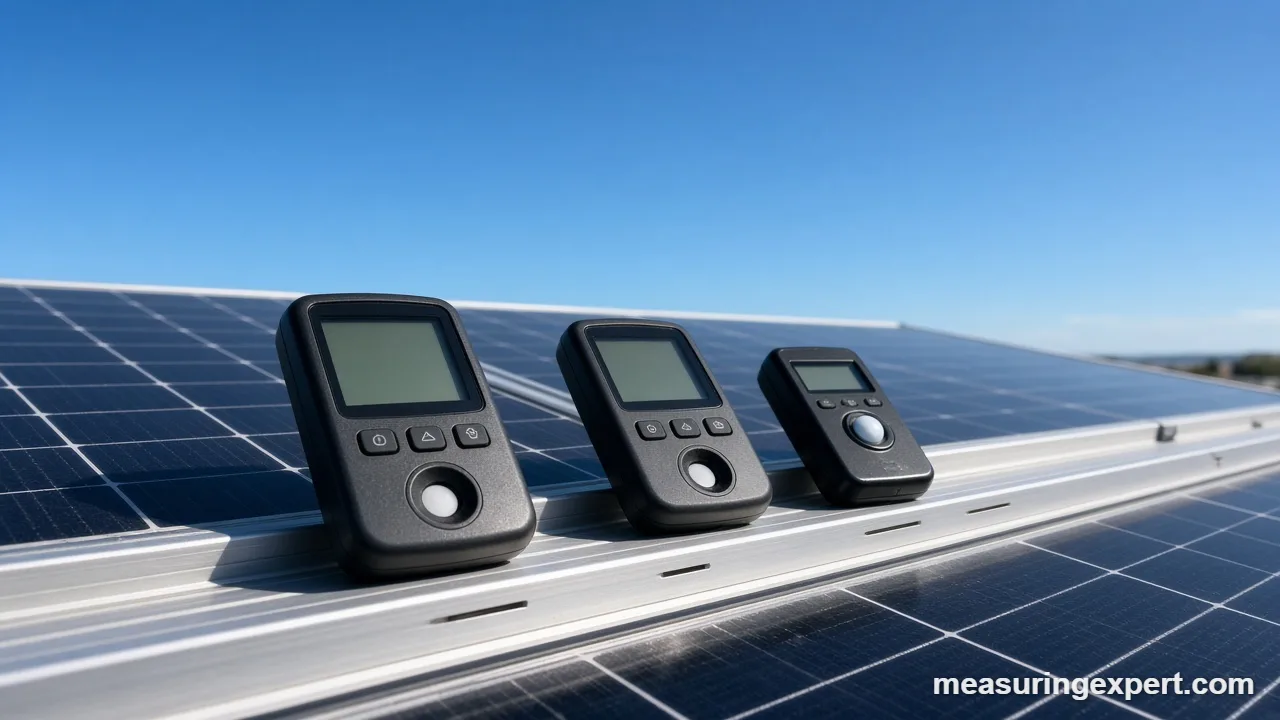
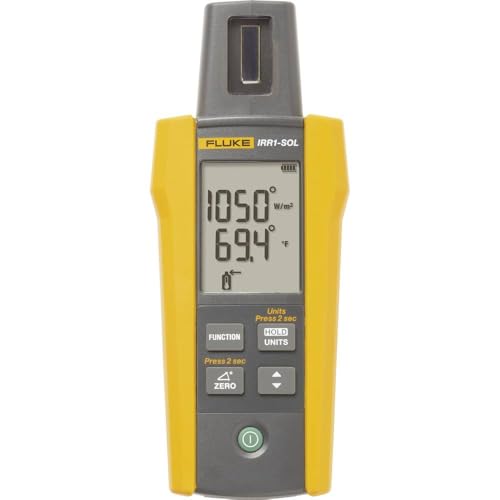
The best solar radiation meter for most buyers is the Fluke IRR1-SOL, because it reads 100 to 1,400 W/m2 with stated accuracy and also logs tilt, heading and panel temperature. However, the right choice depends on what you measure: power for solar panels, the UV index for sun safety, or PAR for plants.
In short: get the Fluke IRR1-SOL for PV work, the FLIR PV78 for app logging, and the Solarmeter 6.5 for UV index readings.
As an Amazon Associate, Measuring Expert earns from qualifying purchases. Our picks are based on research, specifications and owner feedback, not paid placement.
Best Overall
Best Smart

Quick Answer: Which Meter Matches Your Sunlight Question?
- Solar panel output and inspections: the Fluke IRR1-SOL.
- Logging readings to a phone: the FLIR PV78 with the METERLiNK app.
- UV index for sun safety: the Solarmeter Model 6.5.
- Reptile basking lamps: the Solarmeter Model 6.5R.
- Greenhouse and grow-light PAR: the Apogee MQ-500 quantum meter.
- Cheap DIY panel aiming: the VBR-SOL with its angle reading.
- Classroom or backyard site checks: a basic SM206 meter.
On This Page
- Comparison table
- The 7 picks, reviewed
- How we chose
- Meter types compared
- Specs that matter
- Irradiance units and conversions
- How to take a reading
- Calibration and care
- Honest limits
- FAQ
- Bottom line
Best Solar Radiation Meter Comparison Table
| # | Product | Best For | Standout Feature | Amazon |
|---|---|---|---|---|
| 1 | Fluke IRR1-SOL Solar Irradiance Meter | PV installers and inspectors | Irradiance, tilt, compass and module temperature in one | View |
| 2 | FLIR PV78 Solar Irradiance and Temperature Meter | Logging to a phone app | Bluetooth link to the METERLiNK app | View |
| 3 | Solarmeter Model 6.5 UV Index Meter | Sun safety and UV research | Erythemally weighted UV index sensor | View |
| 4 | Solarmeter Model 6.5R Reptile UV Index Meter | Reptile UV lamps and basking spots | UV index readings mapped to Ferguson zones | View |
| 5 | Apogee Instruments MQ-500 Full-Spectrum Quantum Meter | Greenhouses and grow lights | Reads PAR as PPFD for sunlight and LEDs | View |
| 6 | VBR-SOL Solar Power Meter with Panel Angle Measurement | DIY panel aiming | Irradiance plus panel angle in a low-cost unit | View |
| 7 | SM206 Solar Power Meter | Quick sunny-spot checks | The common SM206 design at a low price | View |
The 7 Best Solar Radiation Meter Picks, Reviewed
Best Overall
1. Fluke IRR1-SOL Solar Irradiance Meter
Best for: solar installers, inspectors and serious DIY owners who need irradiance, panel tilt, compass heading and module temperature from one rugged tool.
The Fluke IRR1-SOL is a handheld irradiance meter built for photovoltaic (PV) work. First, you hold it flat against the module, and it reads the sunlight striking that plane in watts per square meter (W/m2). At the same time, it shows the tilt angle and compass heading, so you can log how the array is oriented while you take the reading.
Specifically, Fluke rates the irradiance range at 100 to 1,400 W/m2 with 1 W/m2 resolution. Accuracy is plus or minus (5% + 5 digits) at incidence angles up to 35 degrees, referenced to the AM1.5 spectrum from ASTM G173. In addition, the kit includes an external probe with a suction cup, so you can stick it to the back of a module and read cell temperature. As a result, this is the best solar radiation meter here for anyone who has to compare real output against the panel’s rated output.
- Irradiance: 100 to 1,400 W/m2, 1 W/m2 resolution
- Accuracy: plus or minus (5% + 5 digits) up to 35 degrees incidence
- Tilt: -90 to +90 degrees; compass: 0 to 360 degrees (plus or minus 7 degrees)
- Probe temperature: -30 to 100 C (-22 to 212 F)
- Power: 4 AA batteries, about 50 hours; IP40; 231 g (8.1 oz)
Pros
- Reads irradiance, tilt, heading and temperature in one tool
- Accuracy is stated against a published reference spectrum
- Suction-cup probe reads module back temperature
- Display is made to stay readable in direct sun
Cons
- No app logging, so records are manual
- Lower limit of 100 W/m2 rules out very dim or indoor light
- Costs far more than basic sun meters
Skip it if: you only want a rough sunny-spot check for a garden panel; a basic SM206-style meter is enough for that.
Best Smart Pick
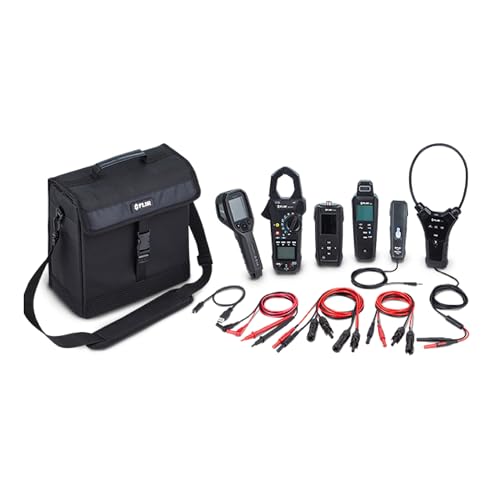
2. FLIR PV78 Solar Irradiance and Temperature Meter
Best for: installers and energy auditors who want to send irradiance and temperature readings to a phone and keep a record for each job.
The FLIR PV78 covers much of the same ground as the Fluke. However, it adds wireless logging. It pairs over Bluetooth Low Energy with the FLIR METERLiNK app, so you can save readings to a phone. It also stores data in files.
FLIR lists the irradiance range as 50 to 1,400 W/m2 with plus or minus 5% accuracy and 3 samples per second. Its lower limit is half of the Fluke’s, so it still reads on heavy overcast days. Meanwhile, the external probe reads -30 to 100 C (-22 to 212 F) at plus or minus 1.5 C, which is tighter than the Fluke’s probe spec.
- Irradiance: 50 to 1,400 W/m2, plus or minus 5%
- Sample rate: 3 per second
- External probe: -30 to 100 C, plus or minus 1.5 C (2.7 F)
- Tilt: -90 to 90 degrees (plus or minus 3 degrees); compass plus or minus 7 degrees
- Bluetooth LE up to 10 m (32 ft); 9 V battery, about 25 hours
Pros
- App logging saves time on large arrays
- Lower 50 W/m2 floor works in dull weather
- Tighter temperature probe accuracy than most rivals
- Built-in data storage
Cons
- Shorter battery life than the Fluke
- Longer body at about 240 mm (9.5 in)
- App adds a step for users who just want a number
Skip it if: you never record readings; in that case the simpler Fluke IRR1-SOL screen is quicker to use.
Best for UV Index
3. Solarmeter Model 6.5 UV Index Meter
Best for: teachers, outdoor workers, researchers and anyone who wants to check the UV index on the spot instead of trusting a regional forecast.
Not every solar radiation meter reads watts. The Solarmeter Model 6.5 from Solar Light Company reads the UV index, which is the number used in sun-safety forecasts. Moreover, its silicon carbide photodiode sits behind an erythemally weighted filter. In other words, the sensor weighs UV wavelengths by how strongly they burn skin, rather than by raw power.
Furthermore, Solar Light says the meter is designed to match the orientation of the U.S. EPA and National Weather Service UV index instruments. So you point it straight up, and it reads both direct and diffuse (sky) UV. Then you compare the value with the EPA scale: 1 to 2 is low, 3 to 7 calls for protection, and 8 or more calls for extra care.
- Measures: UV index (erythemally weighted)
- Sensor: silicon carbide (SiC) photodiode with Eeff filter
- Orientation: skyward, global normal (direct plus diffuse)
- Readout: LCD that reads while you hold the button
- Power: 9 V battery
Pros
- Reads the same quantity forecasts report
- Simple one-button operation
- Small and light enough to carry daily
- Made by a long-running UV instrument maker
Cons
- Does not read W/m2 for solar panel work
- No memory, so you note readings by hand
- Shows a reading only while you hold the button
Skip it if: you are sizing solar panels; for that you need a W/m2 meter such as the Fluke or FLIR.
Best for Reptile Keepers
4. Solarmeter Model 6.5R Reptile UV Index Meter
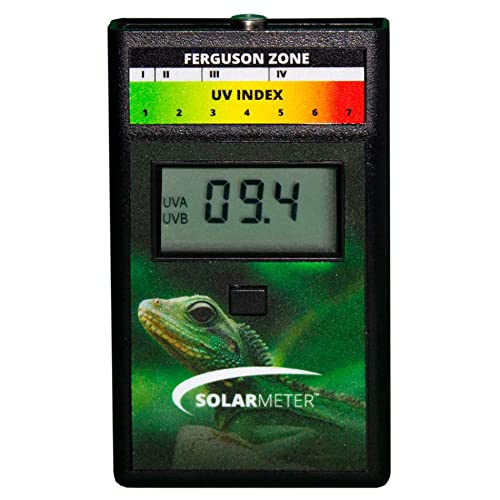
Best for: reptile keepers and zoo staff who need to check that basking spots get the right UV level for the species.
Indeed, Solar Light states that this reptile version is unchanged in operation and specs from the original meter. However, the packaging and guide focus on reptile care. In particular, the company explains that the erythemal weighting is very close to the action spectrum for vitamin D3 synthesis, which is why keepers use UV index readings at all.
In addition, readings are matched to the four Ferguson zones. For example, zones 1 and 2 cover shade-dwelling species that need low UV over a wide area. In contrast, zones 3 and 4 cover basking species that need higher UV in a smaller spot.
- Measures: UV index, erythemally weighted
- Same operation and specs as the Model 6.5
- Guide: four Ferguson zones for reptile UV needs
- Power: 9 V battery, about 2 years of typical use
- Low-battery sign: display dims below 6.5 V
Pros
- Directly answers the question keepers ask
- Long battery life
- Works outdoors and under UV lamps
- Same sensor design as a research-grade UV index meter
Cons
- Nearly identical to the Model 6.5, so pick one, not both
- No W/m2 reading, so it is not for panels
- Lamp readings change a lot with distance, so you must note it
Skip it if: you do not keep reptiles; the standard Model 6.5 does the same job for sun safety.
Best for Plants
5. Apogee Instruments MQ-500 Full-Spectrum Quantum Meter

Best for: growers, greenhouse managers and plant scientists who care about the light plants use, not the total solar power.
To begin with, plants respond to photosynthetically active radiation (PAR), the 400 to 700 nm band. In contrast, a pyranometer-style meter counts the energy across a much wider band, so it cannot tell you how much of the light a plant can use. A quantum meter such as the Apogee MQ-500 counts photons in the PAR band instead and reports photosynthetic photon flux density (PPFD).
Specifically, PPFD is given in micromoles of photons per square meter per second (umol/m2/s). Therefore, it suits checking a greenhouse bench, a shade cloth or a grow-light layout. Also, Apogee sells it as a full-spectrum model meant for both sunlight and LED lights, which matters because older quantum sensors can misread some LED spectra.
- Measures: PAR as PPFD in umol/m2/s
- Band: photosynthetically active radiation (400 to 700 nm)
- Use: sunlight and LED grow lights
- Brand: Apogee Instruments, a U.S. sensor maker
Pros
- Measures the light plants actually use
- Works under sunlight and LED fixtures
- Made by a specialist radiation sensor company
- Ideal for comparing bench positions
Cons
- Not a W/m2 meter, so it is not for PV checks
- High cost for a single-purpose tool
- PPFD does not convert to W/m2 without knowing the spectrum
Skip it if: you are checking solar panel output; a PAR reading does not tell you panel power.
Best Budget with Tilt
6. VBR-SOL Solar Power Meter with Panel Angle Measurement
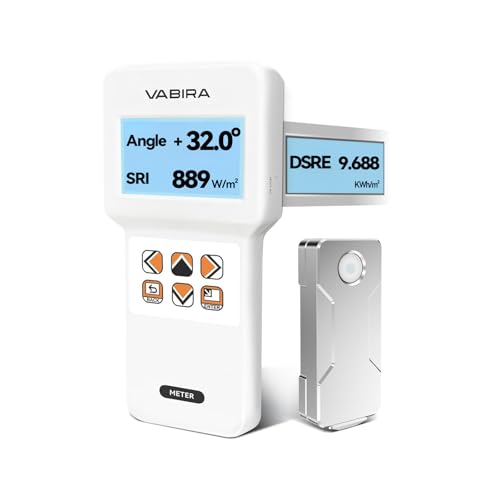
Best for: DIY solar owners, RV and off-grid users who want a cheap way to compare sun spots and set panel tilt.
Overall, the VBR-SOL is a low-cost digital solar power meter. In contrast to the most basic SM206-style units, it adds a panel angle reading. As a result, you can rest it on a panel, read irradiance in W/m2 and check the tilt in one step, which helps when you adjust seasonal mounts.
However, budget meters like this one do not publish accuracy against a reference spectrum the way Fluke and FLIR do. So treat its readings as good for comparisons: this spot versus that spot, morning versus noon, clean panel versus dusty panel. For warranty claims or commissioning reports, use a pro meter instead.
- Measures: solar irradiance in W/m2
- Extra: panel angle measurement
- Best use: relative comparisons
Pros
- Adds tilt reading at a budget price
- Simple handheld design
- Good for comparing sites and angles
- Easy for first-time users
Cons
- No published reference accuracy
- Lesser-known brand with limited support
- No temperature probe, so no module heat check
Skip it if: you need numbers for a report or a warranty claim; then choose the Fluke IRR1-SOL or FLIR PV78.
Best Basic Budget
7. SM206 Solar Power Meter

Best for: hobbyists, students and homeowners who want a simple W/m2 number to compare locations before buying a panel.
In fact, the SM206 is one of the most common budget solar meters, and several sellers offer the same basic design. Then you aim the sensor at the sun, or lay it flat on the panel, and finally read the irradiance.
Because many sellers use the SM206 name, quality and support can vary. Still, for a science project or a backyard site survey, it does the job. Next, compare your noon reading with the 1,000 W/m2 standard test condition used for panel ratings, and you will have a fair idea of how close to rated output your panel can get.
- Measures: solar irradiance in W/m2
- Best use: site comparisons and teaching
Pros
- Lowest-cost way to get a W/m2 reading
- Very simple to use
- Fine for classroom demos
- Light and pocketable
Cons
- Many look-alike sellers, so support varies
- No published reference accuracy
- No tilt or temperature, so it does one job only
Skip it if: you plan to test a commercial array; a meter with a stated reference spectrum is worth the extra cost.
How We Chose the Best Solar Radiation Meter Picks
We did not test these meters in a lab. Instead, this list is research-based. First, we looked at the solar meters a buyer can actually find on Amazon, and we favored established instrument brands such as Fluke, FLIR, Solar Light (Solarmeter) and Apogee. Next, we checked each spec against the maker’s product page, and we left out any figure we could not confirm.
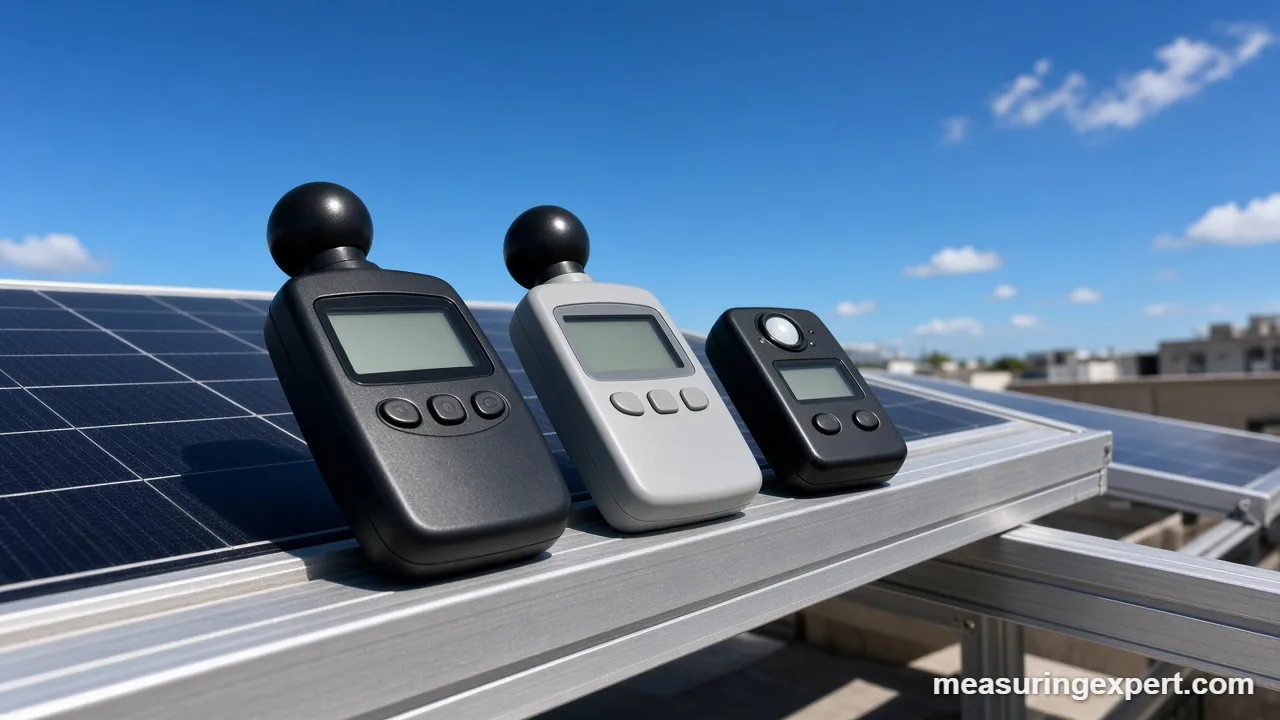
We also looked for Seaward, Triplett, Megger and other well-known meters. However, their listings were not available when we checked, so they are not on this list. Finally, we added two budget meters because many readers only need a rough number for a home project.
- The right quantity: W/m2 for panels, UV index for skin, PAR for plants.
- Published specs: range, accuracy and the reference used to state it.
- Field features: tilt, compass, temperature probe and data logging.
- Ease of use: a readable screen in full sun and simple controls.
- Support: a maker that sells calibration, manuals and spares.
For background, we used the Fluke IRR1-SOL spec page, the EPA UV Index scale and the NREL page on the ASTM G173 AM1.5 reference spectrum.
Best Solar Radiation Meter Type for Each Job
First of all, “solar radiation” covers a wide band of light. As a result, meters split into a few families, and each one answers a different question.
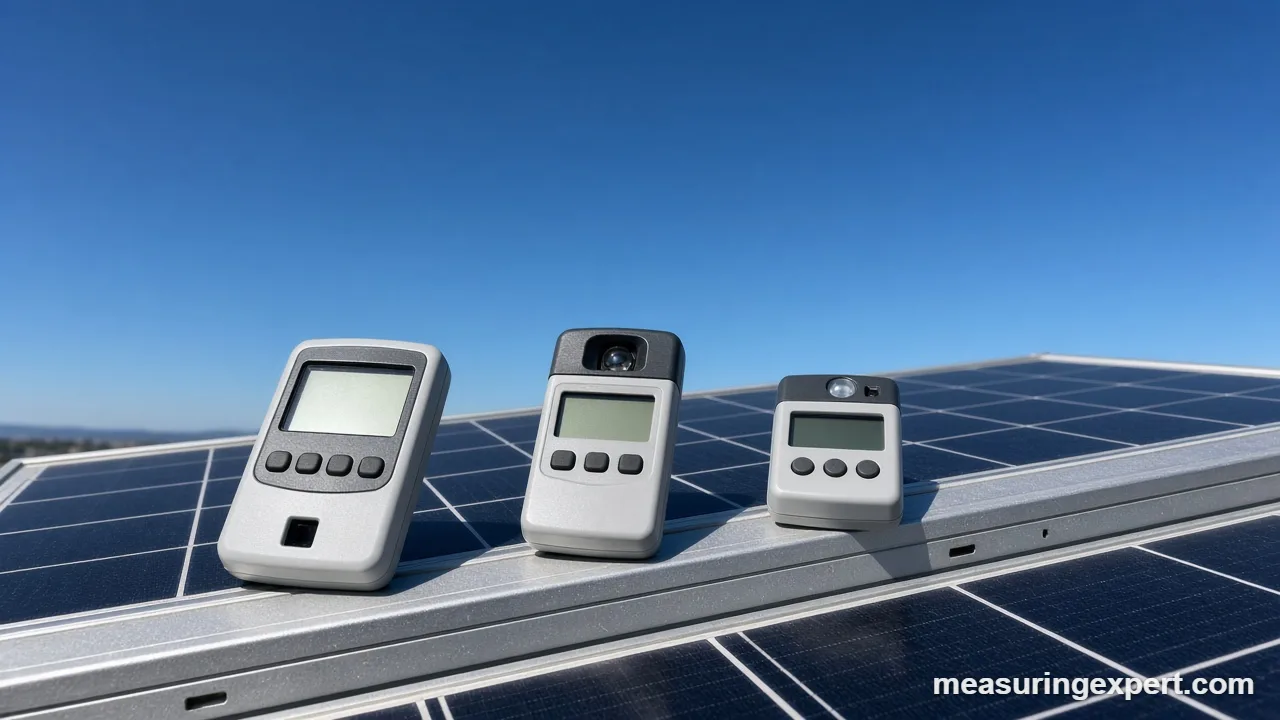
| Type | Measures | Unit | Typical user |
|---|---|---|---|
| Solar power (irradiance) meter | Total sunlight power on a surface | W/m2 or BTU/(ft2 h) | PV installers, DIY solar owners |
| Pyranometer | Global irradiance with a calibrated, classified sensor | W/m2 | Weather stations, research sites |
| UV index meter | Skin-weighted ultraviolet | UV index | Sun safety, schools, reptile care |
| Quantum (PAR) meter | Photons from 400 to 700 nm | umol/m2/s (PPFD) | Growers, plant scientists |
| Lux meter | Light as the human eye sees it | lux or foot-candles | Lighting design, not solar power |
For example, a reading of 900 W/m2 tells a solar installer a lot. However, it says little about sunburn risk, because UV is only a small slice of that power. Likewise, a grower needs PAR, since plants use only part of the spectrum. For UV-only tools, see our guide to the best UV meter, and for whole-weather logging see the best weather station picks.
What Makes the Best Solar Radiation Meter: Specs Explained
Range: In general, clear-sky sunlight on a surface facing the sun is close to 1,000 W/m2, which is also the standard test condition for panel ratings. So a range that reaches 1,400 W/m2 leaves room for bright days, high altitude and light reflected off clouds or snow. Meanwhile, the low end matters too on cloudy days.
Accuracy and the reference spectrum: Above all, an accuracy figure means little unless you know the light it was checked against. That is why Fluke states its accuracy under the AM1.5 spectrum from ASTM G173. Specifically, this reference describes sunlight after it passes through 1.5 air masses of atmosphere, onto a surface tilted 37 degrees toward the equator. In short, a meter with a stated reference is easier to trust.
Cosine response: Light that hits a sensor at a slant spreads over more area, so the true irradiance falls with the cosine of the angle. In practice, though, most handheld sensors drift at steep angles, and Fluke limits its rated accuracy to 35 degrees from straight on.
Resolution and units: Overall, a resolution of 1 W/m2 is plenty for field work. Some meters also switch to BTU/(ft2 h), which suits solar water heating work.
Extras: tilt, compass, temperature and logging: Moreover, panel output drops as cells get hot. Therefore a temperature probe for the module back is very useful when you compare real output with the rating. Similarly, tilt and compass readings help you record the array’s orientation, and logging saves time on large sites.
Irradiance Units and Conversions
So a reading of 1,000 W/m2 means each square meter of surface receives 1,000 joules of energy every second. Thus, if that holds for one hour, the surface collects 1 kWh/m2. Similarly, daily solar data is often given in kWh/m2 per day, also called peak sun hours.
| W/m2 | BTU/(ft2 h) | mW/cm2 | Typical situation |
|---|---|---|---|
| 100 | 31.7 | 10 | Heavy overcast |
| 400 | 126.8 | 40 | Thin cloud or low sun |
| 800 | 253.6 | 80 | Good sun, mid-morning |
| 1,000 | 317.0 | 100 | Standard test condition for panels |
| 1,400 | 443.8 | 140 | Top of the Fluke and FLIR range |
To summarize, the factors are 1 W/m2 = 0.317 BTU/(ft2 h) and 1 BTU/(ft2 h) = 3.155 W/m2. As a quick check, 1,000 W/m2 at the standard test condition becomes about 317 BTU/(ft2 h). Sunlight takes about 8.3 minutes to reach us, as our post on the speed of light explains.
How to Measure Sunlight With a Handheld Meter
Follow these steps for repeatable readings.
- Pick a clear time. Plan your reading for a stable sky near solar noon, because passing clouds can change irradiance by hundreds of W/m2 in seconds.
- Check the battery and zero. Turn the meter on in shade first, then confirm it reads near zero with the sensor covered.
- Match the panel plane. Hold the sensor flat against the module frame, or at the same tilt and heading, so it sees the sun the way the panel does.
- Keep the sensor clear. Keep your hand, body and shadow off the sensor, and wipe any dust off the diffuser.
- Let the reading settle. Wait a few seconds for the number to settle, then record it along with the time, tilt and temperature.
- Repeat and compare. Take at least three readings and average them; then compare the result with the panel’s output at the same moment.
Calibration and Care for Solar Meters
Above all, the diffuser on top of the sensor is the part that matters most. First, keep it clean with a soft, dry cloth, because dust and fingerprints scatter light and lower the reading. Next, store the meter in its case, away from heat, since a hot car dash can age the sensor and the screen.
Sensors also drift with time, so many owners send a pro meter back for calibration once a year. Solar Light, for instance, says the Model 10.0 is calibrated by transfer from a master meter traceable to the World Radiometric Reference.
Do and Don’t for Accurate Readings
For example, some meters, such as the Amprobe SOLAR-100, have a transmission mode that shows what share of sunlight passes through a window. That ties in well with our guide to the window-to-wall ratio if you are planning glazing.
Honest Limits of Even the Best Solar Radiation Meter
Admittedly, a pocket meter is not a research pyranometer. Handheld sensors use small photodiodes, so they respond to some wavelengths more than others. As a result, readings can shift a little under haze or at sunrise.
Also, a UV index meter and a W/m2 meter measure different things, so you cannot convert one into the other. In the same way, a PAR meter cannot tell you panel power. Finally, budget meters rarely publish their reference conditions, so use them for comparisons rather than for formal reports.
Best Solar Radiation Meter FAQ
What is the best solar radiation meter for most people?
The Fluke IRR1-SOL is the best solar radiation meter for most PV users. It reads 100 to 1,400 W/m2 with stated accuracy, and it also measures tilt, heading and module temperature. If you want phone logging, choose the FLIR PV78 instead.
What does a solar radiation meter measure?
Most models measure solar irradiance, which is the power of sunlight on a surface in watts per square meter (W/m2). Other types measure the UV index or PAR for plants. So check which quantity you need before you buy.
What is a good W/m2 reading for solar panels?
First, panels are rated at 1,000 W/m2, the standard test condition. On a clear day near noon, a panel facing the sun can see close to that value. In contrast, readings of a few hundred W/m2 are normal in haze, cloud, morning or evening.
How do I convert W/m2 to BTU per square foot per hour?
Multiply W/m2 by about 0.317. For example, 1,000 W/m2 equals about 317 BTU/(ft2 h). To go the other way, multiply BTU/(ft2 h) by about 3.155.
Is a pyranometer the same as a solar power meter?
To begin with, both measure irradiance in W/m2. However, a pyranometer usually means a calibrated sensor built to a classification standard, often mounted on a weather station. A handheld solar power meter is a portable tool, and it is usually less precise.
Can a lux meter replace a solar radiation meter?
Not reliably. After all, a lux meter weighs light by the human eye’s response, so it ignores much of the infrared and UV that panels and skin respond to. As a result, there is no single fixed factor that turns lux into W/m2 for every sky.
Which solar radiation meter is best for UV index?
The Solarmeter Model 6.5 is the best solar radiation meter for UV index on this list. It uses an erythemally weighted sensor and is designed to match the orientation of EPA and NWS UV index instruments.
Why does my meter read low at a steep angle?
First of all, most sensors lose accuracy as the sun moves away from straight on. For example, Fluke states its accuracy only up to 35 degrees of incidence. So for the most useful readings, hold the meter in the same plane as the panel.
How often should a solar irradiance meter be calibrated?
For instance, many owners recalibrate once a year, and labs often ask for a yearly certificate. Also, check the meter against a trusted reference if readings seem to drift, or after a drop.
Is the best solar radiation meter worth it for a small home system?
Not always. However, a basic meter helps you pick the sunniest spot and spot shading problems before you drill holes in the roof. For a large array, a pro meter also helps you prove underperformance.
Bottom Line on the Best Solar Radiation Meter
For most readers, the Fluke IRR1-SOL is the best solar radiation meter to buy. It reads irradiance with a stated accuracy, and it also records tilt, heading and module temperature, so one tool covers a full PV check. Next, pick the FLIR PV78 if you want app logging.
On the other hand, if your question is about skin or reptiles, a Solarmeter UV index model is the right tool. Likewise, growers should measure PAR with a quantum meter such as the Apogee MQ-500.