
The best UV meter for most people is the Solarmeter Model 6.5, because it reads the UV Index directly, the same scale the WHO and EPA use. However, the right pick depends on your light source: sunlight, a reptile UVB lamp, or a strong 365 nm or 395 nm curing LED.
In short: get the Solarmeter 6.5 for sun and reptile zones, the Solarmeter 6.2R for UVB lamp aging, and the Linshang LS125 for UV curing.
As an Amazon Associate, Measuring Expert earns from qualifying purchases. Our picks are based on research, specifications and owner feedback, not paid placement.

Best for Reptiles

Best for Curing
Quick Answer: Best UV Meter by Job
- Sun safety: the Solarmeter 6.5 reads the UV Index from 0 to 199.9.
- Reptile lamp aging: the Solarmeter 6.2R reads UVB alone in uW/cm2.
- Lamps and window film: the Extech UV505 covers 290 to 390 nm up to 40 mW/cm2.
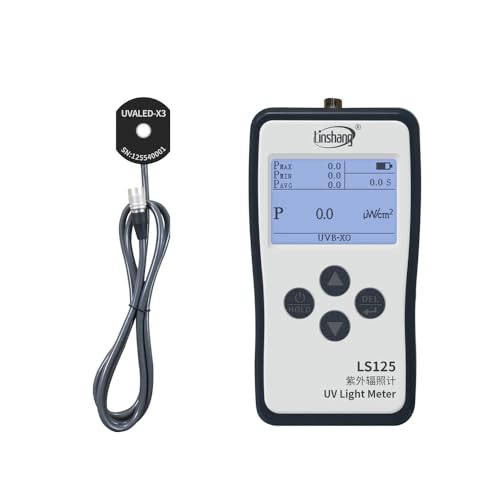
- LED curing: the Linshang LS125 kit reads up to 200,000 uW/cm2 and logs dose.
- Warranty and unit switching: the Triplett UVLT150 offers both.
- Beach alarm: the AquaHorti AH-Sunuvi beeps at a chosen dose.
- UVC spot checks: the QuantaDose card glows under UVC with no battery.
On This Page
- Comparison table
- The 7 picks, reviewed
- How we chose
- UV Index, units and bands
- Meter types compared
- Specs that matter
- How to take a reading
- Care and calibration
- Do and do not
- Honest limits
- FAQ
- Bottom line
Best UV Meter Comparison Table
First, scan the table for the job you have in mind. Then read the review for the measurement details behind each pick.
| # | Product | Best For | Standout Feature | Amazon |
|---|---|---|---|---|
| 1 | Solarmeter Model 6.5 UV Index Meter | Sun safety and reptile UVI checks | Reads the UV Index directly, 0 to 199.9 UVI | View |
| 2 | Extech UV505 Pocket UV-AB Light Meter | Lamp, window film and lab checks | Two ranges up to 40 mW/cm2 with cosine correction | View |
| 3 | Solarmeter Model 6.2R Reptile UVB Meter | Tracking UVB lamp output over time | UVB-only 280 to 320 nm reading at 1 uW/cm2 steps | View |
| 4 | Linshang LS125 with UVALED-X3 Probe | 365 nm and 395 nm LED curing | Reads up to 200,000 uW/cm2 and logs energy dose | View |
| 5 | Triplett UVLT150 UV A/B Light Meter | Shops that want a warranty | Selectable uW/cm2 or mW/cm2 and a 2-year warranty | View |
| 6 | AquaHorti AH-Sunuvi UV Index Meter | Beach, pool and yard days | Beeps at a chosen UV dose level | View |
| 7 | QuantaDose 6-in-1 UV Test Card | Quick yes or no UV checks | Glows for UVA/UVB and UVC, no battery needed | View |
The 7 Best UV Meter Picks, Reviewed
Each review below lists only specs we found on the maker page or a reliable spec sheet. In addition, every pick has a clear job, so you can skip the ones that do not match yours.
Best Overall
1. Solarmeter Model 6.5 UV Index Meter
Best for: anyone who wants a true UV Index number, from beach trips to bearded dragon basking spots.
The Solarmeter 6.5 is the best UV meter for most people because it shows the same number weather services forecast: the UV Index. Its sensor weighs light from 280 to 400 nm the way human skin responds, so a reading of 8 means the same thing as an 8 on the news. As a result, you can check shade, windows or a lamp against the official scale.
Reptile keepers also use it. In fact, Solarmeter sells a 6.5R version with a Ferguson Zone chart printed on the face, and the company says the specs are unchanged. So the plain 6.5 gives the same reading for terrarium work.
- Response: erythemally weighted UV, 280 to 400 nm.
- Range: 0 to 199.9 UVI, and it also resolves 0.1 UVI.
- Accuracy: plus or minus 10%, referenced to NIST, with a NIST traceable certificate.
- Sensor: silicon carbide photodiode under a sealed UV glass window.
- Power: one 9 V battery, which typically lasts about two years.
Pros
- Reads UVI directly, so no unit math is needed.
- Simple, because one button runs it at three readings per second.
- Also works for reptile basking zones.
Cons
- Shows UVI only, not raw UVA or UVB power.
- Also lacks a backlight, data hold or logging.
Skip it if: you need to measure a UV lamp in mW/cm2 for curing or lab work; the Extech UV505 or Linshang LS125 fits that job better.
Best for Lamps and Film
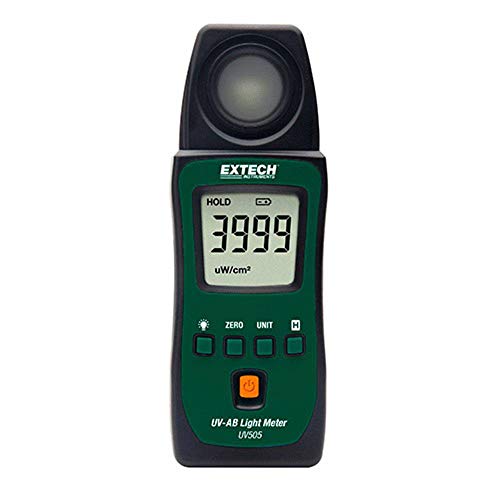
2. Extech UV505 Pocket UV-AB Light Meter
Best for: technicians, hobbyists and inspectors who test lamps, window film or UV transmission.
The Extech UV505 measures broadband UVA and UVB power from 290 to 390 nm. Unlike a UV Index meter, it reports irradiance in microwatts or milliwatts per square centimeter. Therefore, it suits jobs where you compare a lamp to itself over time, or check how much UV a film blocks.
It also has two ranges. First, the low range resolves 1 uW/cm2, while the high range reaches 40 mW/cm2. In addition, a cosine-corrected sensor reads light arriving at an angle more fairly, which matters under wide lamps and open sky.
- Spectral range: 290 to 390 nm (UVA and UVB together).
- Ranges: 1 to 3,999 uW/cm2 and 0.01 to 40 mW/cm2.
- Accuracy: plus or minus 5% of full scale.
- Features: zero, data hold, backlit LCD and auto power off.
- Power and size: two AAA batteries; 3.2 oz (90 g).
Pros
- Clear published accuracy figure.
- In addition, the high range covers strong lamps.
- A tripod mount also helps you repeat the distance.
Cons
- Does not report the UV Index.
- Because the band is broad, it cannot separate UVA from UVB.
Skip it if: you only want to know when to put on sunscreen; a UVI meter is simpler.
Best for Reptile UVB
3. Solarmeter Model 6.2R Reptile UVB Meter
Best for: reptile keepers who want to know when a UVB tube or bulb is fading.
The 6.2R reads UVB alone, from 280 to 320 nm, in uW/cm2. So it tracks the part of the lamp output that drives vitamin D3 in reptiles. Because UVB tubes lose output with age, many keepers log a reading at a fixed distance when a lamp is new and then compare later readings against that baseline.
However, uW/cm2 is not the UV Index. Most Ferguson Zone advice is written in UVI, so many keepers own a 6.5 for zones and a 6.2R for lamp aging. Meanwhile, the 6.2R resolves 1 uW/cm2, which is fine enough to spot a slow drop.
- Spectral range: UVB, 280 to 320 nm.
- Range: 0 to 1,999 uW/cm2 at 1 uW/cm2 resolution.
- Accuracy: plus or minus 10%, referenced to NIST.
- Optics: UV glass lens with a Teflon diffuser.
- Operating range: 32 to 90 F (0 to 32 C), 5% to 80% RH; 4.5 oz (128 g) with battery.
Pros
- UVB-only reading suits lamp aging checks.
- Fine 1 uW/cm2 steps, so small drops show up.
- Made in the USA with NIST-referenced calibration.
Cons
- Not a UV Index reading, so zone charts need a 6.5.
- Also, its 1,999 uW/cm2 ceiling is low for strong sources.
Skip it if: you want one meter for Ferguson Zones; pick the Solarmeter 6.5 instead.
Best for UV Curing
4. Linshang LS125 with UVALED-X3 Probe
Best for: resin printing, nail and adhesive curing, and other 365 nm or 395 nm LED work.
LED curing lamps emit a narrow peak, often at 365 or 395 nm, and they are far stronger than sunlight. The Linshang LS125 kit pairs a meter with the UVALED-X3 probe, which covers 340 to 420 nm and is calibrated against a 395 nm LED. Consequently, it reads where curing LEDs actually emit.
It also integrates power over time. For example, it can log energy dose in uJ/cm2 over a timed run, which is the number many resin and coating data sheets specify. Next, you can switch units between uW/cm2, mW/cm2 and W/m2 to match those sheets.
- Probe range: 340 to 420 nm, calibrated at 395 nm.
- Power range: 0 to 200,000 uW/cm2 at 0.1 uW/cm2 resolution.
- Energy range: 0 to 9,999,999 uJ/cm2 over up to 99,999 s.
- Accuracy: plus or minus 10%; six samples per second.
- Units: uW/cm2, mW/cm2 or W/m2; 10 mm test aperture.
Pros
- Handles very strong LED sources.
- In addition, an energy dose mode suits curing recipes.
- Unit switching, so you avoid conversion errors.
Cons
- Probe does not cover UVB or UVC.
- However, it is overkill for sun and reptile checks.
Skip it if: your source is the sun or a reptile lamp; its 340 nm floor misses most UVB.
Best Unit Switching
5. Triplett UVLT150 UV A/B Light Meter

Best for: buyers who want a pocket UVA/UVB meter with switchable units and a longer warranty.
The Triplett UVLT150 covers the same 290 to 390 nm band as the Extech, and it is calibrated at 365 nm. However, it lets you choose uW/cm2 or mW/cm2 on screen, and Triplett backs it with a 2-year warranty. It also lets you turn off auto power off for long tests.
Its published accuracy is plus or minus 4% of full scale plus 2 digits. Still, it samples about once every 3 seconds, so it is slower to settle when you move it.
- Spectral range: 290 to 390 nm, calibrated at 365 nm.
- Ranges: up to 3,999 uW/cm2 and 39.99 mW/cm2.
- Accuracy: plus or minus (4% of full scale + 2 digits).
- Display: 3-3/4 digit backlit LCD with zero and data hold.
- Power: two AAA batteries; carrying case included.
Pros
- Two-year warranty.
- Auto power off can be disabled.
- Also has a low-battery indicator.
Cons
- Slow 3-second sample time.
- Similarly sized and ranged to the Extech UV505.
Skip it if: you already own a broadband UVA/UVB meter; this one adds little.
Best Sun Alarm
6. AquaHorti AH-Sunuvi UV Index Meter
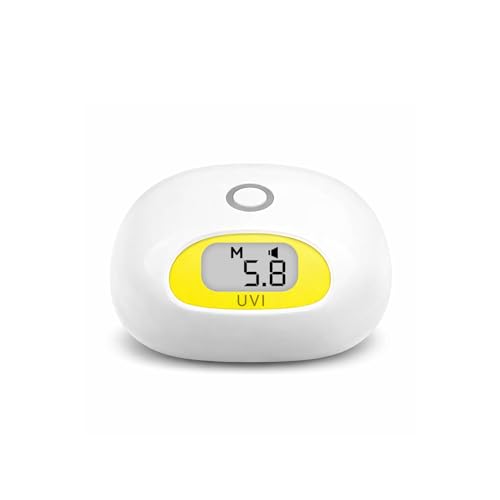
Best for: families who want a pocket alarm, not lab numbers.
The AquaHorti AH-Sunuvi shows a UV Index number and also adds up your UV dose through the day. Then it beeps when the total reaches the reminder level you pick: low, medium or high. As a result, it works like a timer for reapplying sunscreen or moving into shade.
On the other hand, AquaHorti does not publish its spectral range, resolution or accuracy. So treat it as a helpful reminder rather than a reference instrument, and hold it near your body facing the sky, not pointed at the sun, as the maker directs.
- Display: numeric UV Index.
- Dose: tracks accumulated UV exposure over time.
- Alarm: beep at a selectable low, medium or high reminder level.
- Size: pocket size for beach, pool, yard and travel.
Pros
- Dose alarm is easy for kids and parents.
- Also small enough for a beach bag.
- No unit math needed.
Cons
- No published accuracy or spectral range.
- Therefore not suited to lamp or curing tests.
Skip it if: you need traceable numbers; choose the Solarmeter 6.5.
Best No-Battery Check
7. QuantaDose 6-in-1 UV Test Card

Best for: a quick check that a lamp, flashlight or germicidal bulb emits UV at all.
A test card is not a meter, but it answers a common first question: is there UV here? The QuantaDose card glows red to pink under longwave UVA/UVB, from 300 to 395 nm. Meanwhile, it glows green to lime under shortwave UVC, from 220 to 275 nm, and a separate square signals when 254 nm UVC passes a set threshold.
A photochromic strip also turns purple with exposure. However, none of this gives a number, so use the card to sort sources and a meter to measure them.
- UVA/UVB indicator: 300 to 395 nm glow.
- UVC indicator: 220 to 275 nm glow, including far-UVC.
- Response: color change within about 15 seconds.
- Reuse: rated for roughly 300 to 500 uses.
Pros
- No battery and nothing to calibrate.
- Detects UVC, which most handheld meters here do not.
- Also fits in a wallet.
Cons
- Qualitative only; no UVI or mW/cm2.
- Fades, however, if stored in sunlight.
Skip it if: you need a reading you can record; any meter above does that.
How We Chose the Best UV Meter Picks
To be clear, we did not run hands-on tests. Instead, we built this list from research. First, we sorted meters by job: sun safety, reptile lighting, lamp and film testing, and LED curing. Next, we kept only models whose spectral range, measuring range and accuracy we could confirm on the maker page or a distributor spec sheet. We also limited each brand to two picks and dropped near-identical listings.
For the measurement background, we used the WHO guide to the UV Index and the EPA UV Index scale. For reptile zones, we used the Exo Terra summary of Ferguson Zones. Finally, we weighed owner feedback for common problems, such as slow readings and battery life.
UV Index, Units and Spectral Bands Explained
UV meters report three very different things, so it helps to know which one you need before you buy. In short, the number on the screen is only useful if it matches the question you are asking.
What the UV Index Means
The UV Index is sunburn-weighted UV divided by 25 mW/m2. Each wavelength counts by how strongly it reddens skin, so short UVB counts far more than UVA. As a result, a UVI of 10 equals 250 mW/m2 of effective UV, or 25 uW/cm2. The WHO notes that the daily figure is the peak, which occurs in the four hours around solar noon.
| UV Index | WHO category | EPA advice in brief |
|---|---|---|
| 0 to 2 | Low | Little protection needed |
| 3 to 5 | Moderate | Shade at midday, sunscreen, hat |
| 6 to 7 | High | Same steps, and limit midday time |
| 8 to 10 | Very high | Extra protection; avoid midday sun |
| 11+ | Extreme | Take every precaution |
mW/cm2, uW/cm2 and W/m2
Irradiance meters, by contrast, report power per area. Also, the math is simple: 1 mW/cm2 equals 1,000 uW/cm2, and it also equals 10 W/m2. For example, a curing lamp at 50 mW/cm2 delivers 50,000 uW/cm2. Dose is power times time, so 50 mW/cm2 for 20 seconds gives 1,000 mJ/cm2, or 1 J/cm2. If your meter shows nm on the label, our guide to what nm means in measurement explains the nanometer scale.
| Reading | uW/cm2 | mW/cm2 | W/m2 |
|---|---|---|---|
| UVI 1 (effective) | 2.5 | 0.0025 | 0.025 |
| UVI 10 (effective) | 25 | 0.025 | 0.25 |
| Typical UVB meter limit | 1,999 | 1.999 | 19.99 |
| Strong curing LED | 50,000 | 50 | 500 |
UVA, UVB and UVC Ranges
The common scientific split puts UVC at 100 to 280 nm, UVB at 280 to 315 nm and UVA at 315 to 400 nm. However, many US meters use 320 nm as the UVB edge, which is why the Solarmeter 6.2R lists 280 to 320 nm. Also, ozone blocks nearly all solar UVC, so sunlight meters skip it. UV light is still light, and it travels at the speed of light; only its wavelength and energy differ.
Which Type of Best UV Meter Fits Your Job?
Each type, in other words, answers a different question. Therefore, match the type to your light source first, and then compare models.
| Type | Reads | Good for | Example |
|---|---|---|---|
| UV Index meter | UVI, skin-weighted | Sun safety, reptile zones | Solarmeter 6.5 |
| UVB meter | uW/cm2, 280 to 320 nm | Lamp aging, phototherapy lamps | Solarmeter 6.2R |
| Broadband UVA/UVB meter | uW/cm2 or mW/cm2 | Film, lamps, labs | Extech UV505 |
| LED probe meter | Power and energy dose | Resin, nail and adhesive curing | Linshang LS125 |
| Test card | Color change only | Yes or no checks, UVC | QuantaDose card |
If you also want to log total sunlight in W/m2, a pyranometer is a separate tool; see our solar radiation meter picks. Likewise, some home stations add a UV sensor, as covered in our weather station guide.
Specs That Decide the Best UV Meter for You
- Spectral range: it must cover your source. For instance, a 340 nm probe misses UVB, and a 280 nm meter misses UVC.
- Weighting: UVI meters weight by skin response, while irradiance meters count each wavelength in the band evenly.
- Range and resolution: sun UVI rarely tops 15, yet curing LEDs can exceed 100 mW/cm2. So pick a range with headroom and fine enough steps.
- Accuracy: look for a stated figure, such as plus or minus 5% or 10%, and a calibration reference like NIST.
- Cosine correction: it helps the sensor read light from wide angles, such as open sky.
- Dose mode: curing work often needs mJ/cm2, which requires a timer that integrates power.
Above all, do not compare numbers across meter types. A UVB meter and a UVI meter can disagree by design, and both can still be right.
How to Take a Reading With the Best UV Meter
Good technique, however, matters as much as the meter. Next time you measure, follow these steps.
- Pick the right meter: Use a UV Index meter for sun and reptile zones, and an irradiance meter in mW/cm2 for lamps and curing.
- Check the battery and zero: Fit a fresh battery, then cover the sensor and zero the meter if it has a zero button.
- Let the source warm up: Run fluorescent and mercury vapor lamps for at least 15 minutes so output can settle before you read them.
- Set a fixed distance: Measure from the lamp or basking spot to the sensor with a tape and note the distance, since UV falls quickly with distance.
- Aim the sensor: Point the sensor at the source, or straight up at open sky for the UV Index, and keep your shadow off it.
- Read and record: Wait for the number to settle, then write down the reading, distance, time and conditions.
- Repeat and compare: Take three readings and use the middle value, then compare it with your last log entry to spot fading lamps.
Reptile UVI Targets by Ferguson Zone
In short, Ferguson Zones group reptiles by the UV they meet in the wild. The ranges below come from the 2010 work by Gary Ferguson and colleagues, as summarized by Exo Terra. Most keepers aim for the gradient in shaded areas and the maximum at the basking spot.
| Zone | UVI gradient | UVI maximum (basking) |
|---|---|---|
| 1 | 0 to 0.7 | 0.6 to 1.4 |
| 2 | 0.7 to 1.0 | 1.1 to 3.0 |
| 3 | 1.0 to 2.6 | 2.9 to 7.4 |
| 4 | 2.6 to 3.5 | 4.5 to 9.5 |
Care and Calibration
UV sensors and diffusers age, especially under strong lamps. Therefore, keep the sensor window clean with a soft, dry cloth, and store the meter in its case away from heat. Also, remove batteries before long storage. Many owners send meters back for recalibration on the schedule in the manual. Between services, measure one stable reference, such as a new lamp at a fixed distance, and log the result. If readings drift by more than the stated accuracy, it is time for service.
Do and Do Not
Honest Limits of Any UV Meter
First of all, no handheld meter matches a lab spectroradiometer. For example, broadband sensors assume a typical spectrum, so a lamp with an odd peak can read high or low. Likewise, a plus or minus 10% meter can show 9 or 11 when the true UVI is 10. In addition, clouds, reflections from sand, snow or water, and the sensor angle move the number. So use a meter to compare and track, and keep a margin when a reading decides safety.
Best UV Meter FAQ
What is the best UV meter for sun safety?
The Solarmeter Model 6.5 is the best UV meter for sun safety in this list because it reads the UV Index directly from 0 to 199.9, with NIST-referenced calibration. For a simple beeping reminder instead, the AquaHorti AH-Sunuvi tracks dose and alerts you.
Which is the best UV meter for reptiles?
For Ferguson Zones, use a UV Index meter such as the Solarmeter 6.5 or 6.5R, since zone charts are written in UVI. For tracking how a UVB lamp ages, the Solarmeter 6.2R reads UVB alone in uW/cm2.
What does the UV Index measure?
The UV Index is sunburn-weighted UV irradiance divided by 25 mW/m2. So a UVI of 1 equals 25 mW/m2 of effective UV, and a UVI of 10 equals 250 mW/m2. The WHO scale calls 3 to 5 moderate, 6 to 7 high, 8 to 10 very high and 11 or more extreme.
How do I convert mW/cm2 to uW/cm2?
Multiply by 1,000. For example, 2.5 mW/cm2 equals 2,500 uW/cm2. To get W/m2, multiply mW/cm2 by 10, so 2.5 mW/cm2 is 25 W/m2.
Can I convert a UVB reading in uW/cm2 to the UV Index?
Not exactly. The UV Index weights each wavelength by how strongly it burns skin, while a UVB meter adds up 280 to 320 nm with flat weighting. The ratio changes with the lamp spectrum, so use a UVI meter when you need UVI.
Do UV meters measure UVC?
Most of the meters here do not. The Solarmeter 6.5, 6.2R, Extech UV505 and Triplett UVLT150 start at 280 nm or 290 nm, and UVC sits below 280 nm. The QuantaDose card detects UVC, but it gives no number.
Why does my UV meter read zero indoors?
Window glass blocks most UVB, and indoor lights emit little UV. Therefore, a UV Index meter often reads 0 to 0.2 inside. Open the window or step outside to check that it works.
How often should a UV meter be calibrated?
Makers differ, so follow the manual. For example, many labs recalibrate yearly. Between calibrations, compare the meter with a stable reference, such as a new lamp at a fixed distance, and note any drift.
Is a UV test card as good as a UV meter?
No. A card shows that UV is present, and some show a rough threshold, but it cannot give a value you can track. However, cards are useful for spotting UVC and for quick checks without batteries.
Is a phone UV sensor or app accurate?
Most phones have no UV sensor, so apps show a forecast UV Index for your area, not a measurement. A handheld meter reads the UV where you stand, including shade and reflection.
Bottom Line: The Best UV Meter to Buy
For most buyers, the Solarmeter Model 6.5 is the best UV meter, because it reads the UV Index that sun advice and reptile zone charts use. However, pair it with the Solarmeter 6.2R if you track lamp aging, or choose the Linshang LS125 if you cure resin or coatings with LEDs.