

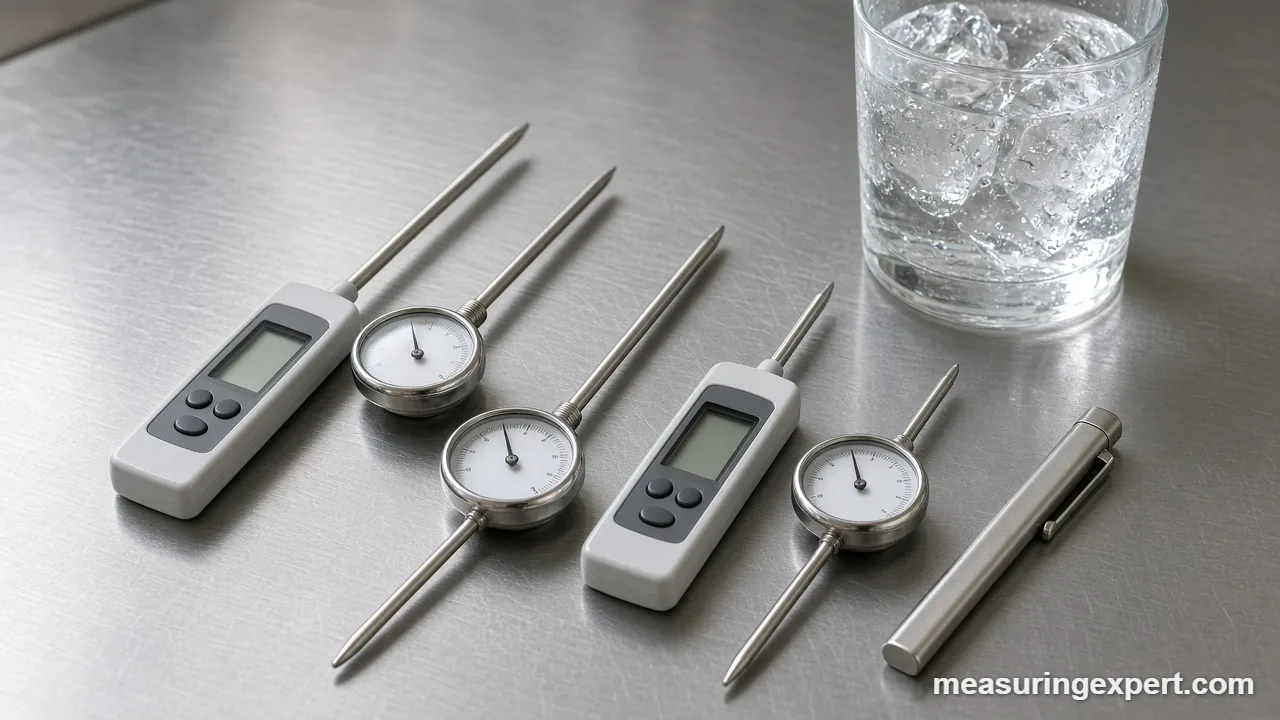
The best pocket thermometer for most people is the ThermoWorks Sizzle, because it reads in about 2 seconds, holds +/-0.9 F across the main cooking range and survives a full dunk. However, the right pick depends on your job: food service, HVAC or lab work, plus probe tip size and calibration needs.
In short: get the ThermoWorks Sizzle for kitchens, the CDN DTT450 for thin foods on a budget, and the Traceable Flip-Stick Ultra for lab checks.
As an Amazon Associate, Measuring Expert earns from qualifying purchases. Our picks are based on research, specifications and owner feedback, not paid placement.
Best Budget
Best for Labs
Quick Answer: Which Pocket Thermometer Fits Your Work?
- ThermoWorks Sizzle: fast, IP67 waterproof and supplied with a NIST-traceable certificate, so it suits busy kitchens.
- CDN DTT450 ProAccurate: a 1.5 mm thin tip for burgers and fillets, plus one-button field calibration.
- Traceable Flip-Stick Ultra: an individually numbered calibration certificate from an ISO/IEC 17025 lab.
- Lavatools Javelin PRO Classic: a large auto-rotating display and a coin battery rated for thousands of hours.
- Taylor 3512FS and Comark T220A: classic dial pocket thermometers, so there is no battery to die.
- Klein ET05 and UEi PDT650: HVAC-friendly digital models that also offer min/max functions.
On This Page
- Comparison table
- The 10 picks, reviewed
- How we chose
- Probe and dial types
- Specs that matter
- Ice-point calibration steps
- Temperature converter
- Good and bad habits
- Honest limits
- FAQ
- Bottom line
Best Pocket Thermometer Comparison Table
First, this table sums up each model in one line. After that, the reviews explain the measurement details that set each one apart.
| # | Image | Product | Best For | Standout Feature | Amazon |
|---|---|---|---|---|---|
| 1 | 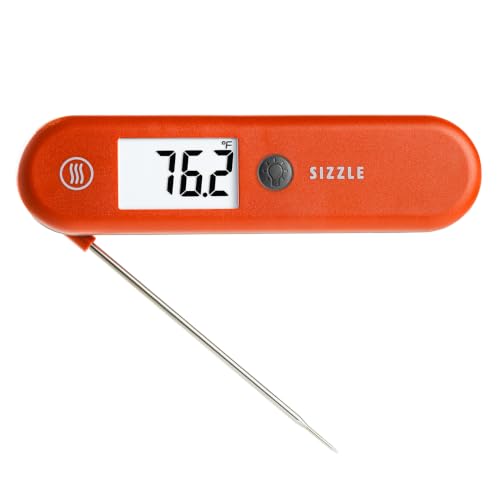 | ThermoWorks Sizzle | Most kitchens | 2-second reads, IP67, NIST-traceable certificate | View |
| 2 |  | Lavatools Javelin PRO Classic | Home cooks | 2-inch auto-rotating backlit display | View |
| 3 |  | CDN DTT450 ProAccurate Thin Tip | Thin foods on a budget | 1.5 mm tip with field calibration | View |
| 4 | 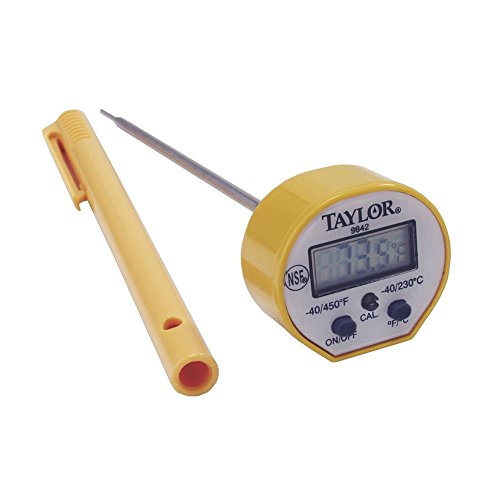 | Taylor 9842 | Line cooks | 5-inch stem with a 1.5 mm step-down tip | View |
| 5 |  | Cooper-Atkins DFP450W | HACCP logs | Temperature alarm and max/min/hold | View |
| 6 |  | Taylor 3512FS | Battery-free checks | 1-inch dial, 0 to 220 F | View |
| 7 |  | Comark T220A Pocket Dial | Adjustable dial | Recalibration nut and clip sheath | View |
| 8 |  | Klein Tools ET05 | HVAC and electricians | Backlight, hold, min/max and average | View |
| 9 |  | UEi PDT650 | Folding HVAC probe | -58 to 572 F with 0.1-degree resolution | View |
| 10 |  | Traceable Flip-Stick Ultra | Labs and QA | +/-0.3 C at certified test points | View |
The 10 Best Pocket Thermometer Picks, Reviewed
Each review first covers who the tool suits, then the specs we could confirm from the maker or a dealer spec sheet. Where a spec was not published, we left it out instead of guessing.
Best Overall
1. ThermoWorks Sizzle
Best for: home and restaurant cooks who want fast, trustworthy reads and also a tool that can go in the sink.
The Sizzle is a folding instant-read probe from ThermoWorks, the brand behind the Thermapen. It reads in about 2 seconds, and ThermoWorks rates it at +/-0.9 F from -4 to 248 F. Outside that band, the tolerance widens to +/-4 F, which still covers fryer oil and candy checks. In addition, each unit ships with a NIST-traceable calibration certificate, so you start with a documented reference point.
The 4.5-inch (114 mm) probe tapers from 3 mm to 1.5 mm. As a result, the tip is thin enough for chicken breasts and fish fillets. Also, the display rotates 180 degrees and the backlight stays on for 60 seconds, so left-handed users and dim grills are covered too.
- Range: -58 to 572 F (-50 to 300 C)
- Accuracy: +/-0.9 F (+/-0.5 C) from -4 to 248 F
- Waterproof rating: IP67; NSF certified
- Power: 2 AAA batteries rated for up to 5,000 hours
- Resolution: 0.1 or 1 degree, user selectable
Pros
- Fast 2-second readings, even on thin cuts
- Calibration certificate in the box
- Fully waterproof IP67 body
Cons
- Wider tolerance above 248 F
- Bulkier than a pen-style probe, so it needs a roomy pocket
Skip it if: you only need a battery-free dial for soups and roasts, because a dial is cheaper.
Best for Home Cooks
2. Lavatools Javelin PRO Classic
Best for: cooks who value a big, easy display and, above all, very long battery life.
The Javelin PRO Classic folds like the Sizzle, but its focus is the screen. For example, Lavatools fits a 2-inch backlit, anti-fog display that rotates on its own as you turn the unit. Meanwhile, accuracy is +/-0.9 F between -4 and 302 F, and the stated read time is about 2 to 3 seconds.
Because it runs on one CR2032 coin cell rated for more than 4,000 hours, battery swaps are rare. However, it is only IP65 splash resistant, so do not submerge it in a sink.
- Range: -40 to 482 F (-40 to 250 C)
- Accuracy: +/-0.9 F (+/-0.5 C) from -4 to 302 F
- Probe: about 4.5 in with a 1.6 mm tapered tip
- Water resistance: IP65 splash resistant
Pros
- Large auto-rotating display
- Coin cell lasts a very long time, so swaps are rare
- Motion wake and auto sleep
Cons
- Splash resistant only
- No user calibration; Lavatools says none is needed
Skip it if: your kitchen washes tools by dunking them, since it is not waterproof.
Best Budget
3. CDN DTT450 ProAccurate Thin Tip
Best for: food handlers who check thin foods and therefore need a simple, low-cost tool they can calibrate on site.
In short, this is a classic pen-style pocket probe. Its tip is 1.5 mm in diameter, which matches the small-diameter probe that food codes ask for when you check thin items such as patties and fillets. CDN lists a 4-second response time and one-button field calibration, so you can reset it after an ice-point test.
Then again, the stem is short at 2.75 in (7 cm). Therefore, it suits thin foods and shallow pans better than deep stockpots.
- Range: -40 to 450 F (-40 to 230 C)
- Tip: 1.5 mm; stem 2.75 in (7 cm)
- Waterproof rating: IPX7; NSF certified
- Power: one LR44 button cell
Pros
- True thin tip for thin foods
- Field calibration button
- Pocket sheath with clip
Cons
- Short stem, so deep pots are awkward
- Slower than the folding picks, though still quick
Skip it if: you want a backlit display for dark grills; instead, look at the Sizzle.
Best for Line Cooks
4. Taylor 9842 Waterproof Digital Pocket Probe
Best for: restaurant line cooks who need a longer stem than the CDN but still want a thin tip.
Above all, the Taylor 9842 is a common sight in commercial kitchens. Its 5-inch stem steps down to a 1.5 mm tip, so one probe can reach the center of a roast and still read a thin chicken breast. In addition, Taylor builds the case to be waterproof and antimicrobial, which helps during sanitizing between checks.
Taylor does not publish the same detail as ThermoWorks, so we list only the specs dealers confirm. For that reason, run an ice-point check when it arrives and at the start of each shift.
- Range: -40 to 450 F
- Stem: 5 in with a 1.5 mm step-down tip
- Case: waterproof and antimicrobial
- Use: built for HACCP temperature logging
Pros
- Long stem plus thin tip
- Waterproof commercial case
- Widely used in food service
Cons
- Few published accuracy details, unlike ThermoWorks
- Small display with no backlight listed
Skip it if: you need a calibration certificate for audits.
Best for HACCP Logs
5. Cooper-Atkins DFP450W
Best for: kitchen managers who log temperatures and want an alarm whenever food falls out of range.
The DFP450W adds a temperature alarm plus max, min and hold modes. Cooper-Atkins rates it at +/-2 F (+/-1 C) with 0.1-degree resolution, which matches the Food Code tolerance for Fahrenheit devices. Also, its reduced tip reads in under 6 seconds.
It belongs to the maker’s “Accurate for Life” line, which uses stored calibration instead of a field adjustment. In other words, you still verify it at the ice point, but you do not tweak it.
- Range: -40 to 450 F (-40 to 232 C)
- Accuracy: +/-2 F (+/-1 C); resolution 0.1 degree
- Stem: 4.75 in (121 mm) with a reduced tip
- Waterproof rating: IPX7; NSF listed
Pros
- Alarm for out-of-range food
- Max, min and hold modes
- Dishwasher-safe IPX7 body
Cons
- Slower than thermocouple-speed models, since reads take up to 6 seconds
- No field calibration if it drifts
Skip it if: speed matters more to you than logging features.
Best Dial
6. Taylor 3512FS Pocket Test Thermometer
Best for: anyone who wants a simple dial pocket thermometer, especially one with no battery.
This is the classic bimetal dial thermometer: a 1-inch magnified dial on a 4.5-inch stainless stem, with a pocket case and clip. Because it reads 0 to 220 F, it covers fridge checks, hot holding and most cooked foods. Also, it never needs a battery.
However, dial models are slower. USDA notes that instant-read dials take about 15 to 20 seconds and must go 2 to 2.5 inches into the food. Consequently, it is a poor match for thin patties.
- Range: 0 to 220 F
- Dial: 1 in with a magnified lens
- Stem: 4.5 in stainless steel
- Listed as NSF certified
Pros
- No battery to fail
- Cheap enough to keep spares
- Pocket case with clip
Cons
- Slow 15 to 20 second reads
- Needs deep insertion before it reads true
Skip it if: you cook thin foods or need readings above 220 F.
Best Adjustable Dial
7. Comark T220A Pocket Dial Thermometer
Best for: food workers who want a dial they can recalibrate after an ice-point test.
The Comark T220A pairs a 1-inch dial with a 5-inch stem and a 0 to 220 F scale. Most importantly, it has a recalibration nut. If the needle sits off 32 F in ice water, you hold the nut and turn the dial back to the mark. In addition, Comark states dial accuracy as +/-1 division.
The lens is watertight plastic rather than glass, and a matching sheath with a clip protects the stem. Similarly to the Taylor, it is slow and needs deep insertion.
- Range: 0 to 220 F
- Dial: 1 in; stem 5 in stainless steel
- Calibration: recalibration nut
- Accuracy: +/-1 scale division (Comark dial spec)
Pros
- Adjustable at the ice point
- Shatter-resistant plastic lens
- No battery, so it works in any cold room
Cons
- Slow response
- Not for thin foods, because the coil needs 2 to 2.5 inches of depth
Skip it if: you want a digital readout with hold; in that case, choose a digital probe.
Best for HVAC
8. Klein Tools ET05 Digital Pocket Thermometer
Best for: HVAC techs and electricians, particularly those who check supply air, return air and duct temperatures.
The ET05 is a tradesperson’s pocket probe. For instance, it has a 3-inch stainless probe, and the sheath doubles as a handle for reaching into vents. Klein rates it at +/-2.7 F (+/-1.5 C) at room temperature. That is looser than the food picks, yet it is fine for comparing air temperatures across a coil.
It also adds hold, max/min and average modes plus a backlight. As a bonus, it shuts off after 15 minutes idle to save its two LR44 cells.
- Range: -40 to 482 F (-40 to 250 C)
- Accuracy: +/-2.7 F (+/-1.5 C) at room temperature
- Probe: 3 in stainless steel with sheath handle
- Functions: hold, max/min, average, backlight
Pros
- Hold, min/max and average
- Backlit screen for attics
- Sheath works as a handle
Cons
- Looser accuracy than food models, so skip it for food logs
- No waterproof rating listed
Skip it if: you need Food Code accuracy for food checks.
Best Folding HVAC Probe
9. UEi PDT650 Folding Pocket Thermometer
Best for: HVAC techs who want a folding probe that fits a shirt pocket without a sheath.
The PDT650 folds its probe into the body, so nothing pokes through your pocket. UEi rates it at +/-1.8 F (+/-1 C) from -22 to 302 F, and +/-4 F outside that band. In addition, resolution is 0.1 degree up to 199.9, and the display updates about once a second.
Min/max recording helps when you watch a system cycle. Meanwhile, auto power off after about an hour protects the single SR44W battery.
- Range: -58 to 572 F (-50 to 300 C)
- Accuracy: +/-1.8 F (+/-1 C) from -22 to 302 F
- Resolution: 0.1 degree up to 199.9, then 1 degree
- Functions: min/max record, auto off
Pros
- Folding probe, no sheath to lose
- Tighter accuracy than many trade probes
- Bright yellow body is easy to find
Cons
- No calibration feature listed
- Wider tolerance when readings go past 302 F
Skip it if: you need a backlit screen; otherwise, it is a strong pick.
Best for Labs
10. Traceable Flip-Stick Thermometer Ultra
Best for: labs, QA teams and schools, since they must show a calibration record.
The Flip-Stick Ultra comes with an individually numbered Traceable certificate. Moreover, the lab behind it is ISO/IEC 17025 accredited by A2LA, and the certificate states traceability to SI units through NIST or another national institute. At the tested points, accuracy is +/-0.3 C (about +/-0.5 F). Elsewhere between -20 and 100 C, it holds +/-1 C.
The 4.5-inch stem flips out to an 11-inch overall length, then folds to 6 in for a pocket. Therefore, it reaches into flasks and water baths more easily than a short pen probe.
- Range: -58 to 572 F (-50 to 300 C)
- Accuracy: +/-0.3 C at certified test points
- Resolution: 0.1 degree from -20 to 200 C
- Certificate: multi-point, ISO/IEC 17025 lab
Pros
- Documented multi-point calibration
- Long reach when extended
- Drop-tested body
Cons
- No waterproof rating stated
- Overkill for home cooking, unless you also run a lab
Skip it if: you only cook at home and never need paperwork.
How We Chose the Best Pocket Thermometer Picks
Our picks are research based, so we did not run lab tests. Instead, we compared published specs and buyer feedback against the jobs readers actually do.
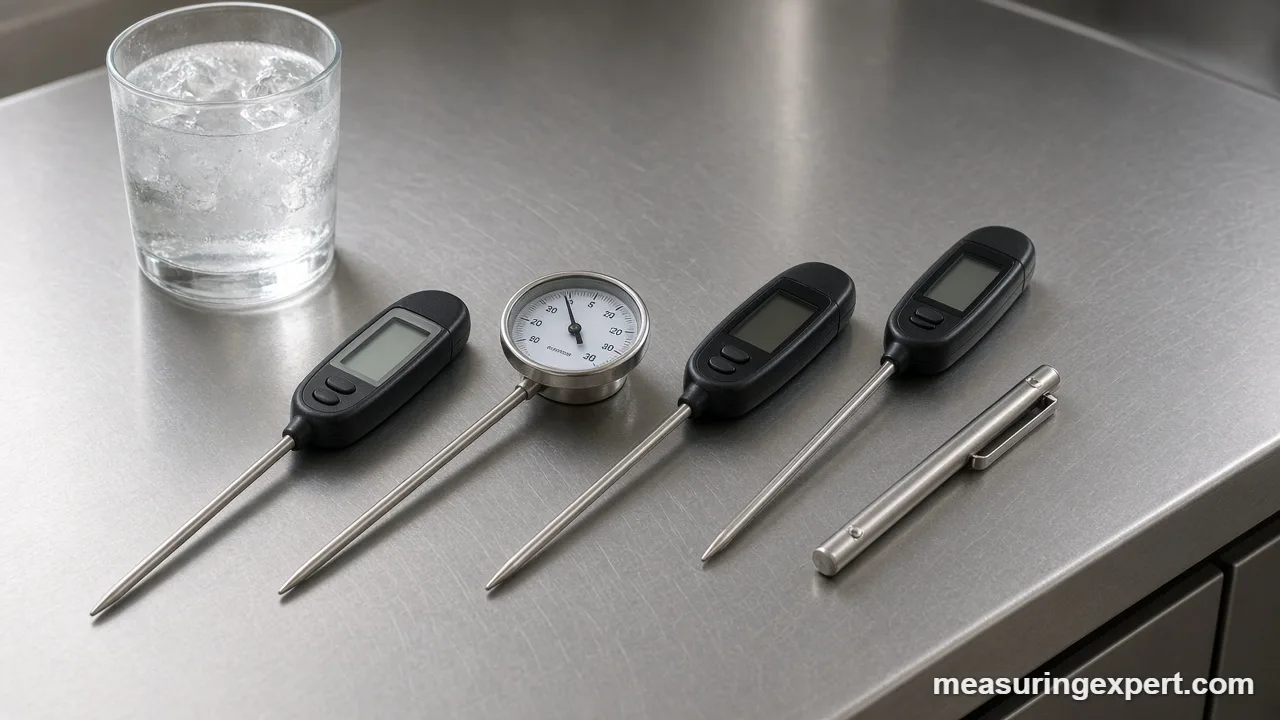
- Accuracy and range: first, we read each spec sheet and favored models that state a tolerance, not just “accurate”.
- Response time: next, we weighed published read times, since a slow probe lets heat escape from the food.
- Probe tip and length: then we checked tip diameter for thin foods and stem length for deep pots and ducts.
- Calibration: also, we gave credit for a calibration button, a recalibration nut or a traceable certificate.
- Use case and brand: finally, we kept a spread across food service, HVAC and lab work, with at most two picks per brand.
Sources included manufacturer pages from ThermoWorks, Lavatools, Klein Tools, Traceable and Cooper-Atkins, dealer spec sheets for CDN, Taylor, Comark and UEi, and the USDA FSIS guide to kitchen thermometers.
Probe Thermometer or Dial: Which Pocket Style Fits?
Pocket thermometers fall into three families. However, each one senses heat differently, so the choice changes how fast and how deep you need to probe.
| Type | Sensor | Typical read time | Insertion depth | Best jobs |
|---|---|---|---|---|
| Bimetal dial | Coiled metal strip | 15 to 20 s (USDA) | 2 to 2.5 in | Soups, roasts, fridge checks |
| Thermistor digital | Resistor in the tip | About 10 s (USDA) to a few seconds on newer models | Tip only | Most food and HVAC checks |
| Thermocouple digital | Junction of two metals | 2 to 5 s (USDA) | Tip only | Thin foods, fast lines |
For food service, the probe tip matters as much as the sensor. An Oregon Food Code fact sheet explains that thin foods call for a probe of 1.5 mm (0.059 in) or less, and that bimetal bayonet dials are only for thick foods. HVAC work is different: there, you mostly compare two air readings, so speed and a hold button matter more than tip size.
Specs That Decide the Best Pocket Thermometer for You
Spec sheets use a few terms that are easy to mix up. So here is what each one means in practice.
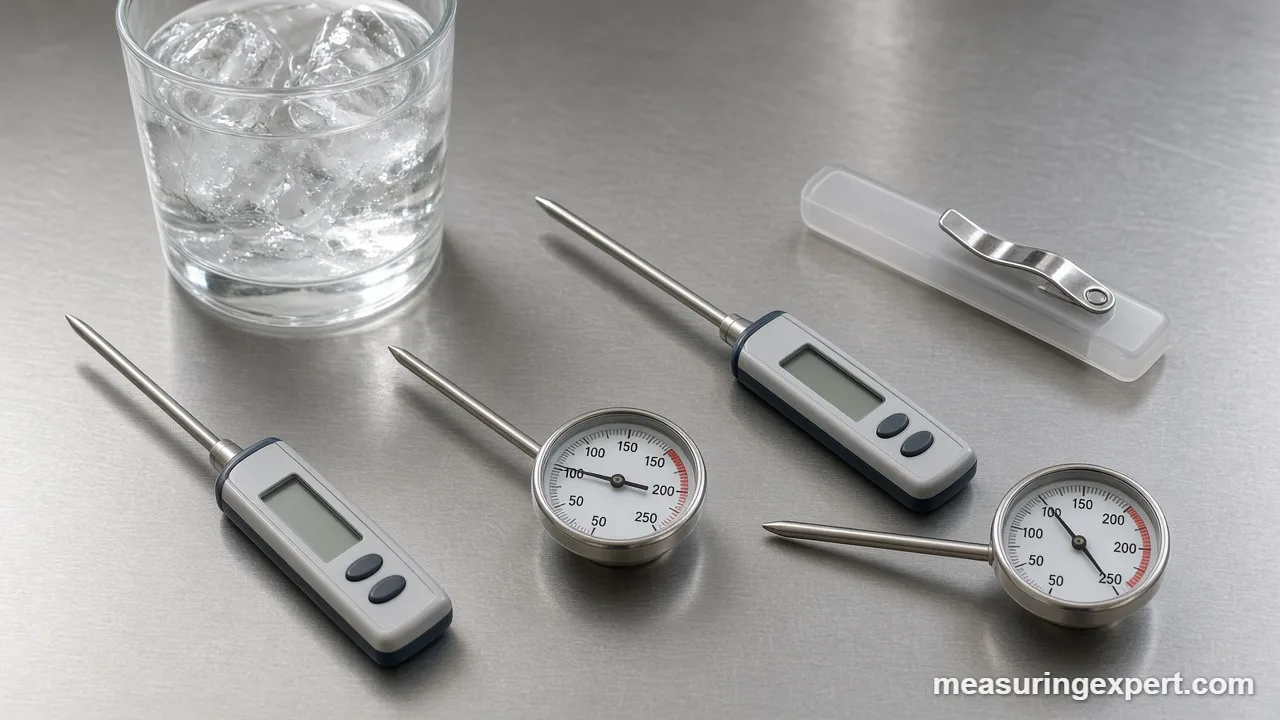
- Accuracy: how close the reading is to the true temperature, such as +/-0.9 F. Check the range it applies to, because many models widen the tolerance at the extremes.
- Resolution: the smallest step on the display, such as 0.1 degree. Even so, a fine display does not make a tool accurate.
- Response time: how long the reading takes to settle. Thermocouple-style probes are fastest; dials are slowest.
- Probe length and tip: a long stem reaches the center of a roast or a duct, and a thin tip reads thin foods and reacts faster.
- Calibration: a reset button, a nut on a dial, or a certificate. Otherwise, you can verify but not correct.
- Water rating: IP67 and IPX7 survive brief immersion, while IP65 only resists splashes.
For food work, the FDA Food Code (section 4-203.11) sets the bar. A device scaled only in Fahrenheit must be accurate to +/-2 F, and a Celsius or dual-scale device to +/-1 C, in its intended range. You can read the current edition on the FDA Food Code 2022 page.
How to Calibrate a Pocket Thermometer With the Ice-Point Method
USDA and state Food Code guides both use the ice point because it is easy to set up and does not change with altitude. Follow these steps whenever the thermometer is new, dropped, or reading oddly.
- Fill a tall glass to the top with crushed ice.
- Add cold drinking water to the top, then stir and let it sit for a minute.
- Insert the probe at least 2 inches into the slurry without touching the glass.
- Wait about 30 seconds, or until the reading stops changing.
- Check that it reads 32 F (0 C).
- If it does not, press the calibration button or turn the dial nut to 32 F, as the manual directs.
- Replace any unit that cannot be adjusted and still reads outside the tolerance.
Convert Thermometer Readings Between F, C and K
Recipes, Food Code charts and lab sheets often mix scales. So enter a reading below to see it in Fahrenheit, Celsius and Kelvin.
Overall, the formula is simple: C = (F – 32) x 5/9. So 165 F becomes (165 – 32) x 5/9 = 73.9 C. For baking conversions, see our chart for Fahrenheit to Celsius in baking.
Good and Bad Habits With a Best Pocket Thermometer
For HVAC readings, hold the probe in the center of the airflow, not against the duct wall. Similarly, wait for the display to settle before you write the number down.
Honest Limits of Even the Best Pocket Thermometer
Even the best pocket thermometer measures only where its sensor sits. For example, if the tip lands in a fat pocket or near bone, the reading can mislead you. USDA notes that thermometer readings are typically within 2 to 4 F only when the probe is placed correctly.
Also, accuracy specs describe the tool, not your technique. A +/-0.9 F probe pulled out too early will still under-read. Similarly, batteries matter, because a weak cell can cause erratic digits on some models. Finally, a calibration certificate is a snapshot; drops and heat cycles can shift any thermometer over time. For a deeper look at why tiny errors add up, read our piece on precision in cooking measurements.
Best Pocket Thermometer FAQ
What is the best pocket thermometer for most people?
For most people, the best pocket thermometer is the ThermoWorks Sizzle. It reads in about 2 seconds, is rated +/-0.9 F across the main cooking range, is IP67 waterproof and ships with a NIST-traceable certificate.
How accurate should a food pocket thermometer be?
The FDA Food Code requires +/-2 F for Fahrenheit-only devices and +/-1 C for Celsius or dual-scale devices in the intended range of use. In practice, many good digital models beat that.
How do I calibrate a pocket thermometer?
Use the ice-point method. Put at least 2 inches of the probe in a glass of crushed ice and water, wait about 30 seconds, and adjust it to 32 F (0 C) if it reads off.
Is a dial or digital pocket thermometer better?
Digital models are faster and read thin foods with only the tip. In contrast, dial models need no battery but take 15 to 20 seconds and must go 2 to 2.5 inches deep.
What is the best pocket thermometer for thin foods?
Pick a thin-tip model such as the CDN DTT450 or the Taylor 9842. Both have a 1.5 mm tip, which matches the small-diameter probe that Food Code guides call for.
Can I use a food pocket thermometer for HVAC work?
Yes, any probe with the right range can read air temperature. However, HVAC models like the Klein ET05 add hold, min/max and average modes that make duct and coil checks easier.
What is the best pocket thermometer for lab use?
The Traceable Flip-Stick Ultra suits labs because it comes with an individually numbered calibration certificate from an ISO/IEC 17025 accredited lab.
How fast should the best pocket thermometer read?
Fast thermocouple-style probes settle in about 2 to 5 seconds. Older thermistor models take about 10 seconds, and dial thermometers take 15 to 20 seconds.
How often should I check my thermometer’s accuracy?
Check it when it is new, after any drop, whenever readings seem odd, and on the schedule your maker or health department sets. For example, many kitchens check it every shift.
Why does probe length matter?
A longer stem reaches the center of roasts, stockpots and ducts without burning your hand. On the other hand, a short stem is handier for thin foods and fits a pocket better.
Bottom Line: The Best Pocket Thermometer to Buy
For most kitchens, the ThermoWorks Sizzle is the best pocket thermometer. Above all, it is fast, waterproof and certified out of the box. If you check thin foods on a tight budget, the CDN DTT450 is the smarter buy. Meanwhile, HVAC techs should look at the Klein ET05, and labs should choose the Traceable Flip-Stick Ultra.
Black Friday is coming: shop the deals with Prime