

The best grow light meter for most growers is the Apogee MQ-500, because it reads PPFD directly with a stated plus or minus 5 percent calibration uncertainty. Also, what decides the choice is whether you need true PAR or only a lux check, plus how much logging you want.
In short: choose the Apogee MQ-500 for accuracy, the DLI-500 for daily tracking, the Photobio for value, and a lux meter such as the Extech LT250W only for rough checks.
As an Amazon Associate, Measuring Expert earns from qualifying purchases. Our picks are based on research, specifications and owner feedback, not paid placement.
Best Overall

Best for DLI Tracking

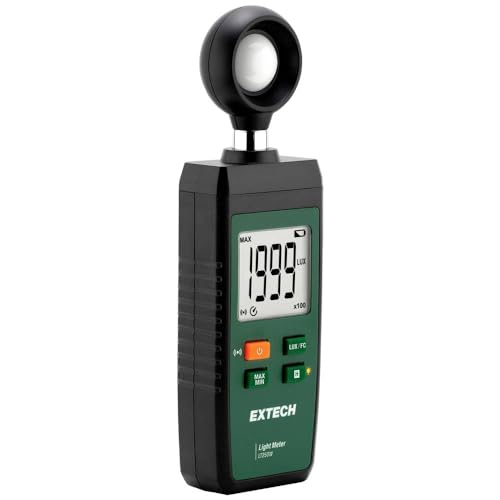
Best Wireless Lux Meter
Quick Answer: The Best Grow Light Meter for Each Need
- Best overall: Apogee MQ-500, a quantum meter with 0 to 4000 range.
- Best for daily light: Apogee DLI-500, which logs DLI and photoperiod.
- Best value PAR meter: Photobio, with a remote sensor.
- Best lux meter with app: Extech LT250W over Bluetooth.
- Best pocket lux meter: UNI-T UT383, or the UT383BT for Bluetooth.
On This Page
- Comparison Table
- The 8 Best Grow Light Meters, Reviewed
- How We Chose
- Lux Meter or PAR Meter
- Lux to PPFD
- Daily Light Integral
- How to Use a Grow Light Meter
- Care and Accuracy
- Honest Limits
- FAQ
- Bottom Line
Best Grow Light Meter Comparison Table
| # | Product | Best For | Standout Feature | Link |
|---|---|---|---|---|
| 1 | Apogee MQ-500 | Accurate PPFD from LED, HPS and sunlight | Plus or minus 5% calibration, 0 to 4000 umol/m2/s | View |
| 2 | Apogee DLI-500 | Leaving a meter in place to track daily light | Logs 99 days of DLI and photoperiod | View |
| 3 | Photobio PAR Meter | Entry into PPFD without a lab-grade price | Remote sensor, 0 to 3,999 umol/m2/s | View |
| 4 | Extech LT250W | Logging lux to a phone | Bluetooth to ExView, CSV export | View |
| 5 | Extech LT40 | A tighter lux spec for white LED lights | Plus or minus 3% basic accuracy, cosine and color corrected | View |
| 6 | Dr.meter LX1330B | A proven design with a separate sensor | 0.1 to 200,000 lux, data and peak hold | View |
| 7 | UNI-T UT383 | Quick brightness checks | 0 to 199,900 lux, data hold, max/min | View |
| 8 | UNI-T UT383BT | Pocket size with an app | Same specs as UT383 plus Bluetooth and iENV app | View |
The 8 Best Grow Light Meters, Reviewed
First, each pick below lists only specs that a maker or retailer page confirms. Also, prices change often, so check the current price on Amazon.
Best Overall
1. Apogee MQ-500 Full-Spectrum Quantum Meter (with AM-330 Wand)
Best for: growers who want a true PAR reading under LED, HPS, metal halide or sunlight, and who plan to use the meter for years.
The Apogee MQ-500 is our best grow light meter pick for most serious growers, because it reads PPFD directly instead of guessing from lux. First, Apogee lists a plus or minus 5 percent calibration uncertainty, repeatability under 0.5 percent and long-term drift under 2 percent per year. In addition, Apogee says the meter works under LEDs, HPS, metal halide and sunlight.
Also, the Amazon listing is a bundle with the AM-330 telescoping wand, which helps you reach a canopy above your head. Next, the sensor housing carries an IP68 rating, so splashes in a humid tent will not hurt it. However, Apogee lists the spectral range as 389 to 692 nm, so it does not count far-red light.
- Measures PPFD from 0 to 4000 umol/m2/s
- Calibration uncertainty plus or minus 5%; repeatability under 0.5%; drift under 2% per year
- Spectral range 389 to 692 nm; field of view 180 degrees
- Cosine response plus or minus 5% at 75 degrees zenith angle
- Sample mode stores 99 readings; log mode stores 99 half-hour averages and a daily light integral
- Housing rated IP68; 4-year warranty, per Apogee
Pros
- True PPFD with a stated accuracy
- Wide 0 to 4000 range covers full sun
- Logging and daily light integral built in
- Tough sealed sensor
Cons
- Costs more than a lux meter
- Does not read far-red light
- Needs the Apogee cable and software to download logs
Skip it if: you only want a rough brightness check for a windowsill plant, because a lux meter is simpler and costs less.
Best for DLI Tracking
2. Apogee DLI-500 PAR, Daily Light Integral and Photoperiod Meter
Best for: greenhouse and grow room growers who care about the total light a crop gets each day.
In short, the DLI-500 is a compact meter built to stay in the canopy. As a result, it tracks light over time. First, Apogee says it shows live PPFD and logs the daily light integral and photoperiod. As a result, you can see whether a timer, a dimmer change or a cloudy week moved your daily total.
Also, the spec sheet lists the same plus or minus 5 percent calibration uncertainty and 0 to 4000 range as the MQ-500, with a 180 degree field of view and an IP65 rating. However, it is a monitor first and a spot meter second, so it suits fixed placement better than walking a grid.
- Shows live PPFD, plus logged daily light integral and photoperiod
- Range 0 to 4000 umol/m2/s; calibration uncertainty plus or minus 5%
- Spectral range 389 to 692 nm; field of view 180 degrees
- Stores 99 days of DLI data, or 10 days of 30-minute PPFD averages
- IP65 rating; 67 g; 4-year warranty, per Apogee
Pros
- Logs daily light integral without a computer
- Small enough to leave in a tent
- Same stated accuracy as the MQ-500
Cons
- Less handy for grid mapping than a wand meter
- Power source not stated on the spec sheet we read
- Higher cost than lux meters
Skip it if: you need a handheld you can sweep across a large bench, since the MQ-500 with its wand is easier for that.
Best Value PAR Meter
3. PHOTOBIO Advanced Quantum PAR Meter

Best for: home growers who want a real PPFD number and accept a less documented meter.
In short, the Photobio meter is a quantum PAR meter with a remote sensor on a cable. As a result, it is an entry-level PPFD tool. For example, the manual lists a 0 to 3,999 umol/m2/s range, a 400 to 700 nm spectral range, and a repeatability of plus or minus 1 umol/m2/s. In addition, Hydrofarm says it works with modern LED fixtures and HPS lights.
However, neither the manual nor the Hydrofarm page gives a calibration accuracy figure, so we cannot rank it above the Apogee meters on accuracy. Therefore, for many hobby grows that is enough, if you treat the number as a comparison tool.
- Range 0 to 3,999 umol/m2/s; resolution 0.1 up to 999, then 1
- Spectral range 400 to 700 nm
- Remote quantum sensor on a cable; stores up to 99 readings
- Two AAA batteries; operating temperature 0 to 50 C (32 to 122 F)
- Press ENTER to hold a reading
Pros
- Reads PPFD, not lux
- Remote sensor is easy to aim
- Hold and log functions
Cons
- No accuracy figure in the manual or the listing
- Warranty not stated on the pages we read
- Brand has less published data than Apogee
Skip it if: you must document your accuracy for research or a licensed facility, because it lacks a published calibration figure.
Best Wireless Lux Meter
4. Extech LT250W Wireless Light Meter with ExView App
Best for: growers who want a lux and foot-candle meter that sends readings to a phone for logs and reports.
In short, the Extech LT250W is a lux meter with Bluetooth. As a result, it adds a phone to a basic meter. For example, Extech lists a range of 0 to 199,900 lux (0 to 18,571 foot-candles), with plus or minus 4 percent accuracy below 9,999 lux and plus or minus 5 percent above. In addition, the ExView app adds min and max recording, CSV export and PDF reports.
However, it does not read PPFD. Therefore it suits comparing two spots or spotting a dimming bulb. Instead, for a PAR target, buy a quantum meter.
- Range 0 to 199,900 lux and 0 to 18,571 foot-candles
- Accuracy plus or minus 4% of reading below 9,999; plus or minus 5% above
- Sampling rate 0.5 seconds; five-digit backlit display
- Bluetooth to the ExView iOS and Android app, up to 90 m line of sight
- Three AAA batteries; 90 g; 2-year warranty
Pros
- App logging and CSV export
- Stated accuracy at every range
- Light and compact
Cons
- Lux only; no PPFD
- Spectral response is not published on the page we read
- Lux misreads purple LED light
Skip it if: your goal is a PPFD target, since a quantum meter answers that directly.
Best Accuracy Lux Meter
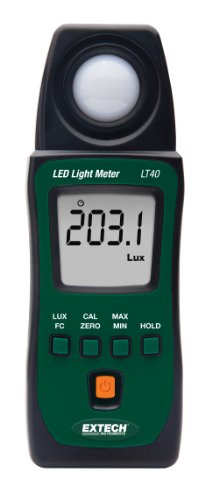
5. Extech LT40 White LED Light Meter
Best for: indoor growers with white LED panels who want the tightest stated lux accuracy in this guide.
In short, the LT40 is a handheld lux and foot-candle meter. As a result, it is a simple LED-friendly tool. First, the datasheet lists four ranges up to 400,000 lux and a basic accuracy of plus or minus 3 percent. It also says the measurements are cosine and color corrected, and that the meter is designed to measure white LED lights.
However, the datasheet does not list data hold or the spectral response, so treat it as a brightness check.
- Lux ranges 999.9, 9999, 99990 and 400000; foot-candle ranges to 40000
- Basic accuracy plus or minus 3%
- Cosine and color corrected; 4000-count display
- Min, max and average; auto power off
- Two AAA batteries; 250 g
Pros
- Tighter stated accuracy than the other lux meters here
- Built for white LED lighting
- Simple, no app needed
Cons
- No data hold listed
- Spectral response not published
- Heavier than the UNI-T meters
Skip it if: you want a Bluetooth log, because the LT250W does that.
Best Classic Lux Meter
6. Dr.meter LX1330B Digital Illuminance Light Meter

Best for: growers who want a plain lux meter with a detached sensor head and a long manual.
In short, the LX1330B has a separate photo detector on a cable. As a result, you can hold the sensor flat under a light. For example, the manual lists four lux ranges up to 200,000 lux, a 0.1 lux resolution and an accuracy of plus or minus 4 percent of reading plus 10 digits below 20,000 lux.
In addition, the manual also says it is calibrated to a standard incandescent lamp at 2856 K. That matters, because a grow light has a very different spectrum.
- Ranges 200, 2000, 20000 and 200000 lux; foot-candle ranges to 20000
- Accuracy plus or minus (4% + 10 digits) below 20,000 lux; plus or minus (5% + 10 digits) above
- Repeatability plus or minus 2%; two readings per second
- Data hold, peak hold and lux/foot-candle switch
- One 9 V battery, about 200 hours; 310 g
Pros
- Detached sensor on a cable
- Peak hold catches brief highs
- Detailed manual
Cons
- Calibrated to an incandescent lamp
- Temperature drift of 1% per degree C
- Bulkier than pocket meters
Skip it if: you want an app or a data log, or you need PPFD. Instead, pick the LT250W or an Apogee meter.
Best Pocket Lux Meter
7. UNI-T UT383 Mini Light Meter

Best for: houseplant owners who just want to compare windowsills or lamps.
In short, the UT383 is a small lux meter. Also, it is a pocket tool. For example, UNI-T lists a range of 0 to 199,900 lux and 0 to 18,500 foot-candles, with accuracy of plus or minus (4 percent + 8 digits) up to 9,999 lux. However, above 10,000 lux it is plus or minus (5 percent + 10 digits).
Like the other lux meters here, it also reads human-eye brightness and not PPFD, so it suits comparing two spots, not setting a PAR target.
- Range 0 to 199,900 lux; 0 to 18,500 foot-candles
- Accuracy plus or minus (4% + 8 digits) up to 9,999 lux
- Sampling time 0.5 seconds
- Data hold, max and min; backlit LCD
- Three AAA batteries; 160 x 50 x 28 mm; 118 g
Pros
- Small and light
- Data hold and min/max
- Clear accuracy spec
Cons
- No Bluetooth on this model
- Lux only
- Accuracy includes a digit error at low light
Skip it if: you want to log readings on a phone, because the UT383BT adds Bluetooth.
Best Bluetooth Pocket Meter
8. UNI-T UT383BT Mini Light Meter with Bluetooth

Best for: growers who want the UT383 body with phone connectivity.
First, UNI-T lists the UT383BT with the same measurement specs as the UT383. In short, it is the same meter with an app. Therefore the only difference is Bluetooth and support for the iENV app.
In addition, the accuracy and range match the UT383, and it is still a lux meter, not a PAR meter.
- Range 0 to 199,900 lux; accuracy plus or minus (4% + 8 digits) up to 9,999 lux
- Bluetooth and iENV app support, per UNI-T
- Data hold, max and min; backlight
- Three AAA batteries; 118 g (UT383 and UT383BT page)
- Sampling time 0.5 seconds
Pros
- Phone readout
- Same pocket size
- Same clear accuracy spec
Cons
- App details are thin on the maker page
- Lux only
- Needs a phone nearby to get the extra value
Skip it if: you do not use a phone with your meter, since the plain UT383 does the same job.
How We Chose the Best Grow Light Meter
In short, we did not test these meters under a lamp. Instead, we compared maker spec sheets, manuals and retail listings. Therefore our picks are research-based, and we state only specs that a maker page confirms. Also, when a figure was missing, we say so.
Next, these criteria decided the ranking:
- What it measures: PPFD from a quantum sensor beats lux for plants.
- Stated accuracy: a published calibration figure counts for more than a vague claim.
- Range: full sun is about 2,000 umol/m2/s, so a PAR meter should read well above that.
- Logging: hold, min/max, daily light integral or app export save time.
- Build: a sealed sensor and a clear warranty matter in a humid grow room.
In addition, we read the Virginia Tech Extension guide to light measurement and the UC Davis article on lighting for the science. Finally, several Amazon items did not render in our affiliate check, so they are not here.
Which Best Grow Light Meter Type: Lux or PAR?
First, a lux meter measures brightness as the human eye sees it. First, the UC Davis article explains that foot-candles favor green-yellow light, with the eye peaking near 555 nm. Plants, however, use photons across 400 to 700 nm. In contrast, a PAR meter, also called a quantum meter, counts all those photons equally and shows PPFD.
| Meter type | Reads | Best use | Weak point |
|---|---|---|---|
| Lux meter | Illuminance in lux or foot-candles | Comparing spots, windowsills and bulb fade | Weights green light; misleads under colored LEDs |
| Quantum (PAR) meter | PPFD in umol/m2/s | Setting and mapping a grow light | Costs more; some skip far-red light |
| DLI logger | PPFD plus daily total | Tracking light over days | Less suited to grid mapping |
In addition, the Virginia Tech guide says it is not recommended to use lux or foot-candles for plant light.
Best Grow Light Meter Readings: Can You Convert Lux to PPFD?
However, you can estimate it, but with care. In short, treat it as a rough guide. First, the Virginia Tech guide gives factors that turn PPFD into foot-candles for common sources. Next, divide foot-candles by the factor to get a rough PPFD. For example, 10,020 foot-candles of sunlight divided by 5.01 gives 2,000 umol/m2/s.
| Light source | Foot-candles per 1 umol/m2/s | Lux per 1 umol/m2/s |
|---|---|---|
| Sunlight | 5.01 | 53.9 |
| High-pressure sodium | 7.62 | 82.0 |
| Metal halide | 6.60 | 71.0 |
| Cool-white fluorescent | 6.87 | 73.9 |
Also, one foot-candle is 10.764 lux. As a result, we multiplied the Virginia Tech factors by that value for the lux column. Also, we found no sourced factor for LED grow lights, and the UC Davis article warns that such conversions lose spectral accuracy. Therefore a lux reading under a purple or blurple LED can be far off.
Best Grow Light Meter Math: Daily Light Integral
First, PPFD tells you the light right now. In contrast, the daily light integral, or DLI, adds it up over a day. Also, the Virginia Tech guide gives the formula: DLI equals PPFD times 3,600 times hours of light, divided by 1,000,000. For example, 200 umol/m2/s for 16 hours gives about 11.5 mol/m2/day.
In addition, the same guide lists reference DLI ranges, which you can adjust for your crop:
| Crop | DLI (mol/m2/day) | PPFD for 16 hours (umol/m2/s) |
|---|---|---|
| Seedlings and cuttings | 5 to 10 | 87 to 174 |
| Lettuce | 12 to 17 | 208 to 295 |
| Basil | 15 to 25 | 260 to 434 |
| Tomato, cucumber, zucchini | 20 to 30 | 347 to 521 |
Next, we worked out the last column with the formula: DLI times 1,000,000, divided by 3,600 and by 16 hours. As a result, a DLI meter such as the Apogee DLI-500 does this math for you.
How to Use the Best Grow Light Meter in Your Grow Space
First, these steps work for any quantum meter. Also, they suit lux meters. In addition, follow your own meter manual.
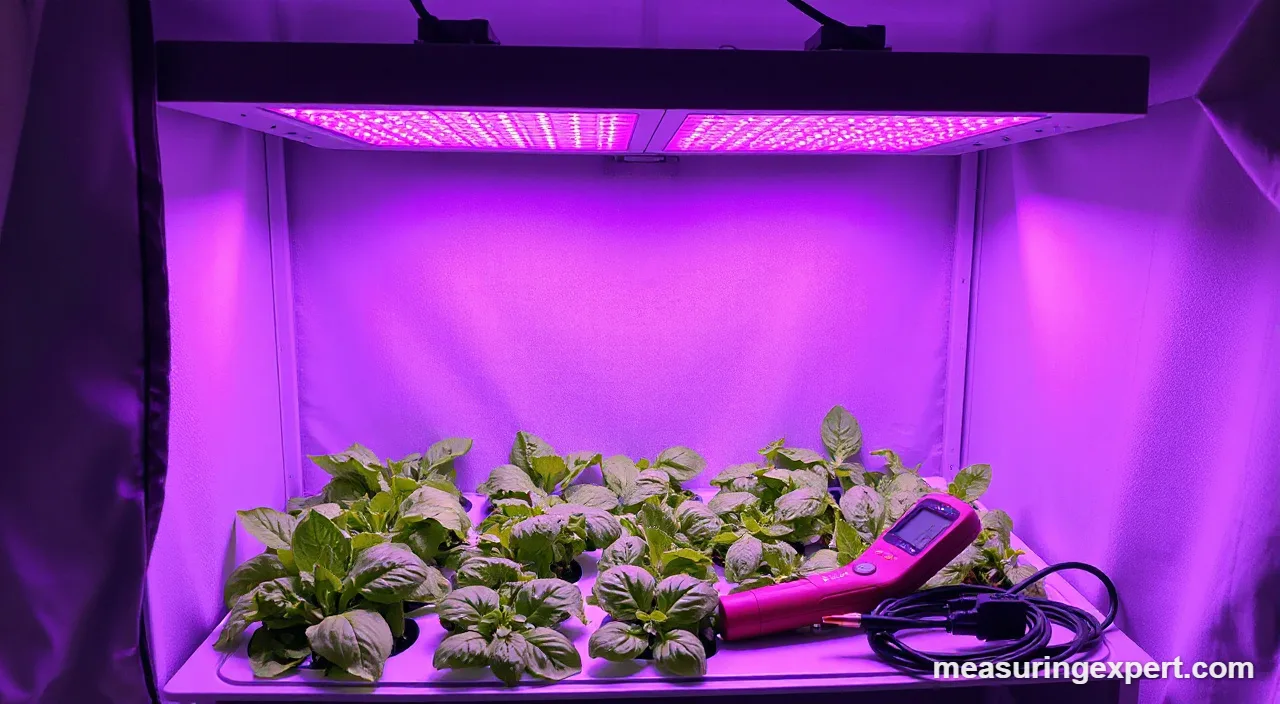
- Protect your eyes. First, put on eye protection. For example, the Photobio manual warns that a grow light can emit hazardous UV, high-energy visible and infrared radiation, and tells you to avoid looking at it.
- Set the light as you grow. Next, turn the light to its normal dimming level and let it warm up, so you read the output your plants will get.
- Level the sensor at canopy height. Then hold the sensor flat, facing the light, at the height of the top leaves. Also, keep your body and the cable out of the light path.
- Take readings on a grid. After that, read the center, the corners and the edges of the footprint.
- Average and compare. Next, average the readings and compare the center with the edges. As a result, a big drop at the edges means you should hang the light lower or add a second fixture.
- Convert to DLI. Finally, multiply the average PPFD by 3,600 and your hours of light, then divide by 1,000,000. Then compare the result with your crop range.
Care Tips for Your Best Grow Light Meter
First, keep the sensor clean, because dust and water spots change the reading. Next, avoid heat, since the LX1330B manual lists a temperature coefficient of 1 percent per degree C, and Apogee lists drift under 2 percent per year for its quantum sensors. Also, for a PAR meter, ask the maker about recalibration if you need documented accuracy. Finally, use the same meter every time, so you compare like with like.
Honest Limits of the Best Grow Light Meter
In short, a meter shows how much light reaches one point at one moment. However, it does not show how the plant responds. Moreover, most PAR meters stop at 700 nm or so, and the Apogee MQ-610 page says some LEDs and sunlight emit far-red light that traditional PAR meters do not count. Therefore treat every number as a good guide, and watch your plants too.
Best Grow Light Meter FAQ
What is the best grow light meter for LED grow lights?
A quantum PAR meter such as the Apogee MQ-500 is the best grow light meter for LEDs, because it counts photons from 389 to 692 nm instead of weighting green light like a lux meter. In addition, Apogee says it works with LEDs, HPS, metal halide and sunlight.
Is a lux meter the best grow light meter for grow lights?
Instead of PPFD, it is fine for comparing two spots or checking bulb fade. However, lux weights green-yellow light, so it can mislead under colored LEDs. Therefore, use a PAR meter to set a PPFD target.
What is the difference between PAR and PPFD?
First, PAR is the 400 to 700 nm band of light plants use. In addition, PPFD is the number of photons in that band reaching a surface each second, in umol/m2/s.
How do I convert lux to PPFD?
First, divide foot-candles by a source factor, such as 5.01 for sunlight or 7.62 for HPS. However, the result is only an estimate, and we found no sourced factor for LED grow lights.
How much light does full sun give?
For example, Virginia Tech says full sun is about 2,000 umol/m2/s of PPFD. Therefore a good PAR meter reads to at least 4000.
What is DLI and why does it matter?
Also, the daily light integral is the total PAR a plant gets in a day, in mol/m2/day. In addition, it equals PPFD times 3,600 times hours of light, divided by 1,000,000. Lettuce, for example, has a reference range of 12 to 17.
Is a phone app the best grow light meter?
Meanwhile, Virginia Tech calls phone apps that use the phone photodiode the cheapest option. However, accuracy varies by phone, so a dedicated meter is better for repeat work.
Where do I hold the best grow light meter?
First, hold the sensor flat at canopy height, facing the light, and read several points across the footprint. Then average them.
Do I need to calibrate the best grow light meter?
Also, quantum meters drift slowly. For example, Apogee lists drift under 2 percent per year. Therefore, ask the maker about recalibration if you need documented accuracy. Similarly, lux meters need the same care.
Are PAR meters safe to use under strong lights?
However, the meters are safe, but the light is not always. For example, the Photobio manual warns of UV, high-energy visible and infrared radiation, so wear protective eyewear and do not stare at the light.
Bottom Line: The Best Grow Light Meter to Buy
In short, if you want one meter for setting up grow lights, the Apogee MQ-500 is the best grow light meter for most people. Next, pick the DLI-500 to track daily totals and a lux meter only for rough checks. Also, for related light tools, see our best solar radiation meter, best UV meter and best soil moisture sensor guides, and our primer on units of measurement in science.