

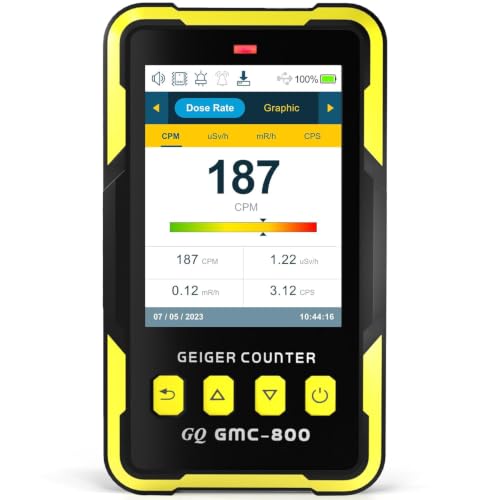
The best Geiger counter for most homes is the GQ GMC-800, because it pairs a Geiger tube with a color screen, data logging and clear alarms. Your goal decides the rest: a scintillator such as the Radiacode 103 for isotope work, or a pancake probe such as the Mazur PRM-9000 for surface checks.
In short: pick the GQ GMC-800 for everyday readings, the Radiacode 103 for a smart spectrometer, and the Mazur PRM-9000 for surface contamination checks.
As an Amazon Associate, Measuring Expert earns from qualifying purchases. Our picks are based on research, specifications and owner feedback, not paid placement.
Best Overall
Best Smart
Best for Surfaces
Quick Answer: Which Best Geiger Counter Fits Your Needs?
- Everyday home readings: the GQ GMC-800 with its color screen and 2 MB log.
- Widest dose rate range: the GQ GMC-500+ with two tubes.
- Isotope identification: the Radiacode 103, which draws a spectrum in a phone app.
- Faster low-level readings: the Radiacode 110, whose larger crystal collects more counts.
- Alpha and beta surface checks: the Mazur PRM-9000 pancake tube.
- No menus or apps: the Radiation Alert Monitor 4EC analog meter.
- Not on the list: cheap EMF and ghost-hunting gadgets, which do not measure ionizing radiation.
On This Page
- Comparison table
- The 6 picks, reviewed
- How we chose
- Best Geiger counter types
- Specs that matter
- How to take a background reading
- Checks and care
- Honest limits
- FAQ
- Bottom line
Best Geiger Counter Comparison at a Glance
| # | Product | Best For | Standout Feature | Amazon |
|---|---|---|---|---|
| 1 | GQ GMC-800 Geiger Counter | All-round home readings and logging | Color LCD, 2 MB log, three alarm styles | View |
| 2 | GQ GMC-500+ Dual-Tube Geiger Counter | Wide range from background to high dose rates | Second tube extends the range | View |
| 3 | Radiacode 103 Smart Radiation Detector | Isotope identification with a phone app | CsI(Tl) scintillator with spectrum view | View |
| 4 | Radiacode 110 Smart Radiation Detector | Finding weak sources and slow-changing readings | About 3 cm3 crystal, 77 cps per uSv/h | View |
| 5 | Mazur PRM-9000 Geiger Counter | Alpha and beta surface checks and logging | 45 mm pancake tube with mica window | View |
| 6 | Radiation Alert Monitor 4EC | Simple, battery-sipping field checks | Analog needle, three ranges, 9 V battery | View |
The 6 Best Geiger Counter Picks, Reviewed
A Geiger counter, in everyday use, is any handheld meter that counts ionizing radiation and shows a count rate or dose rate. This list includes two true Geiger-tube families and two scintillator spectrometers, since buyers often shop for them together. In contrast, we left out EMF meters and ghost-hunting devices, because they measure a different kind of energy. Our best solar radiation meter guide covers sunlight instead.
Best Overall
1. GQ GMC-800 Geiger Counter
Best for: first-time buyers who want a classic Geiger tube, a readable screen and a data log in one handheld.
The GMC-800 uses a Geiger-Muller tube, so it reports counts per minute (CPM) and counts per second (CPS) and converts them to a dose rate. According to the GQ user guide, it responds to beta, gamma and X-ray radiation, with listed energy ranges of 0.25 to 3.5 MeV for beta, 0.1 to 1.25 MeV for gamma and 0.03 to 3.0 MeV for X-ray.
In fact, the screen is the main upgrade over older GQ models. Specifically, it is a backlit color LCD with light and dark themes. Moreover, the unit saves readings to 2 MB of flash memory every second, minute or hour, with a real-time clock for the timestamps. As a result, you can log a basement, a garden and a rock collection, then compare the files on a computer.
- Dose rate range: 0.00 to 2000 uSv/h (0.00 to 200 mR/h)
- Units: CPM, CPS, uSv/h and mR/h, plus accumulated dose in dosimeter mode
- Power: internal rechargeable 3.6 to 3.7 V Li-ion cell (14500 size)
- Alarms: audible, vibration and visual, with thresholds you set yourself
- Data: USB transfer, GQ Data Viewer software and GMCmap upload support
Pros
- Large color screen is easy to read at a glance
- Logs data with timestamps for later comparison
- Three alarm styles, including vibration
- Uses a standard rechargeable cell format
Cons
- Listed dose rate range tops out well below the dual-tube GMC-500+
- The manual does not state weight or size
- The guide lists no alpha response
Skip it if: you need to check surfaces for alpha particles, or you want a spectrum that names isotopes; the Radiacode and the Mazur below cover those jobs.
Best High-Range Dual Tube
2. GQ GMC-500+ Dual-Tube Geiger Counter
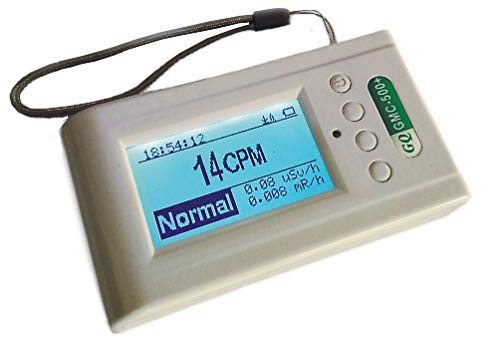
Best for: buyers who want one handheld that covers both low background readings and much higher dose rates.
Similarly, the GMC-500+ keeps the Geiger-tube approach but adds a second tube built for high dose rates. Next, a tube-selection menu lets you use the high-sensitivity tube, the high-dose tube or both. Therefore, the same meter can read quiet background levels and still stay on scale near a strong source.
In addition, GQ says the second tube extends the detection range up to ten times higher. The guide lists a top dose rate of about 42,500 uSv/h for the GMC-500+. Of course, that figure is a long way from anything a normal home will see, so the real value here is headroom rather than daily use.
- Tubes: two, selectable as high sensitivity, high dose or both
- Radiation: beta, gamma and X-ray
- Units: CPM, CPS, uSv/h and mR/h
- Memory: 1 MB flash, logging about once per second, oldest data overwritten when full
- Power: rechargeable Li-ion cell charged over mini-USB; a standard 18650 cell is the suggested replacement
Pros
- Very wide dose rate range for a handheld
- Choice of tube suits both low and high readings
- USB data output plus a 3.5 mm analog output for other gear
- Replacement cell is easy to find
Cons
- Looks and menus are older than the GMC-800
- The guide does not confirm Wi-Fi for the Plus model, so check the listing before you count on it
- Smaller log memory than the GMC-800
Skip it if: you only want background readings around the house; the extra range adds cost you may never use.
Best Smart Spectrometer
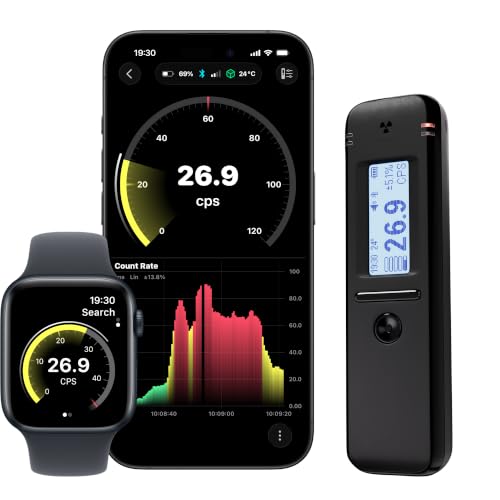
3. Radiacode 103 Smart Radiation Detector
Best for: hobbyists who want to see which isotopes are present, not only how many counts per minute.
First, the Radiacode 103 is not a Geiger-Muller tube meter. Instead, it uses a CsI(Tl) scintillation crystal of about 1 cubic centimeter, and it connects to a smartphone or PC over Bluetooth. Radiacode describes the 100 series as a pocket-sized Geiger counter and gamma spectrometer. The app draws a spectrum, so peaks from isotopes such as Cs-137, K-40 and Ra-226 can be recognized.
Meanwhile, sensitivity is the other big difference. For example, Radiacode lists 30 counts per second for 1 uSv/h of Cs-137 on the 103. A typical small Geiger tube gives far fewer counts for the same dose rate, so the Radiacode settles on a stable reading much faster. However, the screen lives on your phone, and the device has no display of its own.
- Crystal: CsI(Tl), about 1 cm3, with a 6 by 6 mm photomultiplier
- Energy resolution: 8.4% at Cs-137 (FWHM)
- Dose rate range: 0.01 to 1000 uSv/h for Cs-137
- Battery: 1000 mAh Li-poly, up to 200 hours, USB Type-C charging
- Connectivity: Bluetooth to smartphone or PC
Pros
- Names isotopes through the spectrum view
- Settles on a reading quickly because of high sensitivity
- Long battery life and USB-C charging
- Pocket size
Cons
- No built-in screen, so you need a phone or PC
- Maker page does not list weight, size or a numeric energy range
- Gamma focus: the page does not claim alpha or beta response
Skip it if: you want a standalone meter with a screen and a click for every count; pick the GMC-800 instead.
Best Sensitivity
4. Radiacode 110 Smart Radiation Detector
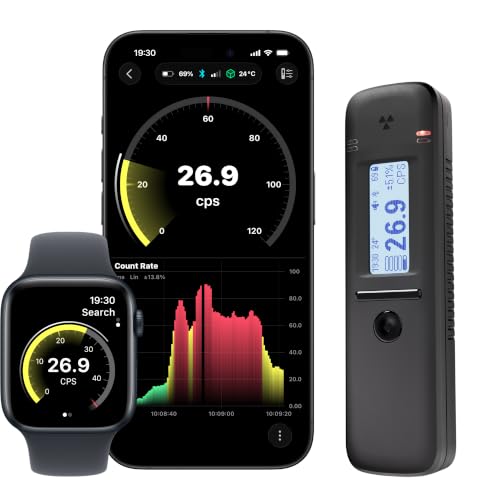
Best for: users who care most about fast, stable readings at very low levels, such as survey walks or rock collecting.
Similarly, the Radiacode 110 follows the same scintillator design as the 103, but with a larger crystal. According to Radiacode, the crystal is about 3 cubic centimeters, and the sensitivity is 77 counts per second per 1 uSv/h of Cs-137. That is more than double the 103 figure of 30, so low-level readings stabilize sooner.
The larger crystal costs some top-end range, and the Radiacode page lists 0.01 to 400 uSv/h for the 110. In exchange, the battery is bigger at 1500 mAh, with up to 290 hours of run time. For most home checks, therefore, the 110 is the more capable of the two Radiacode picks, while the 103 is the one to choose if you expect higher dose rates.
- Crystal: CsI(Tl), about 3 cm3, with a 6 by 6 mm photomultiplier
- Energy resolution: 8.4% at Cs-137 (FWHM)
- Dose rate range: 0.01 to 400 uSv/h for Cs-137
- Battery: 1500 mAh Li-poly, up to 290 hours, USB Type-C charging
- Isotope identification through spectrum visualization in the app
Pros
- Highest sensitivity of the six picks
- Longest rated run time of the two Radiacode units
- Spectrum view for isotope work
- USB-C charging
Cons
- Lower top range than the 103
- Depends on a phone or PC for its display
- Maker page gives no weight or size
Skip it if: you may meet high dose rates or you want a physical dial or screen on the device.
Best for Surface Checks
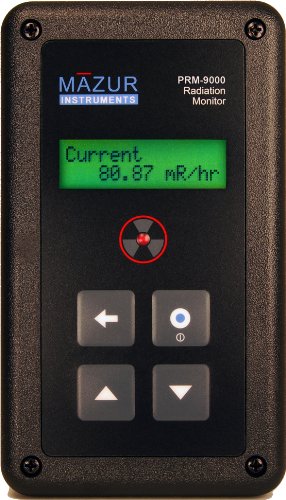
5. Mazur PRM-9000 Geiger Counter
Best for: people who need to check surfaces and small objects for alpha and beta radiation as well as gamma.
Meanwhile, the PRM-9000 uses a halogen-quenched LND 7317 pancake Geiger-Muller tube with a mica window about 45 mm across. First, a thin window lets low-energy particles reach the gas. Because of that, the unit detects alpha, beta, gamma and X-ray radiation, with a stated alpha minimum of 2.0 MeV and a beta minimum of 0.16 MeV.
It also records data. The meter stores readings every minute or every hour in non-volatile memory and exports a time-stamped CSV over USB with an optional cable. In addition, it shows elapsed time, average, minimum and maximum readings. Finally, the specification sheet states typical accuracy of plus or minus 10%, and a wide span of 0.001 to 125 mR/hr.
- Sensitivity: 3,500 CPM per mR/hr, calibrated to Cs-137
- Ranges: 0.001 to 125 mR/hr, or 0.01 to 1,250 uSv/hr
- Size and weight: 143 by 83 by 35 mm, 368 g with battery
- Power: 9 V battery, with a stated life of about 20,150 hours on alkaline
- Operating temperature: -20 to 51 C
Pros
- Detects alpha, beta, gamma and X-ray
- Stated accuracy of plus or minus 10% typical
- Very long battery life
- Made in the USA
Cons
- Two-line text display, no color graphics
- USB export needs an optional cable
- Larger and heavier than the pocket scintillators
Skip it if: you want a colorful screen or a phone app; the GMC-800 or a Radiacode feels more modern.
Best Analog Meter
6. Radiation Alert Monitor 4EC
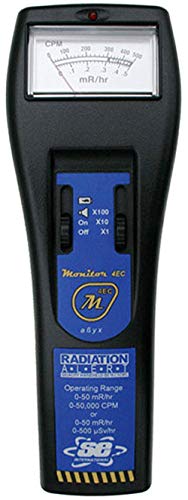
Best for: buyers who prefer a plain analog needle and a click for each count, with no menus or apps.
The Monitor 4EC from SE International is an energy-compensated survey meter built around a halogen-quenched GM tube with a thin mica window. Also, the manufacturer lists detection of alpha, beta, gamma and X-ray radiation, with gamma and X-ray detection down to 10 keV through the window and 40 keV through the compensated sidewall.
Instead of a screen, its analog needle reads three selectable ranges. In mR/hr the full-scale values are 0.5, 5 and 50, and the CPM scales run to 500, 5,000 and 50,000. In addition, a red light flashes and a beeper sounds with each event. The factory accuracy is typically plus or minus 15%, or plus or minus 10% with NIST source calibration, according to the product page.
- Sensitivity: about 1,000 CPM per mR/hr (Cs-137)
- Power: one 9 V alkaline battery, roughly 2,000 hours at normal background
- Size and weight: 209 by 71 by 50 mm, about 231 g
- Operating range: -10 to +50 C, 10 to 70% humidity non-condensing
- Output: 3.5 mm jack with pulse output
Pros
- No menus, so it is quick to learn
- Energy-compensated gamma response above 40 keV
- Pulse output jack for logging by other gear
- Runs on a common 9 V battery
Cons
- Analog scale is harder to read at very low levels
- The maker page lists no on-board data logging
- The standard scale is in mR/hr, and the uSv/hr version is optional
Skip it if: you want logged data or a digital readout; choose the GMC-800 or the PRM-9000.
How We Chose the Best Geiger Counter Picks
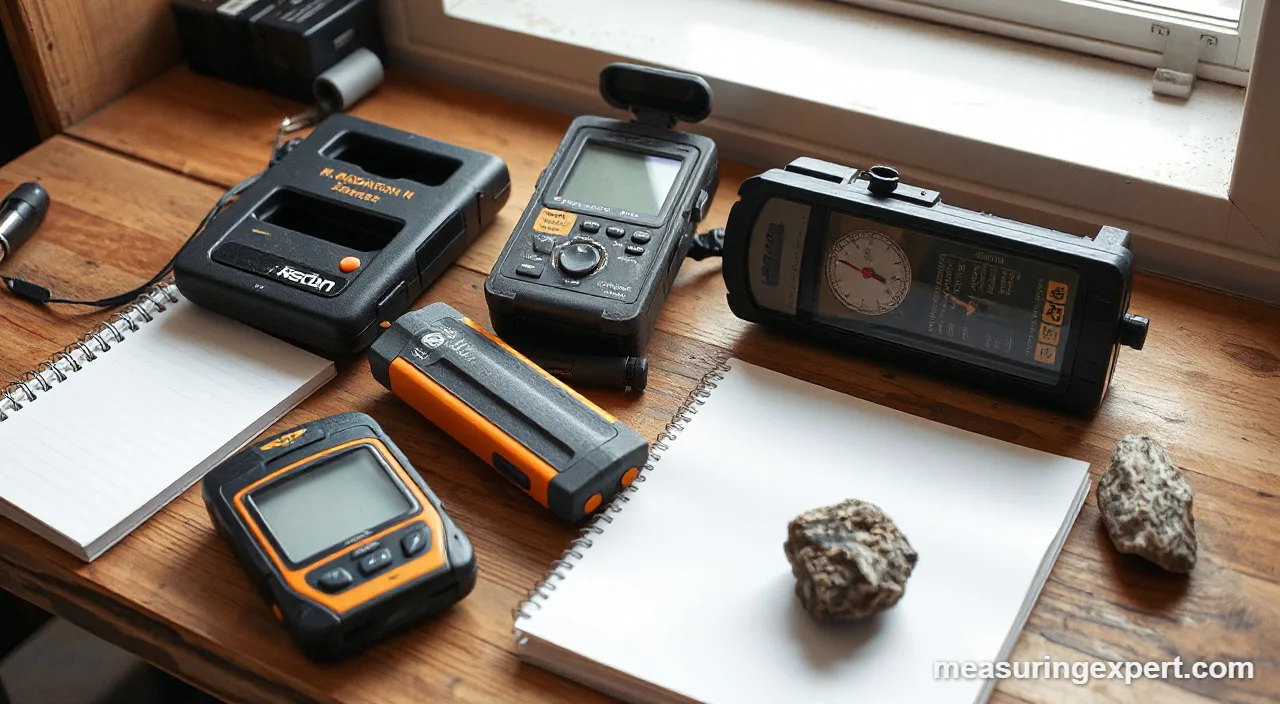
To be clear, we did not test these meters by hand. Instead, we compared manufacturer manuals and product pages, then kept only complete handheld instruments from established makers. As a result, every number in the reviews comes from those documents, and we left out any spec we could not find.
- Detector type: a Geiger-Muller tube, a pancake tube or a scintillator, each with stated radiation types.
- Stated range and units: a published dose rate range in uSv/h or mR/h, plus CPM or CPS.
- Documentation: a manual or maker page that lists sensitivity and the isotope used for calibration.
- Use case: each pick had to solve a different problem, from background logging to isotope work.
- Brand mix: no more than two picks per maker, with one pick from each of four brands.
- Background: for the basics of alpha, beta and gamma radiation we followed the EPA radiation basics page.
Best Geiger Counter Types: Tube, Scintillator or EMF Gadget
To start, the word “radiation” covers very different things, and that causes a lot of wrong purchases. The EPA explains that ionizing radiation has enough energy to knock electrons out of atoms, while non-ionizing radiation, such as radio waves and visible light, does not. In practice, a Geiger counter responds to ionizing radiation only. An EMF meter, however, measures electric, magnetic or radio-frequency fields, which are non-ionizing.
| Device type | What it measures | Typical output | Examples here |
|---|---|---|---|
| Geiger-Muller tube meter | Ionizing radiation counts (beta, gamma, X-ray; some also alpha) | CPM, CPS, uSv/h | GQ GMC-800, GQ GMC-500+ |
| Pancake tube meter | Alpha, beta, gamma and X-ray through a thin window | CPM, mR/hr, uSv/hr | Mazur PRM-9000, Monitor 4EC |
| Scintillation spectrometer | Gamma energy spectrum and dose rate | Spectrum, uSv/h | Radiacode 103 and 110 |
| EMF or ghost detector | Electric, magnetic or radio-frequency fields | mG, V/m or a light bar | None; not a radiation counter |
Likewise, the Mazur PRM-9000 specification listing makes the same point from the other side. In fact, it states plainly that the PRM-9000 does not detect neutron, microwave, RF/EMF, radon or laser energy. So, if a listing promises to find “radiation” for a very low price, check whether it names a Geiger tube and a unit such as CPM or uSv/h. If it does not, it is almost certainly an EMF gadget.
Specs That Matter When You Choose the Best Geiger Counter
In short, four specs separate a useful meter from a toy. First, look at the units. Count rate (CPM or CPS) is raw data from the detector. In contrast, dose rate (uSv/h or mR/h) is a calculated value, and the conversion depends on the detector and the isotope used for calibration. Because of that, two meters can show different dose rates for the same source.
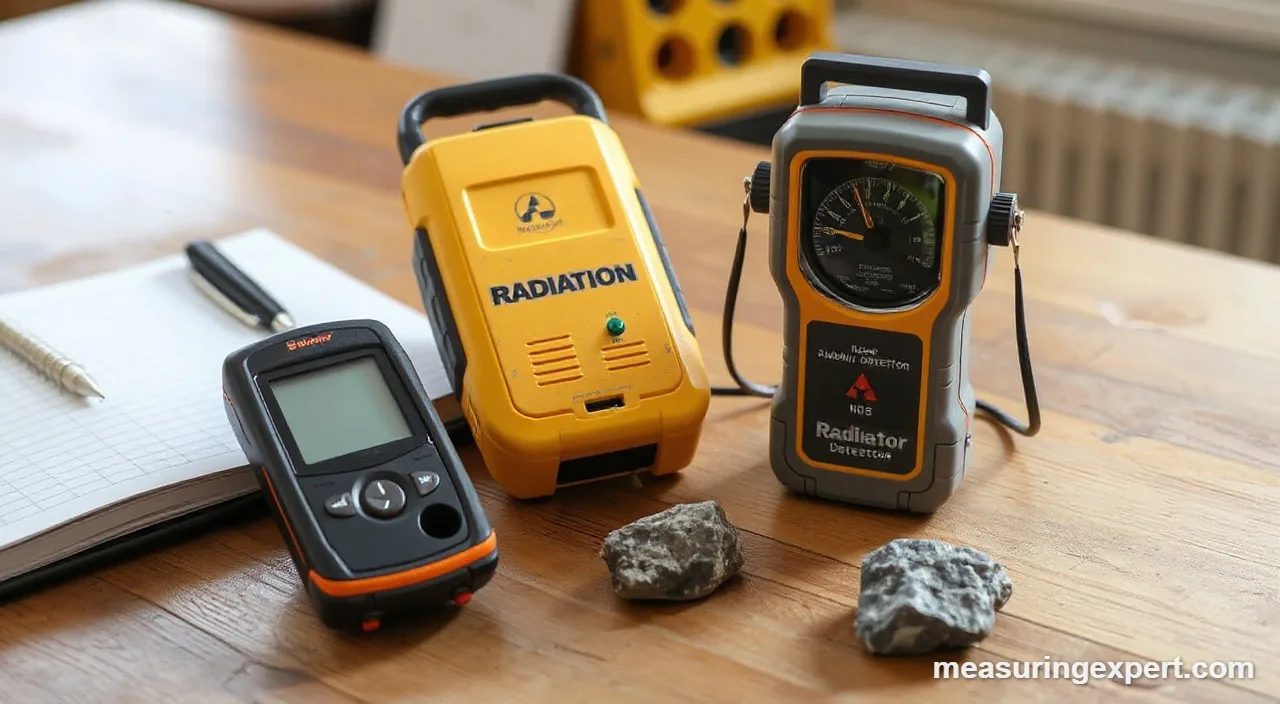
Next, the ratio of counts to dose rate is called sensitivity, and the numbers vary widely. In the table below, each figure comes from the maker and uses Cs-137. We converted mR/hr to uSv/h with the 10-to-1 ratio that the Mazur ranges use (0.001 to 125 mR/hr equals 0.01 to 1,250 uSv/hr).
| Meter | Maker sensitivity | CPM per 1 uSv/h |
|---|---|---|
| Monitor 4EC | About 1,000 CPM per mR/hr | About 100 |
| Mazur PRM-9000 | 3,500 CPM per mR/hr | About 350 |
| Radiacode 103 | 30 cps per 1 uSv/h | 1,800 |
| Radiacode 110 | 77 cps per 1 uSv/h | 4,620 |
In short, higher sensitivity means more counts for the same dose rate. Consequently, the reading settles faster and its random scatter shrinks. For that reason, the Radiacode meters respond to small changes much sooner than the analog Monitor 4EC. Dose rate range is the second spec: a tube with a high ceiling, such as the GMC-500+ second tube, stays on scale near strong sources, but a scintillator can saturate earlier.
Third, check the radiation types. Alpha particles stop in a thin sheet of material, so only a thin-window tube reaches them. Also, the EPA notes that alpha particles cannot penetrate the outer layer of skin. In contrast, beta and gamma radiation travel farther. Finally, look at logging and alarms, because a time-stamped log lets you compare places and days. You can read more about dose units in our guide to units of measurement.
How to Take a Reliable Background Reading
Background radiation is always present, so the first job is to learn your normal. Fortunately, the steps below work with any meter in this guide.
- Charge or power the meter. Install a fresh battery or charge the cell fully, then set the unit you want, such as uSv/h.
- Pick a spot. Choose a place away from large metal objects, then hold the meter at a steady height, for example 1 m (3 ft) above the floor.
- Wait for the reading to settle. Low-sensitivity meters need several minutes. Instead, watch the average value rather than a single flicker.
- Write down the average. Then note the time, the place and the unit, or let the meter log the data automatically.
- Repeat in other places. For example, measure a second room, the outdoors and a spot near the item of interest, always with the same time and height.
- Compare against your background. A reading is only notable if it differs clearly from the normal level you recorded, not from an online number.
Checks and Care for Your Meter
In general, all the meters here depend on a stable detector and a healthy battery. For that reason, replace weak batteries early, because low voltage can distort counts. Likewise, keep the thin window of a pancake tube clean and dry, and never poke it, since the mica is delicate. The Monitor 4EC page states a factory accuracy of plus or minus 15% and plus or minus 10% with NIST source calibration, which shows that even a simple analog meter has a stated uncertainty. Therefore, always read that uncertainty as part of the answer.
Honest Limits of Home Geiger Counters
Overall, these instruments are hobby and curiosity tools. To be clear, we did not test them, and nothing here is advice about health or safety. Dose rates shown by a small meter carry uncertainty, and they depend on the isotope the maker used for calibration. Therefore, treat a reading as a clue and not as a verdict. A Geiger counter also does not measure radon gas, which needs a dedicated radon test, and the Mazur sheet says so about its own meter. If a reading is unexpectedly high, or if you worry about a product or place, contact your state radiation control program or the EPA instead of relying on a consumer meter. In addition, for indoor air topics such as particles and carbon dioxide, see our best air quality monitor guide.
Best Geiger Counter FAQ
What is the best Geiger counter for home use?
For most homes, the GQ GMC-800 is the best Geiger counter to start with. It also has a Geiger tube, a color screen, timestamped logging and several alarm types. If you want isotope identification instead, the Radiacode 103 is a better fit.
Is an EMF meter the same as a Geiger counter?
No. Instead, an EMF meter measures electric, magnetic or radio-frequency fields, which are non-ionizing. In contrast, a Geiger counter counts ionizing radiation. The Mazur sheet even lists RF and EMF energy as things its meter does not detect.
What does CPM mean on a radiation meter?
CPM means counts per minute. In other words, it is the raw number of detector events in one minute. A meter converts CPM to a dose rate, such as uSv/h, using a sensitivity factor. That factor differs by detector, so CPM from two meters cannot be compared directly.
What is the difference between uSv/h and mR/hr?
In short, both are dose rate units. For gamma radiation, 1 mR/hr corresponds to about 10 uSv/h, which is the ratio the Mazur PRM-9000 ranges use. Therefore, always check which unit your meter shows before you compare readings.
Which meters detect alpha particles?
Among our picks, the Mazur PRM-9000 and the Radiation Alert Monitor 4EC list alpha detection through a thin mica window. The GQ guide lists beta, gamma and X-ray for the GMC models, and the Radiacode pages do not claim alpha response.
Is a scintillator the best Geiger counter type?
It depends on the job. For example, a scintillator such as the Radiacode collects more counts, so readings settle faster, and it can show a spectrum. Meanwhile, a Geiger tube is simpler, handles higher dose rates and is easier to use without a phone.
How accurate is the best Geiger counter for home use?
In general, accuracy depends on the model and the isotope. The Mazur sheet states plus or minus 10% typical, and SE International states plus or minus 15% from the factory. Therefore, treat any reading as an estimate with that uncertainty.
Can these meters detect radon?
Not as a practical test. The Mazur specification sheet lists radon among the things its meter does not detect. Instead, a dedicated radon test kit or monitor is the right tool for that job.
What is a normal background reading?
It varies by place, building materials and altitude, so measure your own. For example, take several readings in your home, and use their average as your baseline. Our how-to section above shows the steps.
Do I need a smartphone with these meters?
Only for the Radiacode models, which have no built-in screen. By contrast, the GQ meters, the Mazur PRM-9000 and the Monitor 4EC all show readings on the device itself.
Bottom Line on the Best Geiger Counter
For most homes, the best Geiger counter is the GQ GMC-800. In short, it is easy to read, it logs data and it keeps the classic Geiger-tube workflow. Choose a Radiacode for fast readings and isotope spectra, or the Mazur PRM-9000 when surface checks matter. Finally, avoid EMF gadgets sold under similar names.