

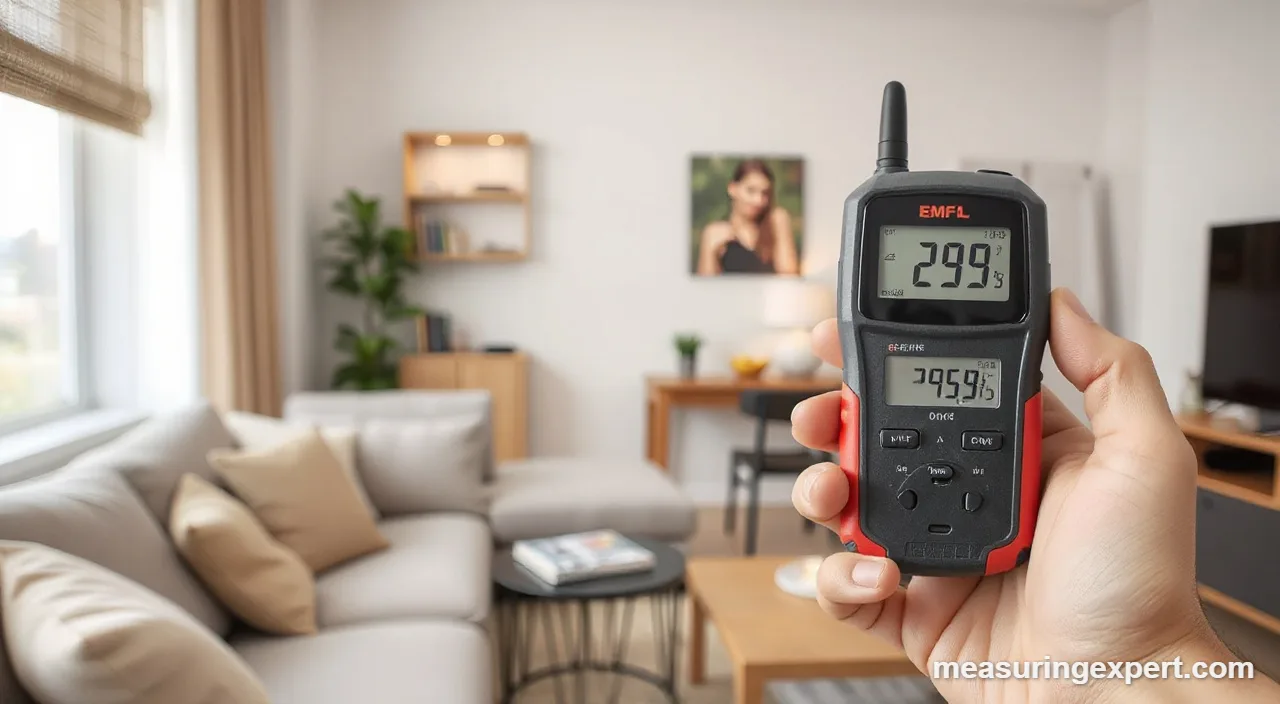
The best EMF meter for most home testing is the TriField TF2, because it reads magnetic fields, electric fields and radio-frequency fields in one handheld and its manual lists accuracy for each. Instead, choose the GQ EMF-390 for the widest RF range and logging, or a Cornet meter when you want to hear and log pulsed wireless signals.
In short: pick the TriField TF2 for a simple three-in-one meter, the GQ EMF-390 for RF range and data logging, and a Cornet meter for pulsed wireless signals you can hear.
As an Amazon Associate, Measuring Expert earns from qualifying purchases. Our picks are based on research, specifications and owner feedback, not paid placement.
Best Overall
Best for RF and Logging
Best for Pulsed Signals
Quick Answer: Which EMF Meter Fits Your Home Test?
- Simple three-in-one use: the TriField TF2, with accuracy stated for each field type.
- Wireless bands and logging: the GQ EMF-390, which covers RF from 10 MHz to 10 GHz.
- Pulsed signals you can hear: the Cornet ED88TPlus5G, with an audio signature and a 50-hour log.
- Light flicker and waveforms: the Cornet ED98QPro5G, a four-mode meter.
- Simplest check: the AceFox light-scale meter, which reads magnetic fields only.
- Know the unit: mG or uT for magnetic fields, V/m for electric fields, and mW/m2 or uW/m2 for RF.
- Not on the list: radiation counters. Those measure ionizing radiation, which is a different job.
On This Page
- Comparison table
- The 5 picks, reviewed
- How we chose
- What each reading means
- Specs that matter
- How to survey a room
- Accuracy and care
- Honest limits
- FAQ
- Bottom line
Best EMF Meter Comparison at a Glance
| # | Product | Best For | Standout Feature | Amazon |
|---|---|---|---|---|
| 1 | TriField TF2 EMF Meter | Three field types with stated accuracy | Magnetic, electric and RF in one meter | View |
| 2 | GQ EMF-390 Multi-Field EMF Meter | Wide RF coverage, spectrum bands and data logging | 10 MHz to 10 GHz RF, 1 MB log | View |
| 3 | Cornet ED88TPlus5G EMF Meter | Hearing and logging pulsed RF signals | Audio signature and 50-hour log | View |
| 4 | Cornet ED98QPro5G Electrosmog Meter | Four-in-one checks with a waveform display | RF, magnetic, electric and light flicker | View |
| 5 | AceFox EMF Meter | A low-effort check of magnetic fields near appliances | Five-level light scale | View |
The 5 Best EMF Meter Picks, Reviewed
First, an EMF meter measures electric, magnetic or radio-frequency fields, and each type uses a different unit. In short, this list covers a simple three-in-one meter, a feature-rich logger, two Cornet meters with sound features and a simple light-scale meter that appeals to ghost hunters. In contrast, we left out radiation counters, which measure ionizing radiation. For electrical units, see our guide to the voltage symbol and unit.
Best Overall
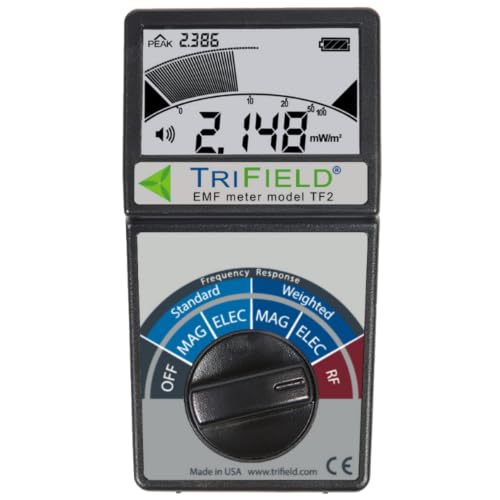
1. TriField TF2 EMF Meter
Best for: home testers who want one simple meter for power-line fields, appliance fields and wireless signals.
First, the TriField TF2 measures three separate things. For example, according to its owner manual, it reads AC magnetic fields on three axes from 40 Hz to 100 kHz, AC electric fields on one axis over the same band, and radio-frequency (RF) or microwave fields from 20 MHz to 6 GHz. Each result has its own scale and unit, so you can tell what kind of field you are looking at.
The manual also states accuracy for each field. For example, magnetic readings are within plus or minus 4% at 50 or 60 Hz, electric readings within plus or minus 5%, and RF within plus or minus 20% at 1 GHz. However, the RF scale tops out at 19.999 mW/m2, so very strong transmitters can overload it. In addition, the meter runs on a 9 V battery with a rated life of more than 20 hours with the backlight off.
- Magnetic: 0.1 to 100.0 mG, resolution 0.1 mG, 3 axis
- Electric: 1 to 1000 V/m, resolution 1 V/m, 1 axis
- RF and microwave: 0.001 to 19.999 mW/m2, 20 MHz to 6 GHz
- Stated accuracy: 4% magnetic, 5% electric, 20% RF (at the stated test frequencies)
- Power: 9 V alkaline, more than 20 hours (backlight off)
Pros
- Stated accuracy for all three field types
- Magnetic readings use three axes, so orientation matters less
- Simple controls
- Long battery life
Cons
- RF range tops out at 19.999 mW/m2
- Display is basic, and there is no data logging
- The manual does not list size or weight
Skip it if: you want a spectrum view, logging or a high RF ceiling; the GQ and Cornet meters do more.
Best for RF Range and Logging
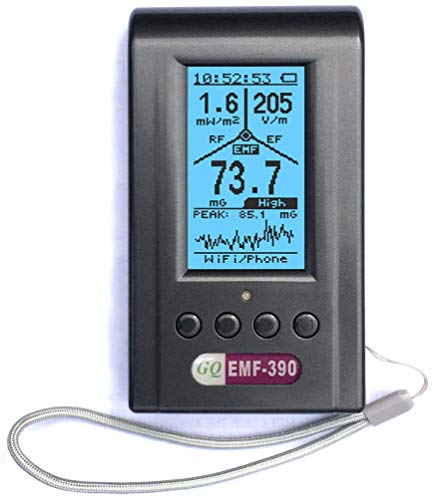
2. GQ EMF-390 Multi-Field EMF Meter
Best for: hobbyists who want to see which wireless bands are active and keep a record of readings.
Overall, the GQ EMF-390 is the most feature-rich meter on this list. Also, its user guide lists RF from 10 MHz to 10 GHz, a three-axis magnetic sensor to 500 mG, and an electric field range up to 1000 V/m. An RF spectrum analyzer view covers several bands between 50 MHz and 2.5 GHz, so you can see which bands are active.
It also logs. The guide states 1 MB of flash memory, which stores about 24 hours of data at one reading per second. Because the unit is rechargeable, it suits long sessions near a router or a smart meter. However, the RF accuracy is stated as plus or minus 10 dB, which is far looser than the 5% magnetic figure. Therefore, use the RF numbers to compare places and times rather than as exact values.
- RF: 10 MHz to 10 GHz, 0.02 uW/m2 to 9999 mW/m2
- Electric: 0 to 1000 V/m, plus or minus 10%
- Magnetic: 3 axis, 0 to 500 mG (0 to 50 uT), 0.5 Hz to 150 kHz, plus or minus 5%
- Display: 128 by 64 pixel backlit LCD; size 135 by 78 by 25 mm
- Power and memory: rechargeable 18650 Li-ion cell, about 24 hours; 1 MB flash log
Pros
- Very wide RF range with a band view
- Logs data for later review
- Rechargeable battery
- Reports RF in uW/m2, mW/m2 and other units
Cons
- RF accuracy is stated only as plus or minus 10 dB
- The menus take time to learn
- The guide does not state weight
Skip it if: you want a quick, simple reading; the TF2 is easier to learn.
Best for Sound and Pulse Signals
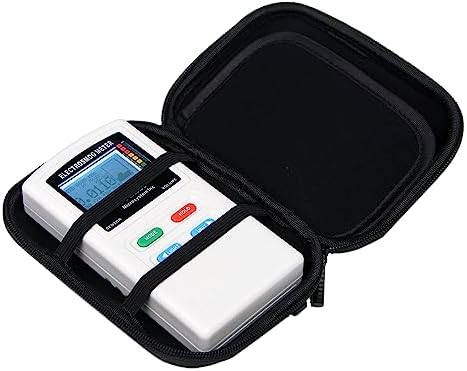
3. Cornet ED88TPlus5G EMF Meter
Best for: users who want to hear the pulse pattern of a signal and log RF over many hours.
In contrast, the Cornet ED88TPlus5G is a three-mode meter with an audio feature. Also, its user manual lists RF from 100 MHz to 8 GHz, two low-frequency magnetic ranges and an electric field mode. In addition, a speaker plays the signal as sound, which helps you tell steady signals from digital bursts. The manual also describes duty cycle and histogram functions for pulsed RF.
However, accuracy is stated in a looser way. For example, the manual lists an error of plus or minus 3.5 dB for RF, 20% for low-frequency magnetic fields and 25% for electric fields. In addition, the meter can log RF level and frequency for up to 50 hours at a three-minute interval, then send the data to a PC over USB. Finally, power comes from one 9 V battery or 5 V USB.
- RF: 100 MHz to 8 GHz, 0.5 uW/m2 to 1.8 W/m2 (-60 to +5 dBm)
- Magnetic: LF1 1 to 600 mG; LF2 0.1 to 10 mG (50 Hz to 10 kHz and 50 Hz to 1 kHz)
- Electric: 10 to 1000 V/m, 50 Hz to 50 kHz
- Units: dBm, mW/m2, V/m for RF; mG and uT for magnetic
- Power: 9 V alkaline, more than 20 hours; USB 5 V does not charge the battery
Pros
- Audio signature for pulsed signals
- Up to 50 hours of RF logging
- Separate low-range and high-range magnetic modes
- Duty cycle and histogram tools
Cons
- Low-frequency magnetic error is stated as 20%, looser than the TF2
- Error of plus or minus 25% for electric fields
- Learning curve for the extra functions
Skip it if: you want a plain three-in-one readout with no menus; the TF2 is simpler.
Best for Light Flicker and Waveforms
4. Cornet ED98QPro5G Electrosmog Meter
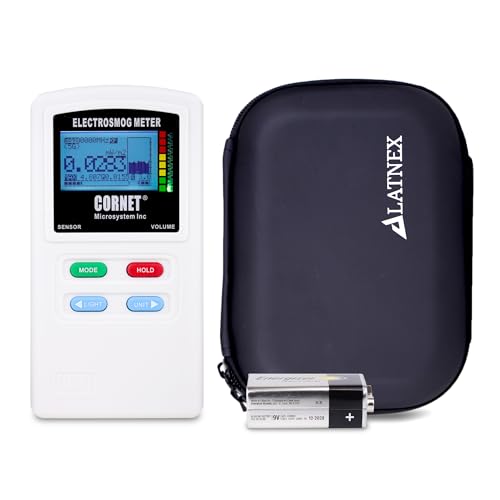
Best for: buyers who want a Cornet meter that also looks at light flicker and shows a live waveform.
The ED98QPro5G is the newer, quad-mode Cornet. First, a retailer page lists four jobs: RF, AC magnetic fields, AC electric fields and light flicker from modern light sources and displays. Also, RF measurement runs from 0.1 to 8 GHz, with the frequency display covering 100 MHz to 4.2 GHz, and power density from 0.5 uW/m2 to 1.8 W/m2. Therefore, the RF figures match those of the ED88TPlus5G.
It adds a real-time waveform display and sound signature analysis with volume control. In addition, the page lists up to 50 hours of data logging and more than 20 hours of battery life. However, the page we read gives no accuracy figures and no field strength ranges for the magnetic and electric modes. Therefore, ask the seller for the manual before you rely on it for numbers.
- RF: 0.1 to 8 GHz; frequency display 100 MHz to 4.2 GHz
- RF power density: 0.5 uW/m2 to 1.8 W/m2
- Magnetic: 50 Hz to 10 kHz; electric: 50 Hz to 50 kHz
- Extras: light flicker mode, waveform display, sound signature
- Logging: up to 50 hours; battery life more than 20 hours; 69 by 130 mm
Pros
- Light flicker mode in addition to field modes
- Live waveform and sound signature
- Up to 50 hours of logging
Cons
- The retailer page we read states no accuracy
- No magnetic or electric ranges on that page
- More features mean more menus
Skip it if: you only want a basic reading of power-line fields; the TF2 is simpler and documents its ranges.
Best Simple Light Meter
5. AceFox EMF Meter

Best for: first-time users who want a very simple indicator for magnetic fields and do not need numbers.
AceFox sells simple handheld EMF meters for home, office and ghost-hunting use. In short, retailer pages for AceFox meters describe a magnetic-field detector that reports in milligauss (mG) on a five-level light scale, from normal background up to 20 mG and above. Also, the same pages list an accuracy of plus or minus 5%, a frequency range starting at 50 Hz and a 9 V battery. However, they do not mention electric or RF readings.
Because the listings differ, check the exact model on the page you buy from. The retailer pages we read also disagree on whether the battery is included. This type of meter is a screening tool, so it shows relative differences between a lamp, a charger and a wall. Also, it will not tell you RF levels from a router, and it does not give a numeric readout on the pages we read.
- Measures: magnetic fields in mG, per retailer pages
- Scale: five light levels, up to 20 mG and above
- Stated accuracy: plus or minus 5%, per retailer pages
- Power: one 9 V battery; auto power-off after 5 minutes
- Electric and RF fields: not listed
Pros
- Very simple to read
- Stated accuracy of plus or minus 5% on retailer pages
- Quick check of appliances and wiring
Cons
- Magnetic only, with no electric or RF readings
- Light scale rather than a numeric value
- Retailer specs for similar models are inconsistent
Skip it if: you need RF readings, numeric values or logging; choose the GQ or a Cornet.
How We Chose the Best EMF Meter Picks
To be clear, we did not test these meters by hand. Instead, we compared manuals and maker pages, then kept handheld meters that publish field ranges and units. As a result, every number in the reviews comes from those documents, and we left out any spec we could not find.
- Field coverage: magnetic, electric and RF, or a clear statement that a meter is RF only.
- Units and ranges: published ranges in mG or uT, V/m and mW/m2 or uW/m2.
- Accuracy statement: a percentage or dB figure from the maker, where one exists.
- Documentation: a manual or maker page, not only a store listing.
- Background: for the basics of electric and magnetic fields we used the EPA page on electric and magnetic fields from power lines.
What Each Best EMF Meter Reading Means: V/m, mG and mW/m2
In short, an EMF meter reports three different quantities, and mixing them up is the most common mistake. For example, the EPA describes electric and magnetic fields as low frequency, non-ionizing energy, and it gives electric field strength in volts per meter (V/m). Magnetic field strength is given in teslas, and consumer meters usually show milligauss (mG) or microtesla (uT).
| Field type | Unit on the meter | Typical sources | Meters here that read it |
|---|---|---|---|
| Magnetic (low frequency) | mG or uT | Wiring, motors, transformers | TF2, EMF-390, both Cornets, AceFox (mG only) |
| Electric (low frequency) | V/m | Cords and wiring with voltage on them | TF2, EMF-390, both Cornets |
| Radio frequency (RF) | mW/m2, uW/m2 or V/m | Wi-Fi, cell phones, smart meters, transmitters | TF2, EMF-390, both Cornet meters |
Also, the units convert cleanly. 1 uT equals 10 mG, so the TF2 limit of 100 mG equals 10 uT. Similarly, 1 mW/m2 equals 1,000 uW/m2, which means the GQ lower limit of 0.02 uW/m2 is far below the TF2 lower limit of 0.001 mW/m2 (1 uW/m2). Because of that, a meter with a higher floor will show zero where another still shows a reading.
Electric field strength and RF power density also connect. Moreover, in free space, power density in W/m2 equals the electric field in V/m squared, divided by about 377 ohms. So 1 V/m equals roughly 2.65 mW/m2. For example, the Cornet range of 14 mV/m to 26.2 V/m matches 0.5 uW/m2 to 1.8 W/m2, which confirms the math.
Specs That Matter When You Choose an EMF Meter
Frequency range and sensor type
First, check the frequency range. Power-line fields sit at 50 or 60 Hz, while Wi-Fi uses 2.4 GHz and 5 GHz bands. As a result, a meter with an RF range that ends at 6 GHz, like the TF2, will not cover everything up to 10 GHz. Likewise, a magnetic-only meter such as the AceFox cannot see wireless signals at all.
Next, look at the number of axes. For example, a three-axis magnetic sensor gives the same reading no matter which way you hold the meter. A single-axis sensor does not, so you must turn it to find the maximum. The TF2 and the EMF-390 both list three-axis magnetic sensing.
Accuracy and display behavior
Third, read the accuracy statement. RF accuracy is usually given in decibels, and 3 dB is a factor of about two in power. Therefore, a stated plus or minus 10 dB on the EMF-390 means readings can be off by a factor of ten, while the Cornet figure of plus or minus 3.5 dB is a factor of about two and a quarter. In contrast, magnetic accuracy of plus or minus 4% to 5% is far tighter. Finally, check peak versus average readings, because pulsed Wi-Fi signals can read very differently in each mode.
How to Survey a Room With an EMF Meter
The steps below work with any meter in this guide. Use a consistent method, so that readings are comparable.
- Choose the unit. Set mG or uT for magnetic fields, V/m for electric fields and mW/m2 or uW/m2 for RF, then write the unit down.
- Read the baseline. Stand in the middle of the room with the meter at chest height, at least 1 m (3 ft) from large metal objects. Wait for the display to settle.
- Map the magnetic field. Move slowly along walls, near the electrical panel, and near appliances. Hold the meter steady, because fast movement can create false readings.
- Check the electric field. Keep your hand away from the sensor and away from your body. Check cords, lamps and wiring one at a time.
- Check RF. Point the sensor toward a router or a window, and watch the peak and average values. Record both.
- Change one thing at a time. Turn a device off, move a meter distance, or switch the router off, and measure again. Compare the numbers, not the colors.
Accuracy and Care Tips
EMF readings change with distance, so keep a fixed distance for repeat tests. Also, the EPA notes that magnetic field exposure falls as you move away from a source, which is why 30 cm (1 ft) and 1 m (3 ft) readings can differ a lot. Replace weak batteries early, because low voltage can distort a reading. Likewise, keep the sensor area clear of your hand, and store the meter away from strong fields.
You can also repeat a reading in the same spot on two different days. However, a small change is normal. In contrast, a large change often points to a changed load, such as a heater that switched on. For related checks of mains voltage, see our best digital voltmeter guide.
Honest Limits of a Best EMF Meter Reading
First, these meters report field strength. Also, they do not tell you whether a level is safe, and this guide makes no health claims. We did not test them, and every number comes from maker documents. Consumer meters also carry broad uncertainty, especially for RF. Moreover, unit and band differences make cross-brand comparison hard, so compare readings from the same meter only. If you have a concern about a power line, a transformer or a transmitter, contact your utility or a qualified inspector. Our best solar radiation meter guide covers sunlight, which is a different kind of measurement.
Best EMF Meter FAQ
What is the best EMF meter for home testing?
For most home testing, the TriField TF2 is the best EMF meter to start with. In addition, it reads magnetic, electric and RF fields, and the manual states accuracy for each. However, if you want logging and a wider RF range, the GQ EMF-390 is a strong alternative.
What do the readings measure?
It measures electric fields in V/m, magnetic fields in mG or uT, and radio-frequency fields in mW/m2 or uW/m2. However, some meters read only one type. The AceFox, for example, reads magnetic fields only.
What is the difference between mG and uT?
First, both measure magnetic field strength. 1 uT equals 10 mG, so 100 mG equals 10 uT. Check which unit your meter displays before you compare readings, because the two scales differ by a factor of ten.
Do I need a three-axis sensor?
A three-axis magnetic sensor is easier to use because direction does not change the reading. In contrast, with a single-axis sensor you must rotate the meter to find the maximum. The TF2 and EMF-390 list three axes.
Is it the same as a Geiger counter?
No, because an EMF meter measures non-ionizing fields such as power-line and wireless signals. A Geiger counter counts ionizing radiation. Therefore, they use different detectors and different units.
Which best EMF meter covers 5G frequencies?
The GQ EMF-390 lists RF up to 10 GHz, and both Cornet meters list RF up to 8 GHz. However, the TF2 stops at 6 GHz. Check the band your device uses before you buy.
How accurate is the best EMF meter for home use?
It depends on the field. The TF2 manual states plus or minus 4% for magnetic and 5% for electric fields, but RF is plus or minus 20%. In contrast, the EMF-390 states plus or minus 10 dB for RF, which is much looser.
What does dB accuracy mean on an RF meter?
In short, decibels describe a ratio. An error of 3 dB is about a factor of two in power, and 10 dB is a factor of ten. Therefore, an RF reading with a plus or minus 10 dB error is a rough guide only.
Can a reading tell me if a level is safe?
No, because a meter reports field strength and does not judge safety. This guide makes no health claims. For a concern about a specific source, contact your utility or a qualified inspector.
Why do readings jump around?
First, fields change with distance and with the load. Moving the meter quickly also creates false readings, and digital RF signals come in bursts. Also, hold the meter steady, wait for the display to settle, and compare peak and average values.
Bottom Line on the Best EMF Meter
For most home testing, the best EMF meter is the TriField TF2. In short, it is simple, it covers all three field types and it publishes accuracy. Choose the GQ EMF-390 for RF bands and logging, the Cornet ED88TPlus5G for pulsed signals, or the Cornet ED98QPro5G for light flicker and waveforms. Finally, always compare readings from one meter, in one method.