

The most precise bathroom scale for most people is the Wyze Scale X, which came out on top in independent accuracy tests. The Inevifit I-BS002S is the closest alternative. The Greater Goods AccuCheck suits you if you want a plain scale that double-checks its own reading, and the Escali HC225W is the one to consider if you want a high-capacity, anti-slip design. All four are digital, and digital scales are generally more accurate than analog ones.
The problem is that most scales look alike and do not behave alike. Step on one, step off, step on again, and a cheap model can give you readings a pound or two apart. That makes a daily weigh-in useless, because you cannot tell a real change from scale noise.
I ranked these four by how consistently independent tests rate them, not by a lab of my own. Where the evidence is thinner, I say so. Measuring Expert focuses on measuring tools and how to test their accuracy, so the last section shows you how to check any scale at home. If you buy through our Amazon links, we may earn a commission at no extra cost to you.
1. Wyze Scale X: best pick for most people
The Wyze Scale X is the strongest all-round choice, because it was rated among the most accurate in more than one independent test. It gave consistent, repeatable weights across repeated trials. It is an app-connected smart scale, so it also logs your readings for you.
Accuracy and performance
In a test where reviewers stepped on repeatedly with five minutes between weigh-ins, this model finished at the top alongside the Inevifit. Repeatability is what matters most for tracking, and this scale delivers it. A scale that returns the same number each time lets you trust a 0.2 lb change over a week.
- Type: digital, app-connected
- Evidence: top accuracy results in several independent tests
- Caution: body-fat percentages from any home scale are estimates
A scale that repeats the same number is worth more than one that shows an extra decimal.
Who it suits and what to check
Choose it if you want precise weight plus an automatic log in an app. You can ignore the body-composition readings and still get a first-rate scale.
Before buying, check the capacity limit on the listing against your weight, and check which health apps it syncs with. Current prices change often, so look at the live listing.
2. Inevifit I-BS002S: the close runner-up
The Inevifit I-BS002S is the best alternative to the Wyze if you want similar accuracy from a different brand. It shared the top spot with the Wyze Scale X in the same timed, repeated-weigh-in test, which makes it one of the few scales with that kind of evidence behind it.
Accuracy and performance
The result that counts is that readings stayed close together over repeated weigh-ins. That is the same quality you want when you track weight over months. I could not verify the finer specs of this model, so treat the test result as the main reason to pick it.
- Type: digital
- Evidence: top accuracy result in a repeated-weigh-in test
- Caution: confirm features and capacity on the product page
Two scales that agree with each other in testing are a good sign for both.
Who it suits and what to check
It suits you if the Wyze is out of stock or you prefer a different brand and app. It is also a sensible pick if you want strong precision without paying for extras you will not use.
Check the capacity limit, whether it needs an app to work, and the battery type. Read recent buyer comments for reports of drifting readings, which can show up after months of use.
3. Greater Goods AccuCheck: simplest verification
The Greater Goods AccuCheck is the pick for people who want a simple digital scale without an app. Its maker says it measures to 0.1 lb, and after you step off it verifies its first reading with a two-step, color-coded check.
Accuracy and performance
The verification step is a useful idea, because it catches a bad first reading. Keep one point in mind, though. A 0.1 lb display is resolution, not proof of accuracy. A scale can show tenths of a pound and still be off by a pound. The evidence here comes mostly from the maker, so run the home test below.
- Type: digital, no app required
- Claim: 0.1 lb resolution with reading verification
- Caution: fewer independent test results than the Wyze or Inevifit
A tenth-of-a-pound display tells you what the scale shows, not how right it is.
Who it suits and what to check
It suits you if you want a basic, glanceable scale, or if you share a bathroom with someone who dislikes apps. It also appeals if you like built-in checking.
Test it against a known weight when it arrives. If it passes, you get simple, reliable weighing. If it does not, return it while you still can.
4. Escali HC225W: for higher weight capacity
The Escali HC225W is the one to look at if you need a sturdier, anti-slip, high-capacity scale. It appears among the top performers in independent consumer testing, though with less detail on its precision than the first two picks. Escali is better known for kitchen scales, a category where accuracy is the whole point.
Accuracy and performance
The name signals a high-capacity design with a non-slip surface. A sturdy platform helps accuracy too, because a scale that flexes or slides is harder to read consistently. I have not seen repeated-weigh-in data for it, so check it yourself.
- Type: digital, high capacity, anti-slip
- Evidence: named among top performers in consumer testing
- Caution: confirm the exact capacity on the listing
If your weight is near a scale’s limit, buy the higher-capacity model.
Who it suits and what to check
It suits heavier users, or anyone who has outgrown a standard 400 lb limit. It also suits households that want a firm, no-fuss scale.
Leave a safety margin between your weight and the stated limit, because accuracy tends to be best in the middle of a scale’s range. Then run the home test below.
How to check that your bathroom scale is precise
You can check any scale in about ten minutes with no special equipment. You need to test two separate things, repeatability and correctness, and the table below shows how they differ.
Precise versus accurate
People use the two words as if they were the same, but they are not. A scale can be consistent and still wrong.
| Term | What it means | How you check it |
|---|---|---|
| Precision (repeatability) | Repeated readings agree | Weigh yourself three times in a row |
| Accuracy | Reading matches true weight | Add a known weight and compare |
| Resolution | Smallest step the display shows | Read the spec, such as 0.1 lb |
Resolution is what the display shows, precision is how steady it is, and accuracy is how right it is.
A three-step home test
- Put the scale on a hard, flat floor and weigh yourself three times. Readings within 0.2 lb of each other are a good result.
- Weigh yourself, then weigh yourself again holding a free weight of known mass, such as a 20 lb dumbbell. The difference should match the weight.
- Repeat with a different weight, then compare the errors.
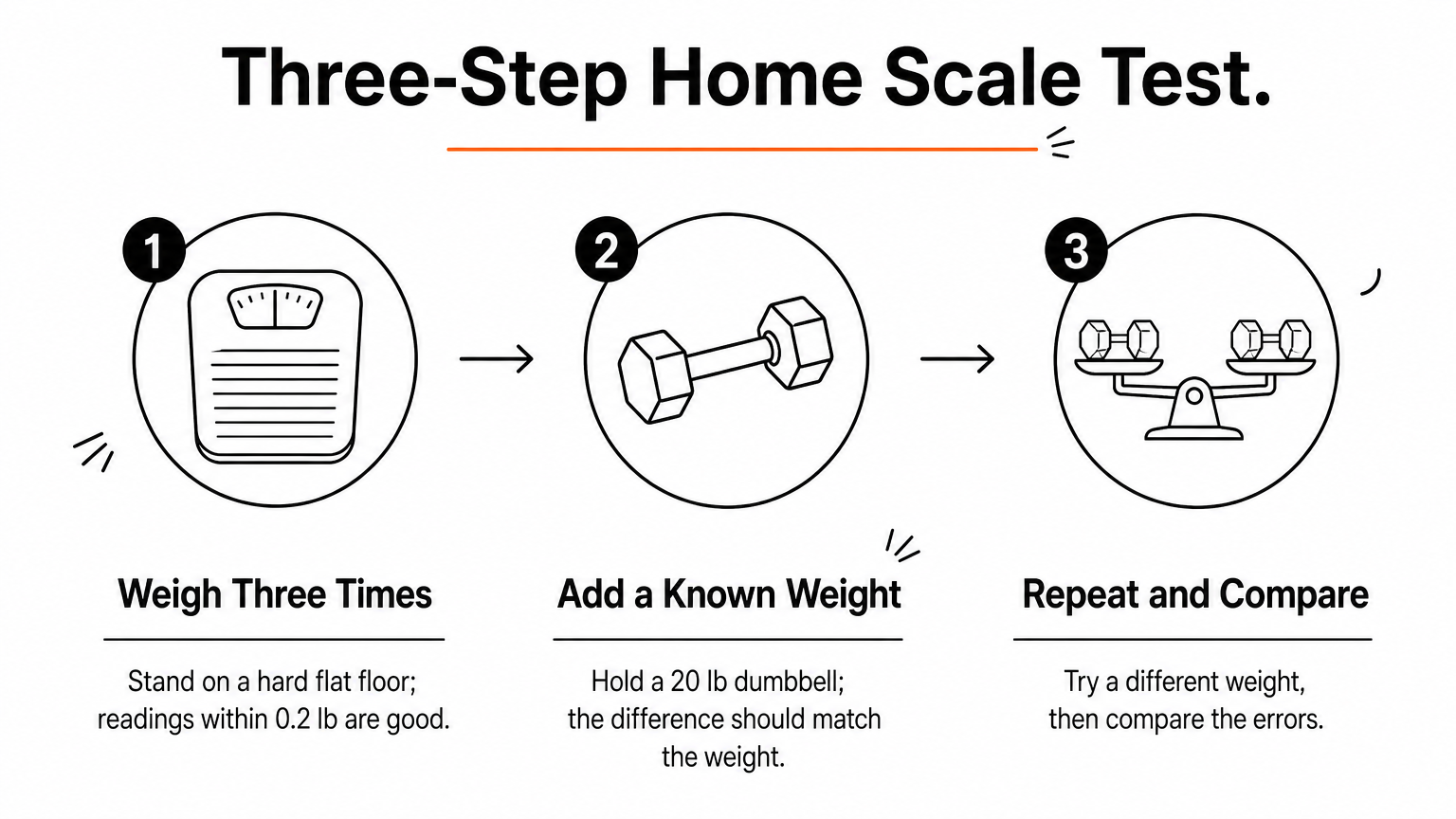
For example, you read 180.0 lb alone and 199.8 lb with the 20 lb dumbbell. The scale is off by 0.2 lb, which is fine. If it said 197.0 lb, the error is 3 lb and the scale is not accurate.
Habits that keep readings steady
Weigh in the morning, at the same time, before eating. Keep the scale on the same hard spot, because moving it or using carpet changes the readings. Replace weak batteries, since low power can cause erratic results.
Pick one and test it
The Wyze Scale X is the safest choice for the most precise readings, the Inevifit I-BS002S is a strong second, the AccuCheck suits simple weighing, and the Escali HC225W fits higher capacity needs. Whichever you buy, run the three-step test in the first week, because that is the only proof that matters in your own bathroom.
For more on how measuring tools work and how to check them, read the accuracy and measuring tool guides at Measuring Expert.