

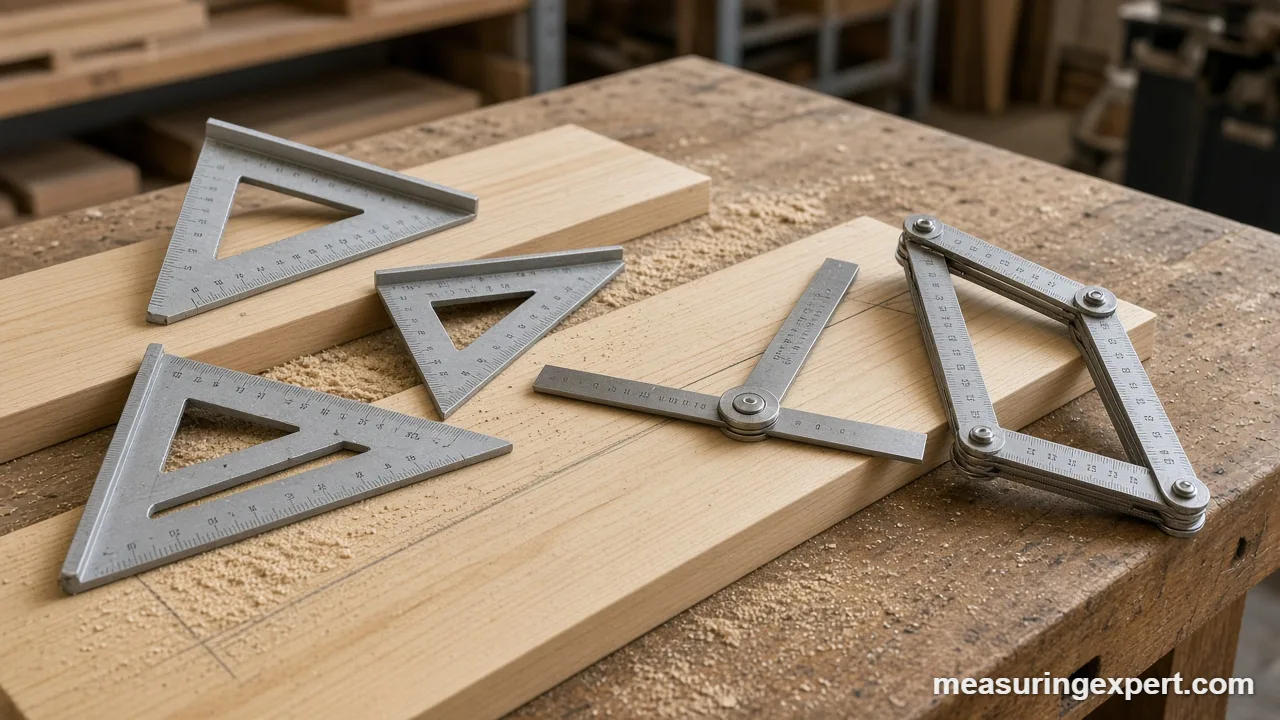
The best angle ruler for most carpenters is the Swanson S0101 Speed Square, because one aluminum triangle marks 90 and 45 degree cuts, reads 0 to 90 degrees and lays out rafters. Beyond that, the job decides the choice: size, digital readout, an adjustable arm or a folding multi-angle template.
In short: get the Swanson S0101 for framing, the IRWIN rafter square on a tight budget, and the General Tools 823 when you want a 0.1 degree digital reading.
As an Amazon Associate, Measuring Expert earns from qualifying purchases. Our picks are based on research, specifications and owner feedback, not paid placement.
Best Overall
Best Budget
Quick Answer: Which Best Angle Ruler Fits Your Job?
- Framing and rafters: above all, the Swanson S0101 7 in Speed Square.
- Low light or tired eyes: Johnson Johnny Square with laser-etched marks.
- Tight budget: IRWIN Hi-Contrast 7 in rafter square.
- Stairs and wide boards: Swanson Big 12 with its layout bar.
- Repeat angle cuts: C.H. Hanson Pivot Square, which locks at a set angle.
- Decimal readings: General Tools 823 digital angle finder rule.
- Tile, pavers and quick templates: a 4-sided folding multi-angle ruler.
On This Page
- Comparison table
- The 9 picks, reviewed
- How we chose
- Angle ruler types compared
- Specs that matter
- Angle to pitch calculator
- How to mark a rafter angle
- Checking for square
- Do and don’t
- Honest limits
- FAQ
- Bottom line
Best Angle Ruler Comparison at a Glance
| # | Image | Product | Best For | Standout Feature | Amazon |
|---|---|---|---|---|---|
| 1 |  | Swanson S0101 7 in Speed Square | Framing, rafters and general layout | Five tools in one, made in USA, Blue Book included | View |
| 2 |  | Johnson 1904-0700 Johnny Square | Readability in dim light | Laser-etched EZ Read marks and CNC-machined edges | View |
| 3 |  | IRWIN 1794463 Hi-Contrast Rafter Square | Budget toolboxes and spares | Hi-contrast aluminum 7 in body | View |
| 4 |  | Klein Tools 9357SSQ Rafter Square | Electricians, plumbers and mixed trades | Pipe prop and 1/4 in scribe notches | View |
| 5 |  | Swanson S0107 Big 12 Speed Square | Stairs, decks and 2×12 stock | Removable layout bar | View |
| 6 |  | C.H. Hanson 03060 Pivot Square | Repeat cuts at one angle | Pivoting arm with a positive lock | View |
| 7 |  | General Tools 823 Digital Angle Finder Rule | Trim, furniture and 0.1 degree work | 10 in stainless arms, 0 to 360 degree LCD | View |
| 8 |  | GemRed 82305 7 in Digital Angle Finder | A compact digital ruler for the apron | Locking stainless arms with 0.1 degree display | View |
| 9 | 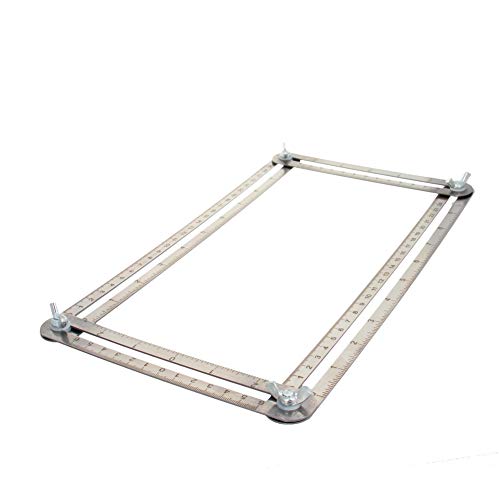 | Utoolmart 4-Sided Multi-Angle Ruler | Tile, pavers, laminate and templates | Folding stainless frame that copies angles | View |
The 9 Best Angle Ruler Picks, Reviewed
An angle ruler is any straight-edged tool that both measures and marks an angle. So, this list covers speed squares, swing-arm digital rulers and folding multi-angle rulers. In contrast, plain protractors, magnetic angle finders and large framing squares have their own guides, so we left those tools out here.
Best Overall
1. Swanson S0101 7 in Speed Square
Best for: first of all, framers, deck builders and DIYers who want one angle tool that lives in a tool belt.
Swanson invented the Speed Square, and the S0101 is still the reference version. Basically, it is a right triangle with a thick lip along one leg. When you hold that lip against a board edge and the other leg gives a square line at once. Then, rotate the square on its pivot point and the hypotenuse scale reads any angle from 0 to 90 degrees.
In addition, the second scale reads common rafter pitches in inches of rise per 12 in of run. As a result, you can mark a 6 in 12 plumb cut without any math. Swanson also adds its Blue Book, which explains hip, valley and stair layout. For most buyers, this is the best angle ruler to own first.
- Material: high-grade aluminum alloy with an anti-glare finish
- Functions: try square, miter square, protractor, line scriber and saw guide
- Size: 7 in legs (178 mm); weight about 0.5 lb (227 g)
- Made in USA; Blue Book instructions included
Pros
- Both degree and pitch scales on one tool
- Thick lip doubles as a circular saw guide
- Blue Book teaches rafter layout
- Thick enough to survive drops, so it rarely bends
Cons
- Engraved marks are hard to read in shade
- 7 in reach is short for 2×12 stair stringers
- Reads whole degrees only, so trim work needs more
Skip it if: you struggle to read black engraving in poor light; the Johnson below uses brighter laser-etched marks.
Best Easy-Read
2. Johnson Level 1904-0700 Johnny Square
Best for: anyone who works in garages, attics or early morning light and needs marks they can read fast.
The Johnny Square is a solid aluminum 7 in rafter square from Johnson Level, a long-standing Wisconsin layout brand. Above all, its main selling point is the laser-etched EZ Read graduations, which stand out against a low-glare anodized surface. Moreover, Johnson machines the edges on CNC equipment, and a straight edge is what makes the square lines true.
Also, a row of scribing notches lets you rip a pencil line at 3-1/2 in or 5-1/2 in, the actual widths of 2×4 and 2×6 lumber. Therefore, it handles quick layout as well as angles. However, this version ships without a manual, so beginners should pair it with a rafter guide.
- Size: 7 in (178 mm) solid aluminum body
- Edges: CNC-machined for straightness
- Markings: laser-etched EZ Read graduations
- Scribing notches for 3-1/2 in and 5-1/2 in rips; 1-year warranty
Pros
- High-contrast marks read well in dim light
- Machined edges for accurate square lines
- Notches also match real lumber widths
Cons
- No instruction manual in the box
- Same 7 in reach as other small squares
- Similarly to any speed square, the scale is whole-degree
Skip it if: you want rafter instructions in the box; the Swanson includes its Blue Book.
Best Budget
3. IRWIN 1794463 Hi-Contrast Rafter Square
Best for: homeowners, students and crews who want a spare square in every truck or bucket.
First, IRWIN is a familiar hardware-store brand. Second, this 7 in aluminum rafter square follows the classic triangle pattern. As the name says, the markings use a hi-contrast finish, so the scale stands out better than plain engraving. Meanwhile, the layout is the familiar one: a fence lip, a 0 to 90 degree scale on the long edge and inch marks on the legs.
Because it is a basic pattern, it suits light framing, shed builds and cut marks on plywood. That said, IRWIN publishes fewer details than Swanson or Johnson, so check it for square when it arrives. For a low-cost backup, though, it is the best angle ruler value here.
- Material: aluminum, so it resists rust
- Size: 7 in (178 mm) overall length
- Hi-contrast markings for easier reading
- Classic rafter square layout with fence lip
Pros
- Common brand, easy to replace
- Hi-contrast marks, so the scale is easier to read
- Light enough for a tool pouch
Cons
- Fewer published specs than rivals
- No guide book for rafter work, unlike the Swanson
- Worth a squareness check on arrival
Skip it if: you cut rafters daily; a better-documented square such as the Swanson pays off over time.
Best for Trades
4. Klein Tools 9357SSQ Rafter Square
Best for: electricians, plumbers and remodelers who cut pipe, conduit and blocking as well as lumber.
Unlike most squares, Klein built this one for mixed trades. According to Klein’s product page, it has double laser-etched markings that stay readable in sunlight. In addition, a preset angle guide marks 0 to 90 degrees, and large scribe notches sit at 1/4 in steps for evenly spaced lines.
The detail that sets it apart, however, is a pipe prop. Because it cradles metal or plastic pipe, so you can mark a square cut on a round part. Also, the 1-1/8 in heel edge gives a wide, stable fence. In addition, the bright orange body is easy to spot in a cluttered job box, too.
- Material: anodized aluminum, corrosion resistant
- Range: 0 to 7 in, 1/4 in graduations; angle guide 0 to 90 degrees
- Dimensions: 7.29 x 7.25 x 1.13 in (18.5 x 18.4 x 2.9 cm)
- Weight: 7.84 oz (222 g)
Pros
- Pipe prop for conduit and PVC cuts
- Double-etched marks for bright sun
- Wide 1-1/8 in heel for a stable fence
Cons
- Imperial scales only, so metric plans need conversion
- Heavier than some 7 in squares
- No rafter guide book, so learn pitch layout elsewhere
Skip it if: you only frame with wood; a classic speed square does the same job for less weight.
Best Large Square
5. Swanson S0107 Big 12 Speed Square
Best for: stair builders, deck framers and anyone who cuts 2×10 and 2×12 stock.
A 7 in square cannot draw a full line across a 2×12, which is 11-1/4 in wide. So, the Big 12 scales the same design up to 12 in (305 mm). As a result, one setting marks a stair stringer, a wide rafter tail or a full-width crosscut.
Besides that, Swanson adds a removable, patented layout bar. Once you clamp it to the square, it repeats the same rise and run on a stringer without re-measuring. It also helps you check, for example, whether a corner is out of square. Finally, the Blue Book covers roof and stair layout, much like the 7 in model.
- Material: die-cast aluminum alloy, anti-glare matte finish
- Size: 12 in (305 mm); weight about 2 lb (0.9 kg)
- Removable layout bar for stairs and repeat marks
- Made in USA; Blue Book included
Pros
- Spans the full width of a 2×12
- Layout bar speeds up stair stringers
- Same scales as the classic 7 in model
Cons
- Too big for most tool belts, so it lives in the truck
- About four times heavier than a 7 in square
- Overkill for trim work, because the reach is wasted
Skip it if: you mostly cut 2×4 and 2×6 lumber; the 7 in S0101 is easier to carry.
Best Adjustable
6. C.H. Hanson 03060 Pivot Square
Best for: roofers and framers who cut dozens of rafters or stair parts at the same angle.
A fixed speed square makes you find the angle again for every board. In contrast, the Pivot Square has a swinging arm that locks in place. Set it once to a degree or pitch, lock it, and every mark after that matches. For this reason, it reads more like a swing-arm angle ruler than a plain square.
The machined scale carries dual graduations for degrees and roof pitch, so it also reads an existing angle. Also, retailers list it at about 1.65 lb (0.75 kg), which is heavier than an aluminum speed square. In short, it trades a little bulk for repeatable marks.
- Pivoting arm with a positive lock, so settings repeat
- Machined scale with degree and roof pitch graduations
- Reads angles, pitch and rise
- Weight: about 1.65 lb (0.75 kg)
Pros
- Locks for fast repeat cuts
- Degree and pitch scales together
- Good for rafters and stairs as well
Cons
- Heavier than a one-piece square
- More moving parts to keep clean
- Costs more than basic speed squares, in general
Skip it if: you cut only a few angles per project; a one-piece speed square is simpler.
Best Digital
7. General Tools 823 Digital Angle Finder Rule
Best for: trim carpenters and furniture makers who need decimal readings for miter and bevel settings.
This is a swing-arm angle ruler with an electronic hinge. First, two stainless steel legs open to the angle; then the LCD shows it. According to the published spec sheet, it reads 0 to 360 degrees with 0.1 degree resolution and plus or minus 0.3 degree accuracy.
Moreover, the legs carry inch and metric scales, so it also works as a straight rule. In addition, a hold button freezes the reading, and a locking knob keeps the arms in place. Therefore, you can read an inside corner and carry the angle to the saw. Of the digital tools here, this is the best angle ruler for long trim runs.
- Range: 0 to 360 degrees; resolution 0.1 degree; accuracy plus or minus 0.3 degree
- Leg length: 10-7/8 in (276 mm); width 1-3/8 in (35 mm)
- Inch and metric scales on the legs
- Hold button, reverse-angle button and lock knob; CR2032 battery included
Pros
- 0.1 degree display for miter settings
- Long legs average out wavy walls
- Hold and lock keep the reading
- Dual-unit rule scales
Cons
- Needs a battery, so carry a spare
- Plus or minus 0.3 degree is not machinist grade
- Too long for a small apron pocket
Skip it if: you need a level-style gauge that sticks to a blade; see our best magnetic angle finder guide.
Best Compact Digital
8. GemRed 82305 7 in Digital Angle Finder
Best for: DIYers who want a digital angle ruler that fits a drawer or apron pocket.
GemRed makes digital angle tools, and the 82305 uses two 7 in (200 mm) stainless steel rulers joined at a digital hinge. Once you open the arms against two surfaces, the display reads the angle to 0.1 degree. Then, lock the arms and carry the setting to the saw or the workpiece.
The rated accuracy is plus or minus 0.3 degree, the same class as the General Tools 823. However, the shorter arms make it easier to fit into small corners and cabinets. As with any digital tool, calibrate it before use, as the listing itself advises.
- Arm length: 7 in (200 mm), brushed stainless steel
- Resolution: 0.1 degree; accuracy plus or minus 0.3 degree
- In addition, a locking function holds any angle
- Power: one CR2032 3 V coin cell, auto power-off
Pros
- Small enough for a drawer or pocket
- Matte stainless arms reduce glare
- Lock holds the angle for transfer
Cons
- Short arms are less stable on long trim, however
- Battery and calibration required, just like any digital tool
- Not a speed square substitute for framing
Skip it if: you measure long baseboard runs; the 10 in General Tools 823 spans more of the wall.
Best Folding Multi-Angle
9. Utoolmart 4-Sided Stainless Multi-Angle Ruler
Best for: tile setters, flooring installers and DIYers who need to copy an odd angle onto a board or tile.
A folding multi-angle ruler is a hinged four-sided frame. Push it into a corner or around an obstacle, and the frame takes the shape. Next, lay it on the tile or plank and trace the outline. As a result, you transfer the angle without reading a number at all.
Notably, this version uses stainless steel arms, so it stays flat and resists rust on wet tile jobs. In size, it opens to about 31 x 17.5 cm (12.2 x 6.9 in). However, it is a template tool, not a precision gauge. For a number, read the traced angle with one of the rulers above.
- Material: stainless steel, four hinged sides
- Size: about 31 x 17.5 cm (12.2 x 6.9 in)
- Copies angles for tile, brick, wood, laminate and pavers
Pros
- Copies irregular shapes in one step
- Stainless steel resists water and rust
- No battery or math needed
Cons
- Hinges can slip if bumped, so lock them first
- Gives a template, not a reading
- Fewer published specs than big brands
Skip it if: you need a degree value; instead, use the GemRed or General Tools digital ruler.
How We Chose the Best Angle Ruler Picks
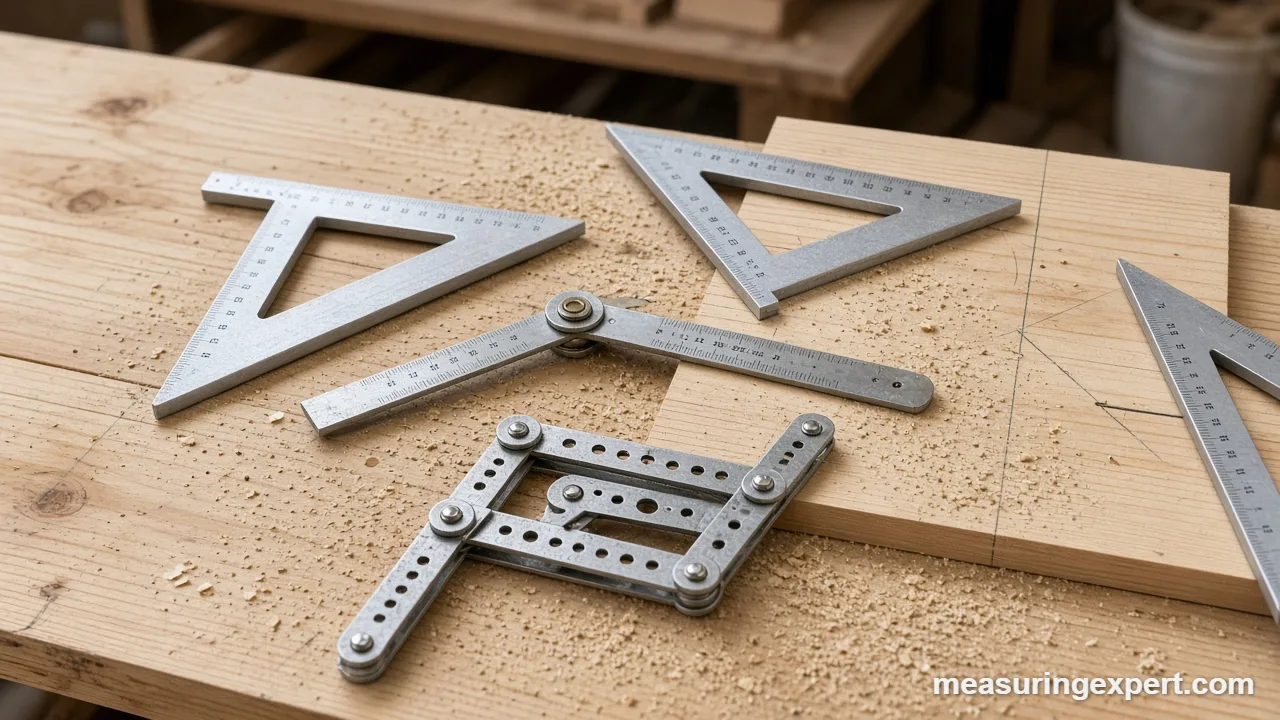
To be clear, we did not test these tools by hand. Instead, we compared manufacturer specifications, spec sheets from tool retailers and patterns in owner feedback. Then, we kept only complete tools from established brands, with no more than two picks per brand.
- Measurement value: clear degree scales, pitch scales or a stated digital resolution and accuracy.
- Build: aluminum or stainless steel, machined or straight edges, and a usable fence.
- Use case: each pick had to solve a different job, from rafters to tile.
- Overlap: we skipped tools that already appear in our best protractor, magnetic angle finder and best framing square guides.
- Units: for angle units we followed the NIST guide to units outside the SI, where 1 degree equals pi/180 radians.
Speed Square, Swing Arm or Folding: Types Compared
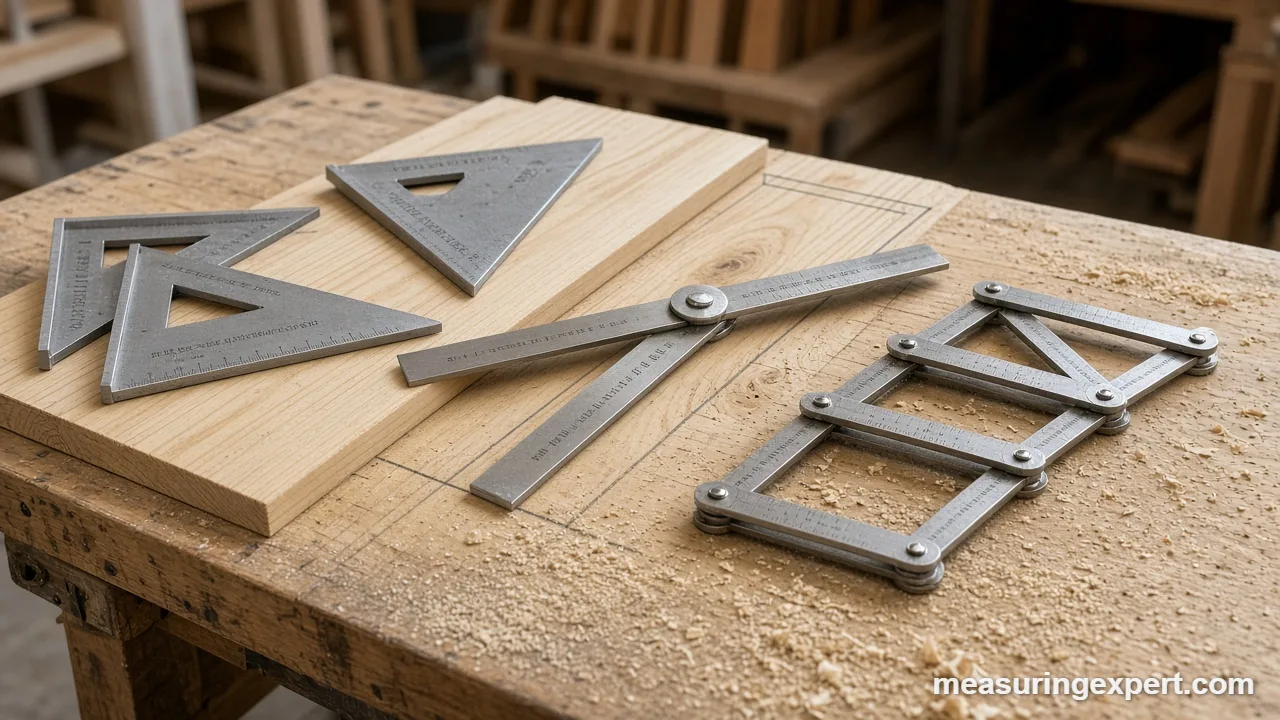
In general, angle rulers fall into four groups. Because each one answers a slightly different question, the right type matters more than the brand.
| Type | How it reads | Typical resolution | Best use |
|---|---|---|---|
| Speed or rafter square (7 in) | Pivot on a fixed triangle, degree and pitch scales | 1 degree | Framing, rafters, saw guide |
| Large speed square (12 in) | Same as above, wider reach | 1 degree | Stairs, decks, 2×12 stock |
| Pivot or swing-arm square | Arm locks at a set angle | 1 degree or pitch steps | Repeat cuts |
| Digital swing-arm ruler | Electronic hinge with LCD | 0.1 degree | Trim, miters, furniture |
| Folding multi-angle ruler | Hinged frame copies a shape | None (template) | Tile, flooring, odd corners |
For flat drawings and school geometry, a printed protractor is still easier. Likewise, a square larger than 12 in belongs in the framing square family.
What Separates a Good Angle Ruler From a Bad One
Resolution versus accuracy. First, resolution is the smallest step the tool shows. Accuracy, on the other hand, is how close that reading is to the truth. For example, a digital ruler can display 0.1 degree and still carry a 0.3 degree error. Similarly, a speed square has 1 degree marks, yet a careful user can split the gap by eye.
Why small errors grow. Angle error turns into length error over distance. For instance, a 0.5 degree error moves the end of a 12 in (305 mm) line about 0.105 in (2.7 mm). In addition, a 1 degree error over the same length gives about 0.21 in (5.3 mm). So, long miters need finer tools than short framing cuts.
Straight edges and fence. After all, a square line depends on the fence lip and the long edge. Therefore, look for machined or CNC-cut edges and a lip thick enough to ride a saw base.
Scales and units. Most US squares read degrees plus pitch in inches per 12 in of run. However, digital rulers often add metric scales on the arms, which helps with metric plans.
Material and finish. For example, aluminum is light and resists rust. Meanwhile, stainless steel stays flat and suits wet tile work. Finally, anti-glare or anodized finishes make the marks easier to read outdoors.
Angle to Roof Pitch Calculator
In practice, builders swap between degrees, pitch and grade all day. For example, a plan may list a 6 in 12 roof while a miter saw reads in degrees. So, enter an angle below to convert it.
Luckily, the math is short. Pitch equals tan(angle) x 12, and grade equals tan(angle) x 100. In reverse, angle equals arctan(rise / 12). For instance, an 8 in 12 roof works out to 33.69 degrees.
How to Mark a Rafter Angle With a Speed Square
These steps work with any speed or rafter square that has a pitch scale. For a broader primer on reading angles, see our guide on how to measure angles using a protractor.
- Find the pitch. First, read the plan or measure the rise over 12 in of run, for example 6 in 12.
- Set the pivot. Hold the pivot corner of the square against the top edge of the rafter board.
- Rotate to the number. Swing the square until the edge of the board lines up with 6 on the pitch scale.
- Mark the plumb cut. Then draw a line along the square’s leg, which now sits at the plumb angle.
- Cross-check in degrees. Read the degree scale at the same edge; a 6 in 12 pitch shows about 26.6 degrees.
- Cut on the waste side. Finally, keep the saw blade outside the line, so the board stays to length.
Checking Your Best Angle Ruler for Square
Unfortunately, any square can drift after a fall. Fortunately, the flip test needs only a straight board and a sharp pencil.
- First, hold the fence against a straight edge and draw a line along the leg.
- Next, flip the square over and line the leg up with the same mark.
- Finally, if the two lines match, the square is true. Otherwise, if they form a narrow V, the error is half the gap.
As for digital rulers, close the arms flat and press zero, then check a known 90 degree corner. Our guide to calibrating angle tools covers both kinds in more detail. Also, wipe aluminum squares after wet work and store digital tools without the battery for long breaks.
Do and Don’t for Angle Rulers
Honest Limits of Any Angle Ruler
Keep in mind that an angle ruler measures the angle of the surfaces it touches. So, if a wall bows or a board twists, the reading reflects that defect. Likewise, a 1 degree scale is fine for framing, but it is too coarse for fine furniture joints. Finally, a folding multi-angle ruler copies shapes, yet it does not give a number. When no tool is on hand, simple trig still works: measure rise and run, then take the arctangent.
Best Angle Ruler FAQ
What is the best angle ruler for carpentry?
For most carpentry, the best angle ruler is a 7 in speed square such as the Swanson S0101. It marks square and 45 degree lines, reads 0 to 90 degrees, and lays out rafters by pitch. Also, its thick lip guides a circular saw.
Is a speed square an angle ruler?
Yes. A speed square is a triangular angle ruler with a fence. In use, you pivot it on one corner and read the angle on the long edge. In addition, it marks lines, so it measures and lays out in one tool.
What is the best angle ruler for roof pitch?
A speed square with a pitch scale is the best angle ruler for roof pitch. That is because it reads rise per 12 in of run directly. For repeat rafters, however, a locking pivot square such as the C.H. Hanson saves time.
How accurate is a digital angle ruler?
Typical digital angle rulers show 0.1 degree and list about plus or minus 0.3 degree accuracy. As a result, that error moves the end of a 12 in line about 0.06 in (1.6 mm). So, they suit trim work but not precision machining.
What is a folding multi-angle ruler used for?
A folding multi-angle ruler copies an angle or shape. First, you press it into a corner and lock it; then you trace it on tile, flooring or wood. In short, it makes templates rather than numbers.
What is the difference between a speed square and a framing square?
A speed square is a small triangle with a fence and a degree scale. In contrast, a framing square is a large flat L, usually 16 by 24 in, used for stair and rafter tables. Consequently, many carpenters carry both.
Should the best angle ruler be 7 in or 12 in?
Choose 7 in for daily framing, because it fits a tool belt. On the other hand, choose 12 in for stairs, decks and 2×12 stock, since a 2×12 is 11-1/4 in wide.
How do I convert roof pitch to degrees?
Divide the rise by 12, then take the arctangent. For example, 6 in 12 gives arctan(0.5), which is about 26.57 degrees. Likewise, 12 in 12 is exactly 45 degrees.
How do I check if my speed square is accurate?
Use the flip test. First, draw a line along the leg; next, flip the square and draw again from the same point. If the lines split, the square is off by half the gap.
Which best angle ruler suits a beginner?
A beginner should start with a 7 in speed square that includes instructions, such as the Swanson S0101 with its Blue Book. Later, add a digital ruler if you move into trim and furniture work.
Bottom Line on the Best Angle Ruler
For most people, the best angle ruler is the Swanson S0101 7 in Speed Square. Above all, it is simple, tough and teaches rafter layout through its Blue Book. Then, add a Big 12 for stairs, a pivot square for repeat cuts, or a digital ruler for trim.
Black Friday is coming: shop the deals with Prime