
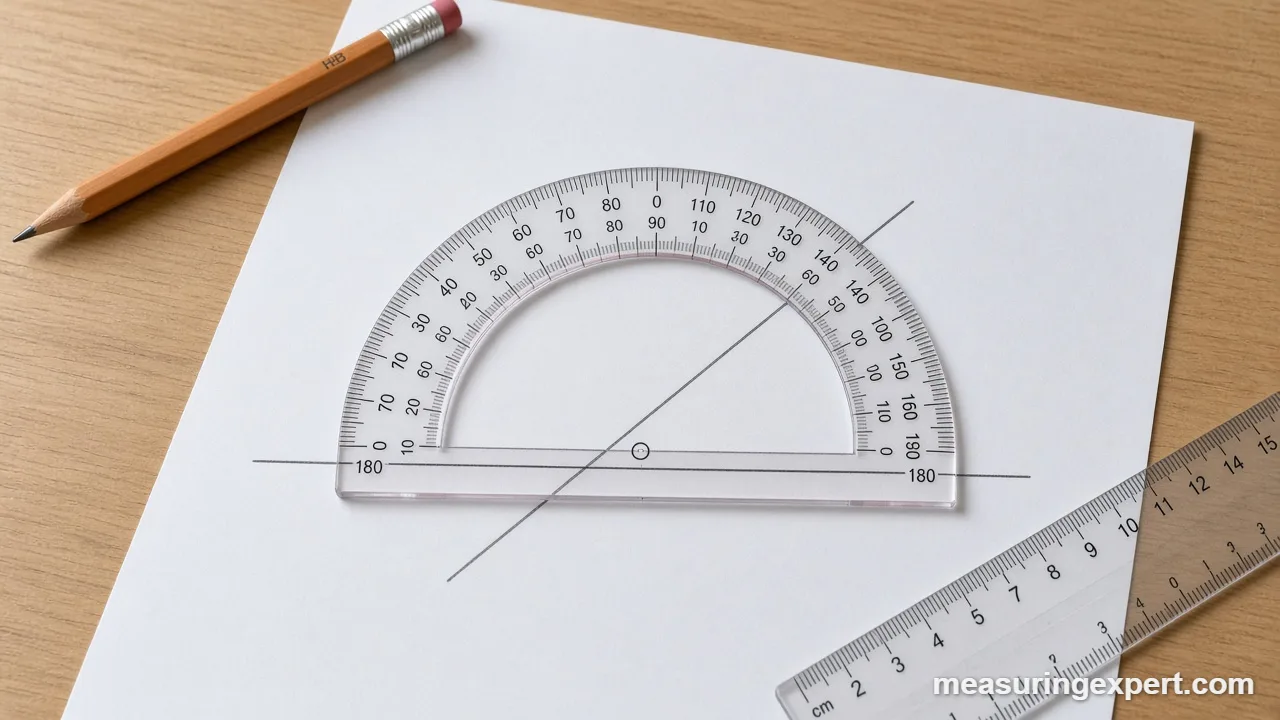
To measure an angle with a protractor, put the center hole on the vertex, line up the baseline with one ray, and then read where the other ray crosses the scale. Use the scale that starts at 0 on your first ray. An acute angle reads under 90 degrees; an obtuse one reads over 90.
A protractor looks simple, yet it trips up students, crafters and woodworkers alike. However, the problem is rarely the tool itself. Instead, most errors come from two small things: the center mark sits slightly off the vertex, or the reader picks the wrong row of numbers. So fix those two habits, and your readings will land within a degree almost every time.
So this guide walks through the whole process. First, you will see how to measure any angle step by step. Next, you will learn how to draw an angle of a given size, how to handle reflex angles bigger than 180 degrees, and finally how digital angle finders do the same job in the workshop.
In short: center on the vertex, zero on one ray, read the matching scale, and sanity-check the result against 90 degrees.
Angles are measured in degrees, and a full turn is 360 of them. The US National Institute of Standards and Technology (NIST) lists the degree as a unit accepted for use with the SI and defines it exactly: 1 degree equals pi/180 radians. Similarly, measuring angles in whole degrees with a protractor is a grade 4 Common Core math standard (4.MD.C.6), so it is a skill most of us learned once and then half forgot.
Turn a Protractor Reading Into Slope and Pitch
Once you have a reading, you may need it in another form. For example, a ramp builder thinks in percent grade, while a roofer thinks in pitch (rise per 12 inches of run). Enter your angle in degrees below; the converter then shows the matching grade and pitch. It handles angles between 0 and 90 degrees, which covers slopes, ramps, roofs and miter work.
Recommended Protractors and Angle Finders
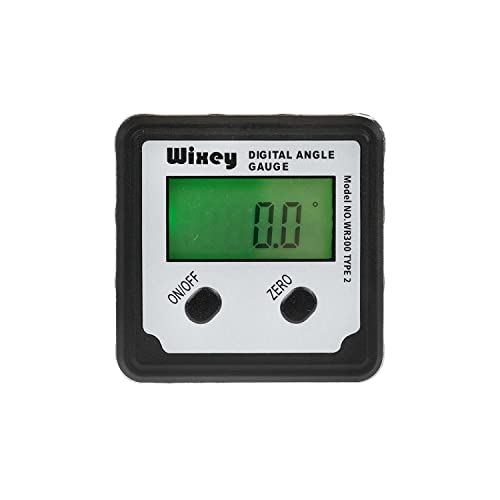
For homework, a clear plastic 6-inch (15 cm) protractor with a center hole is all you need. However, a 360-degree protractor saves a step on reflex angles. For trim, framing and table-saw setup, a digital angle finder or a protractor with locking arms is faster and easier to read. In each case, look for crisp, high-contrast markings and a clearly marked center point.


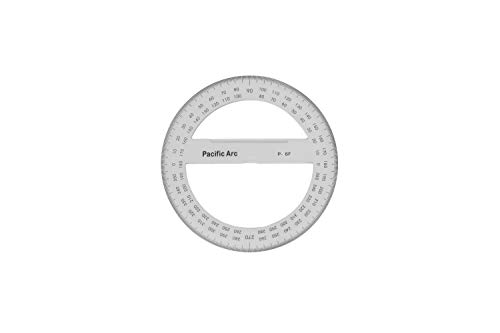


As an Amazon Associate, Measuring Expert earns from qualifying purchases.
Key Takeaways
- The center hole or crosshair of the protractor always goes on the vertex.
- Line the zero line (baseline) up with one ray, not with the bottom edge of the tool.
- Read the scale that starts at 0 on that ray; it may be the inner or the outer row.
- Check your answer: acute angles are under 90 degrees, obtuse angles are over 90.
- For a reflex angle, measure the smaller angle and subtract it from 360.
- Extend short rays with a ruler so they reach the scale.
- Digital angle finders read to 0.1 degree, which suits saw blades and miter cuts.
Parts of a Protractor
Before you measure anything, it helps to know what each mark does. A standard half-circle protractor has four working parts:
- Baseline (zero line). The straight line that runs through the 0 and 180 marks. On many student models it sits a little above the bottom edge.
- Center point (origin). A small hole, crosshair or notch in the middle of the baseline. It marks the exact point every reading is taken from.
- Outer scale. Numbers from 0 to 180 that usually run left to right, counterclockwise around the arc.
- Inner scale. The same numbers in the opposite direction, so you can start from either side.
Because the two scales mirror each other, every tick mark carries two numbers that add up to 180. For instance, the tick labeled 40 on one row is labeled 140 on the other. That is why choosing the right row matters so much.
How to Measure an Angle With a Protractor
Follow these steps for any angle up to 180 degrees. If the angle is drawn on paper, work on a flat table with good light.
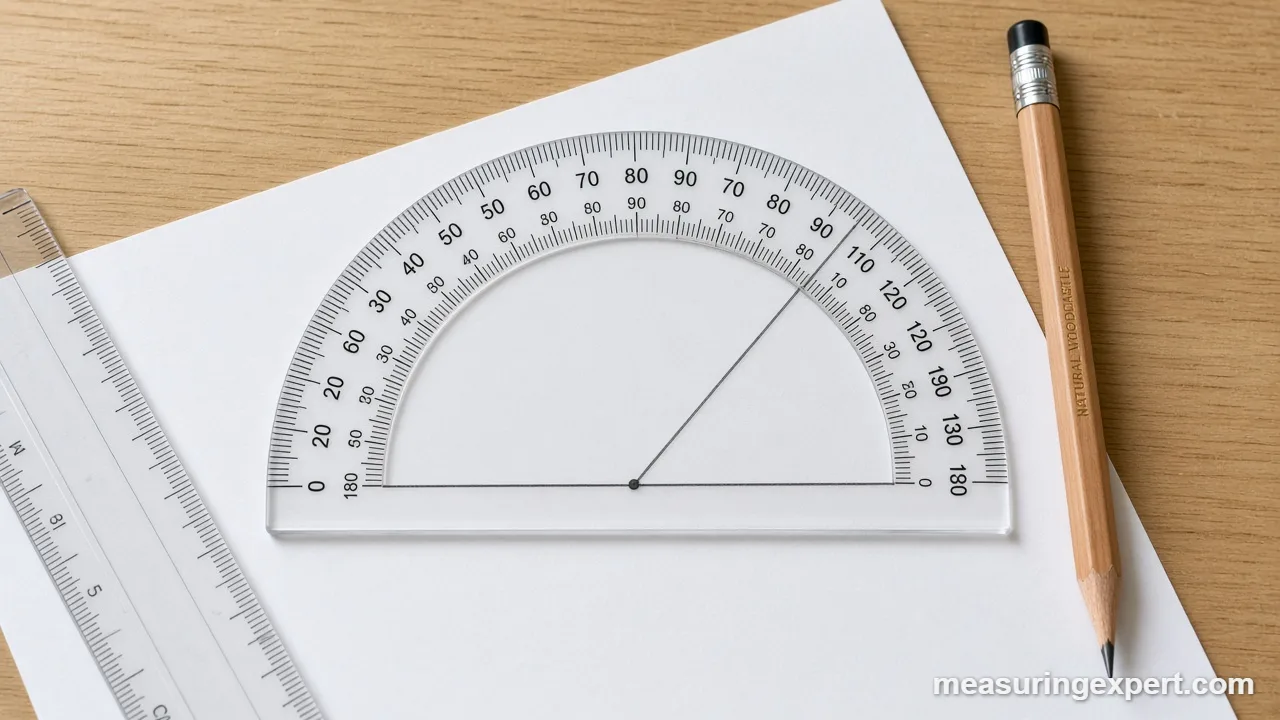
- Find the vertex. Locate the point where the two rays meet. If the rays are short, extend them with a ruler first so they will reach past the scale.
- Place the center point on the vertex. Look straight down through the hole or crosshair and nudge the tool until the vertex sits exactly in the middle.
- Align the baseline with one ray. Rotate the protractor around the vertex until the zero line runs along one ray. Keep the center point fixed while you turn it.
- Pick the scale that reads 0 on that ray. Follow the ray out to the edge. Whichever row shows 0 there, inner or outer, is the row you read.
- Read where the second ray crosses. Count along that same row to the point where the other ray meets the arc. Count each small tick as 1 degree.
- Sanity-check the result. Compare the angle with a square corner. If it looks narrower than a corner, your number should be under 90; otherwise it should be over 90.
Tip: if the second ray falls between two ticks, estimate to the nearest half degree. On a typical school protractor, that is as fine as your eye can reliably read.
Protractor Inner vs Outer Scale: Which One to Read
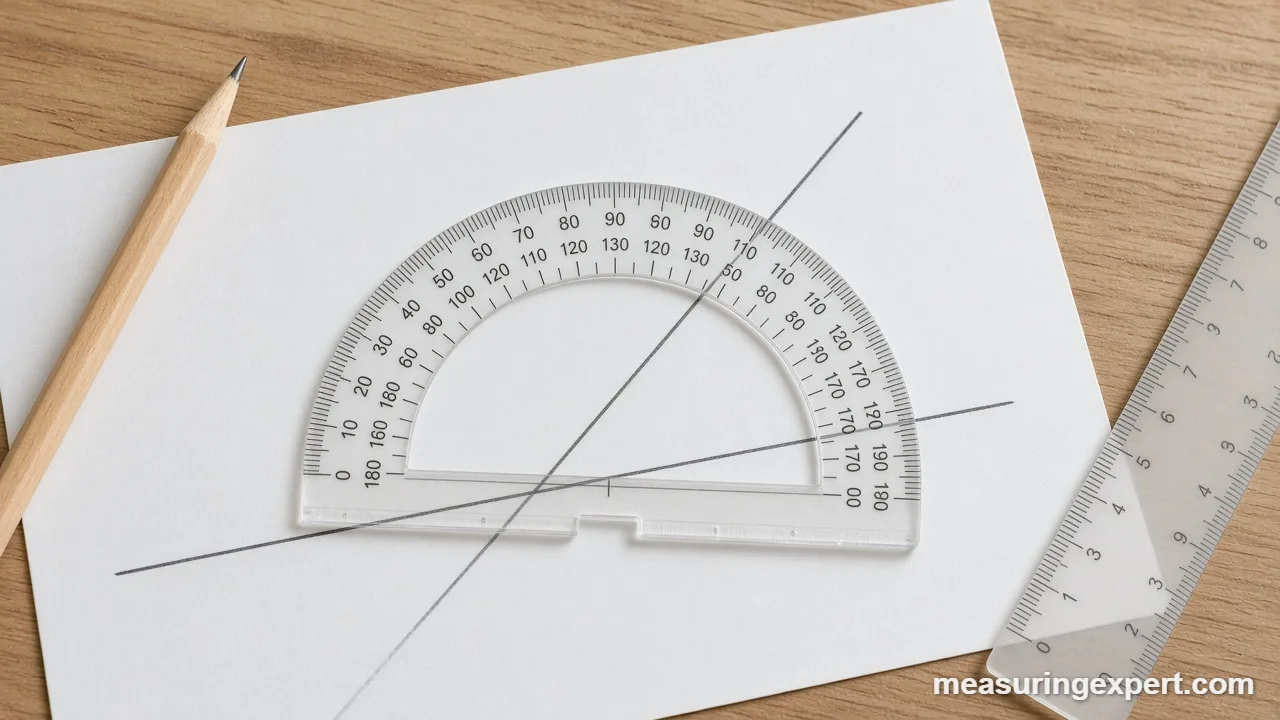
This is the step that causes most wrong answers. Since the two rows run in opposite directions, the same position gives two readings, and only one is correct. The rule is simple, though: always read the row that starts at 0 on your baseline ray.
| Where your baseline ray points | Row that reads 0 there | Example: second ray at the 50/130 tick |
|---|---|---|
| To the right of the vertex | Usually the inner scale | Read 50° (acute) |
| To the left of the vertex | Usually the outer scale | Read 130° (obtuse) |
| Not sure which row | Trace the ray to the arc and look for the 0 | Then cross-check against 90° |
Labels “inner” and “outer” vary by brand, so trust the 0, not the row’s position. In addition, the 90-degree mark is the same on both rows, which makes it a handy reference point.
Angle Types and What a Protractor Should Show
Each angle type has a fixed range, so the category alone tells you roughly what to expect on the scale.
| Angle type | Range | What you see on the tool |
|---|---|---|
| Acute | More than 0°, less than 90° | Second ray falls before the 90 mark |
| Right | Exactly 90° | Second ray hits the center 90 mark |
| Obtuse | More than 90°, less than 180° | Second ray falls past the 90 mark |
| Straight | Exactly 180° | Both rays lie along the baseline |
| Reflex | More than 180°, less than 360° | Will not fit a half-circle tool; measure the other side |
How to Draw an Angle With a Protractor
Drawing works the same way in reverse. Suppose you need a 65-degree angle:
First, draw a straight line with a ruler and mark a point on it for the vertex. Next, place the center point of the protractor on that vertex and line the baseline up with your line. Then find 65 on the row that starts at 0 on your line, and make a small dot at the edge of the arc. After that, lift the tool away and join the vertex to the dot with a ruler. Finally, label the angle and measure it once more to confirm it reads 65.
Also, keep your pencil sharp. A thick line can hide a full degree on a small protractor.
Measuring Reflex Angles With a Protractor
A reflex angle is larger than 180 degrees, so it does not fit inside a half-circle tool. Instead, you measure the smaller angle on the other side of the same two rays and subtract it from 360.
For example, if the inside angle measures 125 degrees, the reflex angle is 360 – 125 = 235 degrees. Likewise, a 70-degree inside angle gives a reflex angle of 290 degrees. Alternatively, a full-circle 360-degree protractor lets you read the reflex angle directly: just start at 0 on one ray and count the long way around. For more worked examples, see what a reflex angle is and how it is measured.
Protractor Types Compared
Of course, not every protractor is a plastic half-moon. Each type suits a different job, so it pays to match the tool to the work.
| Type | Range | Typical reading | Best for |
|---|---|---|---|
| Half-circle student protractor | 0-180° | 1° marks | Homework, drafting, crafts |
| 360-degree protractor | 0-360° | 1° marks | Reflex angles, navigation plots, pie charts |
| Protractor with swing arm | 0-180° | 1° marks | Copying angles from real objects |
| Vernier bevel protractor | 0-360° | 5 arc minutes | Machining and inspection |
| Digital angle finder (rule type) | 0-360° | 0.1° display | Trim, framing, miter angles |
| Digital angle gauge (cube type) | Tilt from level | 0.1° display | Saw blade bevel, jointer fences |
Note that the “typical reading” is the display resolution, not a promise of accuracy. In practice, accuracy depends on the model, so check the manufacturer’s spec sheet.
Digital Protractors and Angle Finders for Woodworking
In the shop, you rarely measure angles on paper. Instead, you measure a wall corner, a stair stringer or a saw blade. That is where a digital angle finder earns its place.
A rule-type digital protractor has two arms joined at a hinge. You press both arms against the surfaces, and then the screen shows the angle between them. For an inside wall corner that reads 92 degrees, for example, each piece of crown or baseboard needs a 46-degree cut, which is half the corner.
By contrast, a cube-type angle gauge works differently. Because it measures tilt, you first set it on the saw table and press zero. After that, you stick it to the blade and tilt the blade until the screen reads the bevel you want, such as 45.0 degrees. As a result, the reading is relative to your table, not to the floor.
Miter frames follow a simple rule, too: the cut angle for each joint equals 180 divided by the number of sides. So a four-sided frame needs 45-degree miters, a hexagon needs 30, and an octagon needs 22.5.
Degrees in Grade, Pitch and Radians
A protractor reads degrees, but plans and formulas often use other units. This table converts common readings; the values come from tan(angle) for grade and pitch, and from the exact pi/180 factor for radians.
| Degrees | Percent grade | Roof pitch (rise in 12) | Radians |
|---|---|---|---|
| 5° | 8.75% | 1.05 | 0.0873 |
| 10° | 17.63% | 2.12 | 0.1745 |
| 15° | 26.79% | 3.22 | 0.2618 |
| 22.5° | 41.42% | 4.97 | 0.3927 |
| 30° | 57.74% | 6.93 | 0.5236 |
| 45° | 100% | 12 | 0.7854 |
| 60° | 173.21% | 20.78 | 1.0472 |
Going the other way, a 4-in-12 roof is about 18.43 degrees and a 6-in-12 roof is about 26.57 degrees. If you work with trigonometry, our guide on converting degrees to radians shows the method.
Common Protractor Mistakes
Most wrong readings trace back to a short list of habits. Check yours against it:
- Reading the wrong row. You get the supplement (180 minus the true angle). The fix is to find the 0 on your baseline ray.
- Lining up the bottom edge. On many tools the zero line sits above the plastic edge, so the whole reading shifts.
- Missing the vertex. Even a 1 mm offset can move the reading by a degree or more on a small protractor.
- Short rays. If a ray stops before the arc, you end up guessing. Instead, extend it with a ruler.
- Reading at a slant. Looking from the side causes parallax, so look straight down at the scale.
- Skipping the check. A quick comparison with 90 degrees catches most errors in a second.
Protractor Do and Don’t List
Do
- Place the center mark exactly on the vertex.
- Read from the row that starts at 0.
- Extend short rays before measuring.
- Zero a digital gauge on the surface you measure from.
- Measure twice and compare.
Don’t
- Align the plastic edge instead of the zero line.
- Trust a reading that contradicts the angle type.
- Use a scratched or warped tool for fine work.
- Read the scale from an angle.
- Expect a half-circle tool to read reflex angles directly.
Honest Limits of a Protractor
A school protractor is a 1-degree tool. On a 6-inch model, adjacent ticks sit only about 1.3 mm apart at the edge, so you can estimate a half degree at best. In addition, thick pencil lines, a worn center hole or a slightly warped arc add further error. Similarly, digital angle finders show 0.1 degree, but the display resolution is finer than the true accuracy, which manufacturers usually list separately. Finally, any tool only measures the surfaces you press it against; a bowed board or an uneven wall will give an honest reading of a crooked surface.
For graded schoolwork, a 1-degree reading is what teachers expect. For cabinet doors and miter joints, however, test cuts on scrap wood remain the most reliable check.
When to Call a Professional
However, some angles carry real consequences. For instance, roof pitch on a permit drawing, accessible ramp slopes, stair geometry and structural framing should be confirmed by a licensed contractor, architect or surveyor who knows the local code. Likewise, precision machine parts belong with a metrology or calibration lab that uses certified instruments.
Protractor FAQs
How do you read a protractor correctly?
Put the center point on the vertex, line up the zero line with one ray, and read the scale that shows 0 on that ray. Then read where the second ray crosses that same scale.
Which protractor scale do I use, inner or outer?
Use whichever scale starts at 0 on the ray along your baseline. The inner and outer labels vary by brand, so follow the 0, not the position of the row.
Why are there two sets of numbers?
The two rows run in opposite directions so you can measure from a ray on either side. Each tick shows two values that add up to 180.
How do you measure an angle bigger than 180 degrees?
Measure the smaller angle formed by the same two rays and subtract it from 360. For example, 360 minus 125 gives a reflex angle of 235 degrees.
What if the lines are too short to reach the scale?
Extend both rays with a ruler and a sharp pencil until they pass the curved edge. Then measure as usual.
How accurate is a plastic protractor?
A typical student model has 1-degree marks, so careful readers can estimate to about half a degree. Accuracy drops if the tool is scratched, warped or misaligned.
What is the center hole for?
It marks the center point. You place it directly over the vertex so the reading starts from the exact point where the two rays meet.
Can I use a digital angle finder instead of a protractor?
Yes. A digital angle finder measures the same angle and shows it to 0.1 degree, which suits woodworking and trim. For math homework, however, teachers usually expect a standard protractor.
How do I draw a 45-degree angle with a protractor?
Draw a line, mark the vertex, and line up the center point and baseline. Then mark 45 on the row that starts at 0 on your line and join the mark to the vertex.
Is a 360-degree protractor better than a 180-degree one?
It is better for reflex angles and full-circle plots because you can read them directly. For everyday angles under 180 degrees, both work equally well.
Measuring Angles With a Protractor: The Bottom Line
To sum up, a protractor gives a reliable reading when the center point sits on the vertex, the zero line runs along one ray, and you read the row that starts at 0. A quick check against 90 degrees then catches nearly every mix-up, and the 360-minus rule handles reflex angles.
For shop work, a digital angle finder adds speed and a finer display, while the converter above turns any reading into grade or roof pitch. In the end, whichever tool you use, measure twice and trust the angle type as your guide.
11 thoughts on “How to Measure Angles Using a Protractor: Step-by-Step Guide”