
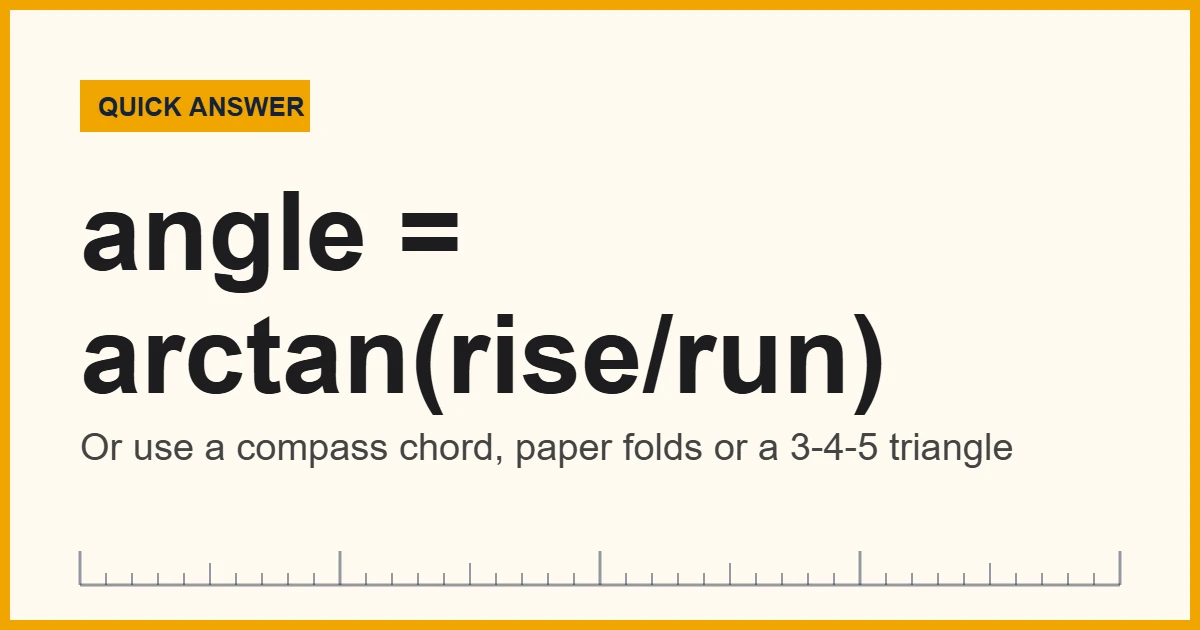
To measure angles without a protractor, turn the angle into lengths and use simple math. For example, measure the rise and run and take the arctangent, measure the chord across an arc, or compare the angle with folded paper (90, 45, 30 and 60 degrees). A phone level app also works.
Every angle is just a ratio in disguise. In other words, if you can measure two lengths with a ruler or a tape, you can usually work out the angle between them. That is why carpenters, roofers and students have measured angles without a protractor for centuries: a square, a string, a sheet of paper and a little trigonometry do the same job.
The methods below range from quick estimates to answers good to a fraction of a degree. First, paper folding gives you exact reference angles in seconds. Next, the rise-and-run method turns two tape measurements into an angle. Finally, the chord method uses a compass (or a pencil on a string) and works for any angle up to 180 degrees.
In short: measure lengths, not degrees, and let the math (or the converter below) do the rest.
The degree itself is an exact unit. The US National Institute of Standards and Technology lists it in its guide to units outside the SI as exactly pi/180 radians, so a full turn is 360 degrees. As a result, the reference angles you build from folds and triangles are exact by geometry, not approximations.
If you want a refresher on the names first, our guide to the types of angles covers acute, right, obtuse and reflex angles.
Turn Rise and Run Into Angles Without a Protractor
Measure the rise (how far the line goes up) and the run (how far it goes across). Then divide the rise by the run and multiply by 100. That number is the percent grade. Enter it below, and the converter gives you the angle in degrees plus the roof pitch. For example, a rise of 6 over a run of 12 is a 50% grade, which is about 26.57 degrees.
Recommended Tools for Measuring Angles
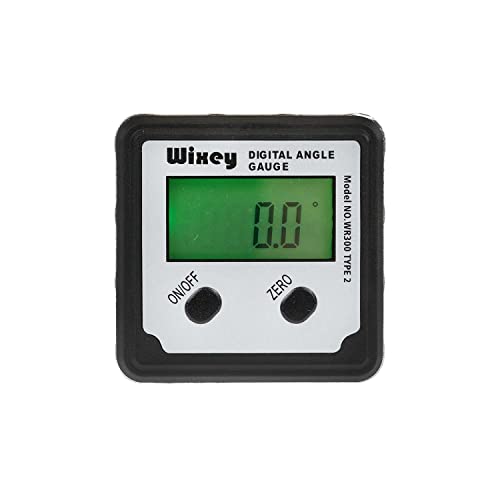
You can do everything on this page with a ruler and a pencil. Still, a few inexpensive layout tools make the work faster. A speed square has degree marks along its edge, so it reads roof and cut angles directly. A sliding T-bevel copies an angle from one place to another without any numbers at all. Meanwhile, a digital angle gauge or angle finder shows the angle on a screen, which helps when you set a saw blade or check a slope.

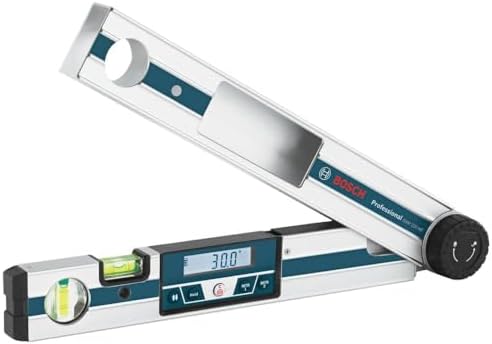


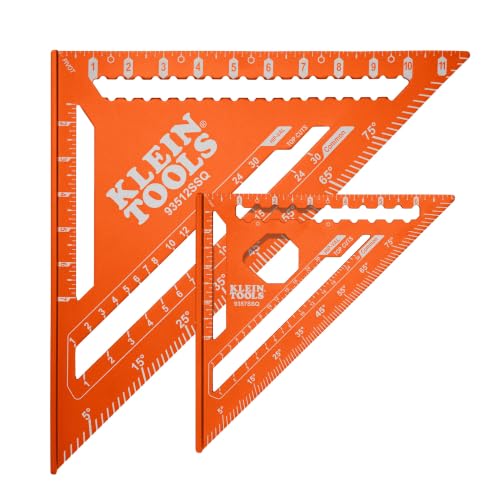
As an Amazon Associate, Measuring Expert earns from qualifying purchases.
- Any angle can be found from two measured lengths: angle = arctan(rise / run).
- A sheet of paper folds into exact 90, 45, 30 and 60 degree templates.
- The 3-4-5 triangle checks a right angle with nothing but a tape measure.
- With a compass, a chord equal to the radius always marks 60 degrees.
- Phone level apps are handy, but check them by flipping the phone around.
- Longer measuring baselines give more accurate angles.
- For structural or safety work, use a calibrated tool or a professional.
Ways to Measure Angles Without a Protractor Compared
Each method suits a different job. So pick by what you have on hand and how close the answer needs to be.
| Method | What you need | Best for | Typical result |
|---|---|---|---|
| Paper folding | A square or rectangular sheet | Checking 90, 45, 30 and 60 degrees | Exact reference angles; error comes from sloppy folds |
| Rise and run | Ruler or tape, a level or square | Slopes, ramps, roofs, stairs | Any angle; better with long measurements |
| 3-4-5 triangle | Tape measure | Squaring walls, decks, layouts | Confirms 90 degrees (a check, not a reading) |
| Chord method | Compass or pencil on a string, ruler | Angles drawn on paper or wood | Any angle from 0 to 180 degrees |
| Shadow method | A stick of known height, tape | Sun elevation angle | Rough outdoor estimate |
| Phone level app | Smartphone | Quick tilt readings | Fast; depends on the phone sensor and case |
A protractor and these methods measure the same thing. The only difference is that a protractor reads degrees directly, while these methods read lengths. If you do own one, our guide on how to measure angles using a protractor shows the usual technique.
Fold Paper to Find Angles Without a Protractor
Paper folding is the fastest way to make reference angles. In fact, any printer sheet already has four 90-degree corners, so you start with a right angle for free.
90 and 45 degrees
To begin, the corner of the sheet is 90 degrees. Next, fold that corner in half so the two edges line up. As a result, the new crease splits the corner into two 45-degree angles. Fold again in the same way, and you get 22.5 degrees.
30 and 60 degrees
First, fold the sheet in half lengthwise and open it again, so a crease runs up the middle. Then hold the bottom-left corner still and fold the bottom-right corner up until it touches the center crease. Make sure the new fold starts exactly at the bottom-left corner. Now the new fold makes 30 degrees with the bottom edge. Meanwhile, a line from the bottom-left corner to the spot where the corner landed makes 60 degrees with the bottom edge. This works because the corner lands at a point exactly one sheet width from the fixed corner, which forms half of an equilateral triangle.
To use a folded template, place its corner on the vertex of your angle and line up one edge. Then see whether the other side falls inside or outside the template. For instance, an angle that sits between the 30-degree fold and the 45-degree fold is somewhere from 30 to 45 degrees.
Rise and Run: Measure Angles Without a Protractor Using a Ruler
This is the most useful method for real projects, because it uses the tangent: in a right triangle, the tangent of an angle equals the opposite side divided by the adjacent side. So for a slope, angle = arctan(rise / run).
- Hold a level or a straightedge on the surface so it runs horizontally away from the point you are measuring.
- Measure along it a fixed distance, the run. A run of 12 inches or 30 cm keeps the math easy.
- After that, measure straight up (or down) from the end of the run to the sloped surface. That is the rise.
- Divide rise by run, multiply by 100, and enter the result in the converter above. Alternatively, use the arctan (tan-1) key on any calculator.
| Rise : run | Rise / run | Angle | Where you see it |
|---|---|---|---|
| 1 : 12 | 0.083 | 4.76° | Maximum ramp slope in the US ADA Standards |
| 4 : 12 | 0.333 | 18.43° | Low-slope roof |
| 6 : 12 | 0.5 | 26.57° | Common roof pitch |
| 3 : 4 | 0.75 | 36.87° | 3-4-5 triangle, small angle |
| 12 : 12 | 1 | 45° | Equal rise and run |
| 4 : 3 | 1.333 | 53.13° | 3-4-5 triangle, large angle |
The same idea works with the other two ratios. For example, if you know the sloped length (the hypotenuse) instead of the run, use angle = arcsin(rise / sloped length). In fact, this is how the OSHA ladder rule works. OSHA says the foot of a leaning ladder should sit about one-quarter of its working length from the wall, and arccos(1/4) is about 75.5 degrees.
Check a Right Angle With the 3-4-5 Rule
Builders often use this trick to square a corner without any angle tool. Because 3 squared plus 4 squared equals 5 squared, a triangle with sides 3, 4 and 5 always has a 90-degree corner between the two shorter sides.
First, mark 3 feet along one edge from the corner. Next, mark 4 feet along the other edge. Finally, measure between the two marks. If the distance is exactly 5 feet, the corner is square. If it is longer, the corner is wider than 90 degrees; if shorter, it is tighter. For bigger layouts, scale it up to 6-8-10 or 9-12-15 feet, or use 30-40-50 cm in metric.
In addition, the same triangle gives two other angles. Since tan = 3/4, the angle opposite the 3 side is about 36.87 degrees. Likewise, the angle opposite the 4 side is about 53.13 degrees.
How to Measure Angles Without a Protractor Using a Compass
The chord method can read any angle drawn on paper, wood or a floor. It relies on one formula: angle = 2 x arcsin(chord / (2 x radius)).
- Set the radius. Open a compass to a round number, such as 10 cm or 10 inches. On a floor, a pencil tied to a string works too.
- Draw the arc. Put the point on the vertex and swing an arc that crosses both sides of the angle.
- Measure the chord. Use a ruler to measure the straight-line distance between the two crossing points.
- Divide by the diameter. Divide the chord by twice the radius. With a 10-unit radius, divide by 20.
- Take the arcsine and double it. Press arcsin (sin-1) on a calculator in degree mode, then multiply by 2.
- Check against the table. Compare your result with the chord table below to catch slips.
| Angle | Chord at 10 cm (or 10 in) radius |
|---|---|
| 15° | 2.61 |
| 30° | 5.18 |
| 45° | 7.65 |
| 60° | 10.00 |
| 75° | 12.18 |
| 90° | 14.14 |
| 120° | 17.32 |
For example, a 7 cm chord at a 10 cm radius gives 2 x arcsin(0.35), which is about 40.97 degrees. Also notice the 60-degree row: when the chord equals the radius, the angle is always exactly 60 degrees. That is the classic compass-and-ruler construction for 60 degrees, and halving it gives 30.
Shadow Method for Angles Outdoors
Outdoors, the sun can tell you its own elevation angle. Stand a stick upright, check it with a level, and measure its height. Then measure the length of its shadow on flat ground. As a result, the sun’s elevation is arctan(stick height / shadow length). For instance, a 6-foot pole with an 8-foot shadow means the sun sits about 36.87 degrees above the horizon.
The same right-triangle logic, run in reverse, finds the height of a tree from an angle. A clinometer does that job directly; see how a clinometer measures angles for the full method.
Measuring Angles Without a Protractor Using a Phone or Household Items
Most smartphones contain an accelerometer, so a level or angle app can show tilt in degrees. On an iPhone, the built-in Measure app includes a level. On Android, many free level apps do the same. Our guide to measuring angles with a smartphone app walks through the setup.
Before you trust the reading, run a quick reversal test. Lay the phone on a surface and note the angle. Then turn the phone end for end in the same spot and read again. If the two readings differ, the phone (or its case) has an offset. In that case, average the two readings or recalibrate the app.
Household objects help with estimates, too:
- Analog clock face. The 12 hour marks split a full turn, so each hour step is 30 degrees and each minute step is 6 degrees.
- Book or box corner. These corners give a quick 90-degree check.
- Floor or wall tiles. Square tiles give 90 degrees at the corners and 45 degrees along the diagonal.
Do and Don’t When Measuring Angles
Do
- Measure lengths over the longest baseline you can.
- Set your calculator to degree mode before using arctan or arcsin.
- Mark the vertex clearly before measuring.
- Check a result with a second method when it matters.
- Repeat each reading at least twice.
Don’t
- Trust a phone reading without the reversal test.
- Mix inches and centimeters in one calculation.
- Measure the rise along the slope; it must be vertical.
- Assume a factory edge is perfectly square.
- Use thick pencil lines when you need fine accuracy.
Honest Limits of These Methods
These methods are only as good as the lengths you measure. For example, with a 12-inch run, one degree of slope changes the rise by only about 0.21 inch (roughly 5 mm). So a ruler read to the nearest 1/16 inch limits you to about 0.3 degree at best. Likewise, paper folds drift if the creases are off by a millimeter. Similarly, phone sensors vary from model to model and can shift after a drop. In short, expect about a degree from careful hand methods. If you need tenths of a degree, use a digital angle gauge on a clean, flat surface, or measure over a much longer baseline.
When to Call a Professional
Overall, hand methods are fine for crafts, homework and most home projects. However, some angles carry real consequences. For example, roof framing, stair stringers, retaining walls, drainage slopes and accessible ramps all have code requirements. In those cases, a contractor, building inspector or land surveyor with calibrated instruments should confirm the numbers. Likewise, for ladder setup and other fall hazards, follow the OSHA guidance and the manufacturer’s label.
Frequently Asked Questions
How do you measure angles without a protractor?
Measure two lengths and use trigonometry. For a slope, angle = arctan(rise / run). For an angle drawn on paper, draw an arc, measure the chord, and use angle = 2 x arcsin(chord / (2 x radius)).
How can I make a 90 degree angle without a protractor?
Use the corner of a sheet of paper, or the 3-4-5 rule: mark 3 units on one side and 4 on the other. If the marks are 5 units apart, the corner is 90 degrees.
How do I get 45 degrees without a protractor?
Fold the corner of a square sheet of paper in half so the edges meet. Alternatively, mark equal rise and run, such as 12 inches up and 12 inches across.
How do I get 30 or 60 degrees without a protractor?
With a compass, set any radius and mark a chord equal to that radius. That gives 60 degrees, and bisecting it gives 30. You can also fold paper as described above.
Can my phone measure angles without a protractor?
Yes. Level and angle apps read tilt from the phone’s accelerometer. Check the reading by turning the phone end for end, because cases and camera bumps can add an offset.
What is the formula for an angle from rise and run?
Angle = arctan(rise / run). For example, a rise of 6 over a run of 12 gives arctan(0.5), which is about 26.57 degrees.
How accurate are angles without a protractor?
Careful hand methods usually get within about a degree. In addition, longer baselines, sharp pencil lines and repeat readings improve the result.
How do I find the angle of a corner in a room?
Mark equal distances, such as 12 inches, along both walls from the corner and measure the gap between the marks. Then use the chord formula with a 12-inch radius.
How do I measure an angle greater than 180 degrees?
Measure the smaller angle on the other side of the vertex and subtract it from 360 degrees. For example, if the outside angle is 100 degrees, the reflex angle is 260 degrees.
Is a speed square the same as a protractor?
Not quite. A speed square is a triangular layout tool with a degree scale along one edge. It reads common cut and roof angles quickly but has a smaller range than a full protractor.
The Bottom Line
To sum up, you can measure angles without a protractor by turning the angle into lengths. Rise and run plus arctan handles slopes, the chord method handles drawn angles, and paper folds or the 3-4-5 rule give exact reference angles for checks.
Finally, choose the method that matches the job. A phone or a folded sheet is enough for quick estimates. For cuts and layouts, however, measure over long baselines and double-check with a second method. And for anything structural, hand the final check to a calibrated tool or a professional.