

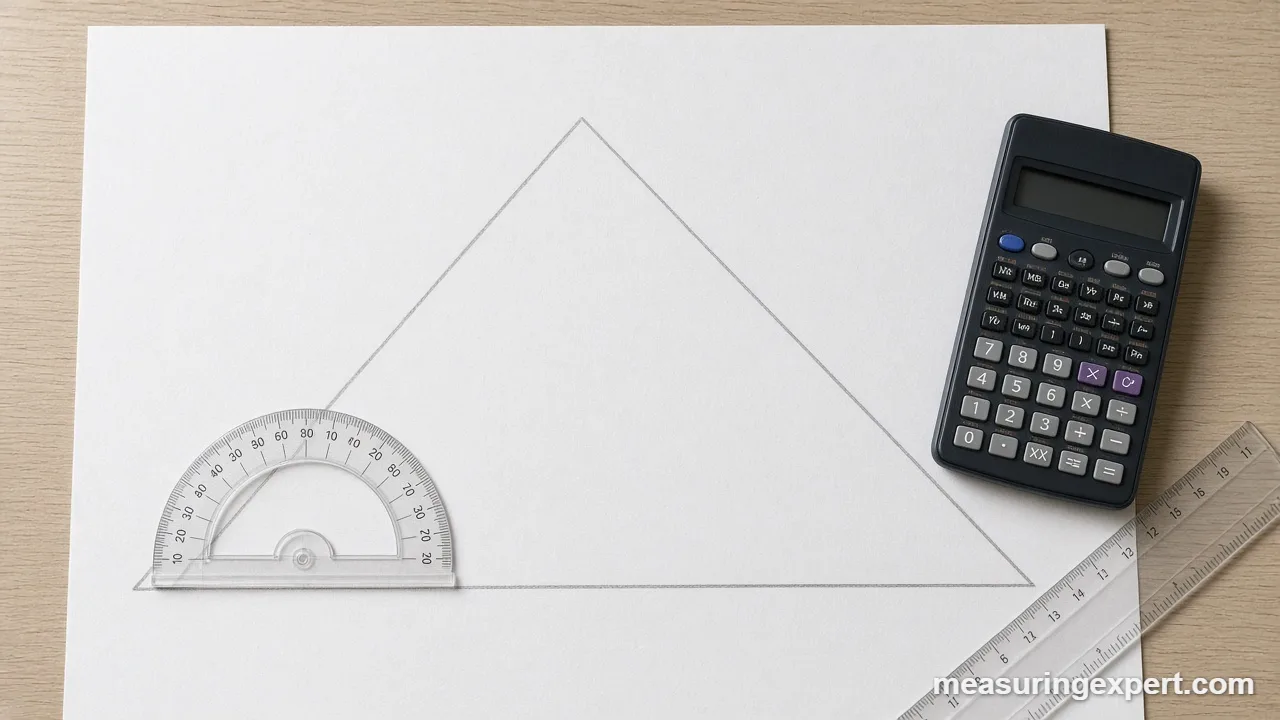
To measure angles in a triangle, place a protractor’s center mark on each corner and read the scale, or calculate them from the side lengths with trigonometry. Either way, the three interior angles always add up to 180 degrees, so once you know two of them, the third is simply 180 minus their sum.
Triangles show up everywhere: roof trusses, stair stringers, bike frames, quilt blocks and, of course, geometry homework. Sooner or later, however, you need to know how wide one of those corners really is. Fortunately, there are only two ways to get the number. You either measure the angle directly with a tool, or you measure the sides and let math do the rest.
The direct route is quick, but it is only as good as your drawing and your eye. The math route, on the other hand, is exact as long as your side lengths are right. As a result, most people use both: they calculate the angles and then check one corner with a protractor to catch mistakes.
In short: measure two angles, subtract their sum from 180 to get the third, and use trigonometry whenever you know the sides better than the corners.
The 180-degree rule is not a rule of thumb. Wolfram MathWorld states that the sum of the angles in a triangle is 180 degrees (pi radians) in ordinary flat, or Euclidean, geometry. Similarly, the free OpenStax Precalculus textbook gives the law of cosines, which turns three side lengths into three angles. In fact, both ideas power the methods below.
Find a Missing Angle From Two Sides
This tool works for any right triangle. First, divide the side opposite your angle by the side next to it (the adjacent side). Next, multiply by 100 and enter the result as a percent grade. The degrees row then shows your angle. For example, legs of 5 and 12 give 5 / 12 x 100 = 41.67, which is about 22.62 degrees.
The other acute angle is just 90 minus the result, so 5 and 12 also give 67.38 degrees. As a check, 22.62 + 67.38 + 90 = 180.
Recommended Tools for Measuring Angles in a Triangle
Paper triangles need a clear protractor with fine marks. Wood and metal parts, by contrast, call for a digital angle finder with long arms. Also, a scientific calculator with inverse sine, cosine and tangent keys is the fastest way to solve angles from side lengths. The picks below cover all three jobs, based on manufacturer specs and buyer reports.


As an Amazon Associate, Measuring Expert earns from qualifying purchases.
Key Takeaways
- The three interior angles of any flat triangle total exactly 180 degrees.
- Knowing two angles is enough: the third is 180 minus their sum.
- A protractor gives about 1-degree readings on a careful drawing.
- For right triangles, inverse tangent of opposite / adjacent gives the angle.
- With three known sides, the law of cosines finds every angle.
- The largest angle always sits across from the longest side.
- Set your calculator to degrees (DEG), not radians, before you start.
Three Rules for Angles in a Triangle
Before you pick up a tool, three facts will save you time and catch errors.
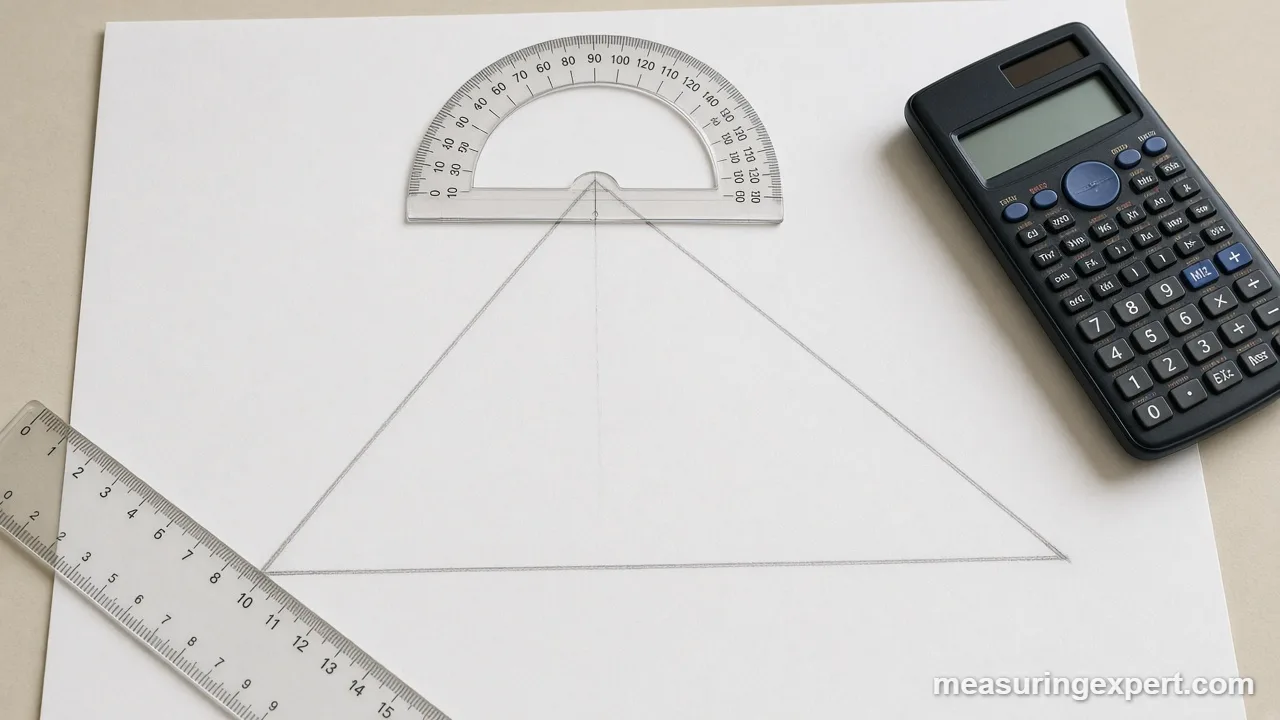
1. The sum is always 180 degrees. No matter how long or skinny the shape is, the inside corners add up to 180. So if you measure 48 and 59 degrees, the last corner must be 73 degrees. If your three readings add up to 177 or 184, one of them is off.
2. Big sides face big angles. The longest side always lies opposite the widest corner, and the shortest side lies opposite the narrowest one. Consequently, it gives you an instant sanity check on any answer.
3. An exterior angle equals the two far interior angles. Extend one side past a corner, and the outside angle you create equals the sum of the two interior angles that do not touch it. For instance, a corner with interior angles of 50 and 60 degrees elsewhere has a 110-degree exterior angle.
For a refresher on acute, right, obtuse and reflex angles, see our guide to the types of angles.
Four Ways to Measure Angles in a Triangle
Each method, of course, suits a different situation. So pick the one that matches what you already know.
| Method | What you need | Typical precision | Best for |
|---|---|---|---|
| Protractor | A drawn or printed triangle | About 1 degree | Homework, drafting, quick checks |
| Digital angle finder | A physical corner (wood, metal, tile) | Often 0.1 to 0.3 degrees (check the spec sheet) | Carpentry, metalwork, setup jobs |
| Angle sum (180 minus two) | Two known angles | As good as the two inputs | Finding the last corner fast |
| Trigonometry | Side lengths (two for right triangles, three otherwise) | As good as your side measurements | Large or real-world triangles |
No protractor at hand? You can still get a usable answer with a ruler, folded paper or a phone app. Our guide on how to measure angles without a protractor walks through those options.
How to Measure a Triangle’s Corners With a Protractor
A standard half-circle protractor reads 0 to 180 degrees in two directions. Most reading errors come from using the wrong scale, so follow these steps in order.
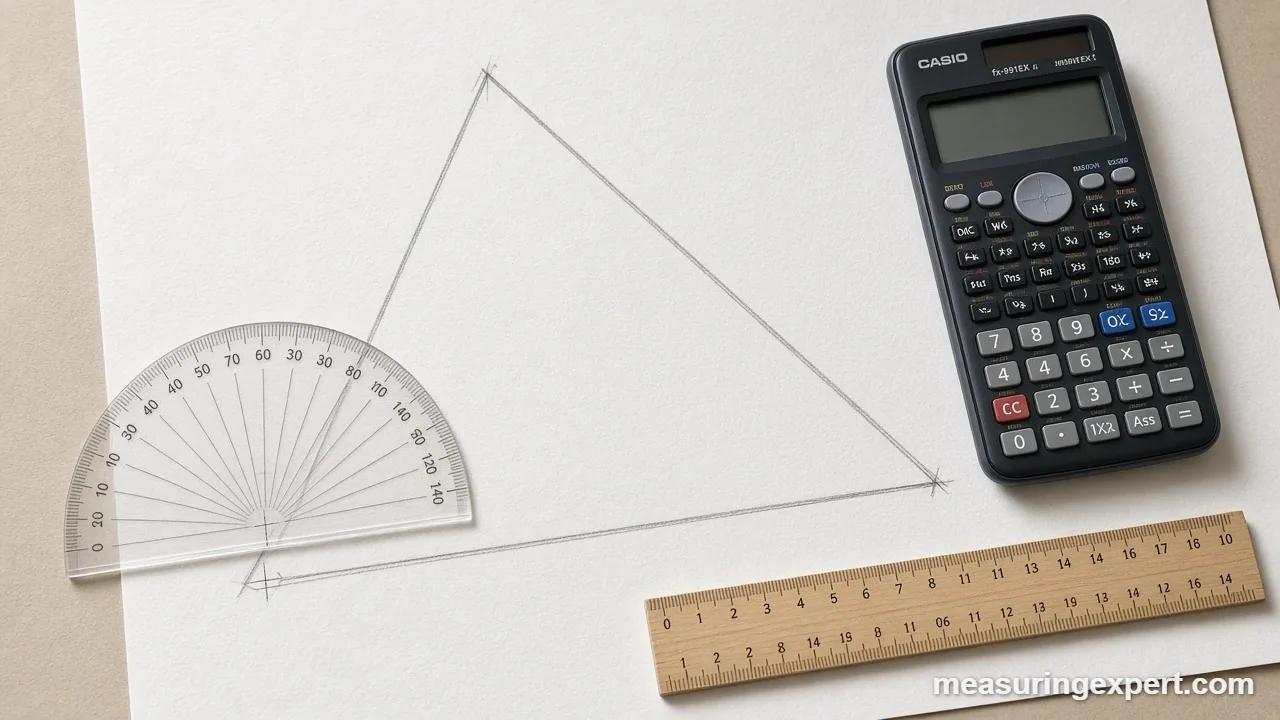
- Extend short sides if needed. Lightly lengthen each side with a ruler so it reaches past the protractor’s curved scale.
- Place the center mark on the vertex. Line up the small hole or crosshair exactly on the corner point.
- Align the baseline with one side. Rotate the protractor until its 0-degree line runs along one side of the corner.
- Choose the scale that starts at zero. Follow whichever row of numbers begins at 0 on that side, inner or outer.
- Read where the second side crosses. Look straight down at the scale and note the degree mark under the other side.
- Repeat for a second corner. Measure another vertex the same way.
- Subtract to find the last one. Take 180 minus the two readings, then measure that corner too as a check.
Also, ask yourself one quick question at every corner: does it look narrower or wider than a right angle? If it looks narrow, the reading must be below 90. That single check catches most inner-versus-outer scale mix-ups. For more detail on this tool, see how to measure angles using a protractor.
Solving Angles in a Triangle With Trigonometry
When the triangle is a roof, a ramp or a plot of land, a protractor is not practical. Instead, you measure the sides with a tape and calculate the corners. First, though, set your calculator to degree mode.
Right Triangles: SOH CAH TOA
In a right triangle, each acute angle links to two sides through sine, cosine or tangent. In turn, the inverse keys on a calculator turn a side ratio back into an angle.
angle = tan-1(opposite / adjacent) = sin-1(opposite / hypotenuse) = cos-1(adjacent / hypotenuse)
Take the classic 3-4-5 triangle. The angle opposite the 3 side is tan-1(3 / 4), about 36.87 degrees. The other acute corner is 90 minus 36.87, or 53.13 degrees. In addition, sin-1(3 / 5) gives the same 36.87 degrees, which is a handy cross-check.
Any Triangle: The Law of Cosines
If you know all three sides but none of the corners, use the law of cosines. Label the sides a, b and c, and call the angle opposite side a “A”.
cos A = (b2 + c2 – a2) / (2bc)
For sides of 7, 8 and 9 units, the corner across from the 7 side works out to cos-1((64 + 81 – 49) / 144), about 48.19 degrees. Likewise, the corner across from the 8 side comes to about 58.41 degrees. Finally, the third is 180 minus both, about 73.40 degrees. Notice that the widest corner faces the longest side, just as rule 2 predicts.
Two Angles and a Side: The Law of Sines
The law of sines links each side to the sine of its opposite corner: a / sin A = b / sin B = c / sin C. It is most useful once you already know two corners. For example, with A = 40 degrees, B = 60 degrees and a = 10 cm, side b = 10 x sin 60 / sin 40, about 13.47 cm. Meanwhile, C is simply 80 degrees.
Triangle Types and What Their Corners Tell You
For example, the shape itself sometimes hands you the answer. Here is what each type guarantees.
| Triangle type | Angle facts | Shortcut |
|---|---|---|
| Equilateral | All three corners are 60 degrees | No measuring needed |
| Isosceles | Two equal base corners | Base corner = (180 – apex) / 2; a 40-degree apex gives two 70-degree corners |
| Scalene | Three different corners | Measure two, or use the law of cosines |
| Right | One 90-degree corner; the other two add up to 90 | Measure one acute corner, subtract from 90 |
| Acute | Every corner under 90 degrees | Longest side squared is less than the other two squared, summed |
| Obtuse | One corner over 90 degrees (never more than one) | That corner faces the longest side |
In addition, two special right triangles are worth remembering. A 45-45-90 triangle has two equal legs. Similarly, a 30-60-90 triangle has sides in the ratio 1 : 1.732 : 2, so the shortest side is half the hypotenuse.
Interior vs Exterior, Degrees vs Radians
Above all, two pairs of terms trip people up more than anything else on this topic.
| Often confused | What it really means | Total for a triangle |
|---|---|---|
| Interior angle | The corner inside the shape | 180 degrees |
| Exterior angle | The turn between one side and the extension of the next | 360 degrees (one at each corner) |
| Degree | 1/360 of a full turn | 180 degrees |
| Radian | The angle whose arc equals the radius; about 57.30 degrees | pi, about 3.1416 radians |
In practice, school geometry, carpentry and most tools use degrees. Radians, however, appear in calculus, physics and many programming languages, so check which unit a spreadsheet or code library expects.
Do and Don’t
Do
- Check that your three readings total 180.
- Put the protractor’s center mark exactly on the vertex.
- Extend short sides so they cross the scale.
- Measure sides carefully before using trigonometry.
- Keep your calculator in degree mode.
Don’t
- Read the outer scale just because it is bigger.
- Trust a sketch that is not drawn to scale.
- Round side lengths heavily before you divide.
- Expect two obtuse corners in one triangle.
- Forget that the widest corner faces the longest side.
Honest Limits of Measuring Angles in a Triangle
A school protractor has 1-degree marks, so a careful reading is good to roughly half a degree to a degree. Three readings can therefore add up to 179 or 181 without anyone making a real mistake. In that case, trust the two clearest readings and calculate the third.
Trigonometry, however, has its own weak spot. Small errors in the side lengths turn into angle errors, and very thin triangles magnify them most. Also, the 180-degree rule only holds on a flat surface. On a sphere, such as a huge triangle drawn across the Earth, the corners add up to more than 180, so surveyors working over long distances use different math. Finally, real objects are rarely perfect: a “square” frame corner may sit at 89.6 degrees, and that small gap is exactly what a digital angle finder can reveal.
When to Call a Professional
For homework, crafts and most DIY projects, the methods above are plenty. Some jobs, though, need a licensed expert. For example, property lines and land plots belong to a licensed surveyor, because their measurements carry legal weight. Roof pitches, stair layouts and structural framing should follow local building codes, so a contractor or building inspector should confirm the angles. Precision machine setups, in turn, may need tools checked by a calibration lab.
Angles in a Triangle: FAQs
Do the angles in a triangle always add up to 180 degrees?
Yes, in any triangle drawn on a flat surface. On a curved surface such as a sphere, the corners add up to more than 180 degrees.
How do I find the third angle if I know two?
Add the two known angles and subtract the total from 180. For example, 45 and 65 degrees leave 70 degrees for the third corner.
How can I find the angles in a triangle from three sides?
Use the law of cosines: cos A = (b squared + c squared – a squared) / (2bc). Repeat for a second corner, then subtract both from 180.
How do I find an angle in a right triangle from two sides?
Divide the opposite side by the adjacent side and take the inverse tangent. With legs of 3 and 4, the angle opposite the 3 side is about 36.87 degrees.
Can a triangle have two right angles?
No. Two right angles already total 180 degrees, which leaves nothing for the third corner. For the same reason, a triangle can have at most one obtuse corner.
What are the angles in a triangle with equal sides?
An equilateral triangle has three 60-degree corners. An isosceles triangle has two equal base corners, each equal to 180 minus the apex, divided by 2.
Which scale on the protractor should I read?
Read the scale that starts at 0 on the side of the corner you lined up with the baseline. Then check whether the corner looks smaller or larger than 90 degrees.
What is an exterior angle of a triangle?
It is the angle between one side and the extension of the next side. It equals the sum of the two interior corners that do not touch it.
Why do my measured angles in a triangle add up to 178 or 182?
Small reading errors add up across three corners. Thick lines, a misplaced center mark or the wrong scale are the usual causes. Measure two corners carefully and calculate the third.
Should my calculator be in degrees or radians?
Use degrees for geometry class, carpentry and most practical work. In radian mode, the inverse tangent of 1 shows about 0.785 instead of 45.
Bottom Line on Angles in a Triangle
Every flat triangle hides the same promise: its three corners add up to 180 degrees. So measure two corners with a protractor or angle finder, subtract from 180, and use the third reading only as a check.
When the sides are easier to measure than the corners, switch to trigonometry instead. Use inverse tangent for right triangles and the law of cosines for everything else. The calculator near the top of this page handles the right-triangle case for your own numbers.