

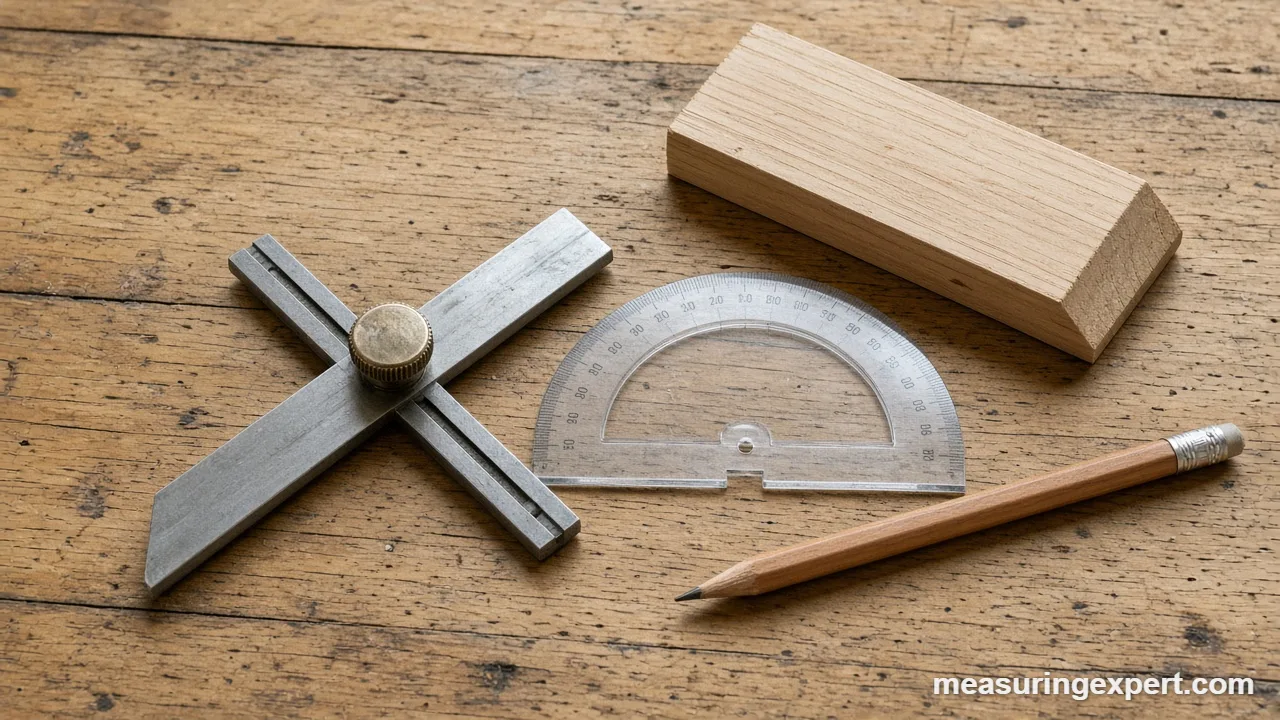
Protractor vs bevel gauge: a protractor measures an angle and shows it in degrees, while a bevel gauge copies an angle without reading it. Use a protractor to find or draw a number, and use a sliding bevel to transfer an existing angle from one piece to another.
Protractor vs Bevel Gauge at a Glance
| Question | Protractor | Bevel gauge (sliding T-bevel) |
|---|---|---|
| Main job | Reads or draws an angle in degrees | Sets, holds and copies an angle |
| Shows a number? | Yes, on a printed scale | Usually no scale at all |
| Typical shape | Half circle or full circle | Handle with a pivoting, lockable blade |
| Typical material | Clear plastic or metal | Metal blade, wood, plastic or metal handle |
| Best for | Geometry, drafting, checking a corner | Woodworking, joinery, matching an existing angle |
Convert the Angle Before You Set the Bevel
A protractor gives you degrees, but the shop may speak in slope or pitch. For example, a 22.5-degree reading is the same as a 41.4 percent grade. Enter the angle you measured below to see the other forms.
People often treat the two tools as rivals. In reality, they solve different halves of one problem. First, you need to know an angle. Then, you often need to repeat it on another piece, again and again, without errors creeping in.
That is where the protractor vs bevel gauge question comes from. A protractor answers “how many degrees?” Meanwhile, a bevel gauge answers “can you make this match?” In short: measure with the first, transfer with the second, and use both when a job needs a number and a copy.
The degree itself is fixed. For example, the US National Institute of Standards and Technology defines it as exactly pi/180 radian in its SI unit guide (SP 811). Because of that, any protractor, digital or printed, reads the same unit.
Quick Summary and Key Takeaways
- A protractor measures and draws angles; a bevel gauge stores and copies them.
- A sliding bevel normally has no scale, so it cannot tell you a number by itself.
- Most school protractors are marked every 1 degree and read to about half a degree.
- A universal bevel protractor combines both jobs and can read to 5 minutes (1/12 degree).
- Copying an angle with a bevel avoids reading and rounding errors.
- Set a bevel against a protractor or a known square to give it a number.
- Many projects work best with both tools on the bench.
What a Protractor Does in the Protractor vs Bevel Gauge Choice
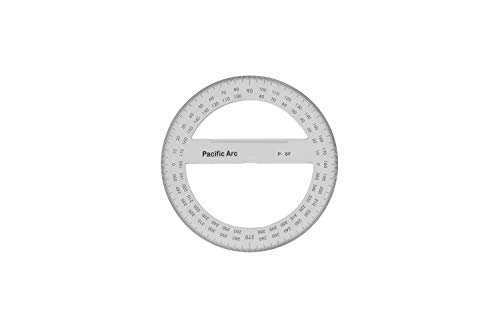
To begin with, a protractor is a flat tool with a curved, graduated edge. The common version is a half circle marked from 0 to 180 degrees, usually in 1-degree steps. In addition, full-circle versions run to 360 degrees. Digital angle finders work on the same idea, but they show the result on a screen instead.
First, you place the center mark on the corner, line up one side with the zero line, and read where the other side crosses the scale. As a result, you get a number that you can write down, compare and share. For polygons and shop layouts, see also our guide to angles in a polygon. Our walkthrough on how to measure angles using a protractor shows each step.
- Strengths: gives a number, draws angles on paper, costs little.
- Weaknesses: hard to use on a thick board, and reading error grows on small drawings.
- Typical users: students, draftsmen, tilers and anyone who needs a figure.
What a Bevel Gauge Does
Next, a bevel gauge, also called a sliding T-bevel or false square, is an adjustable gauge for setting and transferring angles. It has two parts, a handle and a blade, joined by a thumbscrew or wing nut. To use it, loosen the nut, swing the blade, and tighten it again to lock the angle.
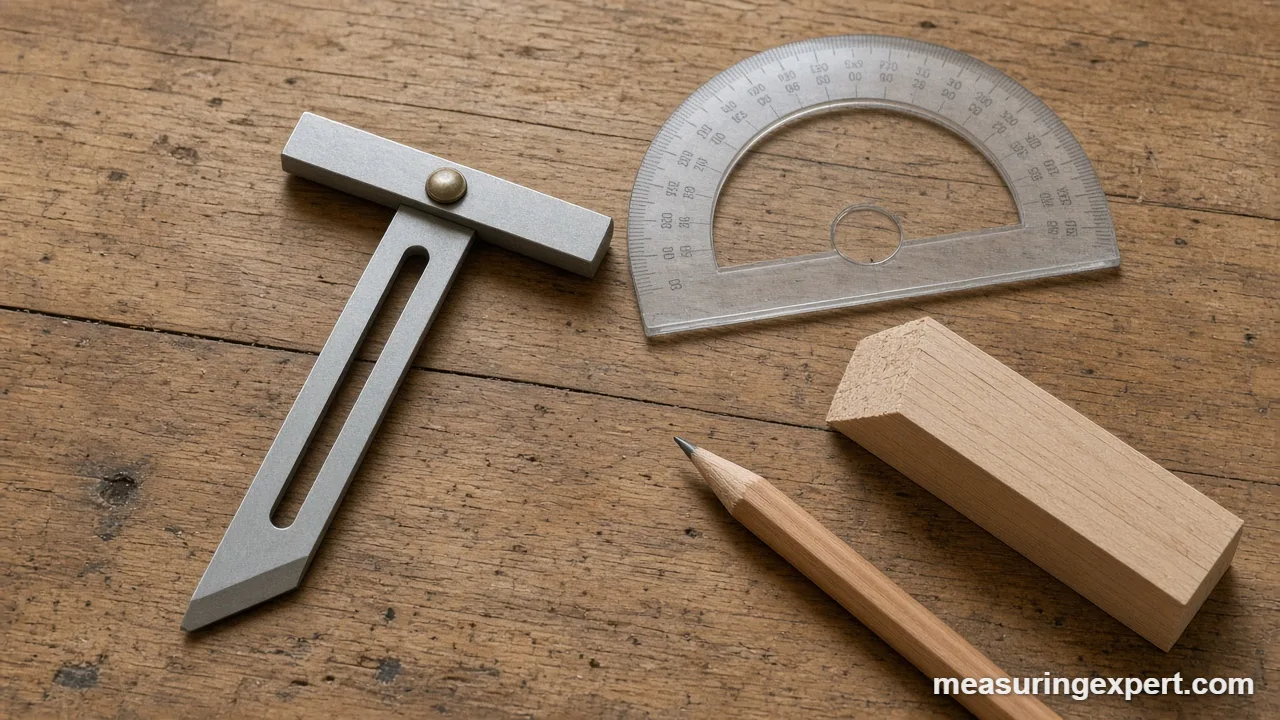
Wikipedia’s entry on the bevel gauge describes how you can copy an existing angle onto another piece, or set the bevel from a protractor or framing square. Therefore, the tool is less about measuring and more about matching.
- Strengths: copies awkward angles, works on thick stock and in tight corners.
- Weaknesses: no number unless you check it against another tool, and the lock can slip.
- Typical users: carpenters, joiners, cabinetmakers and metalworkers.
Key Differences in the Protractor vs Bevel Gauge Debate
| Feature | Protractor | Bevel gauge |
|---|---|---|
| Output | A reading in degrees | A physical angle held by the blade |
| Repeatability | Depends on how well you read the scale | Very good once locked |
| Scale | Printed or engraved | None on most models |
| Works on a drawing | Yes | Only as a straightedge |
| Works on solid stock | Awkwardly | Yes, the blade rests on the edges |
| Cost level | Usually the cheaper tool | Usually a bit higher |
The main point is the output. For instance, a reading can be written on a plan, while a copied angle cannot. Conversely, a reading must be transferred by hand, and each step adds a small error.
Protractor vs Bevel Gauge: Accuracy and Precision
Accuracy asks how close a reading is to the true angle. Precision, on the other hand, asks how well you can repeat it. As a result, the two tools differ on both counts.
For example, a typical plastic protractor is marked in 1-degree steps, so a careful reading is good to about half a degree. Also, thick lines and a slightly off-center vertex can add another degree. A bevel gauge has no reading error at all, since it has no scale. However, it has setting error. For example, if the blade is not tightened evenly, the angle may shift by a fraction of a degree.
| Source of error | Protractor | Bevel gauge |
|---|---|---|
| Reading the scale | About 0.5 degree by eye | Not applicable |
| Centering on the vertex | Adds to every reading | Blade sits on the edges |
| Locking or slipping | Not applicable | Possible if the nut is loose |
| Transfer step | You copy the number by hand | You copy the angle directly |
The Universal Bevel Protractor: Both Tools in One
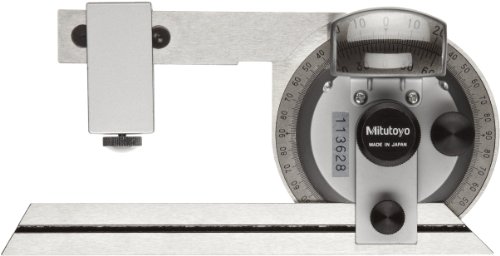
A third tool causes most of the confusion. In fact, a universal bevel protractor combines a graduated dial with an adjustable blade. As a result, it reads an angle and holds it in the same instrument. For this reason, machinists use it for parts that must meet a drawing.
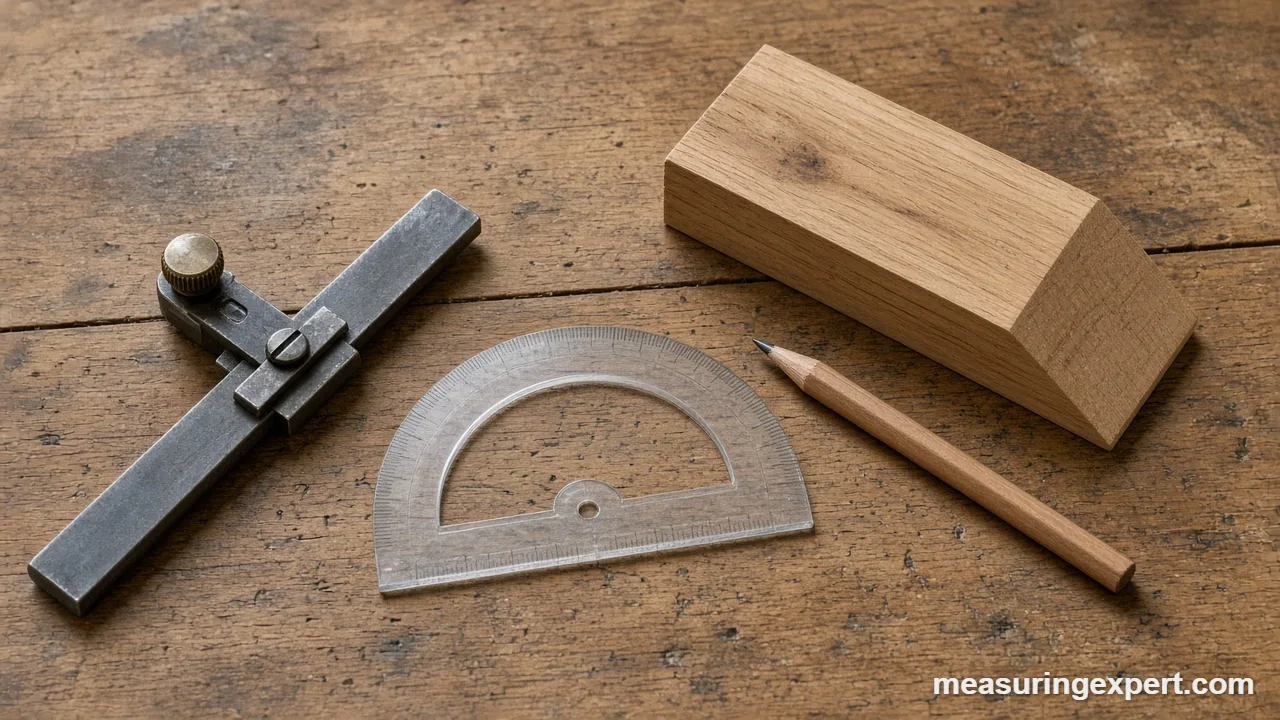
However, the precision versions use a vernier scale. According to Starrett’s 359 series data sheet, the vernier reads to 5 minutes, which is 1/12 of a degree, or about 0.083 degree. Therefore, it is roughly six times finer than a half-degree reading on a school protractor. Still, the price and the learning curve are higher.
How to Copy an Angle With a Bevel Gauge and Check It With a Protractor
This workflow uses both tools, so it shows how many woodworkers handle awkward joints.
- Loosen the lock. First, back off the thumbscrew or wing nut just enough to let the blade swing freely.
- Seat the handle. Next, press the handle flat against one reference edge of the existing angle.
- Swing the blade. Next, rotate the blade until it sits flush against the other edge, with no light showing underneath.
- Lock it. Then tighten the nut firmly without moving the blade.
- Check with a protractor. After that, lay the bevel on the protractor scale to read the angle in degrees, and write it down.
- Transfer the angle. Finally, hold the handle against the new piece and mark along the blade.
Afterward, test the mark on a scrap piece. If the fit is off, re-check the lock first, because a slipped blade is the usual cause.
Protractor vs Bevel Gauge: Which One Should You Choose?
The right pick depends on the job. In other words, no tool is better in general. Instead, ask what the project needs.
| Your task | Better tool | Why |
|---|---|---|
| Homework or drafting | Protractor | You need a number and a drawn line. |
| Copying a wall or roof angle | Bevel gauge | It holds the exact angle for you. |
| Cutting dovetails or miters | Bevel gauge, checked with a protractor | The copy is easy to repeat. |
| Machining to a drawing | Universal bevel protractor | It reads fine graduations. |
| Quick check of a corner | Digital angle finder or protractor | You get a number right away. |
If you only buy one tool, start with a protractor. Then, add the bevel when you begin to repeat angles on real material.
Recommended Tools for Measuring and Copying Angles
Based on manufacturer specs and buyer reports, these tools cover both jobs: sliding bevels for copying, protractors for reading, and one precision bevel protractor. First, look for a firm lock on any bevel, because a loose nut ruins the copy. Also, check the scale range in the listing, since not every protractor reads a full circle.



As an Amazon Associate, Measuring Expert earns from qualifying purchases.
To compare more models, see our roundups of the best protractors and the best angle measuring tools.
Do and Don’t in the Protractor vs Bevel Gauge Choice
- Match the tool to the job, because a number and a copy are different needs.
- Clean the blade and the edges before you set a bevel.
- Tighten the lock firmly, so that the tool holds when you move it.
- Check a copied angle against a protractor once.
- Test the setting on scrap material.
- Expect a plain bevel to show degrees.
- Read the wrong protractor scale.
- Bump the blade after you lock it.
- Trust one reading on a worn tool.
- Use a cracked or bent protractor.
Honest Limits: Protractor vs Bevel Gauge
Neither tool is perfect. For one thing, a protractor is only as good as its printing and your eye. Also, cheap plastic ones can be printed slightly off-center, so check yours against a known 90-degree square. Similarly, a bevel can only copy what its blade can touch, so a rough or curved edge gives a poor copy.
Moreover, small errors stack up. For example, if you read a protractor, set a bevel and then mark a board, each step can add a fraction of a degree. In short, for most woodworking that is fine. For parts with tight tolerances, however, use calibrated instruments and a proper measuring process.
When to Call a Professional for Protractor vs Bevel Gauge Jobs
For classroom work and ordinary DIY, either tool is plenty. However, structural framing, stair stringers, machined parts and anything that must pass inspection need verified angles. In those cases, ask a licensed contractor, machinist or surveyor. Likewise, a calibration lab can certify precision angle gauges.
Protractor vs Bevel Gauge: Frequently Asked Questions
What is the main difference in protractor vs bevel gauge?
A protractor measures an angle in degrees. In contrast, a bevel gauge holds and copies an angle, and most models have no scale.
What is a bevel gauge used for?
It is used to set an angle and transfer it to another piece, for example when marking joints, miters and angled cuts.
In protractor vs bevel gauge, which one measures angles?
The protractor does. A bevel gauge cannot do it by itself, so you set it against a protractor or a known reference, and then read the angle from that tool.
What is a bevel protractor?
It is a protractor with an adjustable blade and a graduated dial. As a result, it can read and hold an angle in one tool.
How accurate is a bevel protractor?
Precision universal models with a vernier scale read to 5 minutes, which is 1/12 of a degree. However, simple dial versions are coarser.
Protractor vs bevel gauge: which is more accurate?
Not necessarily. For example, a school protractor reads to about half a degree, while a locked bevel copies an angle with no reading error.
In protractor vs bevel gauge, do I need both?
For woodworking, yes, it helps. The protractor gives you a number, and the bevel repeats the angle on your material.
Is a sliding T-bevel the same as a bevel gauge?
Yes. In fact, sliding bevel, T-bevel, bevel gauge and false square are names for the same adjustable tool.
How do you set a bevel gauge to a specific angle?
First, loosen the lock and lay the bevel on a protractor. Then swing the blade to the reading you want, and tighten the lock.
What angle is a 45-degree miter on a bevel?
It is half of a 90-degree corner. Therefore, a bevel set to 45 degrees against a square makes a matching miter on each piece.
Protractor vs Bevel Gauge: The Bottom Line
To sum up, a protractor tells you the number, and a bevel gauge holds the angle. Therefore, they overlap only in a universal bevel protractor, which reads and holds in one tool.
Finally, pick the tool that fits your task. For example, use a protractor for numbers and drawings, a bevel for copying on real stock, and both when a project needs a figure and a faithful copy.
3 thoughts on “Protractor vs Bevel Gauge: Differences and Which to Use”