

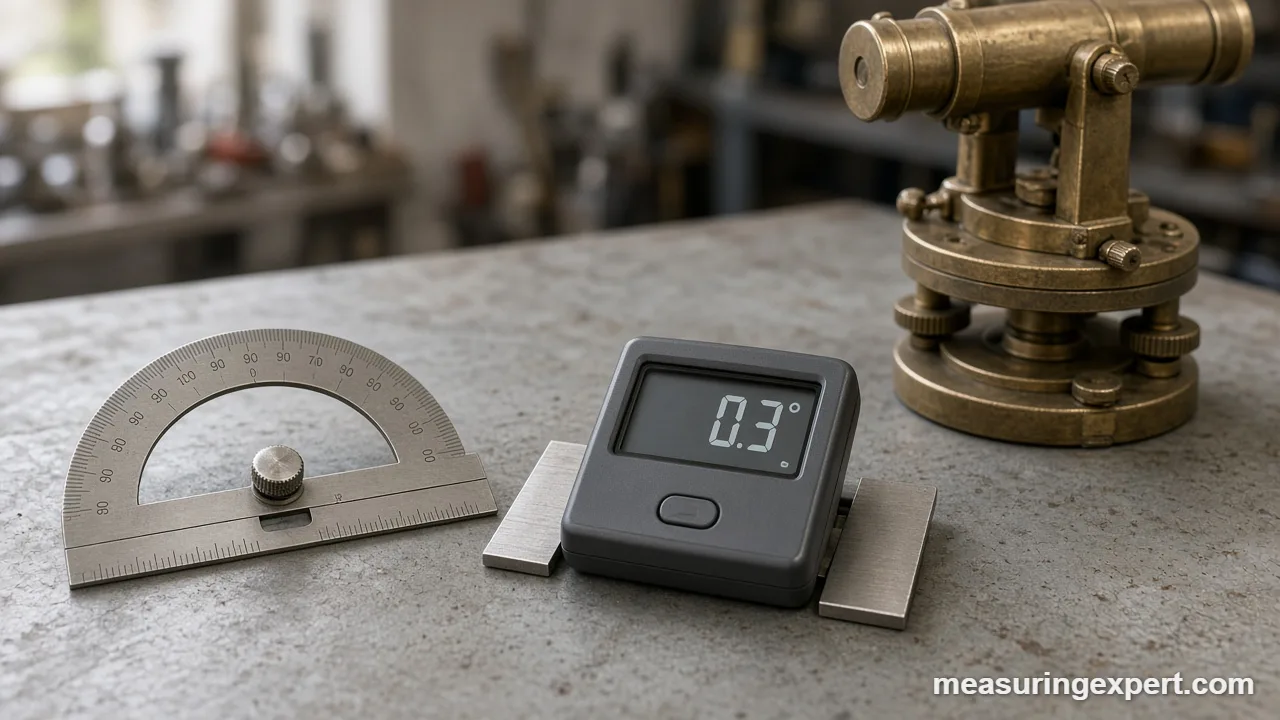
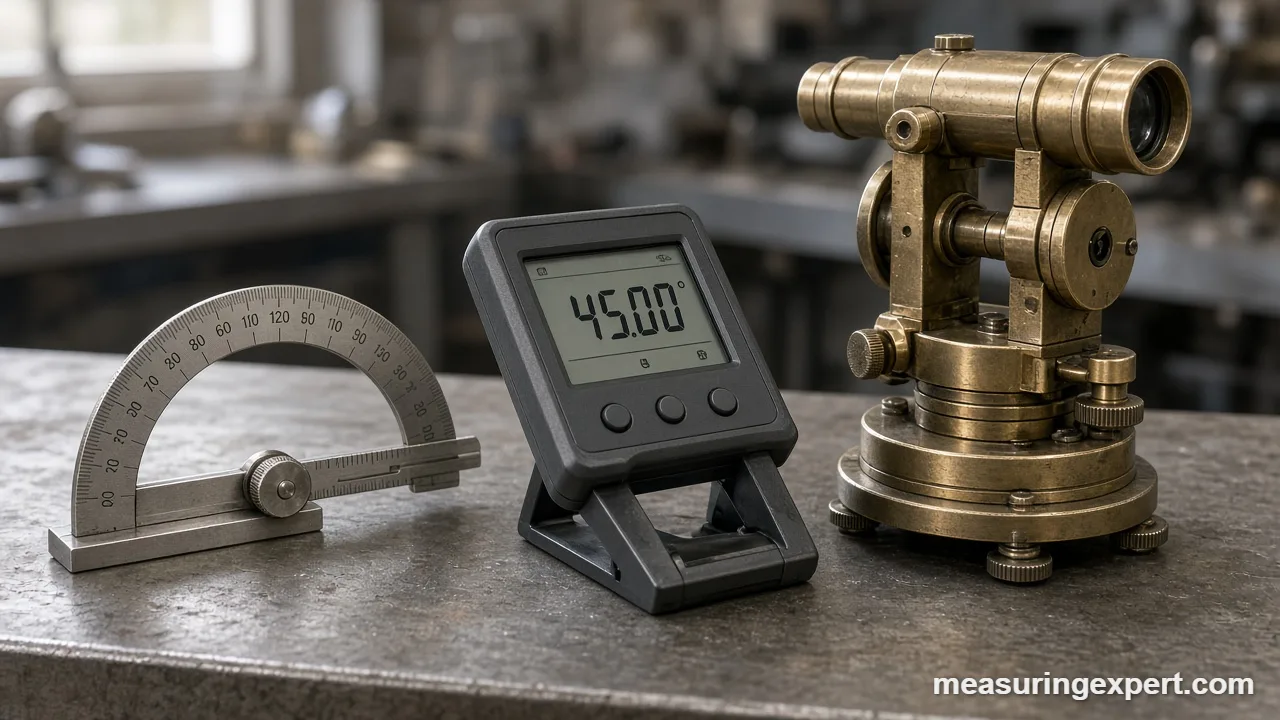
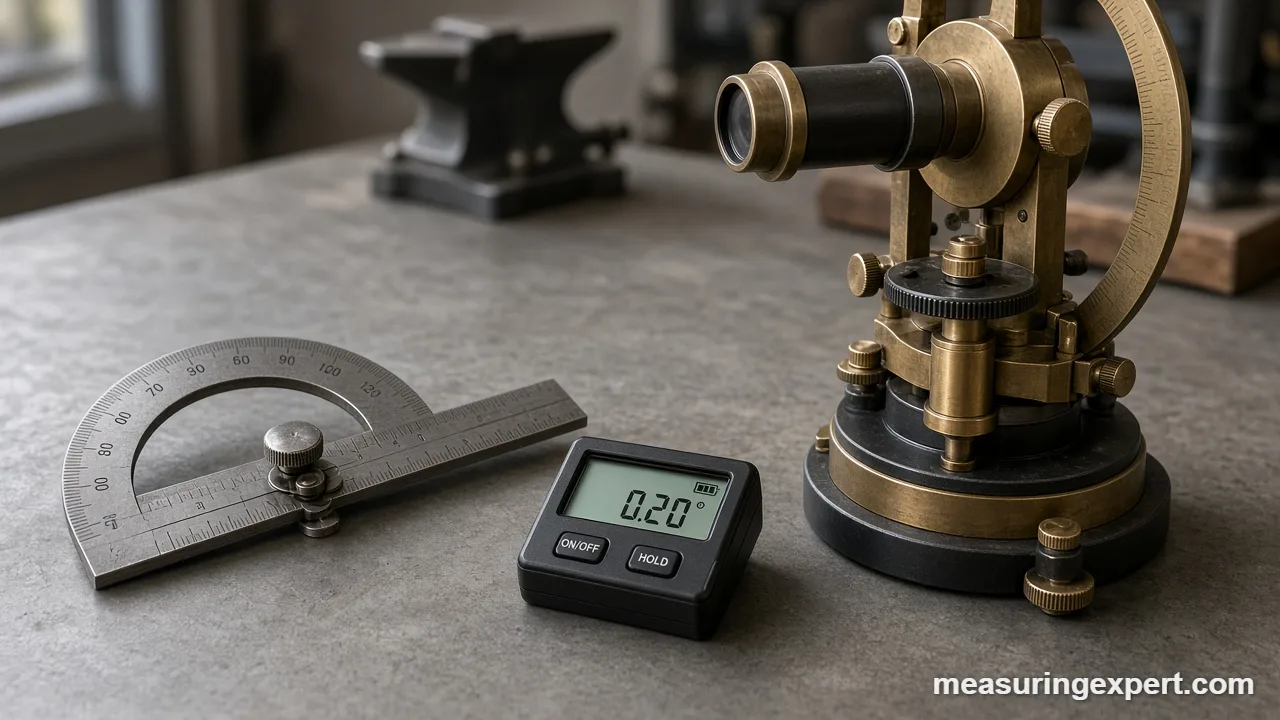
The smallest angle you can measure depends on your tool. A school protractor reads about 1 degree, a digital angle finder 0.1 degree, and a surveyor’s theodolite about 1 arcsecond (1/3,600 degree). In theory, however, no smallest angle exists, because angles can shrink without limit.
Ask ten people for the smallest angle ever measured and you may hear “the Planck angle.” That answer sounds scientific. However, physics has no accepted constant by that name. Angles are ratios of two lengths, so they have no built-in floor. Instead, what stops us is the instrument in our hands.
In short, the real question is how fine a tool can split a circle. For example, a pocket protractor, a total station and a national laboratory all give different answers. As a result, this page walks through each one, with the numbers.
First, try the calculator below to see what a tiny angle means as a slope. After that, you will see the theory, a tool-by-tool table, a scale for the arcsecond, and a method for measuring small angles yourself.
Smallest Angle Calculator: Degrees, Grade and Pitch
First, enter a small angle in degrees, percent grade or roof pitch. The calculator then shows the other two values. For example, try 0.1 degree to see how little slope a fine angle really is.
Is There a Smallest Angle in Theory?
Mathematically, no. That is because an angle is the arc length divided by the radius, so it is a plain ratio. Shrink the arc or stretch the radius, and the angle gets smaller. In fact, nothing in geometry says “stop here.”
Physics is less clear. Even so, it does not name a limit either. For instance, some theories suggest that space itself may have a smallest length, called the Planck length. However, that is a theoretical scale, not a measured one, and nobody has built an instrument anywhere near it. As a result, any claim of a “smallest possible angle” at that scale is speculation.
Therefore, for any practical purpose, the smallest angle is the smallest one your instrument can detect and report with confidence. That is a tool question, and the next section answers it.
Smallest Angle Each Tool Can Measure
The table lists typical limits, from a classroom protractor to a global telescope network. Because spec sheets vary by model, treat each row as a rough guide. In addition, the last column converts every value to arcseconds so you can compare them at a glance.
| Tool | Typical smallest reading | In degrees | In arcseconds |
|---|---|---|---|
| Plastic school protractor | 1 degree (about 0.5 by eye) | 1 | 3,600 |
| Digital angle finder or digital level | 0.1 degree | 0.1 | 360 |
| Vernier bevel protractor | 5 arcminutes | 0.0833 | 300 |
| Surveying total station or theodolite | 1 to 5 arcseconds (some reach 0.5) | 0.00028 to 0.0014 | 1 to 5 |
| Precision laboratory goniometer | 0.1 arcsecond (expanded uncertainty) | 0.0000278 | 0.1 |
| Hubble Space Telescope (resolving power) | 0.05 arcsecond | 0.0000139 | 0.05 |
| Event Horizon Telescope (resolving power) | 20 microarcseconds | 0.0000000056 | 0.00002 |
Two of these rows, in fact, come from named sources. The National Institute of Standards and Technology (NIST) describes a dual-axis goniometer with an absolute accuracy of 0.1 arcsecond around the full circle. Likewise, NASA says Hubble can distinguish objects as close as 0.05 arcsecond.
Notice that telescopes work differently from hand tools. Instead of reading an angle from a scale, they resolve how far apart two points of light are. For example, the Event Horizon Telescope linked radio dishes across the planet and reached a resolution of 20 microarcseconds in a 2020 study. That is the finest angular detail on record in this table.
How Big Is One Arcsecond?
Put simply, an arcsecond is 1/3,600 of a degree, or about 4.848 microradians. One radian equals 206,264.8 arcseconds. That is tiny. For instance, an object 1 inch wide, seen from 3.26 miles (5.24 km) away, spans about one arcsecond.
Next, the table below shows how far an angle moves a point. The offset is distance times the tangent of the angle, so it grows with range.
| Angle | Microradians | Offset at 100 ft | Offset at 100 m |
|---|---|---|---|
| 1 degree | 17,453 | 20.9 in | 1.75 m |
| 0.1 degree | 1,745 | 2.09 in | 174.5 mm |
| 1 arcminute | 290.9 | 0.349 in | 29.1 mm |
| 1 arcsecond | 4.848 | 0.0058 in | 0.485 mm |
| 0.1 arcsecond | 0.4848 | 0.00058 in | 0.048 mm |
As a result, an instrument that reads one arcsecond can notice a shift of about half a millimeter at 100 meters. By contrast, a protractor that reads one degree would miss anything under about 1.75 meters at the same range.
Key Takeaways
- No known smallest angle exists in mathematics, and “Planck angle” is not a standard term.
- The smallest angle you can measure is set by your instrument, not by nature.
- Protractors read about 1 degree, digital finders 0.1 degree, and theodolites about 1 arcsecond.
- One degree equals 3,600 arcseconds, and one arcsecond is about 4.848 microradians.
- Resolution is the finest step shown, while accuracy is how close the reading is to the truth.
- Repeated readings and the distance-and-offset method can improve a small-angle result.
Resolution vs Accuracy: Why the Display Is Not the Whole Story
First, resolution is the smallest step a tool can show. However, accuracy is how close that number is to the true angle. Finally, precision is how well repeated readings agree.
| Term | Plain meaning | Example |
|---|---|---|
| Resolution | Smallest step on the display or scale | A finder shows 0.1 degree |
| Accuracy | Closeness to the true value | The same finder is rated plus or minus 0.2 degree |
| Precision | Agreement between repeated readings | Five readings differ by 0.1 degree |
In other words, the smallest angle you can trust is closer to the accuracy rating than to the display. Meanwhile, the display step only tells you how finely the number is rounded.
How to Measure a Very Small Angle
- Pick a fine enough tool. So choose an instrument whose accuracy is several times better than the angle you care about.
- Set up on stable ground. First, level the tool, lock the tripod and let a metal tool reach room temperature.
- Zero the tool. Also, calibrate or zero a digital finder on a surface you know is flat or square.
- Take the reading. Next, record the number, then flip the tool end for end and read again.
- Repeat five times. Then average the results and note how far they spread.
- Cross-check by geometry. Next, measure a sideways offset and a distance, then divide: angle = arctan(offset / distance).
- Write down the uncertainty. Finally, report the angle together with the spread, such as 0.20 plus or minus 0.05 degree.
The geometry check is handy when no fine tool is at hand. For example, a gap that is 2 inches wide over a 100-foot run gives arctan(2 / 1,200), which is about 0.095 degree. Similarly, 5 mm over 10 m is 0.029 degree. In addition, you can enter the result in the calculator above to get a percent grade.
Recommended Tools for Measuring Small Angles
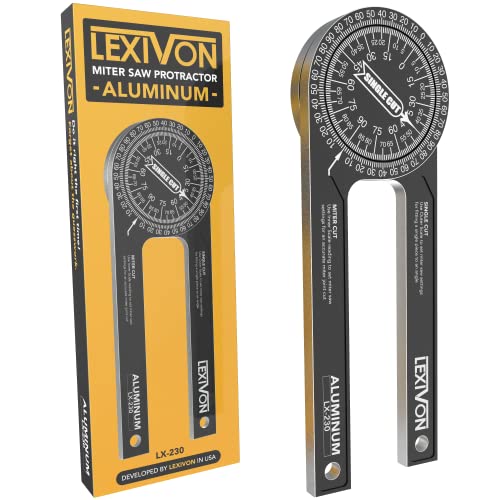
For shop and home jobs, a digital angle finder or a digital level covers most needs. First, look for a display that reads to 0.1 degree. Next, check the stated accuracy, and then confirm that the tool has a zero or calibration button. Also, a long, rigid arm makes it easier to line up against a small gap. Our comparison of a protractor vs bevel gauge explains when each style suits the job.



As an Amazon Associate, Measuring Expert earns from qualifying purchases.
Smallest Angle in Everyday Jobs
Most jobs, however, need far less than an arcsecond. Even so, small angles add up over distance, which is why trades care about a tenth of a degree.
- Carpentry and trim. A miter that is off by 0.5 degree leaves a gap of about 1 inch over 10 feet of run.
- Tile and flooring. A 0.1 degree drift across a 20-foot room shifts a line by about 0.42 inch.
- Solar panels. Aiming within a degree or two is usually enough, as our solar panel angle guide explains.
- Surveying. Crews read arcseconds because errors grow with distance. Our article on angle measurement in surveying shows how.
- Total stations. Modern instruments log angles automatically, as described in how to use a total station.
For a broader view of why small errors matter, read about the importance of angle measurement.
Do and Don’t When Measuring Small Angles
Do
- Zero the tool on a known flat surface.
- Read from both ends of the tool.
- Average several readings.
- Keep the tool clean and free of burrs.
- Write down the units you used.
Don’t
- Trust digits beyond the stated accuracy.
- Measure on a warped or dirty surface.
- Hold the tool with warm hands for long.
- Mix degrees and gons in one record.
- Round early in a chain of calculations.
Honest Limits of the Smallest Angle You Can Measure
Every measurement has noise. For example, temperature changes the length of metal arms, vibration moves a tripod, and air bends light on long sights. Moreover, a display can show more digits than the sensor truly supports. As a result, extra digits can mislead.
Also, the figures in this article are typical values and published results, not guarantees for any one product. For example, two digital angle finders with the same display can differ by several tenths of a degree. In short, the smallest angle you can trust is the one your tool, setup and method can repeat.
When to Call a Professional
First, call a licensed surveyor for boundaries, building layout or anything with legal weight. Likewise, send a precision instrument to an accredited calibration lab when a job needs a documented, traceable angle. Home tools are fine for rough checks. However, they do not replace certified work.
Frequently Asked Questions
What is the smallest angle that can be measured?
It depends on the tool. For example, protractors read about 1 degree, theodolites about 1 arcsecond, and laboratory goniometers about 0.1 arcsecond.
Is there a smallest angle in theory?
No smallest angle is known in mathematics, because an angle is a ratio that can shrink without limit. Likewise, physics names no measured floor.
What is the Planck angle?
It is not an accepted physical constant. Instead, the Planck length is a theoretical scale, so angles themselves have no fixed minimum.
What is the smallest angle a protractor can show?
A standard plastic protractor has 1 degree marks. However, with a steady eye you may estimate about half a degree.
How many arcseconds are in a degree?
There are 3,600 arcseconds in one degree. In other words, each degree has 60 arcminutes, and each arcminute has 60 arcseconds.
How small is one arcsecond in radians?
One arcsecond is about 4.848 microradians, or 0.000004848 radian. In addition, one radian is about 206,265 arcseconds.
Can a phone measure a small angle?
A phone can show about 0.1 degree, but its accuracy is usually coarser. Therefore, use it for rough checks and not for precision work.
What is the smallest angle a theodolite can read?
Many theodolites and total stations are rated at 1 to 5 arcseconds, while a few premium models reach 0.5 arcsecond.
What is the difference between resolution and accuracy?
Resolution is the smallest step on the display. In contrast, accuracy is how close the reading is to the true angle.
How do I find a very small angle without a fine tool?
First, measure a sideways offset and a distance, then compute arctan(offset divided by distance). For example, 2 inches over 100 feet is about 0.095 degree.
The Smallest Angle: Bottom Line
To sum up, nature sets no known smallest angle, and “Planck angle” is a myth in measurement. Instead, your tool does the limiting: about 1 degree for a protractor, 0.1 degree for a digital finder, 1 arcsecond for a theodolite and 0.1 arcsecond in a top laboratory.
Finally, check accuracy before resolution, repeat your readings, and also use the offset-and-distance method as a cross-check. However, when a result carries legal or safety weight, bring in a licensed professional.