

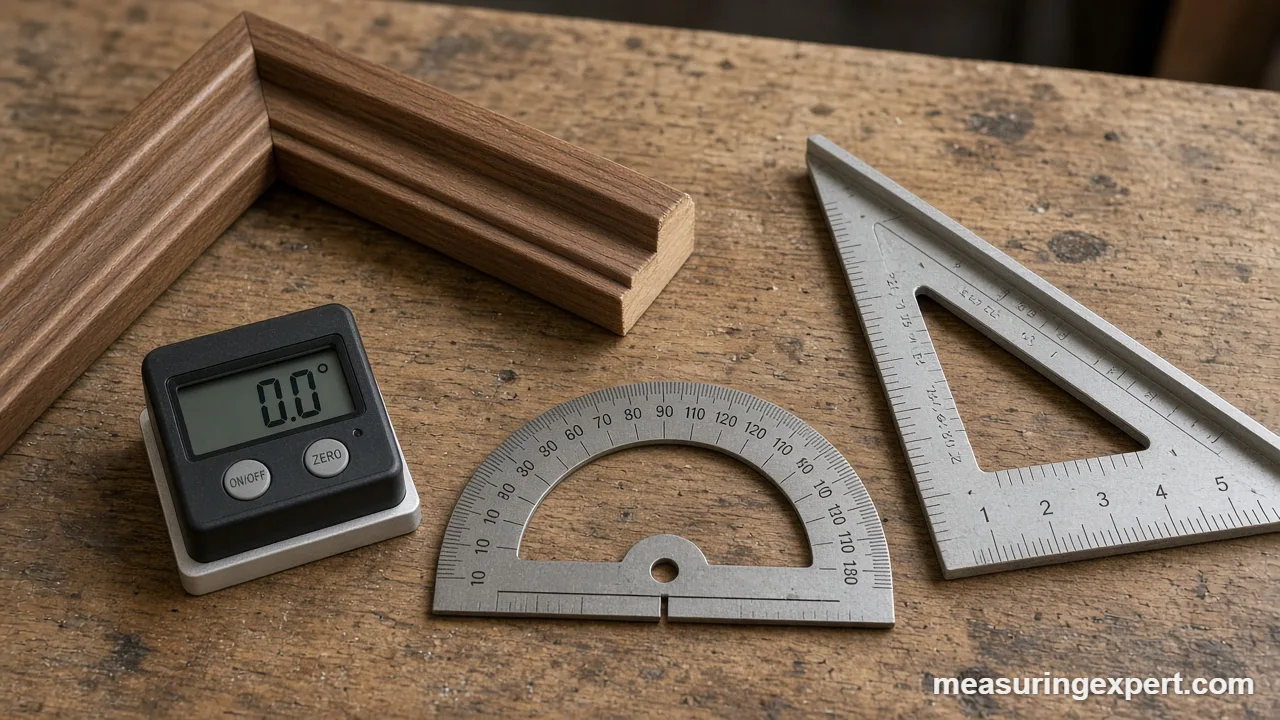
Angle measurement matters because almost everything we build, drive, cook or play depends on getting an angle right. In daily life, it keeps stairs safe, roofs watertight, maps readable and joints tight. One full turn is 360 degrees, and a right angle is exactly 90 degrees.
Most people never think about angles until something does not fit. A door that sticks, a shelf that leans or a ramp that feels too steep all come down to the same thing. Because angles describe how two lines or surfaces meet, they quietly shape the objects around you.
In short, this guide explains why angle measurement is so useful, where it shows up at home, at work and outdoors, and how to do it yourself. First, try the converter below. Then read on for real examples, a comparison of the three ways people state a slope, and the tools worth owning.
Angle Measurement Converter: Degrees, Grade and Pitch
Enter an angle in degrees, a percent grade or a roof pitch (rise per 12 inches of run). The tool converts between them instantly, so you can compare a ramp, a roof and a hillside on the same scale.
What Angle Measurement Means
To begin, an angle is the opening between two lines that meet at a point, called the vertex. Angle measurement tells you how wide that opening is. The most common unit is the degree, where a full circle is 360 degrees and a straight line is 180 degrees.
Mathematicians and engineers also use the radian. One radian equals about 57.3 degrees, so a half turn is pi radians (3.14159). The National Institute of Standards and Technology (NIST) notes in its guide to the SI that the radian is a coherent SI derived unit for plane angle. Meanwhile, the degree remains the everyday choice for building, navigation and sport.
Similarly, builders add two more ways to state a slope. A percent grade is the rise divided by the run, times 100. A roof pitch is the rise in inches for every 12 inches of run. For example, a 6-in-12 roof is a 50% grade, or about 26.57 degrees.
Recommended Tools for Angle Measurement
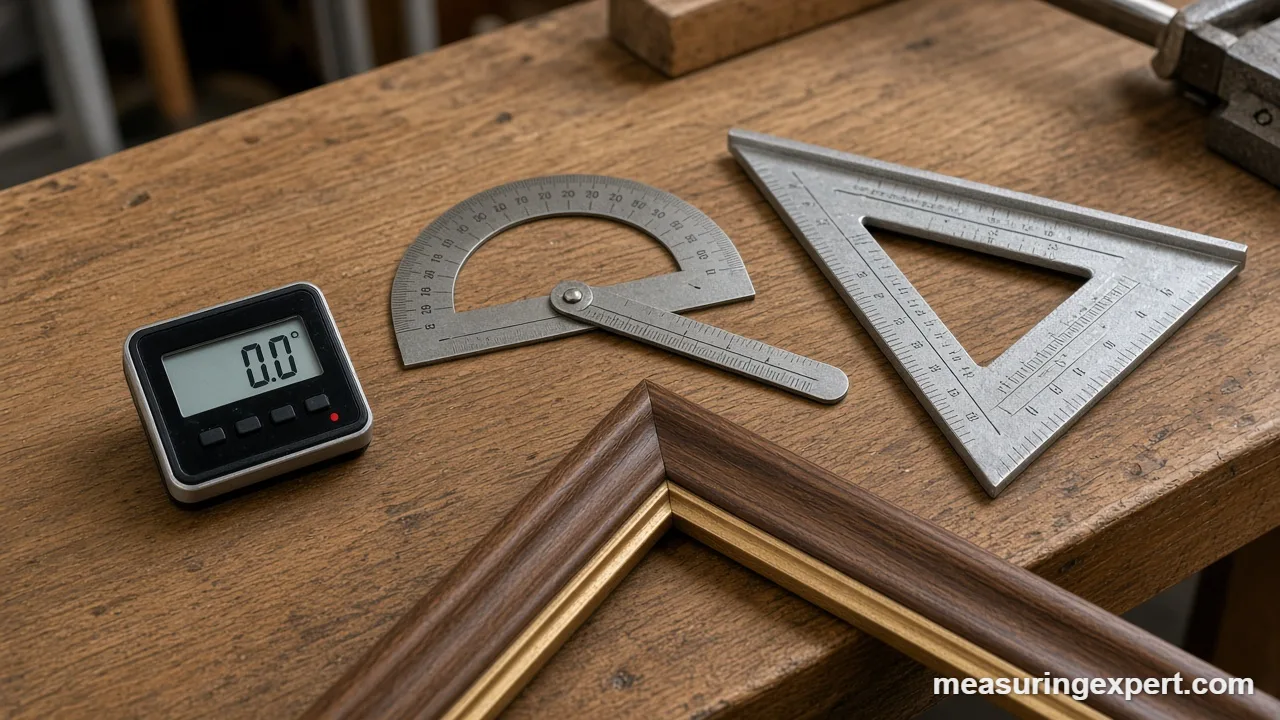
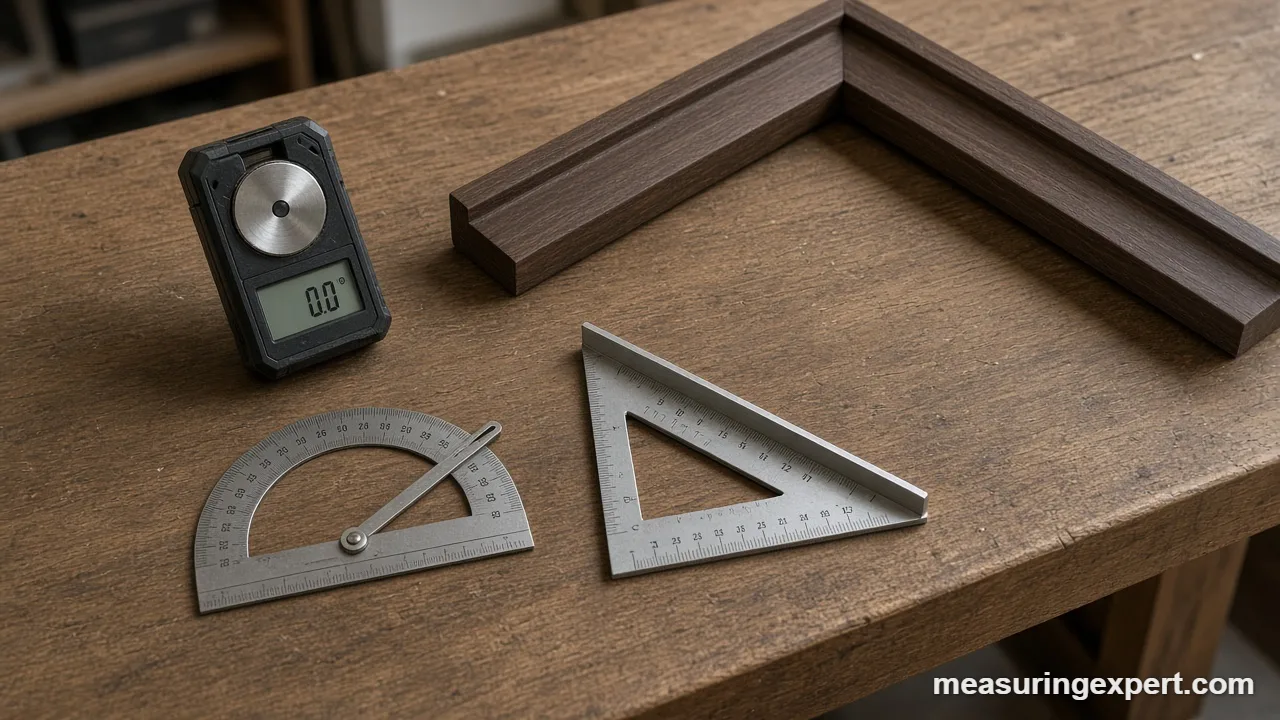
A basic protractor handles drawing and school work. For jobsite tasks, however, a digital angle gauge or a layout square is faster and easier to read. First, decide whether you need to read an angle or transfer one. Next, check the scale resolution, because a tool that reads in whole degrees cannot show half a degree. Finally, look for a magnetic base if you work on metal saw tables and blades.

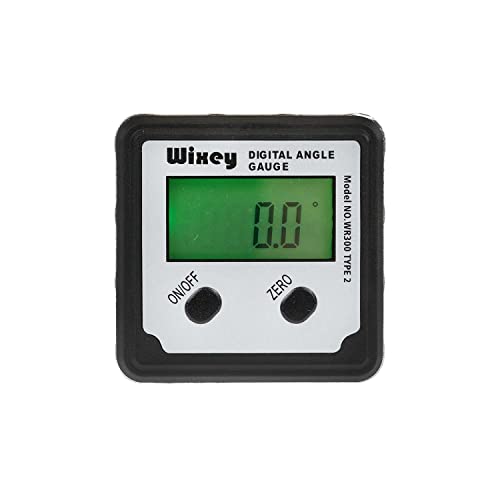
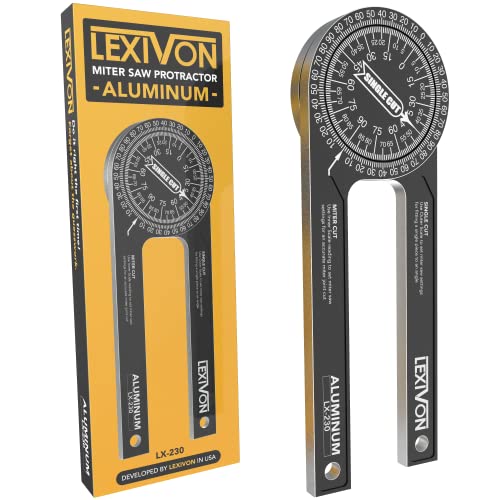
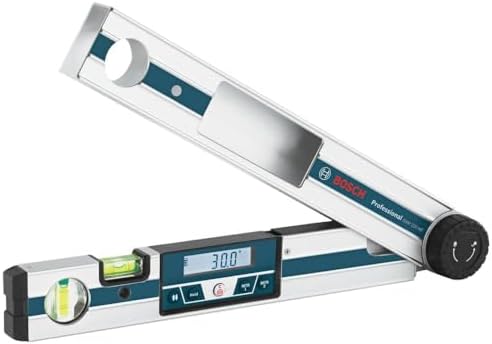

As an Amazon Associate, Measuring Expert earns from qualifying purchases.
For a deeper look at digital and analog options, see our roundup of the best angle gauges.
Key Takeaways
- A full circle is 360 degrees, a right angle is 90 degrees and a straight line is 180 degrees.
- Angle measurement keeps stairs, ramps, roofs and ladders both safe and comfortable.
- Degrees, percent grade and pitch describe the same slope in different words.
- One radian is about 57.3 degrees, and pi radians equal 180 degrees.
- Small angle errors grow with distance, so measure carefully on long cuts.
- Use a digital gauge for repeat work and a protractor for drawing.
Angle Measurement in Building and Home Projects
Construction is where angle measurement pays off most. For example, a wall that leans by one degree looks fine up close. Over an 8-foot wall, however, that lean moves the top about 1.7 inches. Therefore, carpenters check angles all the time, and not only when they cut mitered trim.
Common examples include these jobs:
- Roofs. Pitch decides how fast water and snow shed. A 4-in-12 roof sits at about 18.4 degrees.
- Stairs. Rise and run set the stair angle, which affects comfort and safety underfoot.
- Ramps. A 1-in-12 ramp, a common accessibility slope, is a gentle 4.76 degrees (8.33% grade).
- Trim and frames. Four corners cut at 45 degrees make a clean 90-degree frame.
- Shelves and furniture. Square corners keep doors closing and drawers sliding.
In addition, ladders depend on angle. OSHA’s rule at 29 CFR 1926.1053 says the foot of a non-self-supporting ladder should sit about one-quarter of its working length away from the support. That works out to roughly 75.5 degrees from the ground. As a result, a 12-foot working length needs a base about 3 feet from the wall.
For related jobsite measuring, our guides to measuring building height and construction measurement precision show how angles feed into larger calculations.
Navigation, Maps and Everyday Travel
First, every compass bearing is an angle measured clockwise from north. East is 90 degrees, south is 180 and west is 270. Northeast sits at 45 degrees, halfway between north and east.
In practice, pilots, sailors and hikers use bearings to hold a course. Satellite navigation also depends on geometry. For example, a phone locates itself by comparing signals from several satellites, and the math behind that relies on angles and distances. Even parking is a small angle problem, since a 45-degree space needs a different turn than a 90-degree one.
Similarly, grade signs on the road work the same way. A sign warning of a 6% grade means the road drops 6 feet for every 100 feet of travel, which is about 3.4 degrees.
Sports, Health and Movement
For example, coaches measure angles to improve technique. A golf club’s loft, a pitcher’s arm slot and a high jumper’s takeoff all have an angle that works best. Gymnasts, runners and weightlifters also use joint angles to refine form and spot weak points.
Physical therapists measure how far a joint can bend, called range of motion. For instance, a knee that bends from 0 to about 135 degrees is moving through a typical range. Clinicians use a goniometer for this, which is simply a protractor with two long arms. Since this involves health, treat any numbers here as general information and follow the advice of a licensed clinician.
Science, Technology and Design
Moreover, angles matter well beyond the toolbox. For instance, robot arms rotate joints to exact angles so a part lands in the right spot. Solar installers tilt panels toward the sun, and the best tilt depends on latitude. Telescope mounts, security cameras and satellite dishes all aim by angle.
Likewise, artists and designers use angles too. Perspective drawing relies on lines that converge at set angles, and tile patterns depend on shapes whose corners add up to 360 degrees. Even a sewing pattern or a quilt block fails if the corners drift.
How to Measure an Angle With a Protractor
A protractor is the simplest way to practice angle measurement. Therefore, follow these steps for a clean reading.
- Find the vertex. Locate the point where the two lines or edges meet.
- Align the baseline. Put the protractor’s center mark on the vertex and line up its zero edge with one arm of the angle.
- Pick the right scale. Start at zero on the arm you aligned, and use the scale that begins there.
- Read the second arm. Follow the other arm to the scale and note the number it crosses.
- Check for sense. An angle smaller than a square corner must read under 90 degrees, so flip scales if it does not.
- Record the result. Write the angle in degrees, then convert it if you need a grade or pitch.
On a job, a digital angle gauge works differently. Zero it on a flat reference surface, then set it on the surface you want to check. As a result, you read the angle directly, without lining up any scale.
Degrees vs Percent Grade vs Pitch
These three systems describe the same slope, but each trade prefers its own. The values below use the tangent of the angle for grade (rise over run, times 100) and for pitch (rise per 12 inches).
| Degrees | Percent grade | Pitch (rise in 12 in run) | Typical example |
|---|---|---|---|
| 1 | 1.75% | 0.21 in 12 | Drainage slope on a patio |
| 5 | 8.75% | 1.05 in 12 | Steep ramp |
| 10 | 17.63% | 2.12 in 12 | Steep driveway |
| 18.43 | 33.33% | 4 in 12 | Low-slope roof |
| 26.57 | 50% | 6 in 12 | Common roof |
| 30 | 57.74% | 6.93 in 12 | Steep roof |
| 45 | 100% | 12 in 12 | Rise equals run |
In addition, the grade climbs faster than the angle. At 45 degrees the grade is 100%, and above that it keeps growing without limit, so a vertical wall has no finite grade.
Do and Don’t for Accurate Angles
Do
- Zero a digital gauge on a known flat surface.
- Measure twice, then cut once.
- Keep the tool flat against the surface.
- Convert units before you compare two numbers.
- Check a tool against a known square corner.
Don’t
- Mix up percent grade and degrees.
- Read the wrong scale on a protractor.
- Trust a tool that has been dropped without checking it.
- Measure on dust, paint drips or rough edges.
- Round early on long cuts.
Honest Limits of Angle Measurement
In fact, every angle reading has some error. A plastic school protractor is usually good to about one degree on a good day, while a digital gauge may resolve a tenth of a degree. Resolution, however, is not the same as accuracy. For instance, a gauge can display 0.1 degrees and still be off by more if it was not zeroed properly.
Also, distance multiplies small errors. A half-degree mistake on a 10-foot board shifts the far end by about 1 inch. Moreover, surfaces are rarely perfect, so a warped board or a sagging floor gives different readings at different spots. In short, an angle measurement tells you about the spot you checked, and nothing more.
When to Call a Professional
Overall, home angle checks suit trim, shelves and small projects. Structural work is different. For example, roof framing, stair stringers on a deck, retaining walls and anything that carries weight should follow local building codes. A licensed contractor, engineer or surveyor can measure and certify those angles.
Frequently Asked Questions
Why is angle measurement important in daily life?
Angle measurement helps things fit, stay safe and work well. It guides how we build stairs and roofs, read maps, set up furniture and play sports.
Why is it important for children to learn about angles?
Angles build spatial thinking and prepare children for geometry, design and trades. They also help kids judge turns, slopes and shapes in everyday play.
What are 10 things in which angles are used in daily life?
Stairs, roofs, ramps, ladders, picture frames, compass bearings, parking spaces, golf swings, solar panels and tile patterns all depend on angles.
How is angle measurement done in real life?
People use protractors, digital angle gauges, speed squares, compasses and clinometers. Builders also use slope numbers such as grade and pitch.
How many degrees are in a circle, and why?
A full circle has 360 degrees. In fact, the number goes back to ancient Babylonian mathematics, and it divides evenly by many numbers.
What is a radian in angle measurement?
A radian is the angle whose arc equals the circle’s radius. One radian is about 57.3 degrees, and pi radians equal 180 degrees.
How do I convert degrees to percent grade?
Take the tangent of the angle and multiply by 100. For example, 5 degrees gives 8.75% and 45 degrees gives 100%.
What angle is a 6/12 roof pitch?
A 6-in-12 pitch is about 26.57 degrees, which is a 50% grade.
How accurate is a digital angle gauge?
Many digital gauges resolve 0.1 degrees, but accuracy depends on the model and on zeroing it correctly. Check the manufacturer’s specifications.
What angle should a ladder be set at?
OSHA says the base should be about one-quarter of the working length from the support. That is roughly 75.5 degrees from the ground.
Angle Measurement: The Bottom Line
To sum up, angle measurement turns “looks about right” into a number you can trust. Degrees, grade and pitch all describe the same slope, and the converter at the top of this page moves between them in seconds.
Finally, pick a tool that matches the job, check it against a known square, and remember that small errors grow with distance. When the work carries weight or a ladder is involved, follow the code and call a professional.