
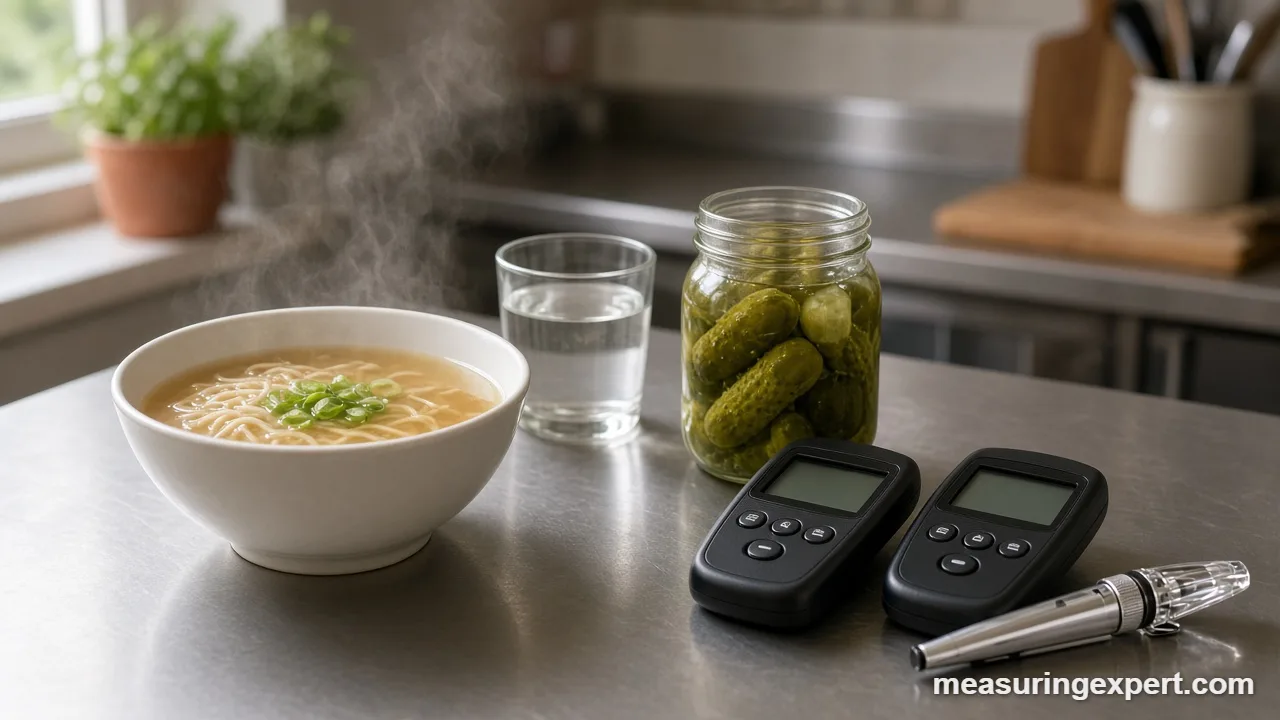
The best digital salt tester for most kitchens is the ATAGO PAL-SALT, a pocket conductivity meter that reads soup, broth and sauce from 0.00 to 10.0% salt in about three seconds. However, the right pick depends on your sample: thin liquids suit a conductivity meter, while strong brines need a refractometer.
In short: get the ATAGO PAL-SALT for soups and sauces, the LOHAND meter on a budget, the HORIBA Salt-11 if you want to calibrate, and a 0-28% refractometer for brines.
As an Amazon Associate, Measuring Expert earns from qualifying purchases. Our picks are based on research, specifications and owner feedback, not paid placement.
Best Overall

Best Budget
Best Pro
Quick Answer: Best Digital Salt Tester by Job
- Soup, ramen broth and sauce: ATAGO PAL-SALT, 0.01% steps and ATC for hot samples.
- Lab-style calibration: HORIBA LAQUAtwin Salt-11 with two-point NaCl standards.
- Busy production bench: ATAGO ES-421 desktop meter.
- Tight budget: LOHAND digital salinity meter, 0 to 10%.
- Strong pickle or cure brines: LOHAND 0-28% digital refractometer.
- Sugar and salt: YINMIK Brix and salt refractometer.
- Pool, pond or aquarium water: see our separate best salinity tester guide instead.
On This Page
- Comparison table
- The 7 picks, reviewed
- How we chose
- Percent salt vs ppm vs conductivity
- Conductivity meter or refractometer
- Typical salt levels in food
- How to test soup and brine
- Brine math and converter
- Calibration and care
- Do and do not
- Honest limits
- FAQ
- Bottom line
Best Digital Salt Tester Comparison Table
First, match the tool to your sample: soup and sauce, or clear brine. Then scan the standout feature and jump to the full review.
| # | Product | Best For | Standout Feature | Amazon |
|---|---|---|---|---|
| 1 | ATAGO PAL-SALT | Soups, broths and sauces | 0.01% steps, ATC, IP65 | View |
| 2 | HORIBA LAQUAtwin Salt-11 | Tiny samples and user calibration | 2-point calibration, IP67 | View |
| 3 | ATAGO ES-421 | Production kitchens and QA | Desktop body, 9 V power, IP64 | View |
| 4 | LOHAND Salinity Meter | Home cooks on a budget | Platinum electrode, concave cell | View |
| 5 | LOHAND 0-28% Refractometer | Pickle, curing and olive brines | 0-28% range with ATC | View |
| 6 | YINMIK Brix + Salt Refractometer | Sauces where sugar matters too | Brix and salt scales, ATC | View |
| 7 | V-RESOURCING NaCl Refractometer | Occasional pickling | Sodium chloride scale to 28% | View |
The 7 Best Digital Salt Tester Picks, Reviewed
Every pick here is a food salt meter, not a pool or aquarium tester. First come the conductivity meters for soups and sauces. After that, we cover refractometers for strong brines.
Best Overall
1. ATAGO PAL-SALT Pocket Salt Meter (Cat. 4250)
Best for: Home cooks, ramen shops and small food makers who want a trusted reading of soup, stock and sauce in about three seconds.
The ATAGO PAL-SALT is our pick as the best digital salt tester for most kitchens. It uses the conductivity method and reads 0.00 to 10.0% salt (grams per 100 g). Below 3%, which covers almost every soup and broth, the display steps in 0.01%. Above that, however, it steps in 0.1%.
In addition, ATAGO rates it at +/-0.05% below 1% salt and +/-5% of the reading from 1% to 10%. It also corrects to 20 C (68 F) for samples from 5 to 100 C (41 to 212 F), so you can test hot broth straight from the pot. Finally, the body is IP65, which means you can rinse it under the tap.
- Range: 0.00 to 10.0% salt (g/100 g)
- Resolution: 0.01% (0 to 2.99%), 0.1% (3.0 to 10.0%)
- Rated accuracy: +/-0.05% below 1%; +/-5% relative from 1 to 10%
- Sample: 0.6 mL or more at 5 to 100 C, with ATC to 20 C
- IP65; two AAA batteries; about 100 g (3.5 oz)
Pros
- Reads hot soup without waiting
- Fine 0.01% steps where cooks need them
- Also rinses clean under the tap
Cons
- Premium cost for a home kitchen
- Tops out at 10%, so no strong brines
- Reads other electrolytes as salt
Skip it if: You mostly test curing brines above 10%, because a 0-28% refractometer below covers that range.
Best Pro Pocket
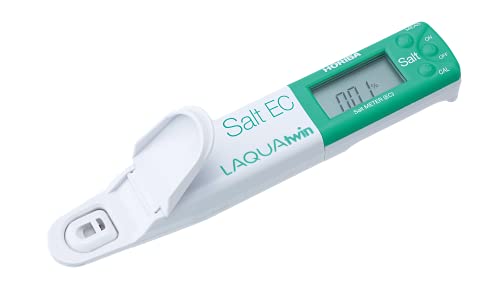
2. HORIBA LAQUAtwin Salt-11 Compact Salt Meter
Best for: Chefs, food labs and serious fermenters who want to calibrate the meter themselves against salt standards.
HORIBA is a large Japanese instrument maker, and LAQUAtwin is its line of pocket meters. Similarly, the Salt-11 is a conductivity salt meter with a flat sensor. So you place a few drops on it, close the cover and read. Also, HORIBA lists a minimum sample of just 0.12 mL, and the range runs 0.00 to 10.00% in 0.01% steps.
Next, the key difference from the PAL-SALT is calibration. The Salt-11 takes up to two points and recognizes 0.50% and 5.00% NaCl standards on its own. As a result, you can check it against known solutions before a batch. Note that HORIBA now lists this model as the 4ECSalt-11 on its LAQUAtwin Salt-11 spec page.
- Range: 0.00 to 10.00% (0.0 to 100.0 g/L) in 0.01% steps
- Rated accuracy: +/-2% of full scale (0 to 9.9 g/L), +/-4% (10 to 100 g/L)
- Minimum sample: 0.12 mL; ATC fixed at 2% per C
- Calibration: up to 2 points (0.50% and 5.00% NaCl)
- IP67; two CR2032 cells
Pros
- User calibration with real standards
- Works with a few drops
- Also IP67 dust and water rated
Cons
- Accuracy is stated as % of full scale
- Batteries are not in the box
- Hot samples must cool to 40 C first
Skip it if: You want to test hot soup straight from the pot, since HORIBA lists a 5 to 40 C (41 to 104 F) adjustment range.
Best Bench Meter
3. ATAGO ES-421 Digital Salt Meter (Cat. 4211)
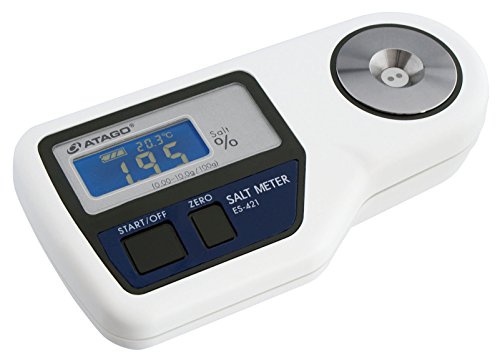
Best for: Food plants, commissaries and caterers who test many batches a day at one station.
The ES-421 is the desktop sibling of the PAL-SALT. It uses the same conductivity method, the same 0.00 to 10.0% range and the same 0.01% steps below 3%. For example, ATAGO rates it at +/-0.05% below 1% salt, and within 5% of the reading from 1% to 10%.
However, the body is built for a counter, not a pocket. For instance, it is 170 x 90 x 40 mm (about 6.7 x 3.5 x 1.6 in) and weighs 220 g. Meanwhile, it runs on a 9 V battery and carries an IP64 rating. So it suits a QA bench where several staff share one meter.
- Range: 0.00 to 10.0% salt
- Resolution: 0.01% (0 to 2.99%), 0.1% (3.0 to 10.0%)
- Sample temperature: 5 to 100 C, with ATC
- Reading time: about 3 seconds
- IP64; 9 V (006P) battery; 220 g
Pros
- Stable desktop body for shared use
- Same rated accuracy as PAL-SALT
- Also takes hot samples
Cons
- Highest cost in this guide
- Not a pocket tool
- Same 10% ceiling as PAL-SALT
Skip it if: You test one pot of soup a day, because the pocket PAL-SALT gives the same readings in a smaller body.
Best Budget Digital
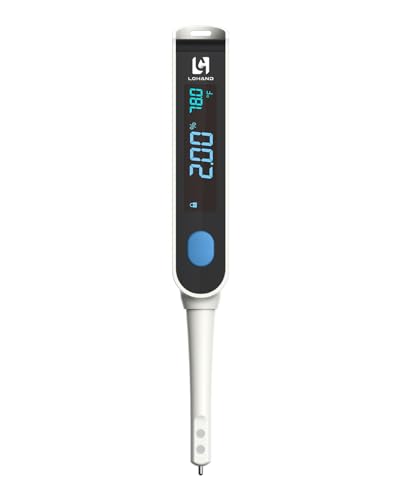
4. LOHAND Digital Salinity Meter (0-10%)
Best for: Home cooks who want a digital salt % reading for soup, broth and brine without paying lab prices.
LOHAND sells lab and field meters under its own brand. Its digital salinity meter is aimed at kitchens: the listing names salty food, liquid food, soup and brine. Also, it lists a range of 0 to 10% (0 to 100 ppt) and a platinum electrode in a concave cell.
The concave cell matters, because it holds a small pool of liquid over the sensor. As a result, you need only a spoon of broth, not a cup. However, LOHAND does not publish an accuracy figure in the listing, so treat its last digit as a guide. Then check it now and then against a salt solution you weigh yourself.
- Listed range: 0 to 10% (0 to 100 ppt)
- Sensor: platinum electrode in a concave cell
- Method: conductivity (electrode type)
- Listed uses: soup, liquid food and brine
Pros
- Digital % reading at a low cost
- Small sample in the concave cell
- Also reads ppt for brine work
Cons
- No accuracy figure in the listing
- Few published specs beyond the range
- No published IP rating
Skip it if: You need a documented accuracy for a food business, since the ATAGO and HORIBA meters publish one.
Best for Brines
5. LOHAND Digital Salinity Refractometer (0-28%)
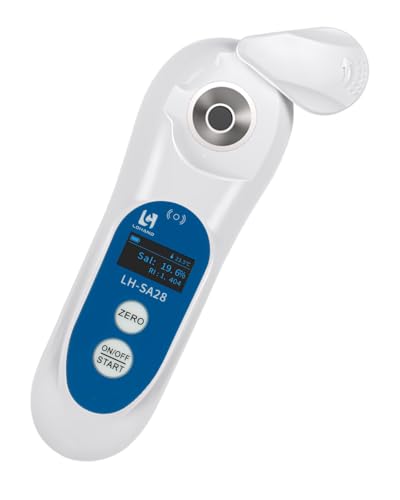
Best for: Picklers, curers and olive makers who mix brines stronger than a conductivity meter can read.
First, a conductivity pen stops at 10%. Yet a pickle or cure brine can run well past that. So this LOHAND digital refractometer lists a 0 to 28% range with automatic temperature compensation (ATC). In other words, it covers everything from a light 2% ferment to a near-saturated cure.
In fact, a refractometer reads how much a liquid bends light, not how well it conducts. Therefore it works best on clear brine of salt and water. In contrast, sugar, vinegar and dissolved solids from food also bend light. So once a brine has pulled juice out of vegetables, read it as a guide.
- Listed range: 0 to 28% salt
- Method: digital refractometer (light-based)
- Temperature: automatic temperature compensation (ATC)
- Best sample: clear salt-and-water brine
Pros
- Covers strong brines up to 28%
- Digital display, no scale to read
- Also unaffected by other ions
Cons
- Sugar and solids inflate the reading
- Less useful for soup than a conductivity meter
- No accuracy figure in the listing
Skip it if: You mainly test soup and broth, because a conductivity meter like the PAL-SALT is the better match.
Best Brix + Salt
6. YINMIK Smart Refractometer (Brix and Salt)
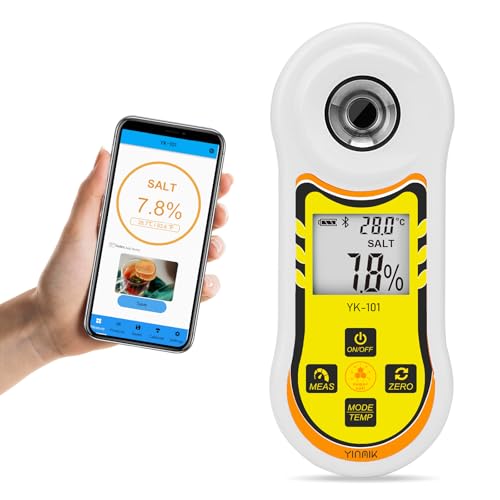
Best for: Cooks and small producers who also track sugar, such as in teriyaki, dressings or fruit brines.
YINMIK sells a wide range of water and food meters. This digital refractometer lists both a Brix (sugar) scale and a salt scale, with ATC. So one tool can tell you how sweet a sauce is and roughly how salty a plain brine is.
However, keep the physics in mind. After all, a refractometer cannot tell sugar from salt. Therefore the salt scale is only meaningful on a sample that is mostly salt and water. For a sweet sauce, use the Brix reading and pair it with a conductivity meter for salt.
- Listed scales: Brix (sugar) and salt
- Method: digital refractometer
- Temperature: automatic temperature compensation (ATC)
- Best samples: clear juices, syrups and simple brines
Pros
- Two scales in one tool
- Also handy for fruit and syrup Brix
- Digital reading, no eyepiece
Cons
- Salt scale fails on sweet samples
- Ranges are not given in the listing title
- Not a soup tool
Skip it if: You only care about salt in soup, since a conductivity meter reads that directly.
Best Low-Cost Brine Check
7. V-RESOURCING Sodium Chloride Refractometer (0-28%)
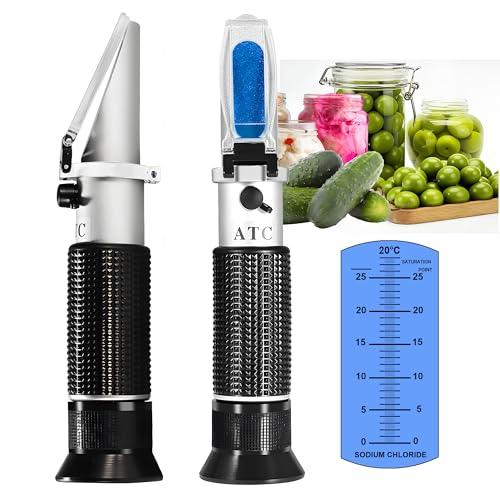
Best for: Home picklers who make a few brines a year and want a cheap way to confirm the mix.
Finally, this sodium chloride refractometer is the low-cost way into brine checking. The listing gives a 0 to 28% range and names food salt testing for pickles. In short, it is the same light-based idea as the LOHAND above, at a much lower cost.
For example, it is useful when you scale a family pickle recipe and want to confirm the brine before the jars go in. Still, the same limit applies: it reads clear salt water well and food-laden brine poorly. So weigh your salt first and use the refractometer as a check, not the recipe.
- Listed range: 0 to 28% sodium chloride
- Method: refractometer (light-based)
- Listed use: food salinity, including pickles
- Best sample: fresh, clear brine
Pros
- Lowest cost in this guide
- Covers full-strength brines
- Also simple to use for a quick check
Cons
- Basic build and fit
- No published accuracy figure
- Useless for soups and sauces
Skip it if: You want a reading of soup or ramen broth, because none of the refractometers here are made for that.
How We Chose the Best Digital Salt Tester Picks
To be clear, we did not test these meters by hand. Instead, our picks are research-based. First, we read maker spec pages and manuals for range, resolution, rated accuracy, sample size, temperature compensation and water resistance. Next, we weighed owner feedback on how well each meter holds its reading over time. Finally, we used the ATAGO salt measurement guide (PDF) to check how conductivity and refractive methods behave in real food.
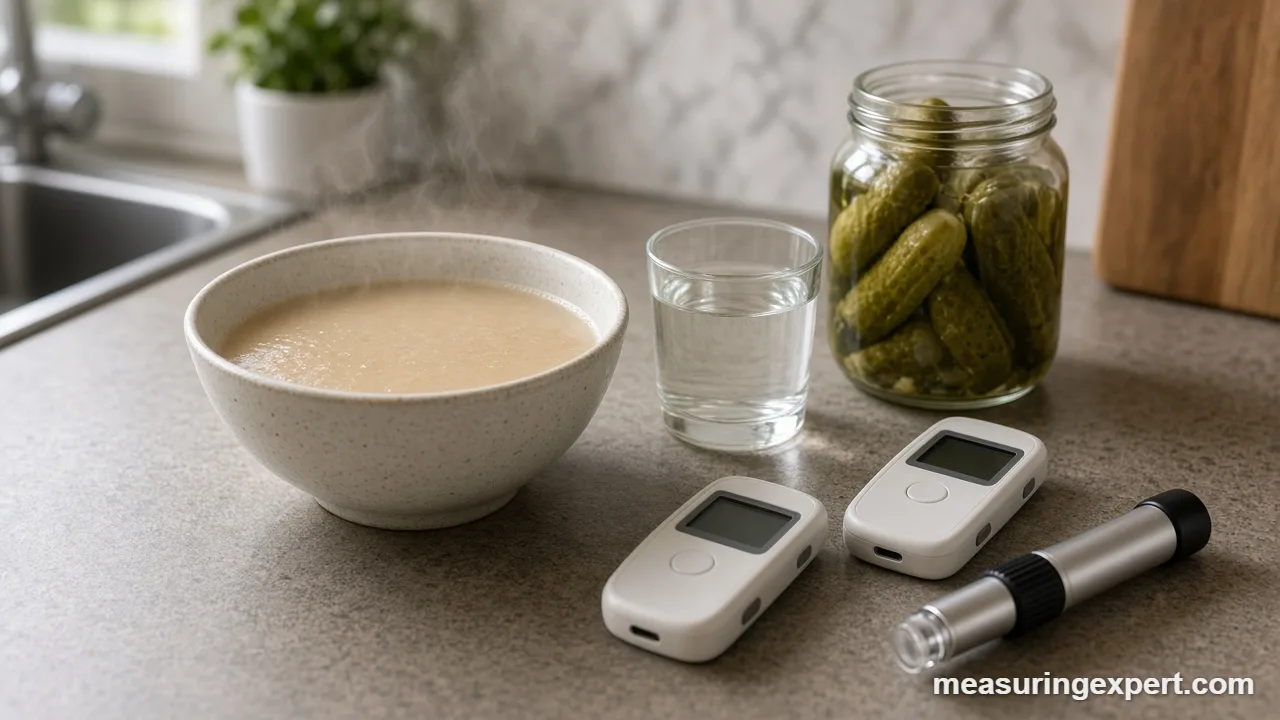
We also kept to food salt meters only. So pool, pond and aquarium testers are left out, because they read in ppm for water and are covered in our best salinity tester guide. In addition, we allowed at most two products per brand and skipped listings with no brand behind them.
In scoring, a published accuracy figure counted most. Then came a range that fits food, the smallest step near 1%, and ATC for hot samples.
Percent Salt, ppm and Conductivity Explained
Salt meters show the same thing in different units, so it helps to know how they connect. First, food meters show percent salt by weight, which means grams of salt per 100 grams of sample. For example, a broth at 1.2% holds 1.2 g of salt in every 100 g.
Water testers, on the other hand, often show ppm (parts per million) or ppt (parts per thousand). The math is simple: 1% equals 10 ppt, and 1% equals 10,000 ppm. So a 1.2% soup is 12 ppt or 12,000 ppm. That is why a pool meter that tops out at a few thousand ppm cannot read soup at all.
| Percent salt | ppt (g/kg) | ppm (mg/kg) | Typical example |
|---|---|---|---|
| 0.3% | 3 | 3,000 | Light stock |
| 0.7% | 7 | 7,000 | Mild miso soup |
| 1.3% | 13 | 13,000 | Ramen soup |
| 3.5% | 35 | 35,000 | About as salty as seawater |
| 10% | 100 | 100,000 | Top of a pocket conductivity meter |
Conductivity, however, is different again. This is because dissolved salt splits into sodium and chloride ions, and those ions carry current. Therefore a conductivity meter measures current between two electrodes, corrects for temperature, and converts the result into percent salt with a sodium chloride curve. In short, the meter infers salt; it does not count it directly.
Conductivity Meter or Refractometer: Which Best Digital Salt Tester Type?
Overall, two methods dominate food salt testing. Each one has a sweet spot, and each one has a blind spot.
| Method | What it senses | Typical range | Best for | Blind spot |
|---|---|---|---|---|
| Conductivity meter | Ions that carry current | 0 to 10% | Soup, broth, sauce, light brine | Other salts and acids also conduct |
| Refractometer | How much the liquid bends light | 0 to 28% | Clear salt-and-water brine | Sugar and food solids also bend light |
| Ion selective electrode | Sodium or chloride ions | Up to about 25% | Lab and QA work | Needs regular calibration |
So for soup, ramen broth and sauces, choose conductivity. For strong pickle or cure brines, choose a refractometer. If you already own one for sugar, our refractometer guide explains how the Brix scale works.
Typical Salt Levels a Digital Salt Tester Will Show
Of course, a number only helps if you know what normal looks like. For example, ATAGO’s salt guide lists these sample values. However, treat them as reference points for seasoning, not as targets to hit.
- Kelp stock: about 0.25%
- Bonito stock: about 0.3%
- Miso soup, mild: about 0.7%
- Miso soup, robust: about 1.2%
- Ramen soup: about 1.3 to 1.4%
Above all, the real value of a meter is consistency. For instance, once a cook finds the level they like, the meter makes every batch match it. Also, cooled food tastes saltier than hot food, so a reading is a steadier guide than a spoon. For sodium in your diet, the FDA sodium page lists a Daily Value of less than 2,300 mg; we do not give diet advice here.
How to Test Soup and Brine with a Digital Salt Tester
In general, these steps suit any conductivity meter in this guide. For a refractometer, the same ideas apply, but you only test clear brine.
- Rinse the sensor with clean water and blot it dry, so leftover salt does not raise the reading.
- Stir the pot well, because salt and solids are not always evenly mixed.
- Take liquid from below any oil layer, since oil does not conduct and can coat the sensor.
- For thick sauces or miso, mix 10 g of sample with 90 g of water, then multiply the reading by 10.
- Place enough sample to cover the sensor, then wait for the reading to settle.
- Write down the reading and the temperature, then rinse the sensor again.
Also, use distilled water for dilution and rinsing when you can. According to ATAGO, tap water alone can shift a reading by about 0.01%, and mineral water is not recommended.
Brine Math: From Percent to Grams
In other words, a meter checks a brine, but a scale builds it. So weigh your salt on a kitchen scale first, then confirm with the meter. Also, two methods are common, and they give slightly different results.
- Percent of water weight: salt = water weight x percent. For example, a 2% brine with 1,000 g (about 1 quart plus 2 oz) of water needs 20 g of salt.
- Percent of total weight: salt = total weight x percent. This method is common for vegetable ferments, where you weigh the vegetables and water together.
Therefore, write down which method a recipe uses to avoid confusion. Our guide to measuring ingredients for fermentation covers the weighing side in more detail.
One more useful number: table salt is about 39% sodium by weight, based on the atomic weights of sodium and chlorine. So 1 g of salt holds about 393 mg of sodium.
Calibration and Care for the Best Digital Salt Tester
First, check the meter on a known solution. You can buy salt standards, or you can make one: dissolve 5.0 g of pure salt in 95.0 g of distilled water for a 5.0% solution. Then compare the reading with that value.
Next, keep the sensor clean. For example, protein and fat from soup leave a film, and that film slows the reading. So rinse after every test and wipe gently with a soft cloth. In addition, store the meter dry and with its cover on.
Finally, watch the battery. That is because a weak battery can cause drifting numbers before the low-battery icon appears. For meters with replaceable sensors, plan on a new sensor once calibration no longer holds.
Do and Do Not with a Salt Meter
Honest Limits of Any Salt Meter
To begin with, no meter in this guide measures sodium alone. A conductivity meter also responds to potassium salts, acids and other minerals. As a result, soy sauce, tomato sauce and pickles with vinegar can read higher than their true salt content. For this reason, ATAGO suggests building a correlation chart or using an offset for mixed foods.
Similarly, a refractometer reads every dissolved solid. So a brine that has pulled sugar from cucumbers will read saltier than it is. Also, solid foods need a probe or a diluted sample, and even then the reading is a reference only. In short, a salt meter is a consistency tool, and a lab titration is still the reference method.
Best Digital Salt Tester FAQ
What is the best digital salt tester for soup?
For soup, ramen broth and sauce, the best digital salt tester is a conductivity meter such as the ATAGO PAL-SALT. It reads 0.00 to 10.0% salt, steps in 0.01% below 3%, and corrects hot samples to 20 C.
How does a digital salt tester work?
Most food salt meters use conductivity. Dissolved salt splits into ions that carry current, so the meter measures that current, corrects for temperature, and converts it to percent salt with a sodium chloride curve.
What is the difference between percent salt and ppm?
Both describe concentration. Percent salt is grams per 100 g of sample, while ppm is parts per million. So 1% equals 10,000 ppm, and a 1.3% ramen soup equals 13,000 ppm.
Can I use a pool salt tester on food?
No. That is because pool testers are built for water at a few thousand ppm, which is well below the 0.5 to 2% of most soups. Also, food testers are made to be rinsed and used with hot samples.
Is a refractometer or a conductivity meter better for brine?
For clear salt-and-water brine, a refractometer is better, because it reads up to about 28%. For soup or brine with food in it, a conductivity meter is usually the better choice.
Why does my salt meter read soy sauce too high?
That is because soy sauce holds other salts, acids and amino acids that also conduct current. As a result, a conductivity meter reads it higher than its true sodium chloride level. Dilute it 1 to 10 and treat the result as a guide.
How do I calibrate a salt meter at home?
Dissolve 5.0 g of pure salt in 95.0 g of distilled water to make a 5.0% solution. Then test it and compare the reading. Meters with user calibration, such as the HORIBA Salt-11, can then be adjusted.
Can a digital salt tester measure hot soup?
Some can. ATAGO lists a sample range of 5 to 100 C for the PAL-SALT and ES-421, with temperature compensation. Others, such as the HORIBA Salt-11, list 5 to 40 C, so let the sample cool first.
Does a salt tester measure sodium?
Not directly. Instead, it measures salt as sodium chloride. Table salt is about 39% sodium by weight, so 1 g of salt holds about 393 mg of sodium.
Which best digital salt tester suits pickles and cures?
For strong pickle and cure brines, a 0-28% refractometer such as the LOHAND digital model is the best digital salt tester. However, read it on fresh brine, since sugar from vegetables raises the result.
Bottom Line: Which Best Digital Salt Tester to Buy
For most cooks, the ATAGO PAL-SALT Pocket Salt Meter (Cat. 4250) is the best digital salt tester. After all, it reads hot soup in seconds, steps in 0.01% where seasoning lives, and rinses clean. However, choose the HORIBA Salt-11 if you want to calibrate, the LOHAND meter on a budget, or a 0-28% refractometer for strong brines.
1 thought on “Best Digital Salt Tester for Food: 7 Salt Meters for Soup, Brine and Pickles”