

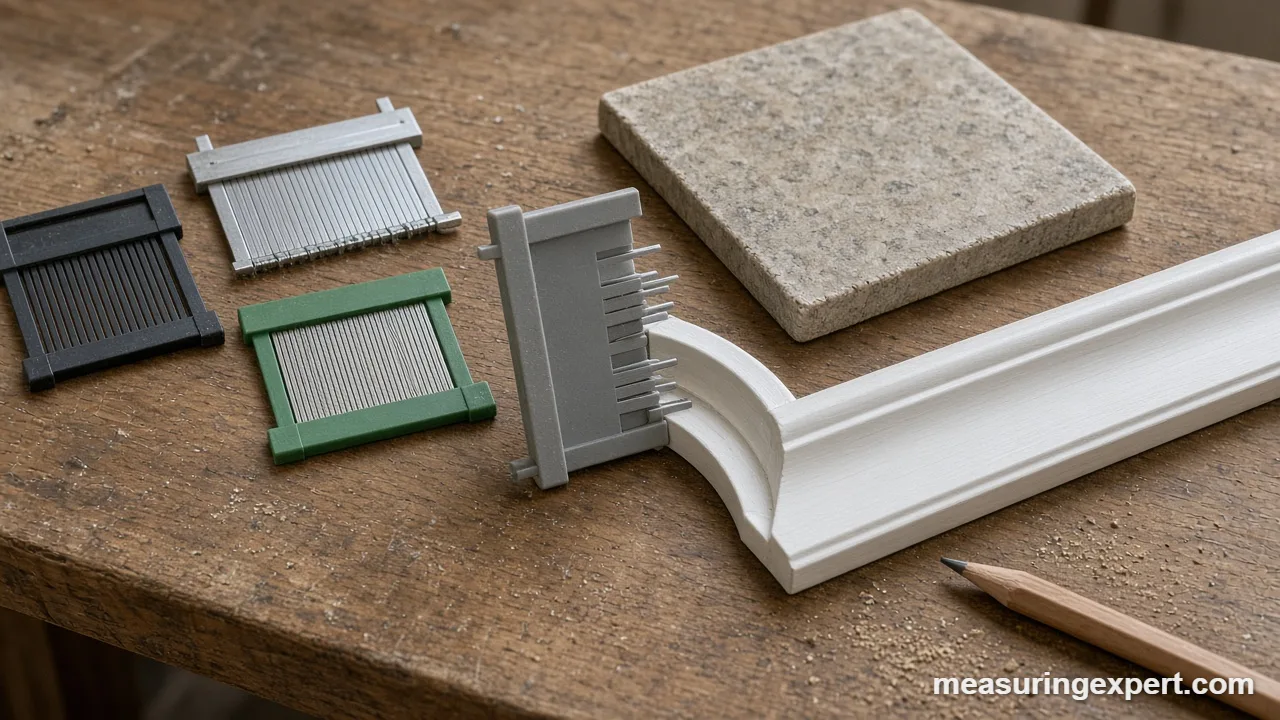
The best contour duplicator for most people is the Saker 10 in + 5 in locking set, because the long gauge copies casings and baseboards while the short one fits pipes and tight corners. However, pin material, body width, pin depth and a good lock decide which profile gauge suits your tile, flooring or trim job.
In short: pick the Saker set for everyday trim and flooring, the Zozen pair on a tight budget, and the FIRSTINFO 20 in gauge for wide jambs on pro jobs.
As an Amazon Associate, Measuring Expert earns from qualifying purchases. Our picks are based on research, specifications and owner feedback, not paid placement.
Best Overall

Best Budget


Best Contour Duplicator Picks at a Glance
- Everyday trim and flooring: Saker 10 in + 5 in set with an adjustable lock.
- Lowest outlay for two sizes: Zozen 10 in + 6 in pair with an engraved scale.
- Wide jambs in one pass: FIRSTINFO 20 in gauge with a metal lock and magnet.
- Split or join as needed: WORKPRO connectable 10 in + 10 in set.
- Tile cutouts and casings: JOREST connectable 10 in + 5 in set with lock.
- One simple tool: RAK 10 in gauge with lock.
- Fine molding detail: look for thin steel pins rather than plastic leaves.
On This Page
- Comparison table
- The 7 picks, reviewed
- How we chose
- Plastic vs metal pins
- Width, depth and locks explained
- Inch and mm converter
- How to copy a profile
- Care and common mistakes
- Honest limits
- FAQ
- Bottom line
Profile Gauges Side by Side
First, match the length to your widest profile. Next, check whether you need a lock or a connector. Then jump to the full review below.
| # | Product | Best For | Standout Feature | Amazon |
|---|---|---|---|---|
| 1 | Saker Contour Gauge with Lock, 10 in + 5 in | Overall | Two sizes with an adjustable lock | View |
| 2 | Zozen 2-Pack Contour Gauge, 10 in + 6 in | Budget | Engraved scale that should not fade | View |
| 3 | FIRSTINFO 20 in Contour Gauge with Metal Lock and Magnet | Pro | 20 in body with a metal lock and attached magnet | View |
| 4 | WORKPRO Connectable Contour Gauge, 10 in + 10 in | Connectable | Two 10 in bodies that join end to end | View |
| 5 | JOREST Connectable Contour Gauge with Lock, 10 in + 5 in | Tile | Connectable 10 in + 5 in set with lock | View |
| 6 | RAK Contour Gauge with Lock, 10 in | Single Gauge | Single 10 in body with lock | View |
| 7 | The Super Gauge Contour Gauge with Lock, 10 in + 5 in | Starter Set | Locking 10 in and 5 in pair | View |
The 7 Best Contour Duplicator Tools, Reviewed
We start with the all-round pick, then cover budget, pro and connectable options. Also, every size below comes from the product listing, and we added metric values in brackets. We do not list specs we could not confirm.
Best Overall
1. Saker Contour Gauge with Lock, 10 in + 5 in
Best for: Most DIYers who copy door casings, pipes and baseboard returns, and want a long gauge plus a short one for tight spots.
The Saker set is our pick as the best contour duplicator for most homes. First, you get two gauges: a 10 in (254 mm) body for wide trim and a 5 in (127 mm) body for corners, toilet flanges and pipe collars. As a result, you rarely have to stitch two readings together. In addition, both gauges have an adjustable lock, so the copied shape stays put while you carry it from the door frame to the saw.
Saker sells this set through Amazon, and the listing focuses on tile, flooring and woodworking. Like most gauges in this class, it is built for trim and flooring rather than fine carving. However, if you copy tiny beads on old molding, a thin steel-pin gauge shows more detail. For most vinyl plank and tile cuts around a casing, that difference does not matter.
- Lengths: 10 in (254 mm) and 5 in (127 mm)
- Lock: adjustable lock on the body
- Use cases named by the seller: tile, flooring, woodworking
Pros
- Two lengths cover wide casings and tight corners
- Lock holds the profile during transfer
- Short gauge fits behind toilets and radiators
Cons
- Not the finest choice for tiny molding detail
- Two loose pieces to keep track of
Skip it if: You trace intricate antique molding, where thin steel pins copy small beads more cleanly.
Best Budget
2. Zozen 2-Pack Contour Gauge, 10 in + 6 in
Best for: Occasional users who want two sizes and a scale that stays readable.
The Zozen pair is the low-cost way into profile copying. You get a 10 in (254 mm) gauge and a 6 in (152.4 mm) gauge. Also, the scale on the body is engraved rather than printed, so the inch and metric marks should survive years in a tool bag. That matters because the scale is what turns a copied shape into a number you can write down.
For example, you can press the 6 in gauge against a stair nosing, read the overhang off the scale, and then mark the same depth on a tread. However, the Zozen listing does not mention a lock. Therefore, you need to handle the gauge gently between the work and the board, or trace the shape right away.
- Lengths: 10 in (254 mm) and 6 in (152.4 mm)
- Scale: engraved, per the listing title
- No lock named in the listing
Pros
- Two useful lengths for a low outlay
- Engraved scale resists wear
- Light enough for a pocket or apron
Cons
- No lock, so the shape can shift if bumped
- Leaves can bend if you force the gauge
Skip it if: You copy shapes and carry them across a room; a locking gauge is safer for that.
Best Pro
3. FIRSTINFO 20 in Contour Gauge with Metal Lock and Magnet
Best for: Flooring installers and remodelers who copy wide door jambs, stair skirts and cabinet bases in one pass.
FIRSTINFO is a Taiwanese tool maker, and this gauge is the widest single body in our list at 20 in (508 mm). Because of that width, you can copy a full door casing plus the jamb in one press. Also, the listing describes a metal lock and an attached magnet. As a result, you can park the gauge on a steel stud, saw table or toolbox lid while you mark the cut.
Still, the long body brings one trade-off. It needs a flat, open surface to press against, so it is awkward under a toe kick or inside a vanity. In short, buy it for wide, open profiles, and pair it with a short gauge for tight corners.
- Length: 20 in (508 mm)
- Lock: metal lock
- Extra: attached magnet for parking on steel
- Made in Taiwan, per the listing
Pros
- Copies wide casings and jambs in a single pass
- Metal lock suits rough jobsite use
- Magnet keeps it handy on steel surfaces
Cons
- Too long for tight spaces
- Heavier and bulkier than 10 in gauges
Skip it if: You mostly work around pipes, toilet flanges or small trim returns.
Best Connectable
4. WORKPRO Connectable Contour Gauge, 10 in + 10 in

Best for: Users who sometimes need 20 in of width but prefer to carry two 10 in pieces.
WORKPRO is a hand tool brand with a broad range of DIY kits. This set gives you two 10 in (254 mm) gauges that connect into one long body. So, on most jobs you use one 10 in piece, and on a wide jamb you join them for about 20 in (508 mm) of coverage.
Next, keep the joint in mind. Any connectable gauge has a seam, and the seam can add a small step in the copied line if the two halves are not snug. Therefore, check the joint before each wide copy and trace both halves in one pencil stroke.
- Lengths: two 10 in (254 mm) bodies
- Connected length: about 20 in (508 mm)
- Brand: WORKPRO
Pros
- Two gauges in one kit
- Joins for wide profiles, splits for tight spots
- Each half works alone as a 10 in gauge
Cons
- Seam can add a small step if loose
- Two pieces to store and keep together
Skip it if: You want one rigid wide body; the FIRSTINFO 20 in has no seam.
Best for Tile
5. JOREST Connectable Contour Gauge with Lock, 10 in + 5 in

Best for: Tile and flooring work where you need to scribe around casings and then switch to small pipe cutouts.
JOREST pairs a 10 in (254 mm) gauge with a 5 in (127 mm) gauge, and the two pieces connect into a 15 in (381 mm) body. In addition, the listing names a lock. For tile setters, that mix is handy: the short piece reads a pipe stub, while the joined gauge reads a wide door casing.
Also, the seller names scribing edges and template making as uses. For example, you can lock the profile, trace it onto card stock, and test the template against the casing before you cut porcelain. As a result, you waste fewer expensive tiles.
- Lengths: 10 in (254 mm) + 5 in (127 mm)
- Connected length: 15 in (381 mm)
- Lock: yes, per the listing
- Uses named by the seller: tile flooring, scribing edges, templates
Pros
- Short and long gauges in one kit
- Lock plus connection in the same set
- Good fit for tile and LVP work
Cons
- Connection seam needs a snug fit
- Not built for very fine molding detail
Skip it if: You only ever copy wide profiles; a single long body is simpler.
Best Single Gauge
6. RAK Contour Gauge with Lock, 10 in

Best for: Anyone who wants one 10 in gauge with a lock and no extra pieces.
To begin with, RAK keeps it simple: one 10 in (254 mm) gauge with a lock. For many homeowners, then, one gauge of that size is enough. After all, it covers most baseboard profiles, standard door casings and floor transition cuts. Also, the lock lets you copy, carry and trace without the leaves sliding back.
However, a single 10 in gauge cannot reach into a tight inside corner as easily as a 5 in one. So, if you plan to cut flooring around a toilet flange or radiator pipe, a two-piece set is more flexible.
- Length: 10 in (254 mm)
- Lock: yes
- Uses named by the seller: flooring, tile, woodwork, construction
Pros
- Simple one-piece design
- Lock holds the shape
- Good length for baseboard and casing
Cons
- No short gauge for tight spots
- No connection for wide profiles
Skip it if: You need to copy profiles wider than 10 in, or work in cramped corners often.
Best Starter Set
7. The Super Gauge Contour Gauge with Lock, 10 in + 5 in

Best for: First-time buyers who want a locking pair without a connector.
The Super Gauge set includes a 10 in (254 mm) and a 5 in (127 mm) gauge, and the listing title names a lock. In fact, that is the same useful size pair as the Saker set. So, choose between them on availability and on how the lock feels to you.
Next, think about where you will use it. The 5 in gauge reaches behind a toilet or along a short return, while the 10 in body covers a standard casing. Therefore, the pair handles most room-by-room flooring jobs.
- Lengths: 10 in (254 mm) and 5 in (127 mm)
- Lock: yes, per the listing title
- No connector between the two gauges
Pros
- Two practical sizes
- Locking design
- Easy for a beginner to learn
Cons
- Gauges do not connect
- Very similar to other 10 in + 5 in sets
Skip it if: You already own a 10 in gauge; a single 5 in gauge would fill the gap for less.
How We Chose the Best Contour Duplicator Picks
To be clear, we did not test these gauges by hand. Instead, we compared product listings, maker pages and owner feedback, and we focused on the details that change how well a gauge copies a shape. Here is what we weighed:
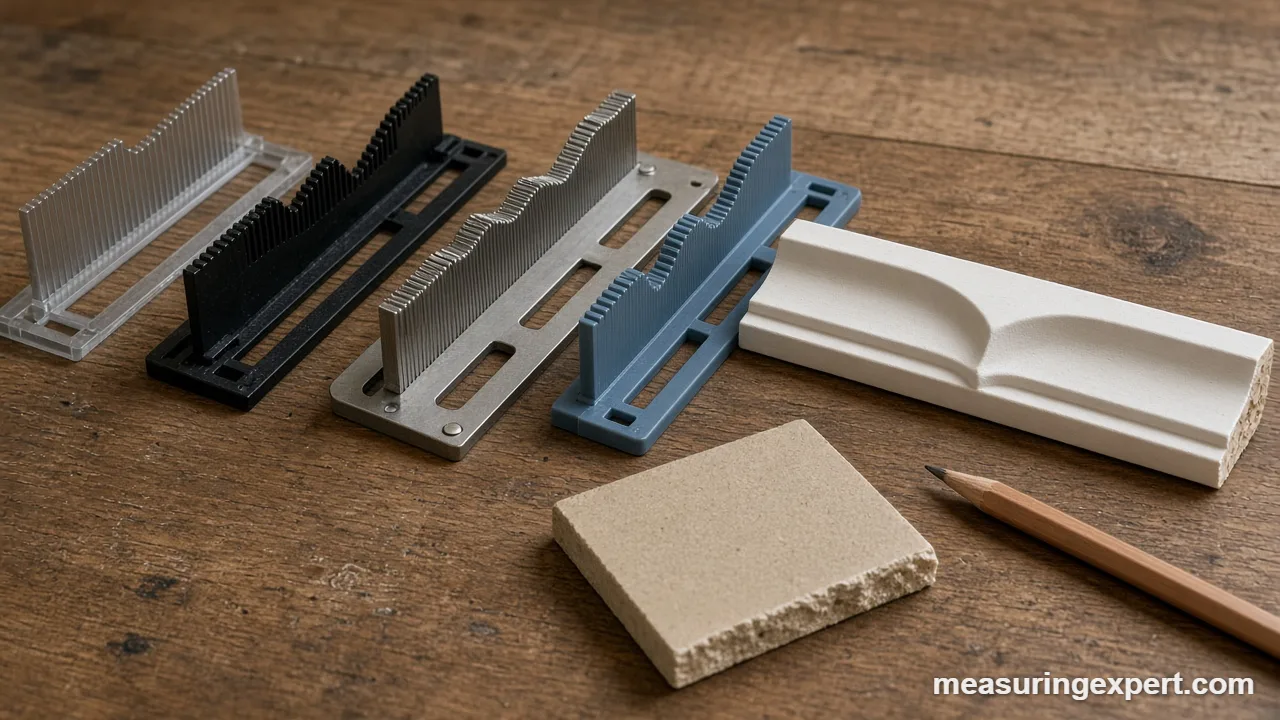
- Usable length: a gauge must span the profile you copy, so we covered 5, 6, 10 and 20 in bodies.
- Locking: a lock keeps the copied shape intact between the work and the board.
- Connectable bodies: joining two gauges adds width without buying a long tool.
- Scale quality: engraved or molded scales last longer than printed ones.
- Brand and listing quality: we skipped unbranded listings and items that did not match the category.
We also removed a listing from the older version of this page because its link pointed to a garden tool, not a gauge. For background on the steel-pin style, we read the General Tools 837 contour gauge page. For unit math, we used the exact inch definition (1 in = 25.4 mm) from NIST.
Plastic vs Metal Pins: Which Copies Better?
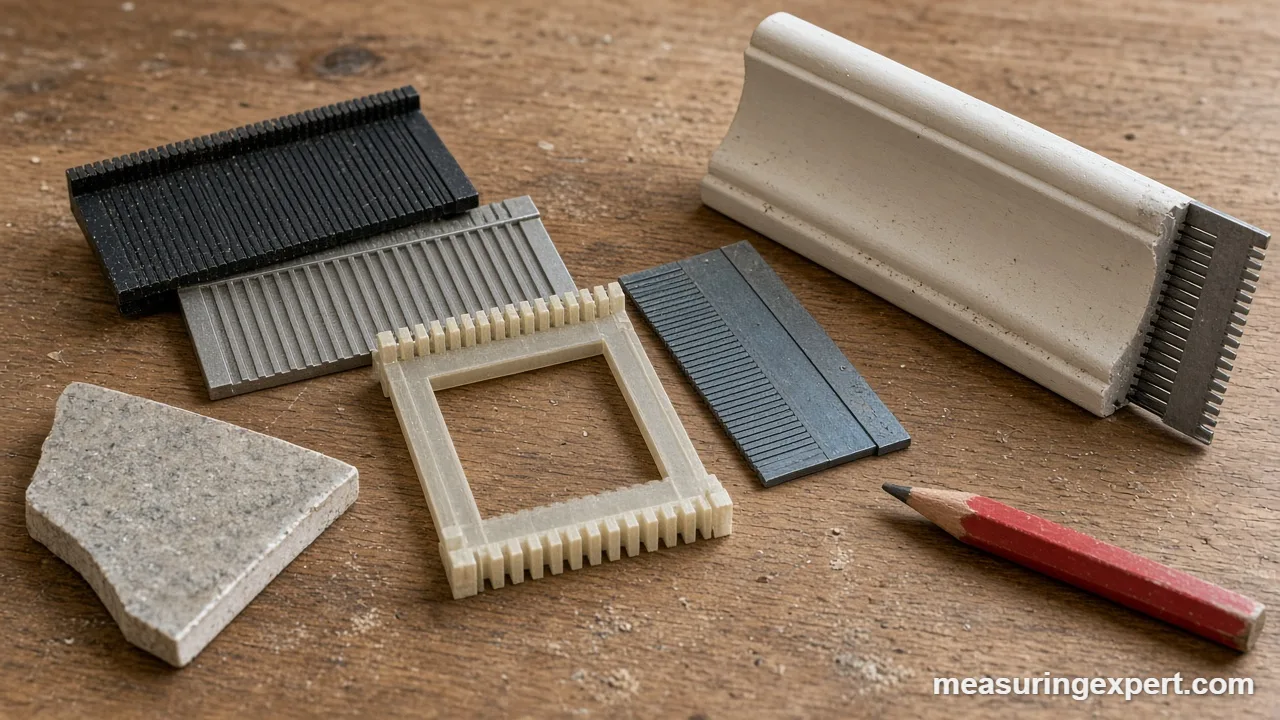
First of all, every contour gauge works the same way. Specifically, a row of thin pins or leaves slides through a friction strip. When you press the row against a shape, each pin stops where it touches, so the tips form a copy of the profile. As a result, pin width sets the finest detail the gauge can show.
| Feature | Plastic leaves | Steel pins |
|---|---|---|
| Detail | Good for trim, tile and flooring | Finer, better for small beads and coves |
| Weight | Light | Heavier |
| Durability | Leaves can bend if forced | Rust-resistant stainless resists bending |
| Typical use | Room-by-room DIY flooring | Fine woodworking, molding repair |
For example, General Tools lists its 6 in stainless steel gauge at 35 leaves per inch. That works out to a pin pitch of about 0.029 in (0.73 mm). Plastic leaves are usually thicker, so they round off small details a little more. However, for cutting vinyl plank around a door casing, plastic copies are close enough, and they are lighter in a tool belt.
Width, Pin Depth and Locks Explained
Four numbers and features decide how useful a profile gauge is. Also, each one ties back to a basic linear measurement, so it helps to think in inches and millimeters.
Body length. The body length is the widest shape you can copy in one press. A 5 in (127 mm) gauge fits pipes and tight corners. Next, a 10 in (254 mm) gauge covers most baseboards and casings. Finally, a 20 in (508 mm) body handles wide jambs and stair skirts.
Pin depth. In other words, pin depth is how far the pins can travel. If a shape is deeper than the pin travel, the gauge bottoms out and the copy is wrong. For example, General Tools lists 3-1/2 in (88.9 mm) of depth on its 6 in steel gauge. So, for a deep crown molding, take two readings or make a card template.
Locking. Specifically, a lock clamps the pins after you copy the shape. Without one, a bump can shift the pins on the way to the saw. Therefore, a lock matters most when the work and the cutting table are far apart.
Scale and connectors. A scale on the body lets you read widths and offsets. In addition, connectable gauges join end to end, so two 10 in bodies can act as one 20 in gauge. However, check the seam each time, because a loose joint adds a small step to the copy.
Gauge Length Converter: Inches to mm
Most gauges list their size in inches, while metric tile and flooring specs use millimeters. So, use this converter to check whether a gauge spans your profile. Type the length in inches, and it shows mm, cm and feet.
For example, a 600 mm wide stair skirt is about 23.6 in, so even a 20 in gauge needs two readings. Also, if you need the floor area for a room, see our guide to the area of a shape.
How to Copy a Profile With a Contour Gauge
These steps work for any of the gauges above. Also, practice once on scrap before you cut good tile or flooring.
- Clean the surface, so dust or caulk does not push the pins out of place.
- Push all pins flat against a straight edge, so every pin starts at the same zero line.
- Hold the gauge square to the work and press it straight in until the pins wrap the profile.
- Lock the gauge, or keep it level if it has no lock, and lift it away gently.
- Line up a reference point on the board, then trace along the pin tips with a sharp pencil.
- Read any key widths off the scale and write them down in inches or mm.
- Cut just outside the line, test the fit, and trim until the piece slides into place.
Care and Common Mistakes
A gauge is only as accurate as its pins are straight. So, a little care keeps every copy true.
Next, watch for slipping pins. If pins slide freely, tighten the lock or end screws. Similarly, if a few pins stick out of line, push them back gently instead of bending them.
Honest Limits of the Best Contour Duplicator
Even the best contour duplicator has limits. First, it copies a two-dimensional slice, so it cannot capture a curve that changes along its length. Second, pin width rounds off very small details. Third, the copy is only as good as your pencil line. In short, use the gauge to get close, and then trim to fit.
Also, a contour gauge does not measure angles in degrees. Instead, it shows a shape. For miters, use a protractor or bevel gauge alongside it.
Best Contour Duplicator FAQ
What is the best contour duplicator for most people?
For most homes, the best contour duplicator is a locking 10 in + 5 in set such as the Saker pair. The long gauge covers casings and baseboards, while the short one fits tight corners and pipes.
What is the difference between a contour gauge and a profile gauge?
In fact, there is no real difference. Contour gauge, profile gauge, contour duplicator and shape duplicator all name the same tool: a row of sliding pins or leaves that copy a shape when you press them against it.
Are metal pin contour gauges better than plastic ones?
Metal pins are thinner, so they copy fine detail better. For example, the General Tools 837 lists 35 steel leaves per inch. However, plastic gauges are lighter, cheaper and fine for most tile and flooring cuts.
Does the best contour duplicator need a lock?
A lock is not essential, but it helps a lot. It stops the pins from sliding while you carry the copied shape to your board, so the best contour duplicator for most users includes one.
How deep can a contour gauge copy?
The pin length sets the depth. Many gauges copy a few inches of depth; General Tools lists its 6 in steel gauge at up to 3-1/2 in (88.9 mm). Deeper shapes need two readings or a template.
What size contour gauge should I buy?
A 10 in (254 mm) gauge covers most baseboard and casing work. Also, add a 5 or 6 in gauge for pipes and corners. Choose 20 in or a connectable set for wide jambs and stair skirts.
Can a contour gauge measure angles?
Not directly. It copies a shape, and you can read widths off its scale. However, to get a number in degrees you need a protractor or a digital angle finder.
Why do the pins on my contour gauge keep sliding?
The friction strip has worn, or the lock is loose. First, tighten the lock or end screws. If that fails, store the gauge flat and avoid pressing it so hard that the pins bottom out.
How accurate is a best contour duplicator copy?
Accuracy depends on pin width and your technique. A gauge rounds the shape to its pin spacing, so thin steel pins give a finer copy. In short, trace slowly and test the cut on scrap.
Can I use the best contour duplicator for tile around a toilet flange?
Yes. Press a short gauge against the flange, lock it, and trace the curve onto the tile. Then cut slightly outside the line and fine-tune with nippers or a grinder.
Bottom Line on the Best Contour Duplicator
For most homes, the Saker 10 in + 5 in locking set is the best contour duplicator. The long gauge covers casings and baseboards, while the short one handles pipes and tight corners. However, choose the Zozen pair to save money, or the FIRSTINFO 20 in gauge for wide pro work.