

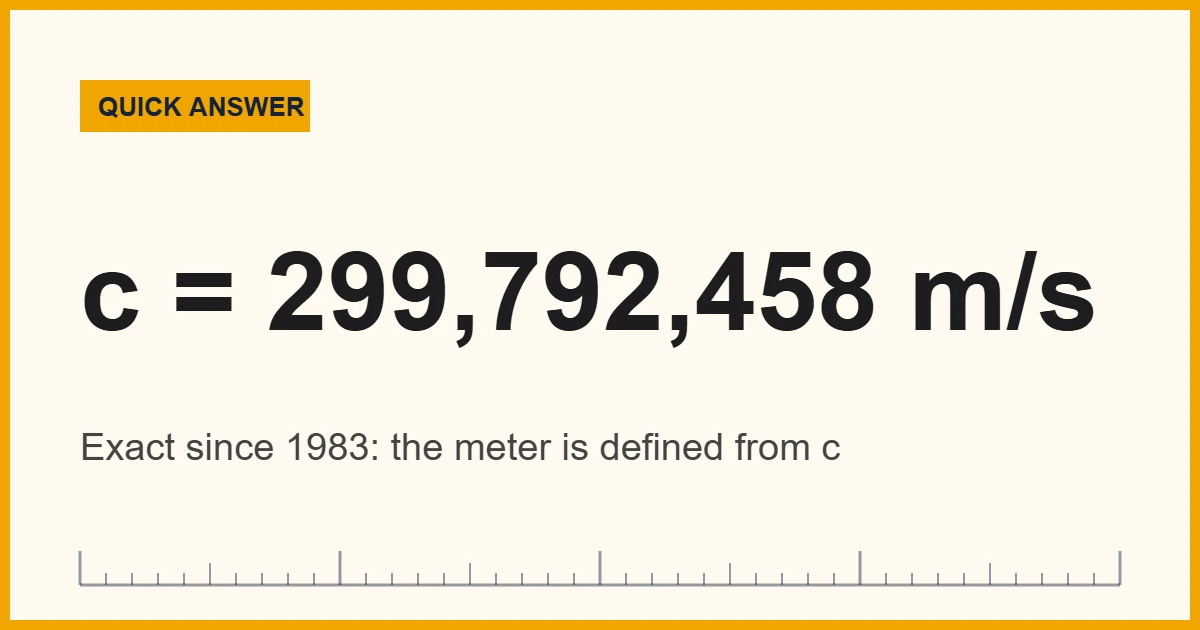
Yes, a speed of light measurement is possible, and astronomers first made one in 1676. Today you can get within a few percent at home with a microwave oven and a chocolate bar. Since 1983, however, light in a vacuum travels at exactly 299,792,458 m/s (about 186,282 miles per second), because the meter is defined from it.
Light is fast, but it is not instant. For example, it needs about 1.28 seconds to reach the Moon and about 8.3 minutes to reach us from the Sun. That delay is what every method on this page exploits: if you can time light over a known distance, or find its frequency and wavelength, you can work out its speed.
So the real question is not whether you can do it, but how well. For example, a classroom microwave test usually lands within 2 to 5 percent of the true value. A professional speed of light measurement in 1972, by contrast, got within about a meter per second. After that, scientists stopped measuring c at all and fixed its value by definition instead.
In short: yes, you can measure the speed of light with simple tools, but the official value is now exact because the meter itself is built on it.
The International Bureau of Weights and Measures (BIPM), which looks after the metric system, lists c as one of the seven defining constants of the SI. In other words, the meter is simply the distance light travels in 1/299,792,458 of a second.
Above all, this guide focuses on methods: how each historic experiment worked, how modern labs used lasers and cavities, and finally how you can repeat the experiment in your own kitchen. For the value itself and what it means for physics, see our main guide to the speed of light.
Convert Your Speed of Light Measurement to Other Units
First, enter a speed in any unit to see it in the others. The box starts with the exact value of c in meters per second, so you can compare your own home result against it right away.
Recommended Tools for Measuring Distance With Light
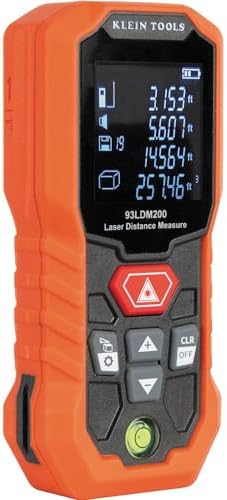
You do not need lab gear to see the speed of light at work. In fact, every laser distance meter does a small speed of light measurement each time you press the button: it times a reflected beam (or compares its phase) and converts that time into distance. Also, a steel ruler or a digital caliper makes the chocolate spacing much easier to read.



As an Amazon Associate, Measuring Expert earns from qualifying purchases.
Key Takeaways
- Ole Romer made the first estimate in 1676 by timing eclipses of Jupiter’s moon Io.
- Fizeau (1849) and Foucault (1862) brought the experiment down to Earth with spinning wheels and mirrors.
- Michelson refined rotating mirrors until 1926 and reached about 299,796 km/s.
- Microwave cavities (1950) cut the error to a few km/s, and stabilized lasers (1972) to about a meter per second.
- Since 1983 the meter is defined from c, so c is exactly 299,792,458 m/s.
- At home, v = 2 x node spacing x frequency gives a result within a few percent.
- Remove the turntable, heat for under half a minute, and never run an empty microwave.
Speed of Light Measurement Before Lasers
For most of history, people assumed light simply arrived everywhere at once. Galileo tried timing lantern signals between hilltops, but human reaction time was far too slow, so he could only conclude that light was very fast. The four experiments below finally put a number on it.
Romer and the Moons of Jupiter (1676)
The Danish astronomer Ole Romer noticed that eclipses of Io, Jupiter’s innermost large moon, ran early when Earth moved toward Jupiter and late when Earth moved away. Therefore, he reasoned that the light simply had farther to travel. From his timings, he estimated that light needs about 22 minutes to cross the diameter of Earth’s orbit.
Romer did not publish a speed himself. However, Christiaan Huygens combined that delay with the best orbit size of the day and got roughly 220,000 km/s, about 27 percent too low. In fact, the real crossing time is closer to 16.6 minutes. Even so, it was the first proof that light has a finite speed.
Fizeau’s Toothed Wheel (1849)
Hippolyte Fizeau then moved the experiment onto the ground near Paris. First, he sent a light beam through the gaps of a spinning wheel with 720 teeth. Next, the beam traveled to a mirror about 8.6 km (5.4 miles) away and came back. At just the right spin rate, the returning light hit a tooth instead of a gap, so the beam disappeared. From the spin rate, the tooth count and the distance, he calculated about 315,000 km/s.
Foucault’s Rotating Mirror (1862)
Next, Leon Foucault replaced the wheel with a fast-spinning mirror. While the light traveled to a distant mirror and back, the spinning mirror turned by a tiny angle, so the returning spot shifted slightly. As a result, he could measure the shift instead of waiting for a beam to vanish. His 1862 value was about 298,000 km/s. In addition, the same setup showed that light moves more slowly in water than in air.
Michelson’s Mountain Baseline (1879 to 1926)
Finally, Albert Michelson spent decades refining the rotating-mirror idea. In 1926 he used an eight-sided spinning mirror and a light path between Mount Wilson and Mount San Antonio in California, about 35 km (22 miles) apart. His result, about 299,796 km/s, was within roughly 4 km/s of today’s value.
Historic Speed of Light Measurement Results
The table shows how each new method shrank the error. Also, the values are rounded and taken from the published results.
| Year | Who | Method | Result | Error vs exact c |
|---|---|---|---|---|
| 1676 | Romer (value by Huygens) | Timing eclipses of Io | about 220,000 km/s | about -27% |
| 1849 | Fizeau | Toothed wheel, 8.6 km path | about 315,000 km/s | about +5% |
| 1862 | Foucault | Rotating mirror | about 298,000 km/s | about -0.6% |
| 1926 | Michelson | Rotating mirror, 35 km path | about 299,796 km/s | about +0.001% |
| 1950 | Essen and Gordon-Smith | Microwave cavity resonator | 299,792.5 km/s | under 0.00002% |
| 1972 | Evenson and team (NBS, now NIST) | Laser frequency x wavelength | 299,792,456.2 m/s | about 2 m/s |
| 1983 | CGPM | Definition of the meter | 299,792,458 m/s | exact |
Modern Speed of Light Measurement: Cavities and Lasers
After 1945, radar and microwave electronics changed the game. Instead of timing a pulse, physicists measured a frequency, which clocks can count very precisely, and then found the matching wavelength. Then multiply the two, and you have the speed.
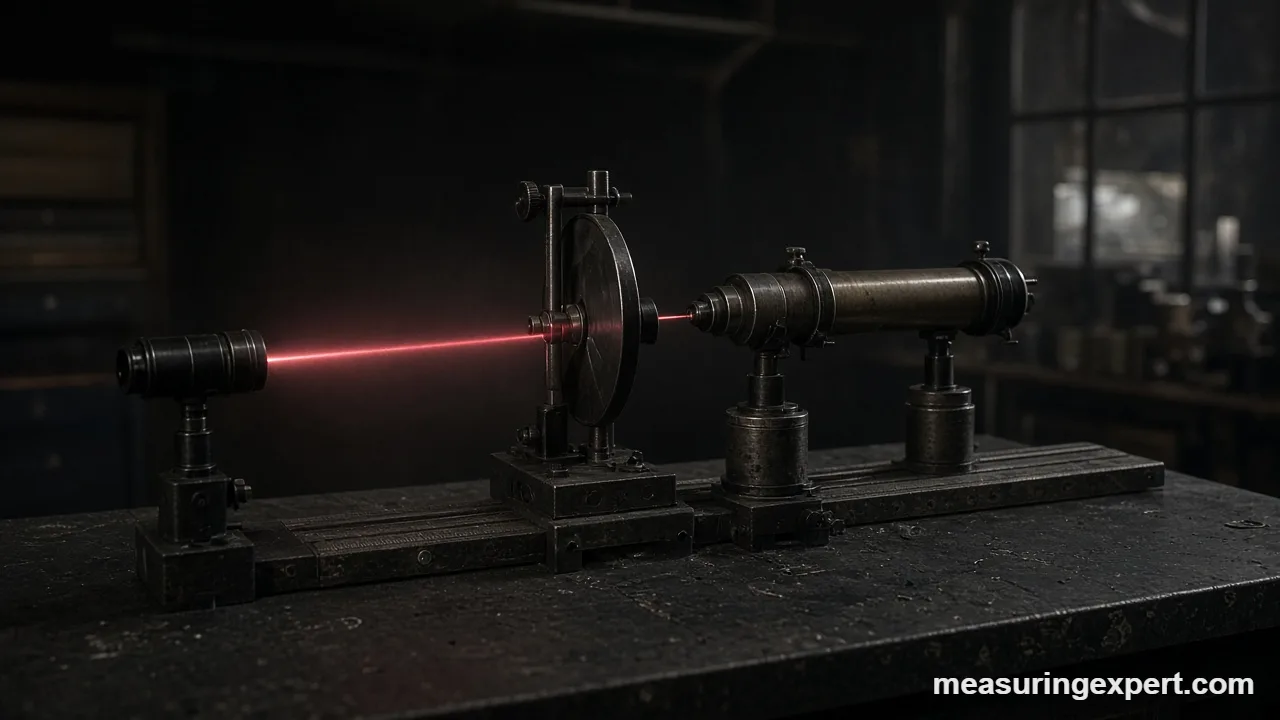
For example, in 1950, Louis Essen and A. C. Gordon-Smith built a metal cavity resonator, a hollow cylinder that resonates only at frequencies whose waves fit its size exactly. Because they knew the cavity dimensions to about a micrometer, the resonant frequency gave them c to within about 3 km/s. In other words, that is the same physics as the microwave oven in your kitchen, only far more controlled.
Next came the laser. In 1972, Kenneth Evenson’s group at the National Bureau of Standards in Boulder measured both the frequency and the wavelength of a helium-neon laser locked to a methane line. According to NIST’s history of the project, this cut the uncertainty in c by a factor of nearly 100. Their value, 299,792,456.2 m/s with an uncertainty of about 1.1 m/s, was limited mainly because no one could define the meter any better at the time.
Today, optical frequency combs link laser frequencies directly to atomic clocks. So labs no longer use them to measure c; instead, they use the fixed value of c to turn frequencies into extremely precise lengths.
Why c Is Now Exact by Definition
By the 1970s, the speed of light was known better than the meter itself, which was then defined by an orange spectral line of krypton-86. So in 1975 the General Conference on Weights and Measures (CGPM) recommended the value 299,792,458 m/s, and in 1983 it redefined the meter: the distance light travels in a vacuum in 1/299,792,458 of a second.
That choice, however, flipped the logic. Before 1983, c was a measured number with an error bar. Since then, it is exact, and the meter carries any uncertainty instead. As a result, a modern speed of light measurement in meters per second would just return the definition. Instead, what labs really measure now is length, using light and atomic clocks.
Also, one subtle point remains. Nearly every method on this page times light on a round trip, out to a mirror and back. Measuring the one-way speed would need two distant clocks that tick in sync, and syncing them already assumes how fast light travels. For that reason, physicists treat the one-way speed as a convention, while experiments test the round-trip value.
Speed of Light in a Vacuum vs in Materials
However, the exact value applies only in a vacuum. In air, water or glass, light slows down, and the ratio between the two speeds is the refractive index. For example, this slowdown is why a straw looks bent in a glass of water. Our guide to Snell’s law and the refractive index shows how to calculate the bending.
| People often confuse | What it really means | Typical value |
|---|---|---|
| c (vacuum) | Fixed constant used to define the meter | 299,792,458 m/s exactly |
| Speed in air | c divided by about 1.0003 | about 299,700,000 m/s |
| Speed in water | c divided by about 1.33 | about 225,000,000 m/s |
| Speed in glass or fiber | c divided by about 1.5 | about 200,000,000 m/s |
| Microwaves in an oven | Same electromagnetic speed as light, in air | effectively c for a home test |
Microwaves and visible light are both electromagnetic waves, so they travel at the same speed. That is why a microwave oven can stand in for a laser in the home experiment below.
How to Do a Speed of Light Measurement at Home With Chocolate
First, a microwave oven fills its metal box with standing waves. At the hot spots (antinodes), food melts first. Two neighboring hot spots sit half a wavelength apart, so the wavelength is twice the spacing. Then the formula is simply v = 2 x node spacing x frequency. The University of Arizona’s College of Optical Sciences describes the same microwave speed of light activity for students.
- Find the frequency. Check the label inside the door or on the back of the oven, because it lists the exact value. Most home ovens run at 2,450 MHz (2.45 GHz).
- Take out the turntable. The food must stay still, otherwise the melted spots smear into a ring. Put a microwave-safe plate upside down over the drive shaft instead.
- Prepare the chocolate. Use a wide, flat bar or spread chocolate chips, cheese slices or marshmallows in one even layer at least 15 cm (6 inches) long.
- Heat it briefly. Run the oven on high for about 15 to 20 seconds, and watch the whole time. Stop as soon as two or three soft or shiny spots appear.
- Measure the spacing. Using a ruler or caliper, measure from the center of one melted spot to the center of the next, in centimeters. Then measure several pairs and take the average.
- Calculate the speed. Convert the spacing to meters, double it, and multiply by the frequency in hertz. Finally, enter your result in the converter above to compare it with c.
A Worked Speed of Light Measurement Example
Suppose the melted spots sit 6.1 cm apart and the label says 2,450 MHz. First, convert: 6.1 cm = 0.061 m. Next, double it to get the wavelength: 0.122 m. Then multiply: 0.122 m x 2,450,000,000 Hz = 298,900,000 m/s. That result is within 0.3 percent of the exact value, so it is a very good home result.
| Measured spacing | Wavelength (2 x spacing) | Speed at 2.45 GHz | Error vs c |
|---|---|---|---|
| 5.8 cm (2.28 in) | 11.6 cm | 284,200,000 m/s | -5.2% |
| 6.0 cm (2.36 in) | 12.0 cm | 294,000,000 m/s | -1.9% |
| 6.1 cm (2.40 in) | 12.2 cm | 298,900,000 m/s | -0.3% |
| 6.2 cm (2.44 in) | 12.4 cm | 303,800,000 m/s | +1.3% |
The ideal spacing at 2.45 GHz is about 6.12 cm (2.41 inches). Notice how a 2 mm reading error moves the answer by several percent, so careful measuring matters more than anything else.
Speed of Light Measurement Do and Don’t
Do
- Read the exact frequency from the oven label.
- Remove the turntable so the food stays still.
- Average several spot-to-spot distances.
- Stop heating the moment the first spots soften.
- Write down every reading before you calculate.
Don’t
- Run the oven empty or with foil wrappers.
- Measure from the edges of the spots.
- Forget to double the spacing.
- Mix centimeters and meters in the formula.
- Expect lab precision from a kitchen oven.
Honest Limits of Home Methods
The microwave test is a real measurement, but it has clear limits. First, the melted spots are blurry, often a centimeter or more across, so finding their centers is a judgment call. Also, the standing wave pattern inside an oven is three-dimensional, and some ovens have a stirrer fan that moves it. Moreover, the label frequency is nominal: magnetrons drift by several megahertz as they warm up. Together, these effects explain why most home results fall within 2 to 5 percent rather than closer. In short, the experiment proves the method and gets the right order of magnitude, but it cannot compete with a laser lab, and it cannot “test” the defined value of c.
When to Ask an Expert
For a science fair or school report, ask a physics teacher to check your setup and your error analysis. If you need traceable length or frequency measurements for work, use an accredited calibration lab instead of home methods. Finally, if the oven sparks, smells burnt or the door seal looks damaged, stop using it and have an appliance technician inspect it.
Frequently Asked Questions
Can you measure the speed of light at home?
Yes. With a microwave oven, a bar of chocolate and a ruler, you can usually get within 2 to 5 percent of the true value by using v = 2 x spot spacing x frequency.
Who made the first speed of light measurement?
Ole Romer did in 1676 by timing eclipses of Jupiter’s moon Io. Christiaan Huygens then turned his delay into a speed of roughly 220,000 km/s.
Why is the speed of light exactly 299,792,458 m/s?
Because in 1983 the meter was redefined as the distance light travels in a vacuum in 1/299,792,458 of a second. The number is exact by definition.
Is a speed of light measurement still useful today?
Yes, but the purpose changed. Labs now use the fixed value of c to measure lengths and distances, for example in laser rangefinders and satellite ranging.
Why do you double the spacing in the microwave experiment?
Neighboring hot spots in a standing wave are half a wavelength apart, so twice the spacing equals one full wavelength.
What frequency does a microwave oven use?
Most home microwave ovens run at 2,450 MHz, or 2.45 GHz. Check the label on your oven, because some models differ.
How did Fizeau measure the speed of light?
He shone light through a spinning wheel with 720 teeth to a mirror about 8.6 km away. At a certain spin rate the returning light hit a tooth, which gave him the travel time.
How accurate is a home speed of light measurement?
Most careful attempts land within 2 to 5 percent. The main errors are blurry melted spots and the oven’s real frequency.
Does light travel slower in water or glass?
Yes. In water, light moves at about 75 percent of its vacuum speed, and in typical glass at about two-thirds of it.
Can I use something other than chocolate?
Yes. Cheese slices, marshmallows, egg whites or thermal fax paper all show hot spots. Choose something that melts or changes color quickly.
Speed of Light Measurement: The Bottom Line
You can measure the speed of light, and people have done it for about 350 years: first with Jupiter’s moons, then with wheels, mirrors, cavities and lasers. Moreover, each method timed light over a known distance or multiplied its frequency by its wavelength, and each one got closer to 299,792,458 m/s.
Since 1983 that value is exact, because the meter is defined from it. Still, the chocolate experiment remains one of the best ways to see the physics for yourself, so remove the turntable, heat briefly, measure carefully, and check your answer with the converter above.