

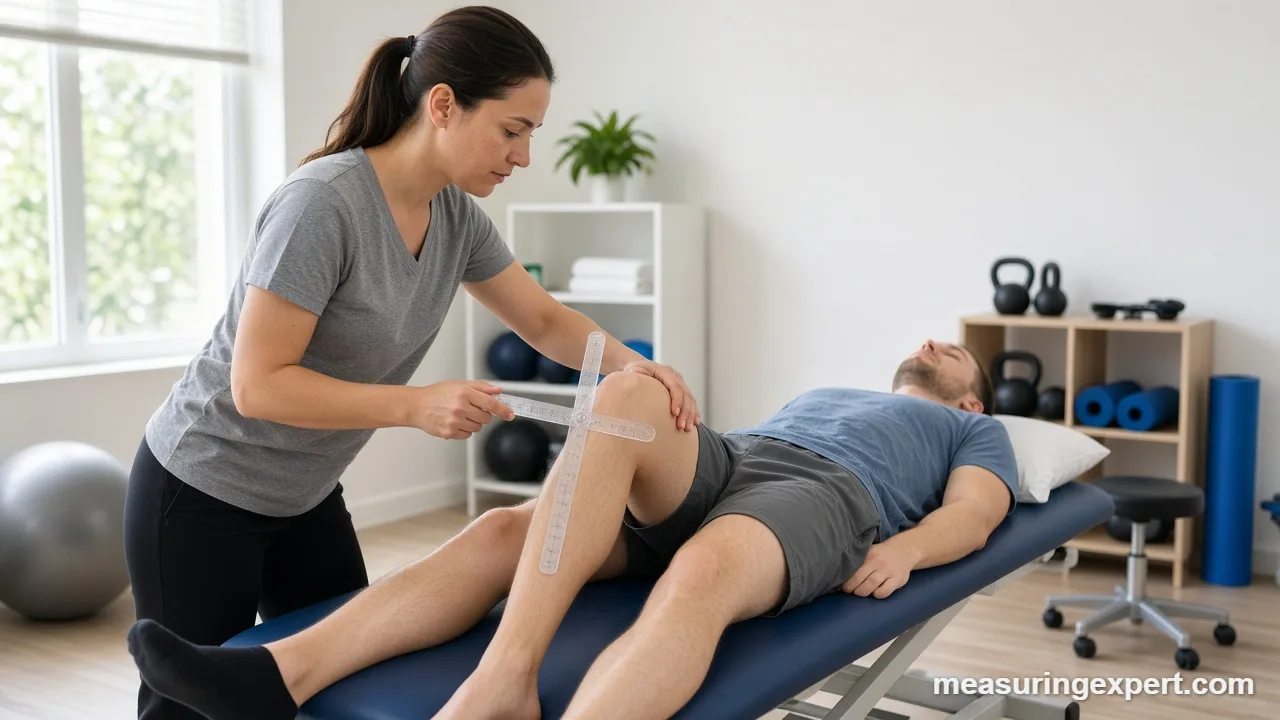
A goniometer is an instrument that measures angles. In health care, it is a protractor with two arms that a therapist lines up with the bones on either side of a joint to record its range of motion in degrees. Scientists and makers also use goniometers for crystal faces, X-ray samples and surface angles.
The name comes from two Greek words: “gonia” (angle) and “metron” (measure). So, quite literally, it is an angle meter. Even so, most people meet one in a physical therapy clinic, where it turns “your knee bends a bit better” into a number such as 120 degrees that can be compared from week to week.
In practice, a goniometer answers one simple question: how far does this joint, part or surface turn from a starting line? For example, the classic version is a clear plastic disc printed with a degree scale. In addition, it has one fixed arm and one moving arm joined by a rivet, so you read the angle where the moving arm crosses the scale.
In short: center the pivot on the joint, line the fixed arm up with the bone that stays still, line the moving arm up with the bone that moves, and read the number.
The technique is standard clinical practice. For example, the NIH-hosted StatPearls clinical review of the instrument describes the same three parts (body, fulcrum, stationary and moving arms) and notes that results depend heavily on technique. Similarly, the CDC ran a Normal Joint Range of Motion Study that measured more than 600 people between 2003 and 2006 to build reference values.
Below, you will find a quick angle converter, how the tool works, the main types, a step-by-step method, typical joint values, and finally the honest limits of what the numbers can tell you.
Convert a Goniometer Reading to Grade and Pitch
Medical readings stay in degrees. However, digital goniometers and angle finders are also used on ramps, roofs and workbenches, where people often need percent grade or roof pitch instead. Enter an angle in degrees below to convert it. This angle converter is the closest match on the site; it does not judge whether a joint reading is normal.
The math is grade = tan(angle) x 100 and pitch = tan(angle) x 12. For example, a 1:12 wheelchair ramp rises 1 inch per 12 inches, which is about 4.76 degrees or 8.3 percent.
Recommended Goniometer Tools for Range of Motion
First, match the size to the joint. A 12-inch (30 cm) arm suits the hip, knee and shoulder, while 6- and 8-inch models fit the elbow, wrist and ankle. Next, add a finger model if you work with hands, since its short arms sit flat on the knuckles. Finally, a digital inclinometer is handy for the spine, where a two-arm tool is awkward to line up. The picks below come from established medical-supply brands, based on manufacturer specs and buyer reports.

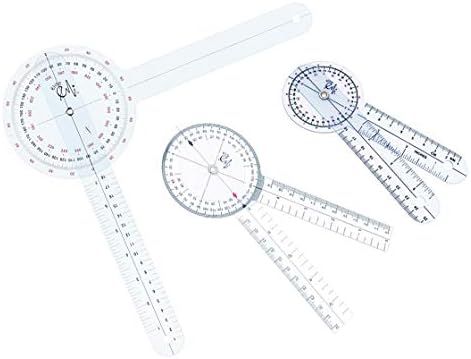

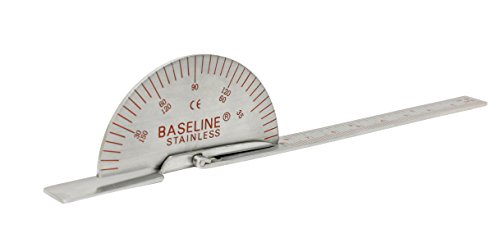

As an Amazon Associate, Measuring Expert earns from qualifying purchases.
- It measures angles in degrees; in clinics, that means joint range of motion.
- Three parts matter: the body (scale), the fulcrum (pivot) and two arms.
- Align the fulcrum with the joint axis and the arms with bony landmarks.
- Pick arm length by joint: 12 inches for big joints, 6 inches for small ones.
- Readings by the same person are more repeatable than readings by different people.
- Even so, errors of 5 to 10 degrees are possible with poor technique.
- In short, a reading is a measurement, not a diagnosis.
How a Goniometer Works
Think of a protractor that you can strap to a body. In this picture, the joint acts as the vertex of an angle, and the two bones on either side act as its two rays. Because the arms of the tool follow those bones, the angle between the arms equals the angle of the joint.
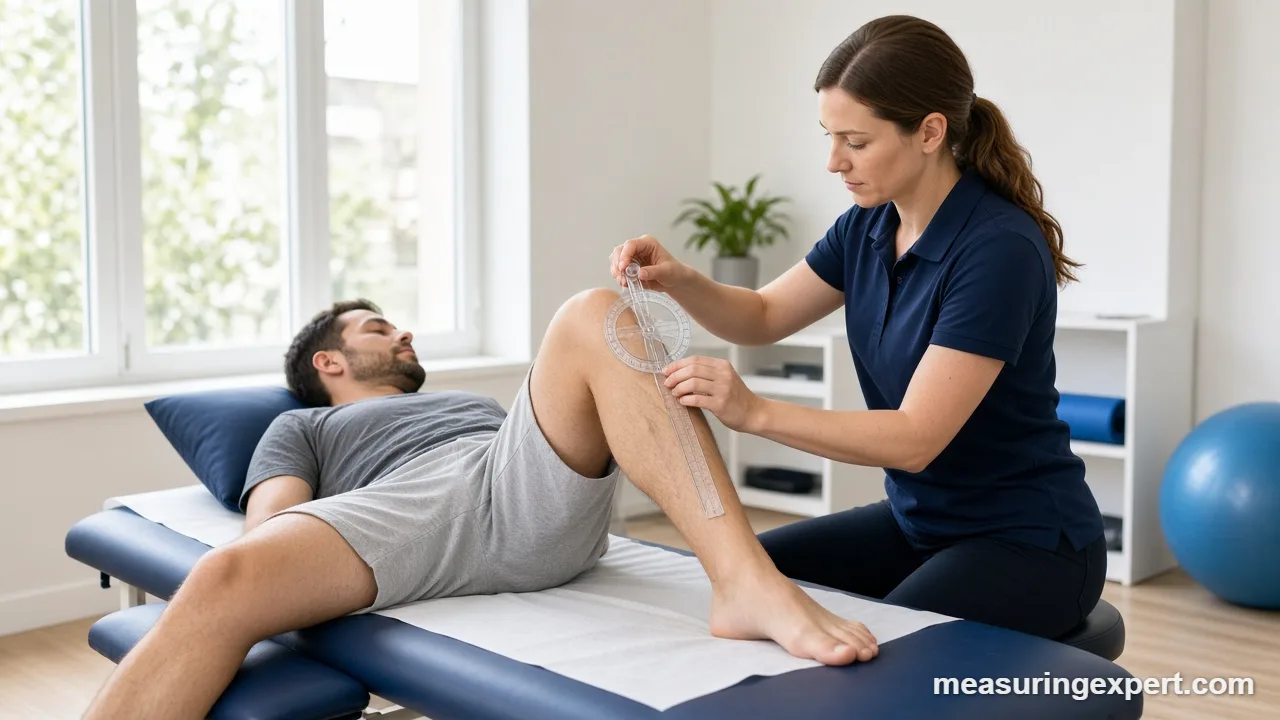
Most clinicians start from the anatomical position, where the body stands upright with palms facing forward. In that position, most joints read 0 degrees. Then, as the person bends or lifts the limb, the moving arm sweeps around the scale and the number climbs. For instance, a fully straight elbow reads about 0 degrees, while a fully bent one often reads around 145 to 150 degrees.
Digital versions, on the other hand, follow a different route. Instead of reading a printed scale, they use an accelerometer or rotary encoder to sense the angle and show it on a screen. As a result, they remove the need to read small tick marks, although they still depend on correct placement.
Parts of a Universal Goniometer
The universal goniometer is the standard clinic model. It has four parts you should know before you take a reading:
| Part | What it does | Where it goes |
|---|---|---|
| Body | Holds the degree scale, either a full circle (0-360) or a half circle (0-180) | Sits over the joint |
| Fulcrum (axis) | The rivet or screw that lets the arms pivot | Lined up with the joint’s axis of rotation |
| Stationary arm | Part of the body; it does not move | Along the bone that stays still |
| Moving arm | Rotates around the fulcrum and points to the reading | Along the bone that moves |
In addition, many scales carry two rows of numbers that run in opposite directions. That way, you can read the angle whichever way the arm turns. Therefore, the trick is to use the row that showed 0 when you started.
Types of Goniometer
Not every model looks like a clear plastic protractor. For that reason, the table below sorts the common types by where you are likely to meet them.
| Type | How it reads | Typical use |
|---|---|---|
| Universal (long-arm or short-arm) | Printed scale, two arms | Most joints in physical and occupational therapy |
| Finger | Short metal or plastic arms that sit on top of the knuckles | Finger and toe joints |
| Gravity (inclinometer style) | A weighted needle or bubble referenced to vertical | Spine, hip rotation, neck |
| Electrogoniometer | Sensors on both segments record the angle continuously | Gait labs and research |
| Smartphone app | Phone accelerometer and gyroscope | Quick checks and home programs |
| Contact and optical (lab) | Hinged arms, or a light beam reflected off a surface | Crystal faces, X-ray diffraction, contact angles |
Goniometer vs Protractor vs Inclinometer
These three tools all measure angles, so people mix them up. However, each one measures the angle against a different reference.
| Tool | Measures the angle between | Best for |
|---|---|---|
| Protractor | Two lines drawn on paper | Geometry and drafting |
| Universal goniometer | Two moving parts that meet at a pivot | Joints and hinged objects |
| Inclinometer | One surface and true vertical or horizontal (gravity) | Spine, slopes, roofs, machinery |
In other words, a goniometer is a protractor with arms you can lay along a body. If you want a refresher on reading the plain version, see our guide on how to measure angles using a protractor. Likewise, for gravity-based tools, our explainer on what a clinometer is and how it measures slope covers the outdoor cousin.
How to Use a Goniometer Step by Step
This method uses knee flexion as the example. Still, the same sequence works for nearly any joint.
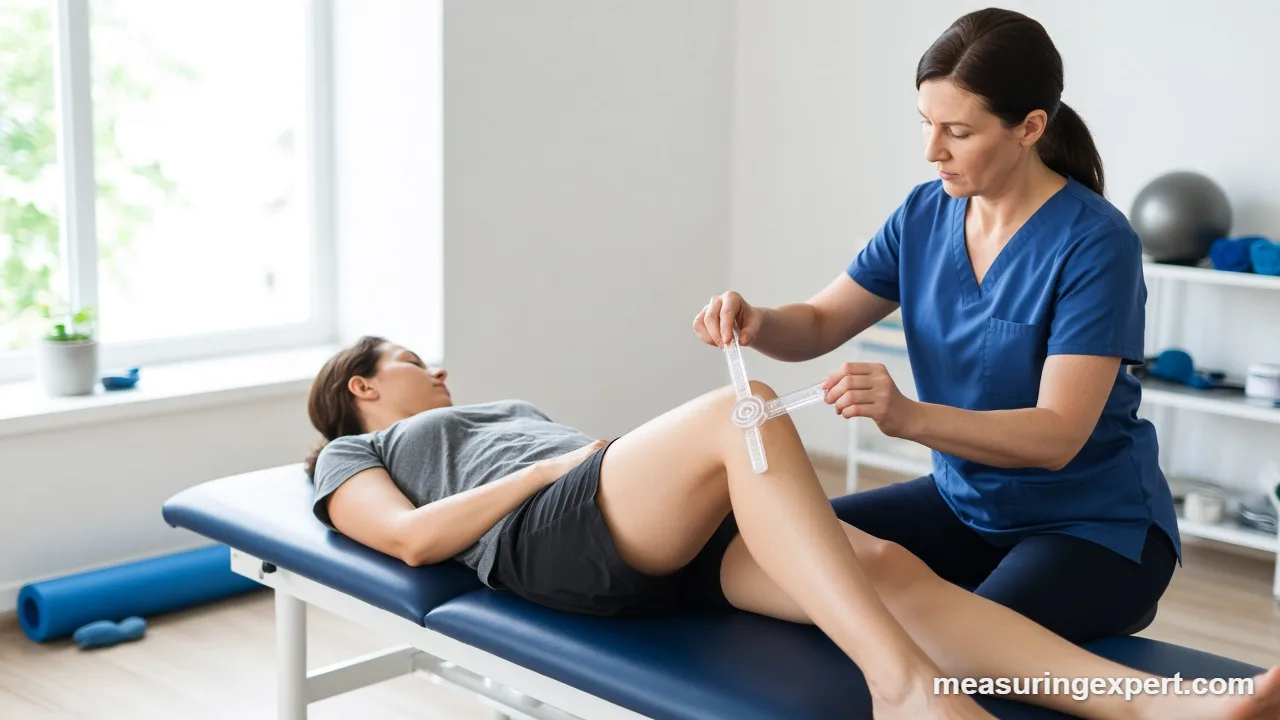
- Position the person. First, have them lie on their back with the leg straight, so the knee starts near 0 degrees.
- Find the landmarks. Feel for the outer knee joint line, the greater trochanter at the hip and the lateral malleolus (ankle bone).
- Place the fulcrum. Center the pivot over the outer side of the knee joint.
- Align the stationary arm. Then point it along the thigh toward the greater trochanter.
- Align the moving arm. Similarly, point it along the lower leg toward the ankle bone.
- Record the starting angle. Note the reading before any movement, then ask the person to bend the knee as far as is comfortable.
- Re-check the alignment. Because skin and muscle shift as the joint bends, adjust the arms back onto the landmarks.
- Read and record. Finally, use the scale that started at 0, and write down the joint, side, position and whether the movement was active or assisted.
Typical Joint Angles You Will Measure
Next, reference values help put a reading in context. The figures below are mean values for adults aged 20 to 44 from the CDC study linked above. Because individual people vary a lot, treat them as a rough guide, not a pass or fail line.
| Movement | Women (mean) | Men (mean) |
|---|---|---|
| Knee flexion | 141.9° | 137.7° |
| Elbow flexion | 150.0° | 144.6° |
| Shoulder flexion | 172.0° | 168.8° |
| Hip flexion | 133.8° | 130.4° |
Overall, notice that women averaged slightly more motion than men at every joint listed. Also, range of motion often narrows somewhat with age, so compare a reading with values for the same age group. For more on the angle names behind these numbers, see the different types of angles.
Uses Beyond the Clinic: Crystals, Labs and Workshops
Long before therapists adopted it, the tool belonged to scientists. The first known description, by Gemma Frisius in 1538, was based on the astrolabe and used for surveying. Later, in the 18th century, mineralogists used hinged contact versions to measure the angles between crystal faces, which helped identify minerals.
Today, however, the idea lives on in several places:
- X-ray diffraction. A motorized stage rotates a sample to precise angles while a detector reads the pattern.
- Surface science. A contact angle instrument measures the angle a water drop makes with a surface, which shows how well a coating repels water.
- Lighting. Similarly, a goniophotometer measures how much light a lamp sends in each direction.
- Woodworking and welding. Likewise, hinged angle finders check miters, bevels and pipe joints.
Do and Don’t
Do
- Use bony landmarks, not the outline of soft tissue.
- Choose an arm length that matches the limb.
- Take two or three readings and record the average.
- Have the same person measure each visit when possible.
- Write down position, side and active or passive motion.
Don’t
- Read from the wrong row of numbers.
- Push a joint past the point of pain to get a bigger number.
- Compare a lying reading with a standing one.
- Let the fulcrum drift as the limb moves.
- Treat a single reading as a diagnosis.
Honest Limits: How Accurate Is a Goniometer?
First, a printed scale usually shows 1 or 2 degree marks. Even so, the tool is rarely the weakest link. Instead, most error comes from finding the landmarks and holding the arms in place. As a result, studies report that errors of 5 to 10 degrees are possible, and readings taken by two different people agree less well than repeat readings by the same person.
The StatPearls review goes further: it says there is still no firm consensus that the device is valid and reliable enough in every situation. Meanwhile, electrogoniometers are more repeatable but harder to use in a busy clinic. In short, a change of a few degrees between visits may be noise, while a steady change of 10 degrees or more is more likely to be real.
When to See a Professional
Home measurements are useful for tracking. Even so, some situations need a trained eye. See a physical therapist, occupational therapist or doctor if motion drops suddenly, if a joint locks, swells or gives way, or if pain gets worse instead of better. Likewise, after surgery, follow the range-of-motion goals your surgical team sets rather than general reference tables. For lab or industrial instruments, send the device to a calibration lab if readings drift.
Goniometer FAQs
What is a goniometer used for?
It measures angles. In health care it records joint range of motion in degrees; in labs and workshops it measures crystal faces, sample angles, surface angles and miters.
How do you read a goniometer?
Center the fulcrum on the joint, align both arms with the bones, and read the number where the moving arm crosses the scale. Use the row of numbers that read 0 at the start.
Do you read the red or black numbers?
Read whichever scale started at 0 in your starting position. The two rows run in opposite directions so you can measure movement either way.
What size goniometer should I buy?
A 12-inch model suits the hip, knee and shoulder. A 6- or 8-inch model fits the elbow, wrist and ankle, and a finger model fits small joints.
Is a goniometer the same as a protractor?
Not quite. It is built like a protractor, but it adds a pivot and long arms so you can line it up with two moving parts, such as the bones of a joint.
How accurate is a goniometer reading?
The scale is marked in 1 or 2 degree steps, but placement errors can reach 5 to 10 degrees. For that reason, repeated readings by the same person are the most consistent.
What is a normal knee range of motion?
In the CDC study, adults aged 20 to 44 averaged about 142 degrees of knee flexion for women and 138 degrees for men. Still, individual values vary widely.
Can I use a phone app instead?
Generally, phone apps use the built-in motion sensors and can work well for quick checks. Still, placement matters just as much, so measure the same way each time.
What does a digital goniometer do differently?
It senses the angle electronically and shows it on a screen, so there are no tick marks to misread. However, it still depends on correct landmarks and alignment.
Who invented the first one?
The first known description is credited to Gemma Frisius in 1538. Hinged contact versions for measuring crystals followed in the 18th century.
The Bottom Line
To sum up, a goniometer is an angle meter. In a clinic, it turns joint movement into a number by lining a pivot up with the joint and two arms up with the bones. Outside the clinic, the same idea measures crystals, X-ray samples, coatings and woodwork.
So pick the right size, use bony landmarks, record your method, and compare readings taken the same way. Finally, remember that a few degrees of change can be measurement noise, and leave diagnosis to a professional.
1 thought on “What Is a Goniometer and How Is It Used? A Clear Guide”