

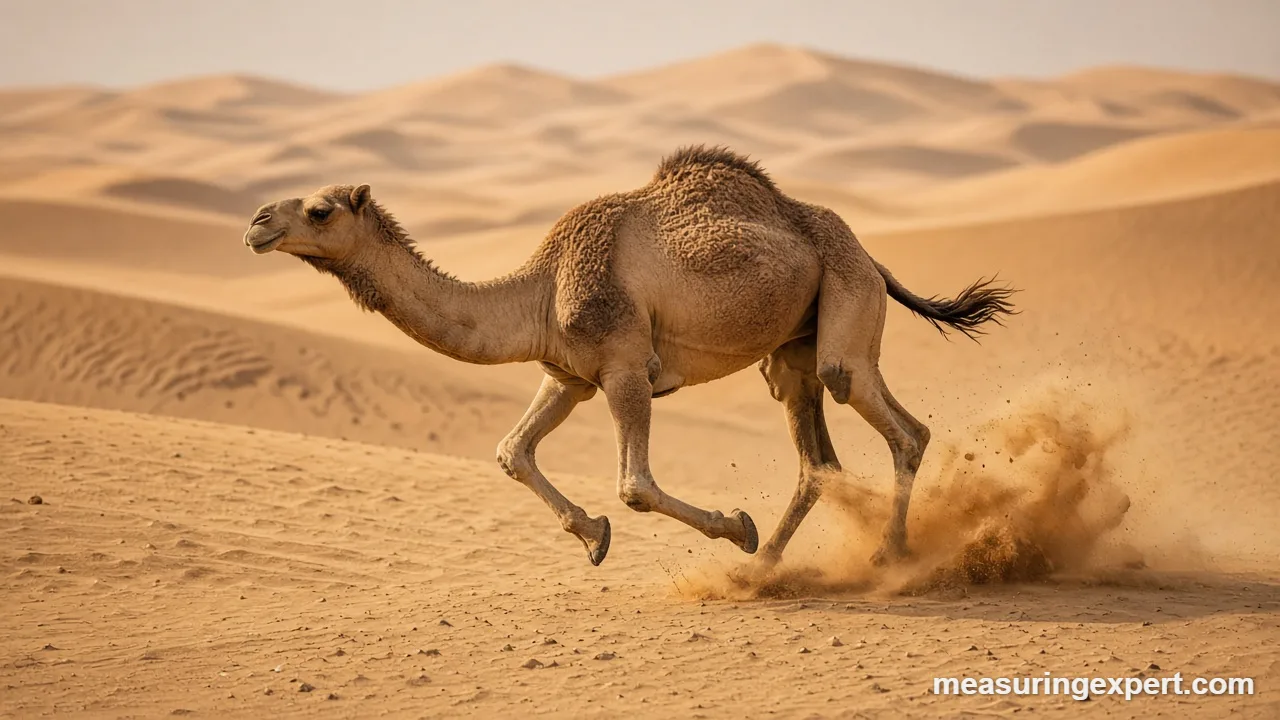
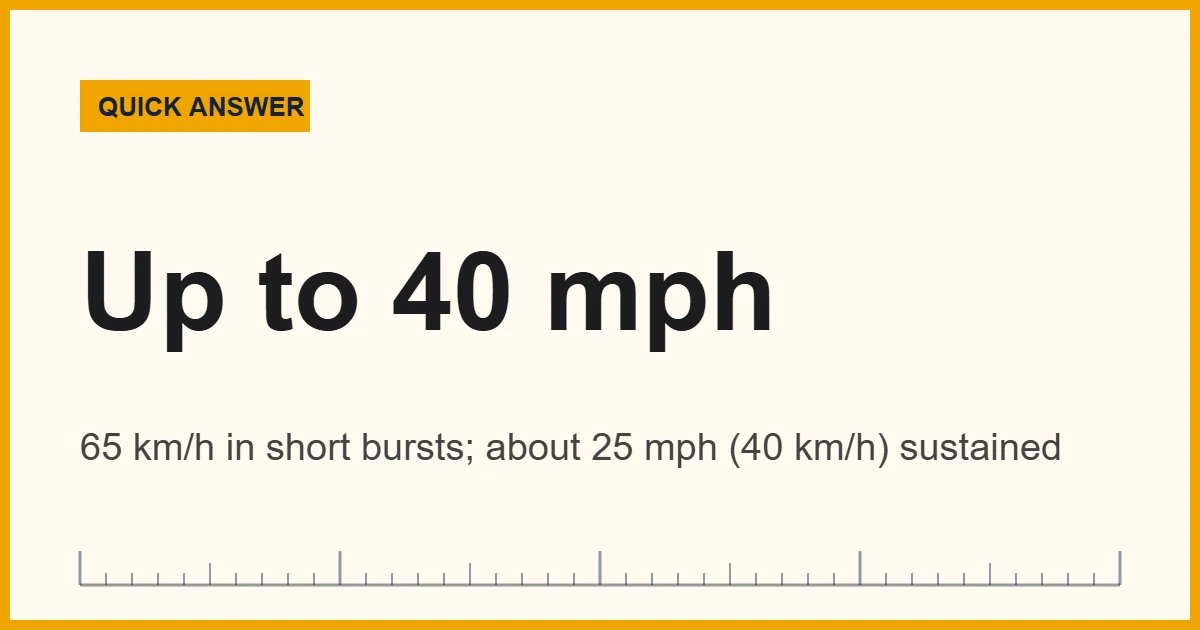
How fast can a camel run? A camel can sprint at up to 40 mph (65 km/h) in short bursts, and it can hold a sustained speed of about 25 mph (40 km/h), according to the San Diego Zoo Wildlife Alliance. On a long trek, however, a camel covers about 93 miles (150 km) in 15 to 20 hours.
Convert Camel Run Speeds to km/h, m/s and Knots
First, type any speed into the box below to convert it. To begin with, the box shows 40 mph, the top sprint figure for camels. You can also enter 25 to see the steady pace, or try a horse or human speed from the comparison table further down.
At first glance, camels look like slow, plodding pack animals. In reality, they are surprisingly quick. For example, a fit camel at full gallop moves at about the same pace as a car on a city street, and it can keep a fast trot going for a long time. Because of that mix of speed and stamina, camels still race across the Arabian Peninsula today.
Still, the figures need context. After all, the 40 mph number is a short burst, not a cruising speed. By contrast, the 25 mph figure is a strong, steady run, and a loaded caravan camel walks far slower than either. The San Diego Zoo Wildlife Alliance, which publishes detailed species fact sheets, lists all three in its camel behavior fact sheet: up to 65 km/h in bursts, up to 40 km/h sustained, and 150 km in 15 to 20 hours.
Camel Run Speed Chart: mph, km/h, m/s and ft/s
Below, this chart converts the published camel speeds, plus walking and trotting paces for context. Every value starts from the exact definition of a mile (1.609344 km), and the results are rounded to two decimals.
| Speed (mph) | km/h | m/s | ft/s | Knots | What it means |
|---|---|---|---|---|---|
| 3 | 4.83 | 1.34 | 4.40 | 2.61 | Relaxed walk |
| 5 | 8.05 | 2.24 | 7.33 | 4.34 | Average pace on a 15 to 20 hour trek |
| 10 | 16.09 | 4.47 | 14.67 | 8.69 | Easy trot |
| 25 | 40.23 | 11.18 | 36.67 | 21.72 | Sustained run |
| 40 | 64.37 | 17.88 | 58.67 | 34.76 | Top sprint, short bursts |
To put that in perspective, a camel sprinting at 40 mph covers 100 meters (about 109 yards) in roughly 5.6 seconds. At its steady 25 mph, however, the same distance takes about 8.9 seconds. Meanwhile, a whole mile takes 90 seconds at top speed and 144 seconds at the sustained pace.
How Fast Can a Camel Run? Dromedary vs Bactrian
There are three living camel species. First, the dromedary (Camelus dromedarius) has one hump and lives in hot deserts of Africa, the Middle East and Australia. Next, the domestic Bactrian camel (Camelus bactrianus) has two humps and lives in the colder deserts of Central Asia. Finally, the wild Bactrian camel (Camelus ferus) survives only in parts of China and Mongolia, where fewer than 1,000 remain.
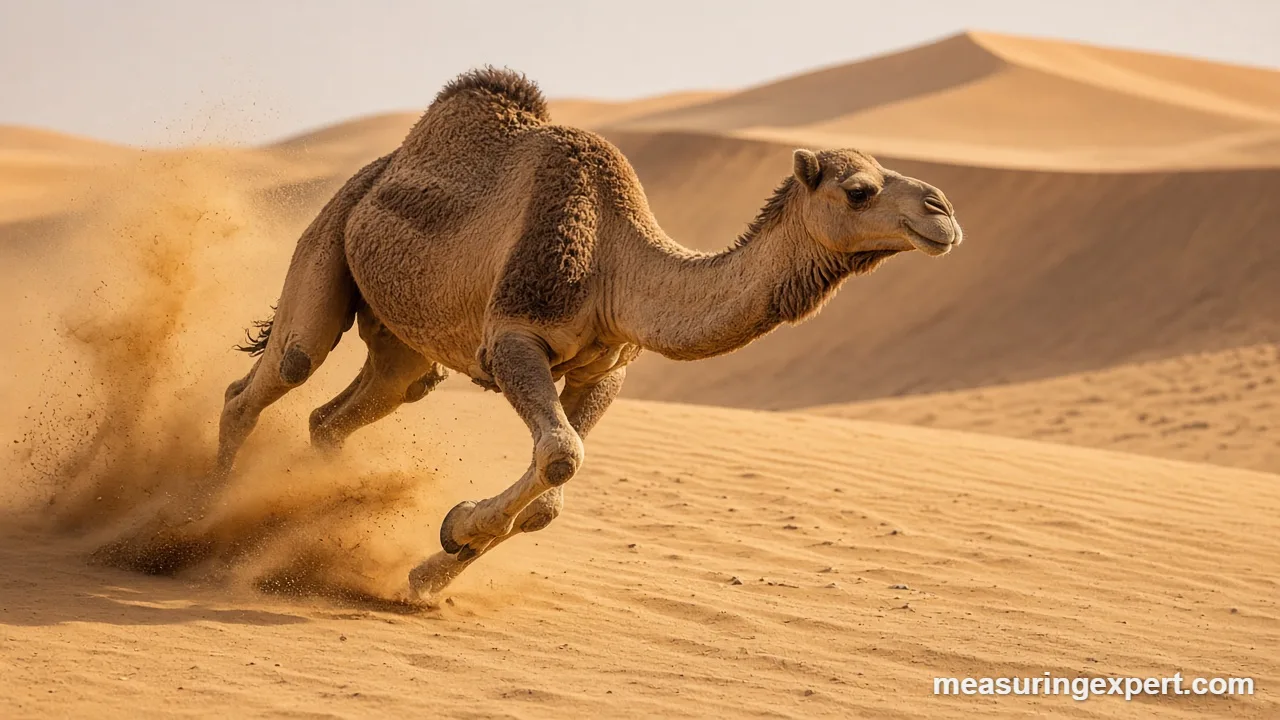
The old version of this page claimed that Bactrian camels top out at 25 mph. However, that is not what the sources say. In fact, the San Diego Zoo fact sheet gives the same 40 mph burst and 25 mph sustained figures for camels in general, and it does not split them by species. So the honest answer is that both kinds can reach about 40 mph, although dromedaries are the ones bred and trained for racing.
| Feature | Dromedary | Bactrian (domestic) |
|---|---|---|
| Humps | 1 | 2 |
| Weight | 400 to 600 kg (882 to 1,323 lb) | 450 to 500 kg (992 to 1,102 lb) |
| Shoulder height | 180 to 200 cm (5.9 to 6.6 ft) | 160 to 180 cm (5.2 to 5.9 ft) |
| Climate | Hot deserts | Cold deserts |
| Top speed | Up to about 40 mph (65 km/h) | Up to about 40 mph (65 km/h), rarely used |
| Main use | Racing, riding, milk, transport | Pack transport, wool, milk |
Similarly, the size and weight figures come from the San Diego Zoo camel characteristics fact sheet.
Camel Run Speed vs Horse and Human
Of course, comparisons only work when the numbers mean the same thing. For that reason, the table below separates sprint figures from steady paces and names where each one comes from.
| Runner | Top speed | Steady pace | Source |
|---|---|---|---|
| Camel | 40 mph (65 km/h), short bursts | 25 mph (40 km/h) sustained | San Diego Zoo fact sheet |
| Racehorse (record) | 43.97 mph (70.76 km/h) over a quarter mile | Much lower over long distances | Guinness record, Winning Brew, 2008 |
| Human (record) | About 27.8 mph (44.7 km/h) peak | About 13 mph (21 km/h) for elite marathoners | Usain Bolt, 100 m world record |
So a top racehorse is a little faster than a camel in a short dash. The record belongs to Winning Brew, a Thoroughbred filly that ran a quarter mile in 20.57 seconds in 2008, as the Pennsylvania Horse Racing Association explains. Over 400 meters, that gap would amount to only about 2 seconds. Over a long, hot desert route, however, the camel usually has the edge, because it can keep going with little water. For the horse side of the story, see how fast a horse can run.
By comparison, a human is no match for either animal. Even so, the fastest sprinter ever measured peaked at about 27.8 mph, which is faster than a camel’s steady run for a few seconds. Our guide on how fast a human can run breaks those numbers down.
Why a Camel Run Looks So Different
If you watch a camel jog, it seems to rock from side to side. That is because camels pace: the front and back legs on the same side move forward together, as the San Diego Zoo fact sheet describes. As a result, the whole body shifts left, then right, which is why riders call camels “ships of the desert”.
Pacing also saves energy on long trips, since the long legs swing like pendulums. In addition, a camel has broad, two-toed feet cushioned by fat. These pads therefore spread its weight over soft sand, so the foot does not sink in. Similarly, long legs keep the body higher above hot ground.
Where the stamina comes from
First of all, the hump stores fat, not water. Then, when food runs short, the camel burns that fat for energy. Also, camels can lose water equal to more than 30% of their body weight, and a thirsty dromedary can drink about 30 gallons (114 liters) in 13 minutes. Together, these traits let a camel travel for hours in heat that would stop most other large animals.
Camel Racing: How Fast Can a Camel Run on a Track?
Camel racing is an old tradition in the Gulf states and North Africa, and it is still a major sport in the United Arab Emirates, Qatar, Saudi Arabia and Oman. Today, racing camels are lean dromedaries, bred and conditioned for speed. Because they carry very little weight, they get as close to the 40 mph burst figure as any camel will.
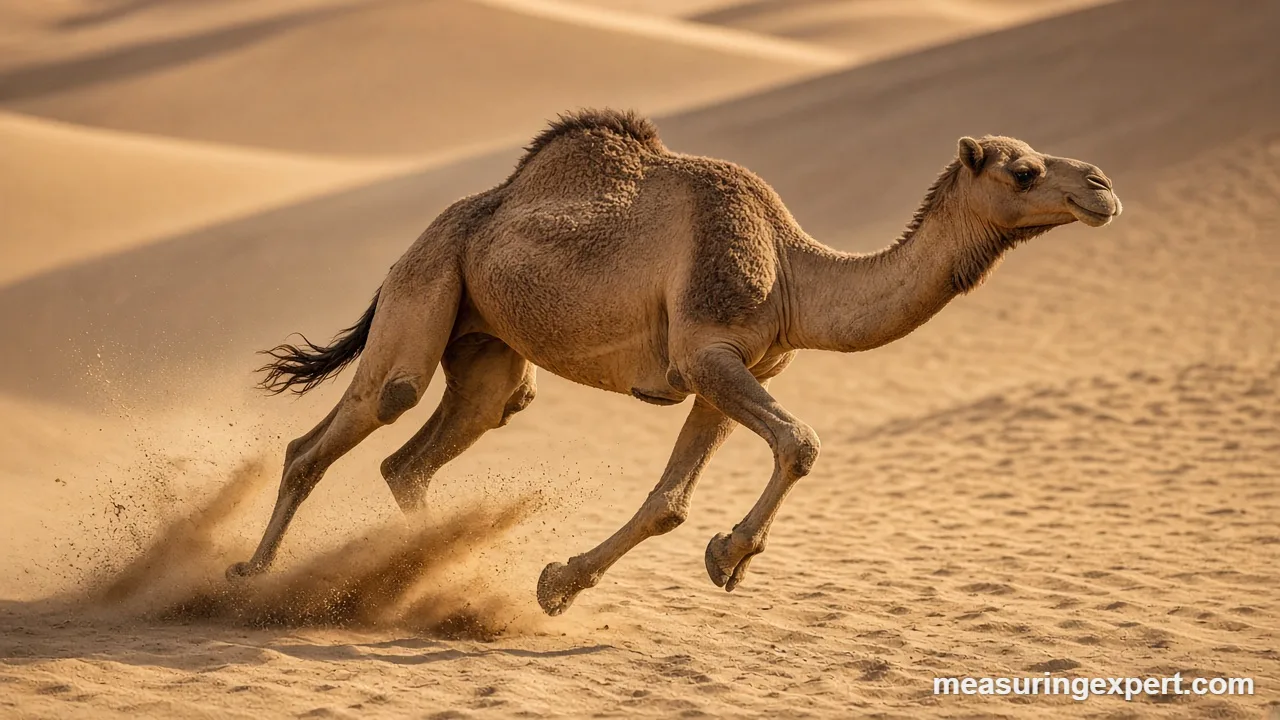
One big change came in 2005. That July, the UAE held a trial race with remote-controlled robot jockeys, after banning riders under 18, as Al Jazeera reported at the time. Today, lightweight robot jockeys are widely used in Gulf racing, and trainers control them remotely.
Even so, published race speeds vary a lot between events, tracks and distances. So treat any single “record” number for a racing camel with caution unless it comes with the distance, the time and who timed it.
Top Speed vs Sustained Speed vs Travel Speed
In fact, most confusion about camel speed comes from mixing up three different numbers. Therefore, this table separates them, along with the units people tend to blur.
| Term | What it means | Camel example |
|---|---|---|
| Top speed | The fastest pace for a short burst | About 40 mph (65 km/h) |
| Sustained speed | A fast pace held for a long stretch | About 25 mph (40 km/h) |
| Travel speed | Average pace over a full day, including slow parts | 150 km in 15 to 20 h, or about 4.7 to 6.2 mph |
| mph vs km/h | 1 mph = 1.609344 km/h exactly | 40 mph = 64.37 km/h |
| Knots | Nautical miles per hour; 1 knot = 1.852 km/h | 40 mph = 34.76 knots |
Admittedly, knots are mostly used at sea and in the air. Still, if you want to know where that unit comes from, see how fast a knot is.
How to Estimate a Camel Run Speed Yourself
In fact, you can estimate how fast any animal moves with a distance, a time and one division. Here is the method, step by step.
- Pick two fixed markers. First, choose points along a straight path, such as two fence posts, that the animal will pass.
- Measure the distance between them. Use a laser rangefinder or a long tape, because longer distances give better results.
- Time the run. Next, start a stopwatch as the animal passes the first marker and stop it at the second.
- Divide distance by time. For example, 50 meters in 4 seconds is 12.5 m/s.
- Convert the result. Then enter the value in the converter above to see it in mph and km/h; 12.5 m/s is about 28 mph.
- Repeat and average. Finally, time several runs, because reaction time adds error to every single reading.
Tools for Timing Animal Speed
In practice, you do not need lab equipment to measure speed. First, a pocket radar gun reads the speed of something moving straight toward or away from you. Next, a laser rangefinder measures the distance between your markers. Also, a simple stopwatch handles the timing, and binoculars help you watch from a safe distance.


As an Amazon Associate, Measuring Expert earns from qualifying purchases.
Do and Don’t When Comparing Animal Speeds
Do
- Check whether a figure is a burst or a steady pace.
- Look for the source and the method behind a number.
- Convert every speed to the same unit before comparing.
- Time several runs and take the average.
- Keep a safe distance from working animals.
Don’t
- Compare one animal’s sprint with another’s cruising speed.
- Trust speeds that come without a distance or a time.
- Assume a hump stores water; it stores fat.
- Round 40 mph to 70 km/h; it is about 64 km/h.
- Stand on a race track to time a camel.
Honest Limits of Camel Speed Figures
Overall, camel speeds are less precise than they look. For one thing, the widely quoted 40 mph comes from observation and race timing, not from a large GPS-collar study like those done on cheetahs and lions. In addition, speed varies with age, fitness, load, heat and footing. For example, a racing dromedary on a groomed track will beat a loaded pack camel on soft dunes by a wide margin. In short, read 40 mph as “about the fastest a fit camel can manage,” not as a guaranteed number for every animal.
Frequently Asked Questions
How fast can a camel run?
A camel can sprint at up to about 40 mph (65 km/h) in short bursts and hold about 25 mph (40 km/h) as a sustained speed.
How long can a camel run at top speed?
Only for a short burst. Instead, over longer stretches, camels settle into a sustained pace of about 25 mph, and on day-long treks they average far less.
Can a camel run faster than a horse?
Not in a sprint. The fastest recorded racehorse reached 43.97 mph, a bit above a camel’s 40 mph. Over long, hot routes, however, camels often outlast horses.
How fast can a camel run in km/h?
About 65 km/h at top speed and, in contrast, about 40 km/h at a sustained pace.
Can a Bactrian camel run as fast as a dromedary?
Sources give camels in general a top speed of about 40 mph, and Bactrians can reach it, but they rarely run that fast. Still, dromedaries are the ones bred for racing.
How far can a camel travel in a day?
A camel can cover about 150 km (93 miles) in 15 to 20 hours, according to the San Diego Zoo Wildlife Alliance.
Is a camel run faster than a human sprint?
Yes. In fact, a camel at 40 mph is much faster than the fastest human, who peaked at about 27.8 mph.
Why do camels sway when they run?
Camels pace, moving both legs on the same side at the same time. As a result, the body shifts from side to side.
Do camels store water in their humps?
No. Instead, the hump stores fat, which the camel uses for energy when food is scarce.
How many seconds does a camel need to run 100 meters?
At 40 mph, about 5.6 seconds. At a steady 25 mph, on the other hand, about 8.9 seconds.
The Bottom Line on Camel Speed
To sum up, a camel can sprint at about 40 mph (65 km/h) and hold about 25 mph (40 km/h), which makes it nearly as quick as a racehorse over a short dash. Above all, its real strength is stamina: about 150 km in a day with very little water.
Finally, if you want to compare camel speed with other animals, the converter at the top of this page turns any speed into mph, km/h, meters per second, feet per second and knots.
2 thoughts on “How Fast Can a Camel Run? Top Speed, Sustained Pace and Camel vs Horse”