

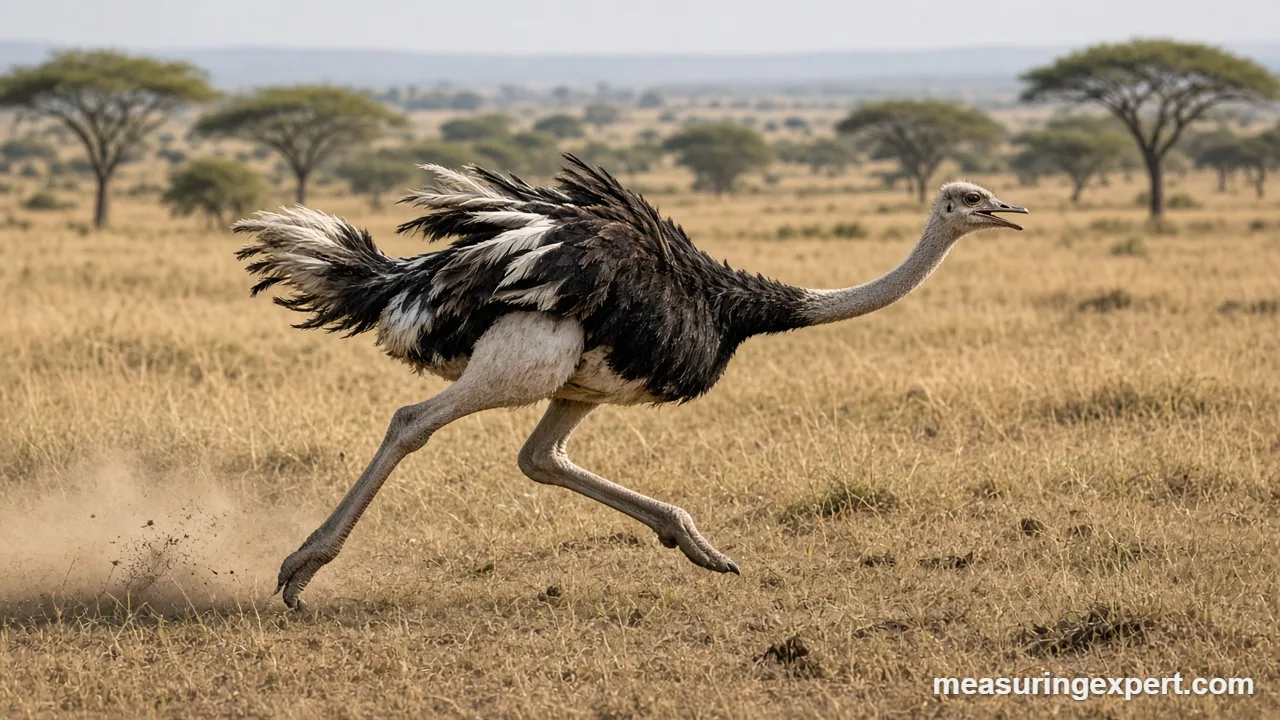
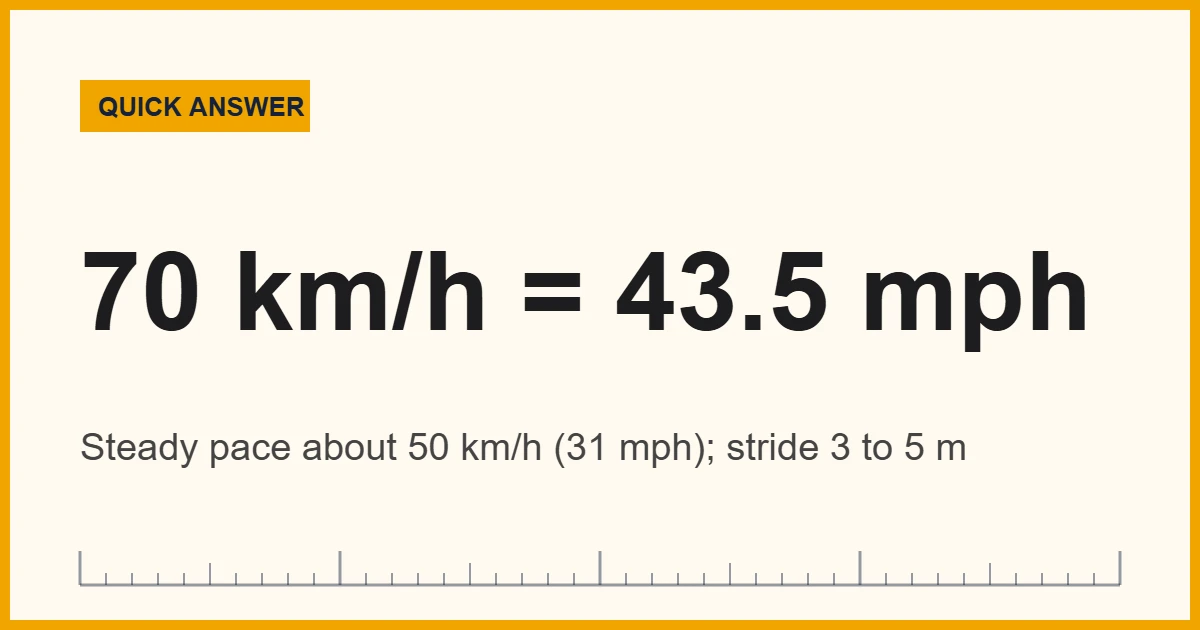
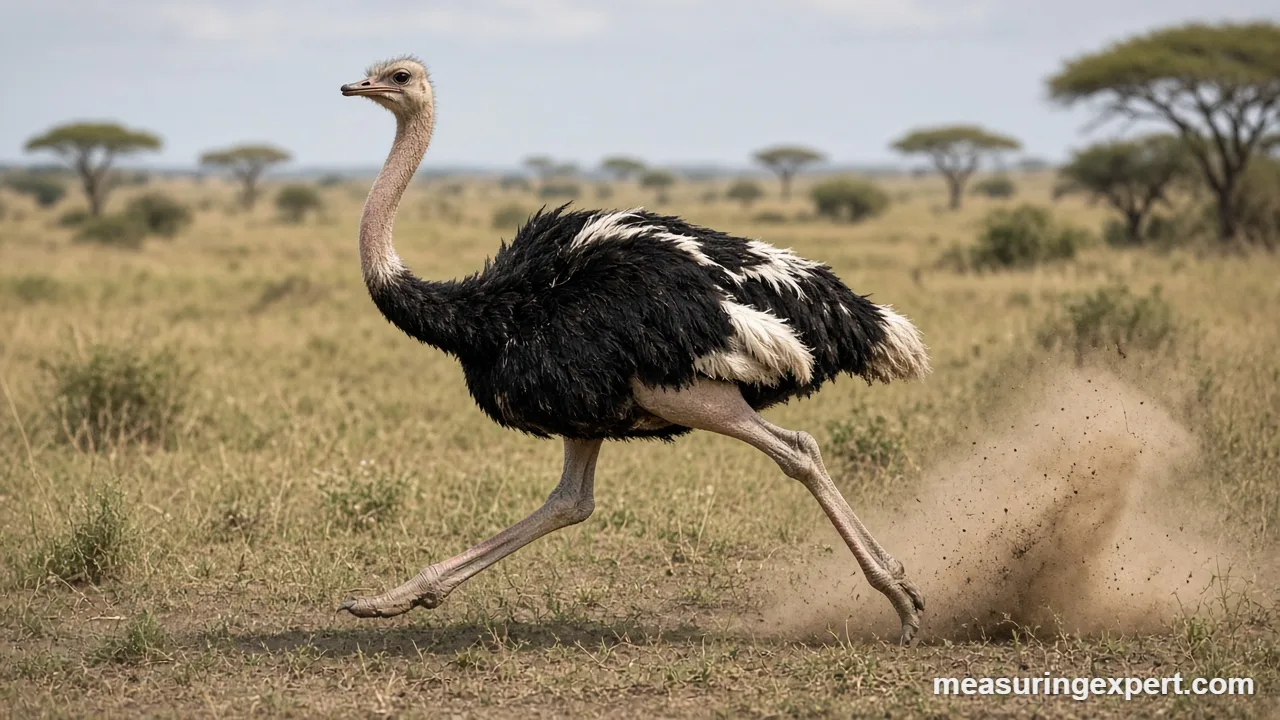
Ostrich speed tops out at about 43 mph (70 km/h) in short sprints, which makes the ostrich the fastest animal on two legs. It can also hold a steady 31 mph (50 km/h) for long stretches, according to the San Diego Zoo, and a single running stride covers 10 to 16 feet (3 to 5 m).




As an Amazon Associate, Measuring Expert earns from qualifying purchases.
So how quick is that in real life? At 70 km/h, an ostrich covers about 64 feet (19.4 m) every second. In other words, it would cross a football field, end zones excluded, in under five seconds. Also, the common ostrich (Struthio camelus) lives in the open savannas and semi-deserts of Africa. Because it cannot fly, running is its main way to escape lions, cheetahs and hyenas. The figures on this page come from the San Diego Zoo Wildlife Alliance ostrich profile, and every conversion uses the exact definition of a mile (1.609344 km).
Convert Ostrich Speed to mph, m/s, ft/s and Knots
To begin, type any speed into the converter and pick its unit. First, it starts at 70 km/h, the sprint figure the San Diego Zoo gives. Next, try 50 to see the steady cruising pace, or enter your own running speed to see how far behind a bird you would be.
Ostrich Speed Chart in Five Units
This chart converts the three ostrich speeds you will meet most often. In addition, it adds a slower trotting value for context. Then each row starts from km/h, and the results are rounded to two decimals.
| km/h | mph | m/s | ft/s | Knots | What it means |
|---|---|---|---|---|---|
| 30 | 18.64 | 8.33 | 27.34 | 16.20 | Easy run |
| 50 | 31.07 | 13.89 | 45.57 | 27.00 | Steady pace (San Diego Zoo) |
| 60 | 37.28 | 16.67 | 54.68 | 32.40 | Steady pace (Science in School) |
| 70 | 43.50 | 19.44 | 63.79 | 37.80 | Short sprint maximum |
Note that sources round in both directions. For example, the zoo writes 70 km/h as 43 mph, while the exact conversion is 43.50 mph. So both “43 mph” and “about 44 mph” describe the same sprint.
Sprint Pace vs Steady Pace: Two Numbers People Mix Up
Most articles give one ostrich number and then stop. However, the bird has two very different speeds, and they answer different questions.
| Term | What it means | Ostrich figure |
|---|---|---|
| Top (sprint) speed | The fastest pace, held for a short burst | About 70 km/h (43 mph) |
| Sustained speed | A pace the bird can hold over a long distance | About 50 km/h (31 mph), San Diego Zoo; some researchers say up to 60 km/h |
| Stride length | Ground covered in one running stride | 3 to 5 m (10 to 16 ft) at speed |
| mph vs km/h | 1 mph = 1.609344 km/h exactly | 70 km/h = 43.50 mph |
| Knots | Nautical miles per hour; 1 knot = 1.852 km/h | 70 km/h = 37.80 knots |
Still, the sustained figure is what really sets the ostrich apart. In fact, the zoo says the bird can keep up 50 km/h for a long time, and that kind of endurance at high speed is rare among large animals. As a result, a predator that misses its first rush rarely gets a second chance.
Ostrich Speed vs Horses, Humans and Other Fast Runners
Of course, comparisons only work when you know where each number comes from. Therefore, the table lists the source type next to every figure.
| Runner | Top speed | Where the figure comes from |
|---|---|---|
| Ostrich | 70 km/h (43.5 mph), short burst | San Diego Zoo profile (estimate) |
| Ostrich, steady | 50 km/h (31 mph) | San Diego Zoo profile |
| Racehorse (record) | 70.76 km/h (43.97 mph) over 402 m | Guinness record, Winning Brew, 2008 (timed race) |
| Human (record) | 44.7 km/h (27.8 mph) peak; 37.58 km/h (23.35 mph) race average | Usain Bolt, 9.58 s 100 m, 2009 |
| Recreational runner | About 7 to 9.5 km/h (4.5 to 6 mph) race pace | Typical pace ranges |
| White-tailed deer | 48 to 64 km/h (30 to 40 mph), burst | Wildlife agency figures |
| Red kangaroo | About 56 km/h (35 mph), burst | Field estimates |
| Emu | About 48 km/h (30 mph) | San Diego Zoo emu profile |
Ostrich vs horse
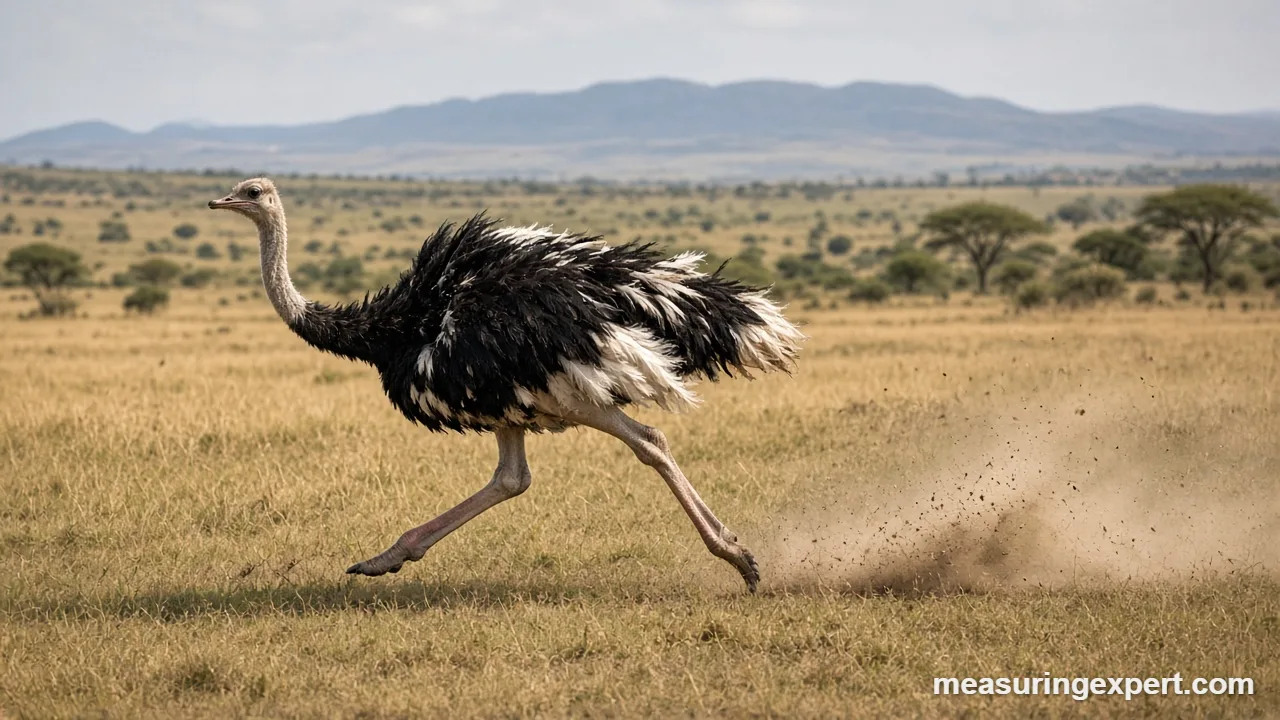
Surprisingly, the two are almost tied at the top. The Guinness racehorse record belongs to Winning Brew, who ran a quarter mile in 20.57 seconds at Penn National in 2008, or 70.76 km/h. Meanwhile, the ostrich figure of 70 km/h is a rounded estimate. So the honest verdict is a draw at sprint speed. The ostrich, however, does it on two legs while carrying no rider.
Ostrich vs human
Here, by contrast, the gap is huge. Usain Bolt peaked at about 27.8 mph, so an ostrich sprint is roughly 1.6 times faster than the fastest human ever timed. In theory, at a constant 70 km/h, a bird would cover 100 m in about 5.1 seconds, against Bolt’s 9.58. For the full human picture, see our guide on how fast a human can run. Similarly, our page on how fast a deer is shows that even a whitetail in full flight sits close to the ostrich’s cruising pace, not its sprint. Likewise, the kangaroo speed guide covers the other famous two-legged runner.
What Makes Ostrich Speed Possible
In many ways, an ostrich is built like a long-distance sprinter. For example, male birds stand 6.9 to 9 feet (2.1 to 2.7 m) tall and weigh 220 to 287 pounds (100 to 130 kg), according to the San Diego Zoo. However, most of that weight sits high on the body, which keeps the legs quick to swing.
Light lower legs, heavy thighs
For instance, Schaller’s research describes the ostrich as having the longest legs relative to its size of any bird. In particular, its big muscles sit high on the thigh and hip, while the lower leg is mostly tendon and bone. Because a light limb takes less effort to swing forward, the bird can take fast steps without tiring quickly.
Ostrich speed and stride length
Next comes the stride. At full speed, then, one stride covers 10 to 16 feet (3 to 5 m). For example, if a bird running at 70 km/h used a 5 m stride, it would take about 3.9 strides per second. A human sprinter, by contrast, covers far less ground per step, so long legs do much of the work.
Two toes and springy tendons
Finally, the foot. To begin with, the ostrich is the only bird with just two toes, and it runs on its tiptoes. In addition, ligaments around the ankle hold the joint steady without extra muscle effort, so the muscles can push the body forward instead. The wings also help: the bird spreads them for balance and sharp turns, but they add no lift.
Fixing Common Ostrich Speed Myths
Sadly, many web pages repeat numbers that do not hold up. So here are the ones we corrected when we rewrote this page.
- “Ostriches run 60 mph.” No reliable source supports this. In fact, the accepted sprint figure is about 43 mph (70 km/h).
- “They hold top speed for 10 to 15 minutes.” The top speed is only a short burst. Instead, the long-distance number is the 50 km/h steady pace.
- “Sand cuts their speed to 30 km/h.” We found no study that measured ostrich speed by terrain, so we removed that invented table.
- “The ostrich is the fastest bird.” Only on land. A peregrine falcon in a hunting dive moves far faster, but that is falling, not running.
How to Time a Running Animal Yourself
Of course, you cannot clock a wild ostrich safely. Still, the same distance-over-time method works on a dog, a horse or a video from a safari trip.
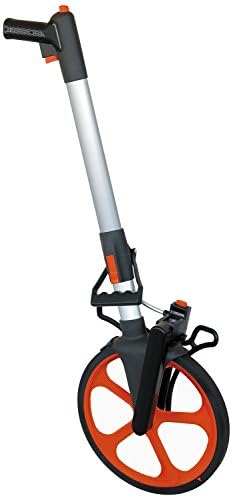
- Measure a straight course. Use a measuring wheel or tape, for example 50 m (164 ft) on flat ground.
- Set up the camera. Next, film from the side, far enough back that both end marks stay in the frame.
- Read the times. Then step through the clip frame by frame and note when the animal passes each mark.
- Divide distance by time. For instance, 50 m in 4 seconds equals 12.5 m/s.
- Convert the result. Finally, enter it in the converter above as m/s to get km/h and mph.
- Average several runs. One trial can mislead you, so repeat it three or more times.
Alternatively, a sports radar gun gives a faster reading. However, it reads low when the animal runs at an angle to the beam, so aim it straight along the path.
Recommended Tools for Timing Animal Speed
Admittedly, none of these tools will help you race an ostrich. Still, they make it easy to measure a course, time a run and watch fast movement from a safe distance at a zoo or farm park.
Do and Don’t When Comparing Animal Speeds
Do
- First, check who published the number.
- Separate burst speed from steady pace.
- Convert with 1 mph = 1.609344 km/h.
- Compare figures from similar methods.
- Keep a safe distance from large birds.
Don’t
- Trust a speed that has no source.
- Read “up to” as a typical pace.
- Mix knots with miles per hour.
- Rely on a single timed run.
- Chase or corner an ostrich on a farm.
Honest Limits of Ostrich Speed Figures
Even now, no large study has clocked many wild ostriches at full sprint with GPS. As a result, the 70 km/h figure is a widely accepted estimate, not a precise record like a horse race time. Moreover, sources round heavily, and the steady pace ranges from 50 to 60 km/h depending on who you read. In addition, individual birds differ by sex, age and fitness. So the honest answer is about 70 km/h at the top and roughly 50 km/h over distance.
When Accuracy Really Matters
For example, for trivia or a class report, “about 43 mph” is enough. On the other hand, three uses need more care. First, school and science writing should name the source and say whether the number is a burst or a steady pace. Second, comparisons with horses or deer should use figures of the same type. Finally, safety planning on ostrich farms or safari drives should assume the bird can close a gap of 20 m in about a second.
Ostrich Speed FAQs
What is the top ostrich speed?
About 43 mph (70 km/h) in a short sprint, according to the San Diego Zoo Wildlife Alliance.
How fast is an ostrich in km/h?
About 70 km/h at a sprint and about 50 km/h at a steady pace it can hold for a long time.
How long can an ostrich keep its speed?
The top sprint lasts only a short burst. However, the bird can hold about 50 km/h (31 mph) over long distances.
Is an ostrich faster than a horse?
In fact, they are about even. The Guinness racehorse record is 70.76 km/h, and the ostrich sprint estimate is about 70 km/h.
Can a human outrun an ostrich?
No. Usain Bolt peaked at about 27.8 mph, while an ostrich sprints at about 43 mph and cruises near 31 mph.
How long is an ostrich stride?
At speed, a running stride is 10 to 16 feet (3 to 5 m) long, so it is a big part of the bird’s speed.
How does ostrich speed compare with an emu?
An ostrich is faster. The San Diego Zoo gives emus a sprint of about 30 mph (48 km/h), close to the ostrich’s cruising pace.
What is ostrich speed in meters per second?
That works out to about 19.44 m/s at 70 km/h and about 13.89 m/s at 50 km/h.
Why can’t ostriches fly?
Simply put, their wings are too small for a body of up to 287 pounds. Instead, they use the wings for balance, turning and display.
Is the ostrich the fastest bird?
It is the fastest bird on land and the fastest two-legged runner. In the air, a diving peregrine falcon is much faster.
The Bottom Line on Ostrich Speed
In short, an ostrich sprints at about 43 mph (70 km/h) and can hold about 31 mph (50 km/h) for long stretches, with strides of up to 16 feet. As a result, that ties the fastest racehorse on record and leaves any human far behind. Also remember that the sprint figure is an estimate, so use the converter above whenever you need it in m/s, ft/s or knots.
Black Friday is coming: shop the deals with Prime