

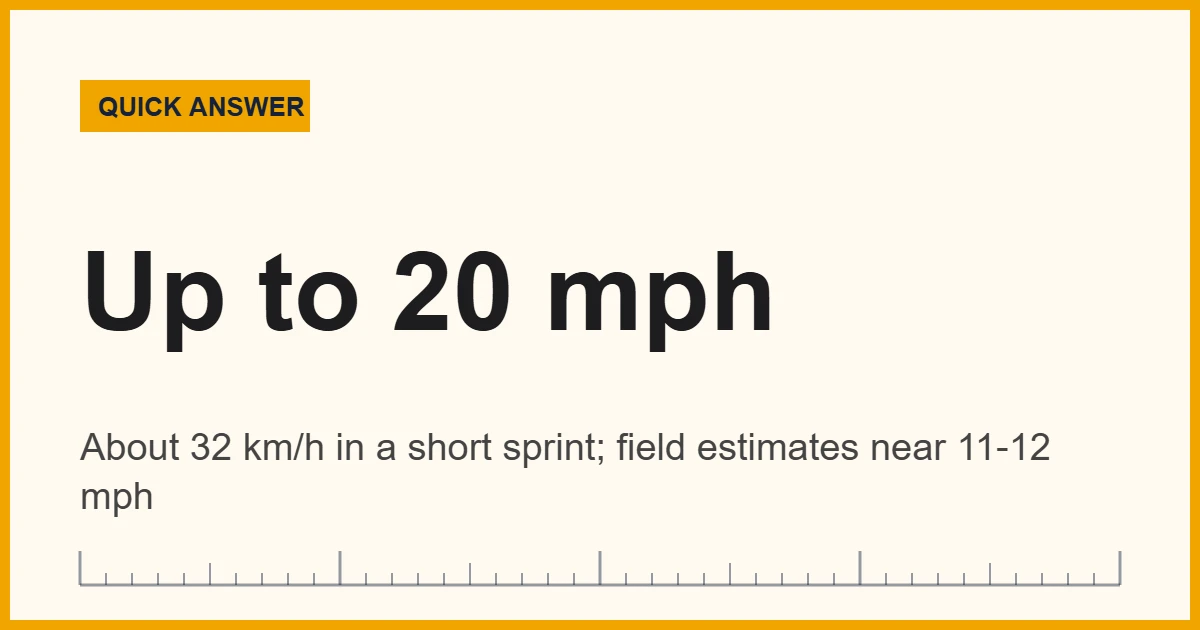
Squirrel speed tops out at about 15 to 20 mph (24 to 32 km/h) in a short sprint. For example, eastern gray and fox squirrels are usually quoted at up to 20 mph, while some field estimates come in lower, near 11 to 12 mph (18 to 20 km/h). So a squirrel can cross a 50-foot yard in about 2 seconds.
Convert Squirrel Speed to km/h, m/s or Knots
Start with 20 mph, the figure most wildlife guides give, or type any speed you have read or measured. The converter then shows the same pace in kilometers per hour, meters per second, feet per second and knots, using the exact definition of the mile (1 mile = 1.609344 km).
Anyone who has watched a squirrel bolt across a lawn knows it looks faster than a car in a parking lot. In reality, the sprint lasts only a few seconds, and it rarely runs in a straight line. That is why published figures vary so much. Still, the range is narrow enough to be useful: roughly 11 mph at the low end and 20 mph at the top.
For instance, the NYC Parks wildlife team says on its eastern gray squirrel page that squirrels can run up to 15 mph on the ground and leap more than 8 feet. Meanwhile, the Forest Preserve District of Will County, Illinois, puts the gray squirrel’s top speed at up to 20 mph. Both numbers describe a short burst, not a pace a squirrel keeps up.
Below, you will find squirrel speed by species, a unit chart, what makes such a small animal so quick, how it compares with people, and finally a simple way to time a squirrel in your own yard.
Squirrel Speed by Species
North America has several tree squirrels, and the two big ones, the eastern gray and the fox squirrel, get most of the attention. The table lists the figures that wildlife agencies and field observers publish, along with their metric values. Note that these are top sprint speeds over a few yards.
| Squirrel | Published top speed | Metric | Where the figure comes from |
|---|---|---|---|
| Eastern gray squirrel | 15 to 20 mph | 24 to 32 km/h | NYC Parks (15 mph); Will County Forest Preserve (20 mph) |
| Eastern gray squirrel (field estimates) | 11 to 12.4 mph | 18 to 20 km/h | Trail camera timing and older published estimates |
| Eastern fox squirrel | up to about 20 mph | about 32 km/h | Regional wildlife guides |
| Eurasian red squirrel | about 20 mph | about 32 km/h | Timed escapes and video analysis in the UK |
The lower gray squirrel figures come from the UK naturalist site Wildlife Online, which reviews squirrel locomotion and estimates about 11 mph from trail camera footage. In other words, a squirrel that is merely hurrying across open ground goes noticeably slower than one fleeing a hawk or a dog.
Squirrel Speed in Every Unit
Because some sources use mph and others use km/h, this chart lines up the values side by side. All conversions use 1 mph = 1.609344 km/h and 1 knot = 1.852 km/h, both exact definitions.
| mph | km/h | m/s | ft/s | Knots |
|---|---|---|---|---|
| 8 | 12.9 | 3.58 | 11.7 | 7.0 |
| 10 | 16.1 | 4.47 | 14.7 | 8.7 |
| 12 | 19.3 | 5.36 | 17.6 | 10.4 |
| 14 | 22.5 | 6.26 | 20.5 | 12.2 |
| 15 | 24.1 | 6.71 | 22.0 | 13.0 |
| 16 | 25.7 | 7.15 | 23.5 | 13.9 |
| 18 | 29.0 | 8.05 | 26.4 | 15.6 |
| 20 | 32.2 | 8.94 | 29.3 | 17.4 |
Print this chart if you plan to time squirrels with a class or a nature group. Also, for boating units, our guide to how fast a knot is explains why sailors use them.
Recommended Tools for Timing Backyard Wildlife
You do not need lab gear to estimate how fast a squirrel runs. First, a trail camera records the run without disturbing the animal, and most models stamp the time on each clip. Next, a stopwatch helps with quick checks. Finally, a good pair of binoculars lets you watch from a distance, so the squirrel behaves normally.


As an Amazon Associate, Measuring Expert earns from qualifying purchases.
How a Small Animal Runs So Fast
A gray squirrel is only about 9 to 12 inches long without its tail and weighs up to about 2 pounds, according to NYC Parks. Even so, it covers ground quickly because its body is built for bursts.
Legs, Claws and a Bounding Gait
Squirrels do not trot like dogs. Instead, they bound: the long hind legs push off together, the front feet land, and then the hind feet swing past them for the next push. As a result, each stride covers several body lengths. Sharp, curved claws also grip bark, fences and grass, so little energy is lost to slipping. In addition, the rear ankles can rotate almost 180 degrees, which is why squirrels can run head-first down a tree.
The Tail as a Rudder
The bushy tail is nearly as long as the body. During a sprint, it works as a counterweight, so a squirrel can cut left and right without tipping over. This zigzag running matters more than raw speed. After all, a hawk or a fox can often outrun a squirrel on a straight line, but it struggles to follow sudden turns.
Squirrel Speed Compared With People and Other Animals
Most people jog at about 5 to 6 mph, so a sprinting squirrel is two to three times faster than a casual runner. However, the fastest humans can match it. During his 2009 world record, Usain Bolt briefly reached about 27 mph (roughly 44.7 km/h).
| Runner | Typical top speed | Metric |
|---|---|---|
| Casual human jogger | 5 to 6 mph | 8 to 10 km/h |
| Squirrel, field estimate | 11 to 12 mph | 18 to 20 km/h |
| Squirrel, published top speed | 15 to 20 mph | 24 to 32 km/h |
| Elite human sprinter (peak) | about 27 mph | about 44.7 km/h |
Larger animals are another story. For example, a white-tailed deer is far quicker over open ground, as our guide to how fast a deer runs shows. Similarly, see how fast a human can run for the full range of human speeds, from walking to world records.
Running Speed vs Climbing and Jumping
A squirrel rarely needs to outrun anything for long. Instead, it heads for the nearest tree. Climbing is its real escape plan, and jumping links one branch to the next.
- Jumping: NYC Parks says gray squirrels can leap upward more than 8 feet. Wildlife Online also reports gaps of about 2.5 m (8.2 ft) between branches, roughly ten times the body length.
- Climbing: claws and rotating ankles let a squirrel go straight up a trunk and come back down head-first.
- Falling: a light body and a tail that spreads like a brake help squirrels survive drops that would injure larger animals.
So when people ask about squirrel speed, the honest answer includes all three moves. On the ground the burst is short; in the trees, agility does most of the work.
How to Measure Squirrel Speed in Your Yard
You can estimate a squirrel’s speed with a phone, a tape measure and the converter above. Here is the method:
- Pick a regular route. Watch for a path the squirrel uses every day, such as a fence top or a run from a feeder to a tree.
- Mark a known distance. Place two markers along the route and measure the gap with a tape, for example 20 feet (6.1 m).
- Record the run on video. Set a phone or trail camera to the side so both markers are in the frame.
- Count the frames. Step through the clip and count frames between the two markers. At 30 frames per second, 24 frames equals 0.8 seconds.
- Divide distance by time. For example, 20 feet in 0.8 seconds is 25 feet per second.
- Convert the result. Enter 25 ft/s in the converter: that is about 17 mph, or 27.4 km/h.
- Repeat and compare. Time several runs, because a calm squirrel and a frightened one move at very different speeds.
If you want sharper timing, light gates do the job without video. Our guide on how to use light gates to measure speed explains the setup.
Do and Don’t When Watching Squirrels
Do
- Watch from a distance, ideally with binoculars.
- Measure the marker gap with a tape, not by eye.
- Film side-on so the run crosses the frame.
- Note whether the squirrel was calm or fleeing.
- Average several runs before quoting a number.
Don’t
- Chase a squirrel to make it run faster.
- Hand-feed or try to touch wild squirrels.
- Trust one stopwatch reading for a 1-second run.
- Film at an angle, which distorts the distance.
- Assume the top speed is a typical speed.
Honest Limits of Squirrel Speed Figures
Squirrel speed is hard to pin down, and every number on this page carries some uncertainty. First, nobody has run large, controlled trials of wild squirrels at top speed. Second, a sprint often lasts under two seconds, so a timing error of a tenth of a second changes the result by 5 to 10 percent. Third, squirrels zigzag, so the straight-line distance underestimates how far they actually ran. Moreover, many websites repeat the same rounded 20 mph figure without saying where it came from. In short, treat 15 to 20 mph as a reasonable top-speed range and 11 to 12 mph as a common field estimate, not as exact values.
When Accuracy Really Matters
For a school project or backyard curiosity, a range is fine. However, two situations call for more care. If you are writing a report, cite where each number comes from and say whether it is a top speed or an estimate. If you are building a squirrel-proof feeder or garden, plan for jumps of 8 feet or more, because jumping, not running, is how squirrels get past barriers.
Frequently Asked Questions
What is the top squirrel speed?
Most wildlife sources put the top squirrel speed at about 15 to 20 mph, or 24 to 32 km/h, during a short sprint.
How fast can a squirrel run in km/h?
A squirrel can run about 24 to 32 km/h at full sprint. Field estimates for calmer runs are closer to 18 to 20 km/h.
Is squirrel speed faster than a human?
A squirrel is much faster than a jogger at 5 to 6 mph. However, elite sprinters peak around 27 mph, which is faster than any squirrel.
Which squirrel is the fastest?
Eastern gray, fox and Eurasian red squirrels are all quoted at up to about 20 mph. No reliable study ranks them against each other.
How long can a squirrel keep running?
Only a few seconds at top speed. Squirrels sprint to the nearest tree or cover rather than running long distances.
How fast is a squirrel in meters per second?
At 15 mph, a squirrel moves about 6.7 m/s. At 20 mph, it moves about 8.9 m/s.
How far can a squirrel jump?
Gray squirrels can leap more than 8 feet, and they can cross gaps of about 2.5 m (8.2 ft) between branches.
Does squirrel speed change with age or health?
Probably, as with most animals, an injured or sick squirrel moves more slowly. However, no published data give exact speeds by age.
Why do squirrels run in a zigzag?
Zigzag running makes it hard for hawks, foxes and cats to predict where the squirrel will go. The tail acts as a counterweight for the sharp turns.
How can I measure squirrel speed at home?
Mark a measured distance on a route the squirrel uses, film a run, count the frames between the markers, then divide distance by time and convert the result.
Squirrel Speed: The Bottom Line
To sum up, a squirrel sprints at about 15 to 20 mph (24 to 32 km/h), and calmer runs measured in the field come in nearer 11 to 12 mph. That is fast enough to cross a yard in about 2 seconds and, relative to body size, far faster than any human runner.
Still, a squirrel’s real advantage is not straight-line speed. Instead, its zigzag running, climbing and 8-foot leaps keep it safe. So if you want your own number, mark a distance, film a run and use the converter at the top of this page.