

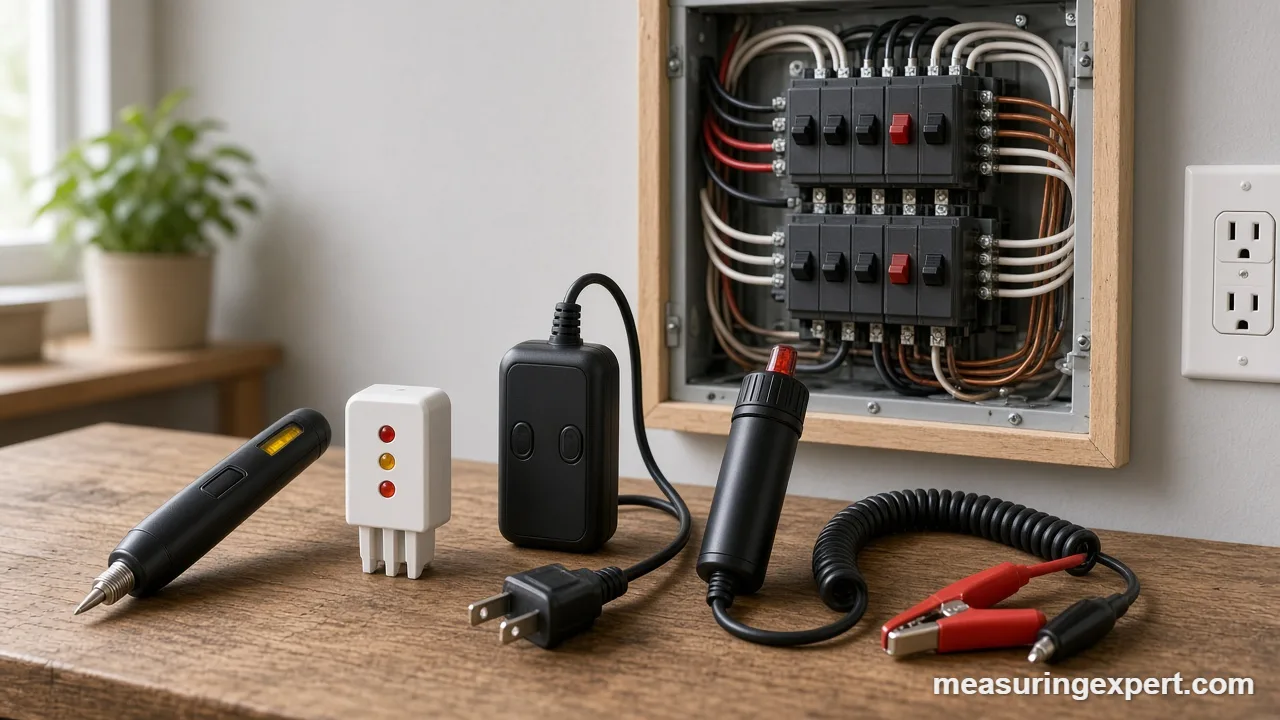
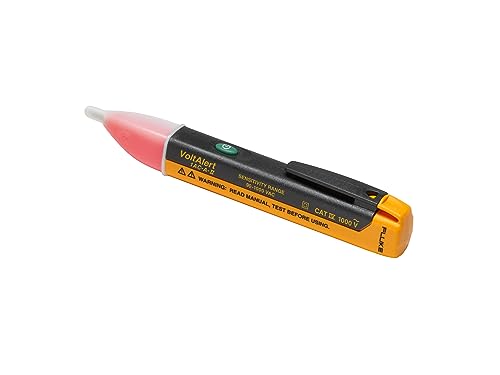
The best electric circuit tester for most homes is the Fluke 1AC II, a CAT IV 1000 V non-contact pen that warns you before you touch a live wire. However, the job decides the tool: outlet wiring calls for a plug-in GFCI tester, an unlabeled panel calls for a breaker finder, and dead circuits call for continuity.
In short: carry the Fluke 1AC II, add the Klein RT250 for outlets, and buy the Sperry STK001 kit if you want both on a tight budget.
As an Amazon Associate, Measuring Expert earns from qualifying purchases. Our picks are based on research, specifications and owner feedback, not paid placement.
Best Overall
Best Outlet Tester

Best Budget

Quick Answer: Which Circuit Tester Fits Your Job?
- Is this wire live? Fluke 1AC II, rated CAT IV 1000 V.
- Thermostat or doorbell wiring: Bosch GVD1000-17, which senses down to 24 V AC.
- Outlet wiring and GFCIs: Klein RT250 shows voltage and trip time.
- Tight budget: Sperry STK001 bundles a pen and an outlet tester.
- Unlabeled panel: Klein ET310, or the Fluke BK120 for pros.
- Fuses and cords: Gardner Bender GCT-3304 continuity tester.
- Car wiring: Power Probe 3 for 12 to 24 V DC.
On This Page
- Side-by-side comparison
- The 8 testers, reviewed
- How we chose
- Four tester types compared
- CAT ratings explained
- Test-before-touch steps
- Reading the lights and beeps
- Care and self-checks
- What testers cannot tell you
- FAQ
- Final pick
Best Electric Circuit Tester Comparison at a Glance
Scan the Best For column first, then jump to the full review.
| # | Product | Best For | Standout Feature | Amazon |
|---|---|---|---|---|
| 1 | Fluke 1AC II VoltAlert | Most homeowners and electricians | CAT IV 1000 V rating with a continuous self-test | View |
| 2 | Bosch GVD1000-17 | HVAC techs and low-voltage work | 24 V low-voltage mode, IP67 sealing and a flashlight | View |
| 3 | Klein Tools RT250 | Checking outlets and GFCIs | LCD shows outlet voltage and GFCI trip time | View |
| 4 | Sperry STK001 Test Kit | First-time DIY toolbox | NCV pen plus GFCI outlet tester in one kit | View |
| 5 | Klein Tools ET310 | Labeling a panel at home | Breaker finder with a built-in GFCI outlet tester | View |
| 6 | Fluke BK120 SmartTrace | Electricians and inspectors | Breaker finder, socket tester and 90-240 V NCV mode | View |
| 7 | Gardner Bender GCT-3304 | Fuses, cords and switches | Simple bulb tester with a 36 in lead and alligator clip | View |
| 8 | Power Probe 3 (PP319FTC) | 12 V and 24 V vehicle circuits | Probe can apply power or ground through an 8 A breaker | View |
The 8 Best Electric Circuit Tester Picks, Reviewed
We grouped the picks by job. First come two non-contact pens, then two outlet testers, two breaker finders, a continuity tester and a car probe. Two-pole voltage testers such as the Fluke T5-1000, Klein ET250 and IDEAL 61-557 live in our best digital voltmeter roundup, so we do not repeat them here.
Best Overall
1. Fluke 1AC II VoltAlert
Best for: Anyone who wants one pocket tester to confirm a wire, cord or outlet is live before touching it.
The Fluke 1AC II is the pen that many electricians clip into a shirt pocket, and for good reason. It senses AC voltage through insulation, so you never touch a bare conductor. When it finds voltage, the tip glows red and a beeper sounds.
Above all, what sets it apart is the safety rating. Fluke rates the 1AC II at CAT IV 1000 V under IEC 61010, which covers the service entrance and the meter base, not just wall outlets. In addition, the tip blinks during a continuous self-test, so you can see the tester is alive before you trust a quiet reading. For most readers, it is the best electric circuit tester to buy first.
- Detection range: nominally 90 V to 1000 V AC
- Safety rating: CAT IV 1000 V (IEC 61010-2-030)
- Alerts: bright red tip LED plus a beeper you can silence
- Power: two AAA batteries, typical life over a year
Pros
- Highest safety rating in this roundup
- Continuous self-test blink shows it is working
- Simple one-button use with an optional silent mode
Cons
- Will not detect voltage below about 90 V AC
- No flashlight or low-voltage mode
- Gives a yes or no answer, not a voltage reading
Skip it if: you work on doorbells, thermostats or 24 V HVAC controls; the Bosch below reaches lower voltages.
Best Dual-Range NCV
2. Bosch GVD1000-17

Best for: Technicians who check both 120 V circuits and low-voltage controls, often in dark or damp spaces.
In general, most pen testers start sensing around 50 to 90 V AC. The Bosch GVD1000-17 adds a second, more sensitive mode that starts at 24 V AC. Therefore, you can check a furnace control circuit or a landscape lighting run with the same pen you use on branch circuits.
Bosch also gives it three kinds of feedback. A green light means no voltage, red means voltage, and orange marks low voltage, while sound and vibration back them up. Meanwhile, IP67 sealing and a built-in flashlight help in damp or dark spaces.
- Detection ranges: 24 to 1000 V AC (low mode) and 90 to 1000 V AC (standard)
- Safety rating: CAT IV 1000 V
- Sealing: IP67 dust-tight and water-resistant
- Alerts: color light, beeper and vibration
- Self-test runs every 5 seconds; power from two AAA batteries
Pros
- Low-voltage mode reaches 24 V AC
- Vibration alert works in loud places
- IP67 sealing and a built-in flashlight
Cons
- High-sensitivity mode picks up more phantom signals
- Newer model with a shorter track record than the Fluke
Skip it if: you only ever test standard 120 V outlets; the simpler Fluke 1AC II covers that well.
Best Outlet Tester
3. Klein Tools RT250
Best for: Homeowners, inspectors and landlords who need to check many 120 V receptacles quickly.
A plug-in receptacle tester answers a different question than a pen. Instead of asking whether a wire is live, it checks whether the outlet is wired correctly. The Klein RT250 plugs into a standard 3-wire 120 V outlet and lights green or red LEDs to flag common wiring faults. In addition, its backlit LCD shows the voltage at the outlet, which plain 3-light testers cannot do.
Similarly, the GFCI test stands out. When you press the test button, the RT250 trips the GFCI and then displays how long the trip took. Klein also adds open neutral and open ground detection, plus Auto-Hold. For outlet work, it is the best electric circuit tester in this group.
- For 3-wire, 120 V North American outlets only
- Safety rating: CAT II 135 V
- Displays outlet voltage and GFCI trip time on a backlit LCD
- Open neutral and open ground detection
- 6.6 ft (2 m) drop rating; two AAA batteries
Pros
- Shows actual voltage, not just a light pattern
- Measures GFCI trip time
- Auto-Hold for hard-to-see outlets
Cons
- Does not work on 240 V or 2-wire outlets
- CAT II rating limits it to plug-in use
- Cannot find every fault, such as a bootleg ground
Skip it if: you need a tester for wires inside a panel or box; use a pen tester for that.
Best Budget Kit
4. Sperry STK001 Test Kit
Best for: New homeowners who want both basic tester types without paying for two premium tools.
To begin with, the Sperry STK001 pairs two classic tools. The VD6504 pen detects 50 to 1000 V AC without contact, and the GFI6302 plugs into 120 V outlets to show wiring condition with color-coded neon lights. As a result, one purchase covers the two checks most homeowners make. Sperry Instruments now sits under the Gardner Bender family, so you may see either name on the packaging.
Moreover, both tools are built to take abuse. The listing rates each one for a 10 ft drop and a 250 lb crush. However, the outlet tester only shows a light pattern, so it will not tell you the actual voltage or GFCI trip time the way the Klein RT250 does.
- VD6504 range: 50 to 1000 V AC, non-contact
- VD6504 rating: CAT III 1000 V and CAT IV 600 V
- GFI6302: tests standard 3-wire and GFCI-protected 120 V outlets
- Both: 10 ft drop and 250 lb crush rating
Pros
- Two tester types in one low-cost kit
- Pen starts sensing at 50 V AC
- Tough housings with drop and crush ratings
Cons
- Outlet tester has no voltage readout
- Pen has no flashlight or low-voltage mode
Skip it if: you already own an NCV pen; buy the Klein RT250 alone instead.
Best Breaker Finder
5. Klein Tools ET310

Best for: Anyone who faces a panel full of unlabeled breakers and wants to map them without flipping each one.
A circuit breaker finder has two parts. First, you plug the transmitter into a live outlet. Next, you sweep the receiver along the breakers until it signals the one that feeds that outlet. The Klein ET310 works on 90 to 120 V AC circuits, and its transmitter doubles as a GFCI outlet tester that also checks wiring condition.
Klein made the pair easy to carry, because the transmitter docks inside the receiver. The receiver runs on a 9 V battery, shows a low-battery warning and turns itself off after about three minutes. Note the CAT II 120 V rating, which reflects that this is a plug-in tool, not a probe for panel conductors.
- Works on 90 to 120 V AC circuits
- Safety rating: CAT II 120 V
- Transmitter includes a GFCI and wiring tester
- Receiver: one 9 V battery, auto power-off, low-battery indicator
Pros
- Maps breakers without cutting power to the house
- Two tools in one compact package
- Transmitter needs no battery
Cons
- 120 V circuits only, so no 240 V breakers
- Needs a working outlet on the circuit
- Crowded panels can give more than one signal
Skip it if: your panel is already labeled, or most of your circuits are 240 V appliance circuits.
Best Pro Breaker Finder
6. Fluke BK120 SmartTrace

Best for: Pros who want breaker tracing, a socket check and a non-contact voltage mode in one receiver.
The Fluke BK120 takes the same plug-in transmitter idea and adds more to the receiver. Besides tracing breakers, the receiver works as a non-contact voltage detector from 90 to 240 V AC, with dual sensitivity settings. Therefore, you can confirm that the breaker you found really killed the outlet without grabbing a second tool.
Meanwhile, the transmitter runs on 110 to 125 V AC outlets, performs a wiring check and runs a one-button GFCI test. Fluke rates both parts at CAT III 150 V, which is a step above the CAT II ratings common on budget breaker finders.
- Transmitter: 110 to 125 V AC outlets
- Receiver NCV mode: 90 to 240 V AC with dual sensitivity
- Safety rating: CAT III 150 V (transmitter and receiver)
- One-button GFCI test and outlet wiring check
- Receiver: two AAA batteries, auto power-off
Pros
- NCV mode confirms the circuit is dead
- Higher CAT rating than most breaker finders
- Fluke build quality and support
Cons
- Transmitter still limited to 120 V class outlets
- Costs more than basic breaker finders
Skip it if: you only need to label a few breakers once; the Klein ET310 does that for less.
Best Continuity Tester
7. Gardner Bender GCT-3304

Best for: DIYers who need a quick yes or no on whether a fuse, cord, switch or heating element has a complete path.
A continuity tester checks for an unbroken path on a circuit that has no power. You clip the lead to one end of a conductor and touch the probe to the other end. If the path is complete, the indicator bulb lights. Gardner Bender lists extension cords, fuses, switches, water heater elements and de-energized low-voltage wiring as typical jobs.
It is not a voltage tester, so never use it on a live circuit. Instead, confirm the circuit is dead with an NCV pen first, then use the GCT-3304 to find the break. For resistance values in ohms rather than a lamp, step up to one of the meters in our best digital multimeter guide.
- 36 in (91 cm) insulated test lead
- Alligator clip on the lead end
- Indicator bulb lights when continuity exists
- cUL/UL listed
Pros
- Dead simple and hard to misread
- Long lead reaches across appliances
- Handy second tool next to an NCV pen
Cons
- Must only be used on de-energized circuits
- No resistance value, only a light
- No safety CAT rating for live testing
Skip it if: you already own a multimeter with a continuity beeper.
Best for Cars
8. Power Probe 3 (PP319FTC)

Best for: DIY mechanics and auto techs chasing faults in 12 to 24 V DC vehicle wiring.
The Power Probe 3 is a 12 to 24 V DC circuit tester for vehicles, and it does not belong on household AC wiring. You clip it to the car battery, then probe wires to read DC voltage, check continuity and spot a bad ground.
Above all, its party trick is driving components. With a rocker switch, the tip can apply battery power or ground, so you can run a fan motor, horn or lamp directly. In addition, a resettable 8 A breaker protects the tool when you hit a short. The kit includes a 20 ft extension, so the probe can reach from the battery to the tail lights.
- Voltage range: 12 to 24 V DC vehicle systems
- 20 ft cable plus a 20 ft extension
- Resettable 8 A circuit breaker
- Applies power or ground; tests continuity and bad grounds
Pros
- Powers components directly for quick tests
- Long reach for whole-vehicle work
- Bad-ground indicator saves time
Cons
- Not for household AC circuits
- Applying power to sensitive modules can damage them
Skip it if: you only work on home wiring; any pick above suits you better.
How We Chose the Best Electric Circuit Tester Picks
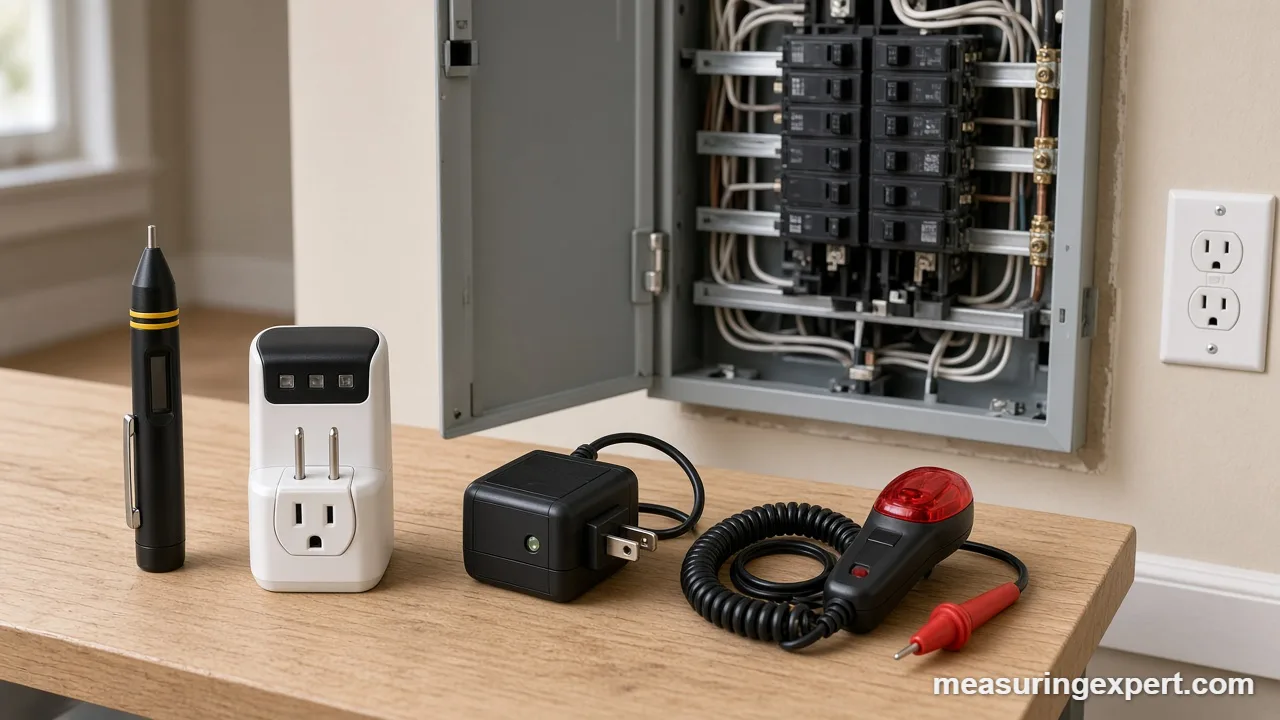
We did not run hands-on tests for this guide. Instead, our picks are research-based. We read manufacturer spec sheets and manuals, compared safety ratings, and weighed long-running owner feedback. Then we applied four filters.
- Safety rating first: every tool meant for live AC circuits carries a stated CAT rating, and we report that rating exactly as the maker lists it.
- Clear job fit: each pick does one job well, so the list covers pens, outlet testers, breaker finders, continuity and car probes without near-duplicates.
- Established brands: Fluke, Klein, Bosch, Sperry, Gardner Bender and Power Probe all publish specs and support their tools.
- Verified specs only: if we could not confirm a number on a maker or spec page, we left it out.
We also checked the rules that drive the habit of testing before touching. For example, OSHA rule 29 CFR 1910.333 requires a qualified person to use test equipment to verify that exposed parts are de-energized. Above 600 V, the rule also requires checking the tester itself immediately before and after the test.
Four Circuit Tester Types and What Each One Measures
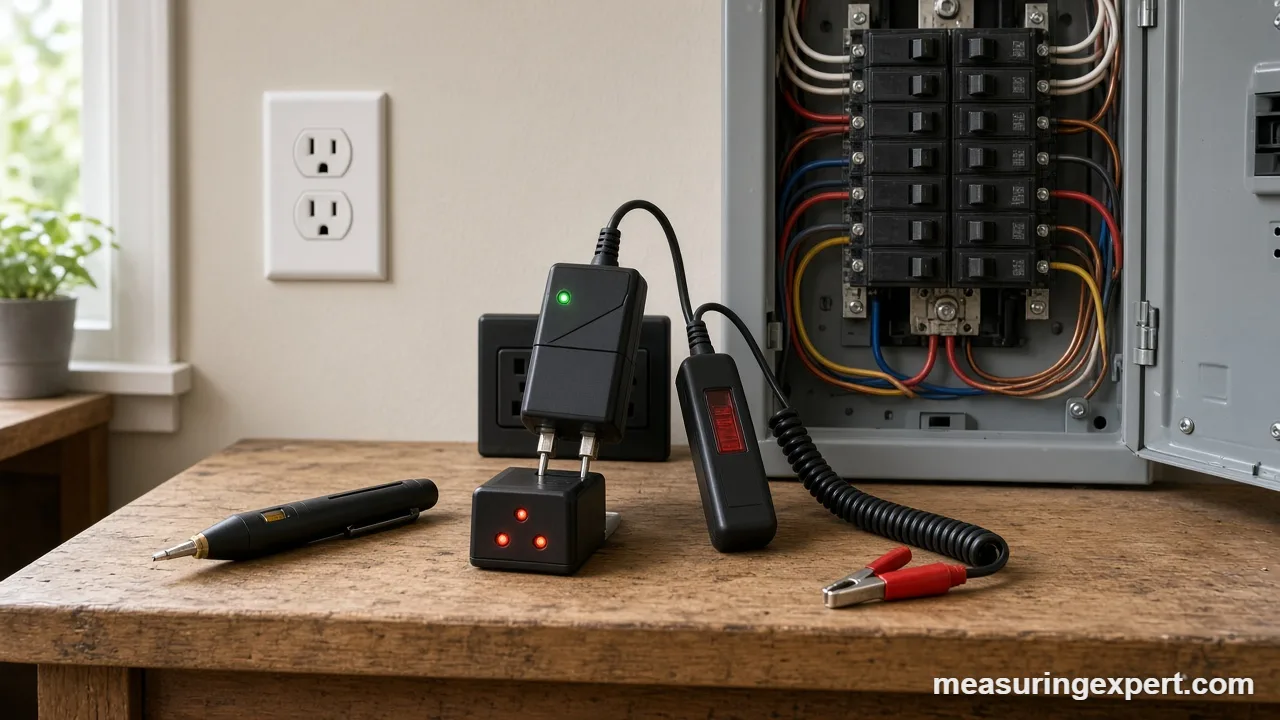
“Circuit tester” covers several tools, and each one answers a different question.
| Type | Question it answers | Works on | Gives a number? |
|---|---|---|---|
| Non-contact voltage tester (NCV pen) | Is AC voltage present here? | Live AC wires, cords, outlets | No, a light and beep |
| Outlet / GFCI receptacle tester | Is this outlet wired right, and does the GFCI trip? | Live 120 V, 3-wire outlets | Some show volts and trip time |
| Circuit breaker finder | Which breaker feeds this outlet? | Live 120 V circuits | No, a signal on one breaker |
| Continuity tester | Is there an unbroken path? | De-energized parts only | No, a lamp or beep |
A two-pole voltage tester or a multimeter adds actual readings in volts. If you want to understand what those numbers mean, our explainer on the voltage symbol and unit covers the volt itself.
CAT Ratings: The Spec That Matters Most on the Best Electric Circuit Tester
A CAT (measurement category) rating tells you where in a building a tester can safely be used. It also shows how well the tool resists brief voltage spikes, called transients, which can arc inside a tester. According to Fluke’s summary of IEC 61010-1, the categories break down like this:
- CAT II: single-phase loads plugged into receptacles, such as appliances and portable tools.
- CAT III: fixed distribution wiring, such as panels, switchgear, motors and commercial lighting.
- CAT IV: the utility connection and service entrance, such as outdoor conductors and the meter.
Higher categories face larger transients, so a CAT IV 1000 V pen like the Fluke 1AC II or Bosch GVD1000-17 can be used anywhere in a house. By contrast, the Klein RT250 (CAT II 135 V) and Klein ET310 (CAT II 120 V) are plug-in tools. That is fine for their job, but they are not meant for probing inside a panel. Also, always compare the category first and the voltage second; the category tells you where the tool belongs.
How to Test a Circuit Before You Touch It
Electricians call this routine “test before touch,” and it mirrors the live-dead-live check that OSHA describes. Use it every time, even when you just flipped the breaker yourself.
- Check your tester on a known live source, such as an outlet you know works, and confirm it alerts.
- Turn off the breaker for the circuit, then lock or tag it so nobody turns it back on.
- Test every conductor you will touch, including neutral and ground, at the actual work location.
- Check the tester again on the same known live source to prove it still works.
- Begin work only after both checks pass and the circuit reads dead.
The second check on a live source matters because a dead battery looks exactly like a dead circuit. For that reason, a pen with a visible self-test, such as the Fluke 1AC II, adds a useful layer.
Reading Outlet Lights, Beeps and Breaker Signals
Each tester speaks its own language, so read the manual before you trust a pattern.
NCV pens. A steady light and beep means AC voltage is near the tip. However, a pen can also react to a neighboring live wire, so move along the cable and test each conductor separately. On a dual-range pen, start in standard mode and switch to the low range only when you expect low voltage.
Outlet testers. Most use a chart of light combinations for faults such as open ground, open neutral, open hot, hot/ground reversed and hot/neutral reversed. A tester like the Klein RT250 also shows the voltage. For a 120 V outlet, a reading far outside the normal range is worth a call to an electrician.
GFCI test. Pressing the tester button should trip the GFCI. If it does not trip, press the test button on the GFCI itself. When neither trips it, replace the device or have it checked.
Care, Batteries and Self-Checks
- Batteries: replace them at the first low-battery sign, because a weak pen may stay silent near a live wire.
- Storage: keep tools dry and within their stated temperature range; the Fluke 1AC II, for example, lists 14 to 122 F (-10 to 50 C).
Unlike a multimeter, most pens and outlet testers have no user calibration. Even so, the idea behind regular checks is the same one we cover in our post on calibration in measurement tools: you trust a reading only when you have proved the tool works.
Do: test before touch, read the manual, match the CAT rating to the location, and verify the breaker you found by switching it off.
Don’t: trust a silent pen without a known-source check, use a continuity tester on live wires, or use a car probe on household AC.
What the Best Electric Circuit Tester Still Cannot Tell You
Even the best electric circuit tester has blind spots. Knowing them, therefore, keeps you safe.
- DC and shielded cable: NCV pens sense AC through insulation. As a result, they will not detect DC, and shielded or armored cable can hide voltage.
- Hidden faults: a plug-in outlet tester cannot see every wiring error, and it cannot prove a ground is safe for heavy loads.
- Phantom voltage: induced voltage on a dead wire can make a pen light up. A two-pole tester or meter helps sort that out.
When a result makes no sense, stop and call a licensed electrician.
Electric Circuit Tester FAQ
What is the best electric circuit tester for home use?
For most homes, the Fluke 1AC II is the best electric circuit tester to own first. It warns you of AC voltage from 90 to 1000 V without contact and carries a CAT IV 1000 V rating. Then add a plug-in outlet tester such as the Klein RT250 for checking receptacles.
What is the difference between a voltage tester and a circuit tester?
A circuit tester is a broad name for several tools. A voltage tester answers whether voltage is present, while other circuit testers check outlet wiring, find breakers or confirm continuity. So, a voltage tester is one type of circuit tester.
Which CAT rating should the best electric circuit tester have?
For a tool you will use on wiring inside walls and panels, look for CAT III or CAT IV with a voltage rating above your system voltage. Plug-in outlet testers and breaker finders are usually CAT II, which suits their job at the receptacle.
How does a non-contact voltage tester work?
It senses the electric field around an AC conductor through the insulation. When the field is strong enough, the tester lights and beeps. Because it relies on an AC field, it does not detect DC voltage.
Can an outlet tester find every wiring problem?
No. A 3-light or LCD outlet tester catches common faults such as open ground, open neutral and reversed polarity. However, it can miss some errors, such as a bootleg ground, and it does not test how a connection behaves under load.
Is a circuit breaker finder accurate?
A good breaker finder usually points to the right breaker, but nearby breakers can also respond. Therefore, always confirm by switching off the breaker and checking that the outlet is dead.
Can I use a continuity tester on a live circuit?
No. A continuity tester sends its own small current through the part and is only for de-energized circuits. Turn off the power and prove it dead with a voltage tester before you clip on.
Does the best electric circuit tester work on cars?
House testers are built for AC and will not read 12 V DC car circuits. For vehicles, use a DC tool such as the Power Probe 3, which works on 12 to 24 V DC systems.
Why does my voltage tester beep on a wire that is turned off?
The wire may carry induced or phantom voltage from a nearby live conductor, or the breaker you switched may feed a different circuit. Check again at the panel and use a two-pole tester or meter to confirm.
How often should I check my circuit tester?
Check it on a known live source before and after every use. In addition, replace the batteries at the first low-battery sign and retire any tester with a cracked case or damaged leads.
Bottom Line: The Best Electric Circuit Tester to Buy
If you buy one tool, make it the Fluke 1AC II. Its CAT IV 1000 V rating, simple alerts and visible self-test make it the best electric circuit tester for confirming a wire is live before you touch it. Next, add the Klein RT250 if you check outlets often, or grab the Sperry STK001 kit to cover both jobs on a budget. Finally, whichever tool you choose, test before touch every time.
3 thoughts on “Best Electric Circuit Tester: 8 Picks for Voltage, Outlets and Breakers”