

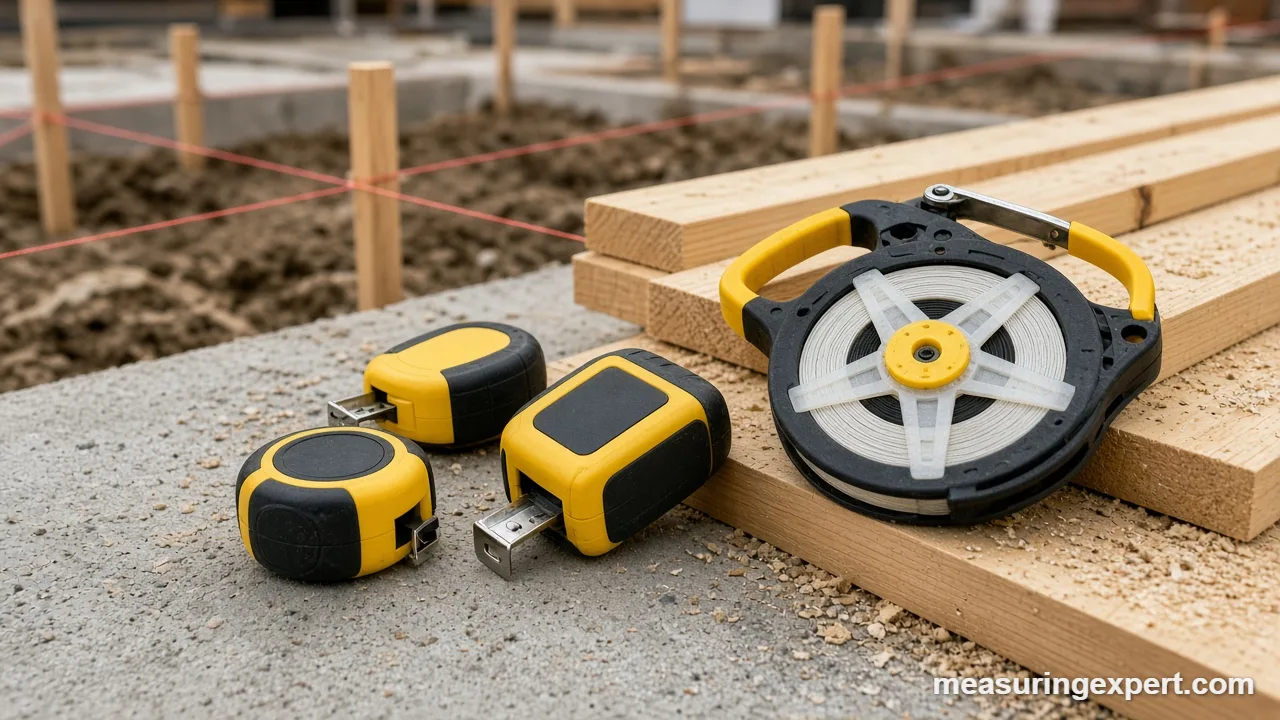
The best construction measuring tape for most crews is the Stanley FatMax 35 ft, because it pairs a 14 ft maker-rated reach with a tough coated blade. Still, the right choice depends on two things: how far you measure in one pull, and whether you need a retractable tape or a 100-300 ft long reel.
In short: get the Stanley FatMax 35 ft for daily layout, the Craftsman PRO Reach 2-pack on a budget, and the Milwaukee 200 ft geared reel for site work.
As an Amazon Associate, Measuring Expert earns from qualifying purchases. Our picks are based on research, specifications and owner feedback, not paid placement.
Best Overall

Best Budget
Best Long Reel

Quick Answer: The Right Tape for Each Jobsite Task
- Best overall: Stanley FatMax 35 ft, 14 ft reach.
- Most reach: Milwaukee 40 ft Wide Blade, up to 17 ft.
- Budget pair: Craftsman PRO Reach 25 ft 2-pack.
- Compact 100 ft: Stanley 34-790 fiberglass long tape.
- Steel accuracy: Komelon N6100 100 ft open reel.
- Fast rewind: Milwaukee 200 ft geared reel.
- Longest reach on the ground: Komelon 6633 300 ft.
On This Page
- Comparison Table
- The 8 Picks, Reviewed
- How We Chose
- Retractable, Closed Case or Open Reel
- Standout, Blade Width and Hook
- Class II and NIST Tolerances
- Length Converter
- How to Measure a Long Distance
- Temperature, Tension and Sag
- Keeping a Tape Accurate
- Do and Don’t
- Honest Limits
- FAQ
- Bottom Line
Best Construction Measuring Tape Comparison Table
| # | Product | Best For | Standout Feature | Link |
|---|---|---|---|---|
| 1 | Stanley FatMax 35 ft Tape Measure (33-735) | Framing, decks and general jobsite layout | 14 ft maker-rated reach, BladeArmor hook | View |
| 2 | Milwaukee 40 ft Wide Blade Tape Measure (48-22-0240) | Long spans, roofing and steel framing | 1-5/16 in blade, up to 17 ft reach | View |
| 3 | Craftsman PRO Reach 25 ft Tape Measure 2-Pack (CMHT37265S) | Crews that need spare tapes | Two 25 ft tapes, 14 ft maker-rated reach | View |
| 4 | Stanley 100 ft Fiberglass Long Tape (34-790) | Lot lines, fences and foundations | Tru-Zero folding hook, winds when wet | View |
| 5 | Komelon N6100 100 ft Open Reel Steel Tape | Repeatable layout and inspection checks | Nylon-coated steel blade that will not stretch | View |
| 6 | Milwaukee 200 ft Fiberglass Open Reel Long Tape (48-22-5302) | Site layout, landscaping and paving | 3:1 planetary metal gear rewind | View |
| 7 | Johnson Level 200 ft Metric/Inch Fiberglass Long Tape (1829-0200) | Mixed-unit plans and survey checks | Millimeters on one side, 1/8 in on the other | View |
| 8 | Komelon 6633 300 ft Open Reel Fiberglass Tape | Large lots, sports fields and road work | 300 ft blade, glare-proof finish, ground stake | View |
This guide focuses on jobsite work, so it covers long retractable tapes with high standout, plus 100-300 ft long tapes for site layout. For everyday 16-25 ft tapes, see our best tape measure guide. Also, if you want a keychain-size tape, our best mini tape measure picks cover that.
The 8 Best Construction Measuring Tape Picks, Reviewed
Best Overall
1. Stanley FatMax 35 ft Tape Measure (33-735)
Best for: framers, remodelers and site supervisors who want one long, stiff retractable tape that handles most daily layout.
To begin with, the FatMax 35 ft is the long version of Stanley’s classic jobsite tape. Stanley rates it for 14 ft of reach, which it defines as the maximum extension an average professional user gets before the blade buckles.
Durability is also a reason it leads this list. First, Stanley coats the full blade with Mylar to resist abrasion. Second, an added BladeArmor coating protects the first section near the hook, where most blades crack. Finally, the high-impact case wears a non-slip rubber grip, so it is easier to hold with gloves.
- Length: 35 ft (about 10.7 m)
- Reach: 14 ft, per Stanley’s average-pro test
- Full-length Mylar blade coating plus BladeArmor at the hook
- High-impact case with non-slip rubber; blade lock
- Limited lifetime warranty
Pros
- Long reach, so one person can lay out spans
- Tough coating where blades usually fail
- Extra length saves double measurements
Cons
- Heavier and bulkier than a 25 ft tape, so it fills a pouch
- No magnetic hook
- Stanley does not publish an accuracy class
Skip it if: you mostly cut trim or cabinets indoors; a lighter 16-25 ft tape from our best tape measure guide is easier to carry.
Best Max Reach
2. Milwaukee 40 ft Wide Blade Tape Measure (48-22-0240)

Best for: crews who measure long runs alone and want the most reach a retractable tape offers.
Milwaukee’s 40 ft Wide Blade uses a 1-5/16 in (33 mm) blade, which is wider and more curved than a typical 1 in blade. Therefore, it stays straight longer when you push it across open space. Also, Milwaukee quotes up to 17 ft of reach, the longest figure among the retractable tapes here.
In addition, Milwaukee protects the first 6 in of the blade with an anti-tear coating, and a nylon bond layer guards the rest. Meanwhile, a 5-point reinforced frame is built to absorb drops, and a finger stop lets you control a fast return. However, at 1.84 lb (0.83 kg) it is a heavy tape for a pouch.
- Blade: 1-5/16 in (33 mm) wide, 40 ft (12.2 m) long
- Reach: up to 17 ft, per Milwaukee
- Anti-tear coating on the first 6 in, nylon bond blade protection
- 5-point reinforced frame, finger stop, wire belt clip
- Weight: 1.84 lb (0.83 kg); two-sided printing
Pros
- Longest reach claim in this guide
- Two-sided printing helps because you can read it overhead
- Wire clip is lanyard-ready for work at height
Cons
- Heavy, so all-day belt carry is tiring
- Also, the wide case is awkward in a pocket
- No published accuracy class
Skip it if: you work mainly inside cabinets or tight framing bays; a compact tape is faster there.
Best Budget
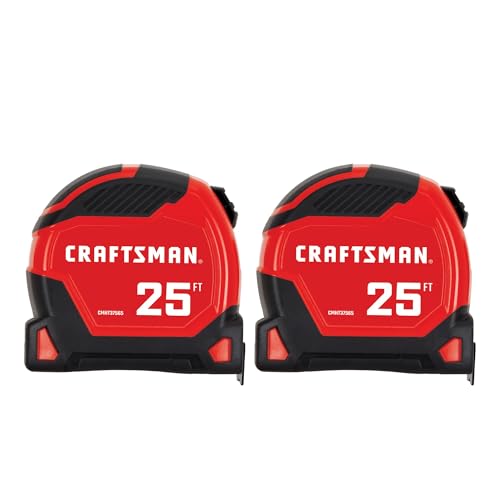
3. Craftsman PRO Reach 25 ft Tape Measure 2-Pack (CMHT37265S)
Best for: contractors and DIYers who want two long-reach tapes, one for the truck and one for the belt.
First, Craftsman’s PRO Reach tapes come as a pair of 25 ft tapes. Similarly, Craftsman rates them for 14 ft of reach, based on an average professional user.
Also, Craftsman says this version adds hook protection over the previous model. On the other hand, Craftsman does not list a coating type or an accuracy class, so treat it as a strong general tape rather than a precision tool.
- Two 25 ft (7.6 m) tapes in one pack
- Reach: 14 ft, per Craftsman
- Improved hook protection versus the previous version
- Limited lifetime warranty
Pros
- Two tapes for the price of one buying decision
- High reach for a 25 ft tape
- Also lighter than 35-40 ft models
Cons
- Only 25 ft, so long slabs need two pulls
- Few published blade specs
- No magnetic hook
Skip it if: you need more than 25 ft per pull; the Stanley 35 ft or Milwaukee 40 ft is better.
Best 100 ft Closed Case
4. Stanley 100 ft Fiberglass Long Tape (34-790)
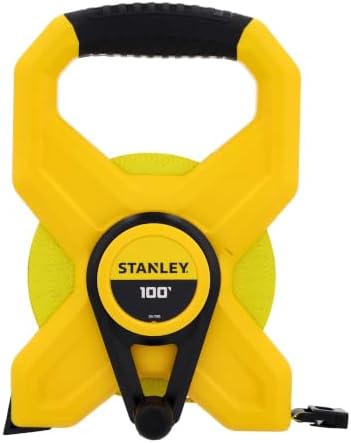
Best for: builders who need 100 ft in a compact closed case for site layout, fencing and foundation checks.
The Stanley 34-790 is a closed-case long tape with a 1/2 in blade, so it stays compact for 100 ft. In addition, Stanley gives the blade a polymer coating to resist abrasion, and it says you can wind it when it is wet.
The Tru-Zero folding end hook is also a useful detail. First, it hooks over a stake or a form board. Then, because the zero point sits on the hook, you can read straight from the scale.
- Length: 100 ft (30.5 m); blade width 1/2 in
- Polymer-coated blade resists abrasion and can be wound wet
- Corrosion-resistant Tru-Zero folding end hook
- High-impact ABS case with rubber grip; printed on both sides
- Limited lifetime warranty
Pros
- Compact case for a 100 ft tape
- Folding hook works with stakes and forms
- Fine to rewind wet, so muddy days are easier
Cons
- No lock, so it needs a holder at the far end
- Slower crank than a geared open reel
- Fiberglass can stretch under hard pulls
Skip it if: you lay out 200 ft or more; an open reel such as the Milwaukee 200 ft is faster.
Best Steel Long Tape
5. Komelon N6100 100 ft Open Reel Steel Tape

Best for: layout crews and inspectors who want a steel blade for the most repeatable long measurements.
Steel is the classic choice for accurate long tapes, because it does not stretch the way fiberglass can. For example, the Komelon N6100 uses a 1/2 in nylon-coated steel blade, and Komelon says it will not stretch or distort.
In addition, the open reel frame is heavy-duty ABS, with a folding handle and a rubber hand grip. Also, an open reel lets mud and sand fall out instead of jamming inside a case.
- Length: 100 ft (30.5 m)
- Blade: 1/2 in nylon-coated steel
- Heavy-duty ABS open reel frame
- Folding handle and rubber hand grip
Pros
- Steel blade holds length better than fiberglass
- Open reel sheds dirt, so it rarely jams
- Simple, light frame
Cons
- Steel can kink if stepped on or run over
- Wipe it dry, because steel can rust
- No geared rewind
Skip it if: you work near live electrical lines; a nonconductive fiberglass tape is the safer choice.
Best Geared Open Reel
6. Milwaukee 200 ft Fiberglass Open Reel Long Tape (48-22-5302)
Best for: site crews who pull long tapes many times a day and want the fastest, cleanest rewind.
Rewinding 200 ft by hand is slow, so Milwaukee adds a 3:1 gear ratio with planetary metal gears. In other words, each turn of the crank brings in three times the tape of a direct-drive reel. Milwaukee also says the metal gears will not strip, which is a common failure on cheap reels.
In addition, a Grime Guard wiper cleans dirt off the blade as it winds in.
- Length: 200 ft (61 m) fiberglass blade
- 3:1 planetary metal gear rewind
- Grime Guard blade wiper
- Dual-sided printing
- Limited lifetime warranty
Pros
- Fast geared rewind saves time
- Wiper keeps grit off the reel
- Metal gears resist stripping
Cons
- Bulky, so it rides in the truck instead of on a belt
- Fiberglass can stretch under hard pulls
- Milwaukee does not list blade width
Skip it if: you rarely measure past 100 ft; the Stanley 100 ft closed case is lighter.
Best Metric and Inch
7. Johnson Level 200 ft Metric/Inch Fiberglass Long Tape (1829-0200)

Best for: crews that work from metric plans or share drawings with engineers and need both scales on one blade.
First, Johnson prints millimeters on one side of this 200 ft (60 m) blade and 1/8 in graduations on the other. So you can lay out a metric plan and still talk feet and inches with the framing crew.
Also, a tough blade hook keeps the end from slipping off a stake. However, Johnson backs it with a 1-year warranty, which is shorter than the lifetime coverage on several other picks.
- Length: 200 ft (60 m); blade width 1/2 in
- Fiberglass blade with PVC coating
- Metric (mm) on one side, 1/8 in on the other
- High-impact ABS case; blade hook
- 1-year warranty
Pros
- True dual metric and inch scales
- Abrasion-resistant coated blade
- Hook resists slipping, so solo pulls are easier
Cons
- Short 1-year warranty
- No geared rewind listed
- Also, the closed case traps mud
Skip it if: you only work in feet and inches; the Milwaukee reel rewinds faster.
Best 300 ft Tape
8. Komelon 6633 300 ft Open Reel Fiberglass Tape
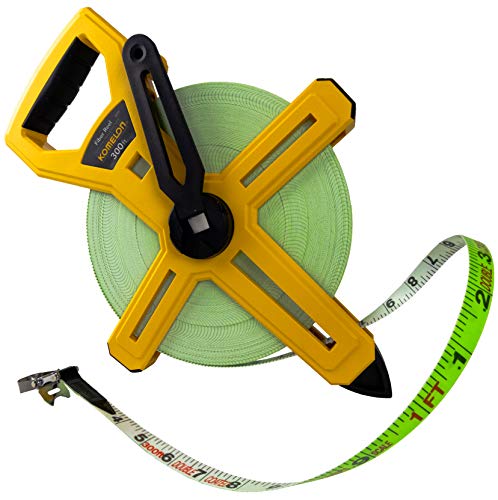
Best for: anyone who measures lot lines, athletic fields or road sections where 100-200 ft is not enough.
The Komelon 6633 covers 300 ft (91.4 m) on a 1/2 in double-coated fiberglass blade. Komelon also adds a transparent PVC layer and an embossed, glare-proof finish. As a result, the markings stay readable in bright sun.
In addition, the ABS frame has a shock-absorbing bumper, and Komelon includes a ground stake. Therefore, you can anchor the zero end in soil and walk out the full length alone.
- Length: 300 ft (91.4 m); blade width 1/2 in
- Double-coated fiberglass with transparent PVC
- Embossed glare-proof finish; white and yellow blade
- ABS frame with shock-absorbing bumper
- Ground stake included
Pros
- Longest tape in this guide
- Ground stake makes solo layout possible
- Glare-proof finish is easy to read outdoors
Cons
- Sag and stretch add error over long spans
- No geared rewind, so winding takes time
- Too much tape for most building work, so it suits site jobs
Skip it if: your longest measurement is under 100 ft; a 100 ft tape is lighter and faster.
How We Chose the Best Construction Measuring Tape Picks
We did not run hands-on tests. Instead, these picks are research-based. First, we read maker spec pages and catalogs for length, reach, blade width, coating, hook design and rewind. Finally, we scanned owner feedback for common failures, such as cracked blades near the hook, stripped reel gears and worn printing.
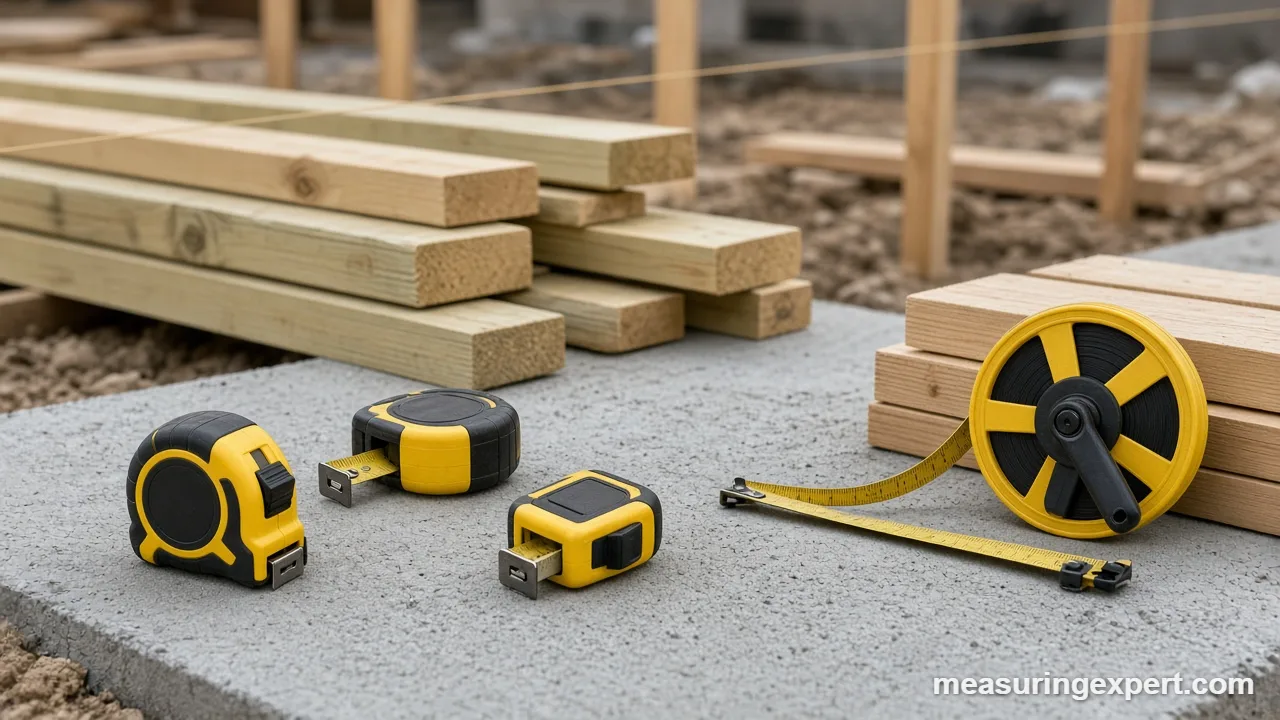
- Jobsite length: every retractable is 25 ft or longer, and every long tape covers 100-300 ft.
- Published specs: a stated reach, blade width or gear ratio beat vague claims.
- No overlap: we left out the 16-25 ft tapes already reviewed in our general and mini tape guides.
For accuracy rules, we used the NIST Handbook 44 section on linear measures and the EU Measuring Instruments Directive Annex X on material measures of length.
Which Best Construction Measuring Tape Type Fits the Job?
In general, construction tapes come in three main formats. So pick the format first, and then compare models.
| Type | Typical length | Blade | Best for | Watch out for |
|---|---|---|---|---|
| Retractable (power return) | 25-40 ft (7.6-12 m) | Curved steel, 1-1.3 in wide | Framing, walls, openings, lumber | Hook damage from snapping back |
| Closed-case long tape | 100 ft (30 m) | Fiberglass or steel, about 1/2 in | Foundations, fences, room-to-room runs | Mud trapped in the case |
| Open reel long tape | 100-300 ft (30-91 m) | Fiberglass or nylon-coated steel | Site layout, lots, paving, fields | Sag and stretch over long spans |
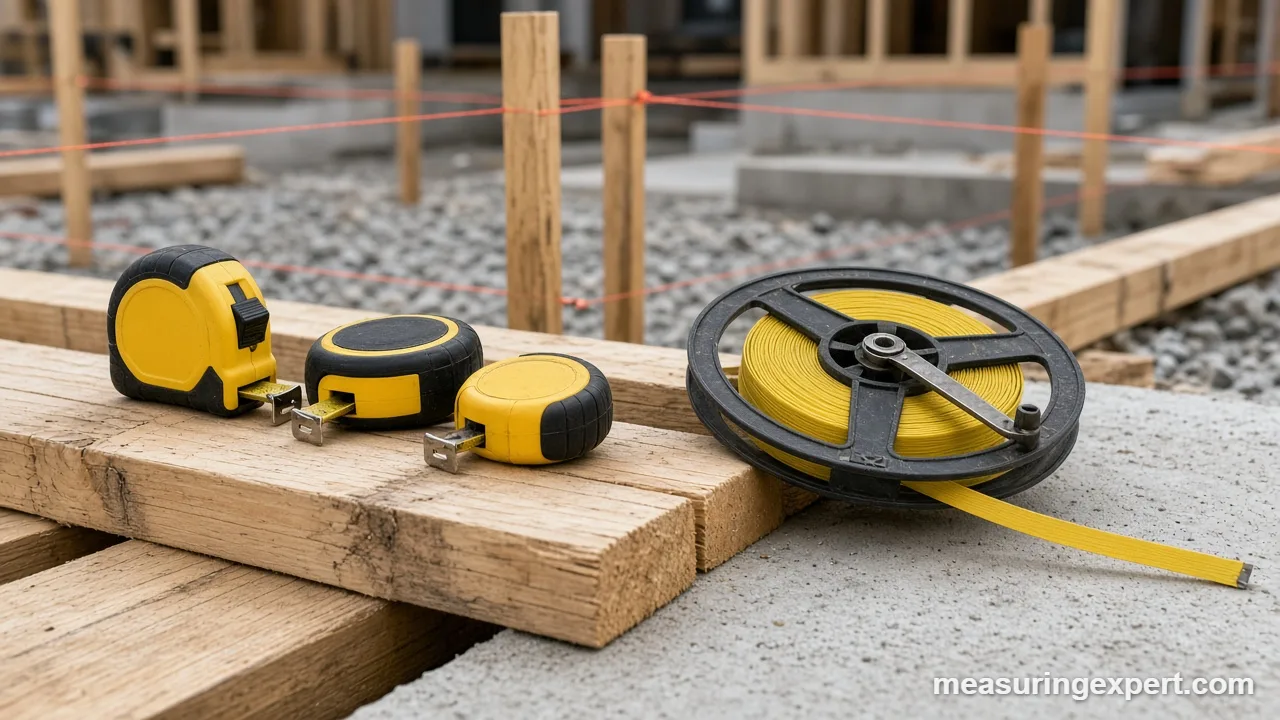
For this reason, most builders carry two tapes: a retractable on the belt and a long reel in the truck. If you are new to the basics, our guide on how to measure length explains reading graduations step by step.
Standout, Blade Width and Hook: What Makes the Best Construction Measuring Tape
Standout and reach: Standout is how far the blade sticks out before it folds. Also, makers often call it reach. However, there is no shared test standard. Stanley and Craftsman, for instance, define reach as the maximum extension an average professional user gets.
Blade width and curve: In general, a wider, deeper curve makes the blade stiffer. As a result, the Milwaukee 33 mm blade reaches farther than a typical 1 in blade.
Hook and True Zero
The end hook is riveted loosely on purpose. First, it slides out by its own thickness when you hook an edge. Then it slides in when you push against a wall. In other words, both readings start at true zero. Also, look for extra coating or armor at the hook, because the first few inches take the most abuse.
Drop and impact protection: Tapes fall off ladders, roofs and tailgates all day. For this reason, the picks here use reinforced frames, rubber overmolds or bumpers. Still, few makers publish a standard drop test, so compare frame design and warranty instead of a single drop number.
Class II and NIST Tolerances for the Best Construction Measuring Tape
In general, two rule sets matter. First, in the EU, the Measuring Instruments Directive sets accuracy classes I, II and III. For example, the maximum permissible error for Class II is 0.3 mm plus 0.2 mm per meter, with the length rounded up to the next whole meter. Meanwhile, in the US, NIST Handbook 44 sets tolerances for metal tapes used in commerce.
| Tape length | EU Class I max error | EU Class II max error | EU Class III max error | NIST HB 44 metal tape tolerance |
|---|---|---|---|---|
| 25 ft (7.6 m) | 0.9 mm | 1.9 mm (0.075 in) | 3.8 mm | 1/16 in (1.6 mm) |
| 35 ft (10.7 m) | 1.2 mm | 2.5 mm (0.098 in) | 5.0 mm | 1/8 in (3.2 mm) |
| 100 ft (30.5 m) | 3.2 mm | 6.5 mm (0.26 in) | 13.0 mm | 1/4 in (6.4 mm) |
| 200 ft (61 m) | 6.2 mm | 12.5 mm (0.49 in) | 25.0 mm | Not listed |
| 300 ft (91.4 m) | 9.3 mm | 18.7 mm (0.74 in) | 37.4 mm | Not listed |
Also, a few notes help you read the table. First, the EU rule adds 0.2 mm for Class II when the measurement starts at an end surface, such as a hook. Second, Handbook 44 tests tapes of 25 ft or more under about 10 lb (5 kg) of tension, fully supported on a flat surface. Finally, none of the US makers above print an accuracy class on their spec pages, so a Class II mark on the blade is a bonus, not a given.
What the Tolerances Mean on Site
For framing, 1/16 in over 25 ft is tighter than most cuts require, so it is rarely a problem. For a 100 ft foundation diagonal, however, 1/4 in is real, so steel tapes and good technique matter more there. Also, to see how these lengths fit the bigger picture, read our explainer on what a linear measurement is.
Convert Long Tape Readings
Long tapes often mix feet, inches and meters, because plans may use any of them. So use this converter to switch between units before you mark a line.
How to Measure a Long Distance With an Open Reel Tape
In fact, long tapes reward good technique more than any spec sheet. Therefore, follow these steps for repeatable readings.
- Anchor the zero end. First, hook the end ring over a nail, stake or form board, or push the ground stake into the soil. Also, if you have a helper, ask them to hold the zero mark exactly on the starting point.
- Walk out in a straight line. Next, unreel the tape while you walk toward the far point. Also, keep it clear of rocks, rebar and tire paths, so it does not kink or snag.
- Apply steady tension. Pull the tape firm and level, because slack adds error. NIST Handbook 44 tests tapes of 25 ft or more at about 10 lb (5 kg) of tension, so aim for a similar, repeatable pull.
- Read at the mark, not the case. Then sight straight down on the graduation at your point. For example, on a dual-scale blade, confirm you are reading the correct side.
- Measure twice. After that, release the tension, pull again and take a second reading. If the two readings differ, however, look for sag, wind or a slipping hook.
- Wipe while you rewind. Finally, run the blade through a dry rag as you crank it in. As a result, less grit wears the printing or jams the reel.
Temperature, Tension and Sag: Hidden Errors on Long Tapes
In practice, most tape error on a big site comes from how you use the tape, not from the tape itself.
- Temperature: steel grows by roughly 6-7 millionths of its length per degree F. For example, over 100 ft, a 30 F rise above the 68 F (20 C) reference adds about 0.23 in (6 mm).
- Tension: a loose pull reads long because the tape bows, while a very hard pull can stretch fiberglass. So use the same firm pull each time.
- Sag: when a tape hangs between two points, the curve makes the reading longer than the true straight distance. So support the tape on the ground or add a middle helper on long spans.
Keeping a Jobsite Tape Accurate
- Control the return: slow the blade with a finger, because slamming the hook into the case bends it over time.
- Check zero: for example, once a month, compare the tape against a known good tape or steel rule at 1 ft and 10 ft.
- Dry steel blades: wipe a wet steel blade before you wind it, since trapped moisture causes rust.
Do and Don’t
Honest Limits
We did not measure these tapes against a reference standard, so we cannot rank them by accuracy. Also, reach figures come from each maker’s own test, and the makers use different methods.
Best Construction Measuring Tape FAQ
What is the best construction measuring tape for framing?
For most framing, the Stanley FatMax 35 ft is the best construction measuring tape, because it pairs a 14 ft maker-rated reach with a tough coated blade. If you want even more reach, the Milwaukee 40 ft Wide Blade claims up to 17 ft.
How long should the best construction measuring tape be?
Carry a 25-35 ft retractable tape for daily work, because it covers most walls, openings and lumber. Then add a 100 ft long tape for foundations and site layout, and a 200-300 ft reel for lots, fences and roads.
What does standout mean on a tape measure?
Standout is how far the blade extends straight out before it buckles. Also, makers often call it reach. Stanley and Craftsman, for example, base their 14 ft reach claims on the maximum extension an average professional user gets.
Is a wider blade more accurate?
No. Instead, a wider blade mainly adds standout and stiffness. Accuracy depends on how well the graduations are printed and how well the hook is calibrated, so check for a stated accuracy class instead.
What is a Class II tape measure?
Class II is an accuracy class in the EU Measuring Instruments Directive. In short, the maximum permissible error is 0.3 mm plus 0.2 mm per meter of length, with the length rounded up to the next whole meter. For example, a 5 m Class II tape may be off by up to 1.3 mm.
How accurate does a tape measure have to be in the US?
In the US, NIST Handbook 44 sets tolerances for metal tapes used in commerce. For example, a tape may be off by 1/16 in from 7 to 30 ft, 1/8 in from 31 to 55 ft, and 1/4 in from 81 to 100 ft.
Is steel or fiberglass the best construction measuring tape blade?
Choose steel for the most repeatable layout, because it does not stretch. Choose fiberglass for wet sites and work near electrical lines, because it does not rust and does not conduct electricity.
Why does the hook on my tape measure move?
The hook slides on purpose. It moves out by its own thickness for outside measurements and in for inside measurements, so both start at true zero. So never bend or tighten the rivets, or you will lose that correction.
Does temperature affect a long steel tape?
Yes. Steel grows by roughly 6-7 millionths of its length per degree F. For example, over 100 ft, a 30 F rise above the 68 F reference adds about 0.23 in (6 mm), which matters on foundation layout.
Can one best construction measuring tape do everything?
No single tape covers every job. Instead, pair a 25-40 ft retractable for daily work with a 100-300 ft long tape for site layout. Together, those two cover nearly every construction measurement.
Bottom Line: Our Best Construction Measuring Tape Pick
The Stanley FatMax 35 ft is the best construction measuring tape for most crews, because it reaches far, survives jobsite abuse and covers most daily layout in one pull. If you need even more reach, step up to the Milwaukee 40 ft Wide Blade.
5 thoughts on “Best Construction Measuring Tape (2026): 8 Jobsite and Long Reel Picks”