

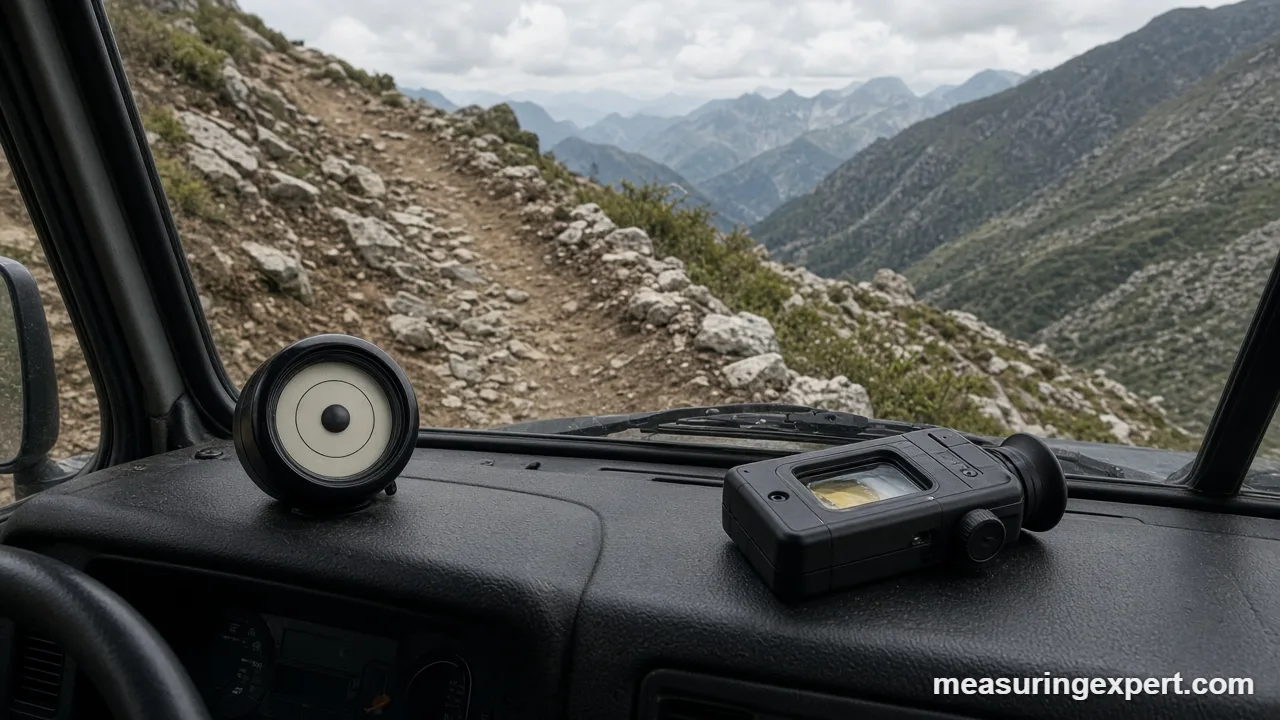
The best incline meter for most drivers is the Sun Company 201-F Lev-o-gage, a damped ball gauge that reads vehicle tilt from -45 to +45 degrees with no power. However, the right choice depends on the job: trail tilt, leveling a parked RV, or measuring the percent grade of a slope.
In short: put a Sun 201-F on the dash, level a camper with a LevelMatePRO+, and measure hill or road grade with a SUUNTO Tandem.
As an Amazon Associate, Measuring Expert earns from qualifying purchases. Our picks are based on research, specifications and owner feedback, not paid placement.
Best Overall

Best Budget

Best Smart

Quick Answer by Use
- Jeep, truck or boat dash: Sun Company 201-F, a no-power ball gauge.
- Leveling a trailer or motorhome: LogicBlue LevelMatePRO+ or Beech Lane, both app based.
- Cheap trail indicator: Timloon, if a rough reading is enough.
- Road, ditch or driveway grade: SUUNTO Tandem, which reads percent directly.
- Roof pitch: Johnson 750, with a rise-per-foot scale.
- Hiking and ski touring: SUUNTO MC-2, a compass with a clinometer.
- Cycling climbs: Sun Company CyclClimb on the handlebar.
On This Page
- Comparison table
- The 8 picks, reviewed
- How we chose
- Types of incline meters
- Degrees, percent grade and pitch
- Degrees to percent grade calculator
- Reading tilt on a vehicle or RV
- How to mount and zero a dash gauge
- Measuring a hill or road grade
- Honest limits
- FAQ
- Bottom line
Best Incline Meter Picks at a Glance
First, find your use in the table. Then, jump to the full review.
| # | Product | Best For | Standout Feature | Amazon |
|---|---|---|---|---|
| 1 | Sun Company 201-F Lev-o-gage Inclinometer | Jeeps, trucks, campers and boats | Brass ball in damped fluid, -45 to +45 degrees | View |
| 2 | LogicBlue LevelMatePRO+ Wireless RV Leveling System | Leveling travel trailers and motorhomes | Bluetooth app with hitch memory | View |
| 3 | Timloon Car Inclinometer Level Tilt Gauge | Casual off-road and road-trip drivers | Stick-on base that rotates 360 degrees | View |
| 4 | SUUNTO Tandem 360PC/360R G Clino/Compass | Surveyors, foresters and site grade checks | Reads degrees and percent, 1/4-degree accuracy | View |
| 5 | Johnson Level & Tool 750 Pitch & Slope Locator | Roof pitch and quick yard slope checks | Degrees plus inch-rise-per-foot pitch scale | View |
| 6 | SUUNTO MC-2 Mirror Compass with Clinometer | Hikers, ski tourers and trail builders | Built-in clinometer in a mirror sighting compass | View |
| 7 | Sun Company CyclClimb Bike Inclinometer | Road and mountain bikers | Handlebar gauge in percent and degrees | View |
| 8 | Beech Lane Wireless RV Leveling System | RV owners who want an app leveler with a long warranty | Live roll and pitch with an automatic mode | View |
The 8 Best Incline Meter Options, Reviewed
This list covers tilt and slope in the field: vehicles, RVs, bikes, roofs and hillsides. By contrast, if you need a digital level for woodworking, machine setup or framing, see our separate guide to the best inclinometer for construction and woodworking. Likewise, for saw blades, pipe and steel, our best magnetic angle finder picks fit better.
Best Overall
1. Sun Company 201-F Lev-o-gage
Best for: Off-road drivers, overlanders and boat owners who want a simple tilt gauge that needs no power, no wiring and no app.
For most drivers, the 201-F is the best incline meter because it does one job and does it well. A brass ball rides in damping fluid inside a curved tube, so it shows tilt the moment the vehicle leans. In addition, the scale runs from -45 to +45 degrees with marks every 5 degrees, which is easy to read at a glance.
Because it sticks on with 3M VHB tape, you can mount it on the dash without drilling. Typically, owners fit one gauge across the dash for side-to-side roll. Then, if they want pitch as well, they add a second gauge on a side panel for front-to-rear tilt.
- Range -45 to +45 degrees, marked in 5-degree steps
- Also, a brass ball in damping fluid inside a shatterproof copolymer tube
- About 3.5 x 1.5 x 0.3 in (8.9 x 3.8 x 0.8 cm); 1.12 oz (32 g)
- 3M VHB adhesive tape for no-drill mounting
- Finally, it is made in the USA
Pros
- No batteries, wiring or app
- Damped ball settles quickly
- Small enough for almost any dash
Cons
- Reads one axis per gauge
- 5-degree marks are coarse for leveling a camper
- Braking and cornering push the ball, as with any pendulum gauge
Skip it if: you need to level a trailer to a fraction of a degree, because an app-based leveler like the LevelMatePRO+ reads much finer.
Best Smart Leveler
2. LogicBlue LevelMatePRO+
Best for: RV owners who want their phone to show exactly how much to raise each side before they unhitch.
Instead of a ball in a tube, the LevelMatePRO+ uses a 3-axis digital accelerometer plus a temperature sensor. It then sends roll and pitch to an iOS or Android app over Bluetooth. As a result, you see how far the camper is from level and which side needs blocks, all from the driver seat.
Also, it saves your hitch position, so you can return the tongue jack to the same height when you leave. The PRO+ adds an on/off switch to save the battery, and it can also run from USB power. However, the audible “Listen to Level” tone is an in-app purchase.
- 3-axis digital accelerometer and digital temperature sensor
- Bluetooth link to iOS and Android apps; Apple Watch compatible
- In addition, hitch memory for quick reconnects
- Battery power with on/off switch, or USB power
- About 5 x 2 x 1.25 in (12.7 x 5.1 x 3.2 cm); 8.3 oz (235 g)
Pros
- Shows block height guidance, not just an angle
- Reads both axes at once
- Hitch memory saves time on departure
Cons
- Needs a phone and a working battery
- Audio tone costs extra in the app
- Built for parked leveling, not trail driving
Skip it if: you only want a glance gauge on a Jeep dash, since the Sun Company 201-F does that with no electronics.
Best Budget
3. Timloon Car Inclinometer
Best for: Drivers who want a low-cost dash gauge for occasional trails and do not need a precise scale.
On a tight budget, the Timloon covers the basics. Specifically, it is a small 2.36 in (6 cm) dash gauge with a peel-and-stick base, so it installs in seconds. Also, the base rotates through 360 degrees, which lets you aim the face at the driver.
However, the listing gives few hard numbers beyond a 40-degree warning limit. So, treat it as a trend indicator that shows when the vehicle is leaning more, not as a precise instrument.
- Compact 2.36 in (6 cm) body
- Moreover, a peel-and-stick base, so no tools are needed
- Also, the base rotates 360 degrees for viewing angle
- Listing cites a 40-degree warning limit
Pros
- Low cost
- Fast, tool-free install
- Adjustable viewing angle
Cons
- Few published specs
- Small markings are hard to read on rough trails
- Adhesive bases can loosen in summer heat
Skip it if: you want a clear, documented scale, because the Sun Company 201-F publishes its range and step size.
Best for Percent Grade
4. SUUNTO Tandem 360PC/360R G

Best for: Anyone who has to measure the grade of a road, ditch, driveway or hillside from a distance and read it in percent.
Unlike a dash gauge, the Tandem is a handheld sighting clinometer. For instance, you look through the lens at a target at eye height, and the scale then reads the slope directly. Better still, it shows both degrees (up to plus or minus 90) and percent grade (up to plus or minus 150%), so you do not need a conversion table.
In addition, Suunto rates the clinometer at 1/4 degree accuracy, which is far tighter than any ball gauge here. It also pairs the clinometer with a sighting compass, so you can log both the bearing and the grade of a slope in one stop.
- Clinometer scales: +/-90 degrees and +/-150 percent
- Accuracy 1/4 degree; resolution 1 degree and 1 percent
- In addition, compass accuracy of 1/3 degree
- Also, a tripod thread; 177 g (6.24 oz); no batteries
- Made in Finland; 2-year warranty
Pros
- Reads percent grade directly
- Pro-level accuracy
- Clinometer and compass in one body
Cons
- Costs far more than a dash gauge
- Takes practice to sight correctly
- No declination adjustment on the compass
Skip it if: you only need to see how far your truck is leaning, because a dash gauge is simpler for that.
Best for Roof Pitch
5. Johnson Level 750 Pitch & Slope Locator

Best for: Homeowners, roofers and landscapers who want to lay a tool on a surface and read the slope in degrees or roof pitch.
If you need roof pitch rather than vehicle tilt, the Johnson 750 is the practical choice. First, you set it on a rafter, a roof deck or a board laid on the ground. Then, a gravity pointer reads the slope.
Specifically, two quadrants read 0 to 90 degrees, while the other two read pitch in inches of rise per 12 in of run. Therefore, you flip the tool to switch units, and you never need a conversion table for roof pitch. For percent grade, multiply the rise per foot by 100 and divide by 12, or use the calculator below.
- 0-90 degree scale in two quadrants
- Pitch scale in inches of rise per 12 in run in the other two
- In addition, the scale is printed on a durable acrylic lens
- Also, a high-impact molded body
- 1-year warranty
Pros
- Reads roof pitch with no math
- Simple, no batteries
- Low cost
Cons
- No percent-grade scale
- Pointer resolution is coarse
- Not made for mounting in a vehicle
Skip it if: you need to measure tilt while driving, because it has no mount and is made to sit on a surface.
Best for Backcountry Slopes
6. SUUNTO MC-2 Compass with Clinometer

Best for: Hikers and backcountry skiers who want one pocket tool for navigation and for checking slope angle in the field.
After all, many walkers already carry a compass, so a model with a built-in clinometer adds slope measurement for almost no extra weight. The MC-2 reads slope from 0 to plus or minus 90 degrees, at 2-degree accuracy and resolution. That is coarse for survey work, yet it is fine for judging whether a slope sits near a threshold you care about.
For example, avalanche educators note that most slab avalanches start on slopes between 30 and 50 degrees. So, a quick reading helps you plan, although it never replaces avalanche training and a current forecast.
- Clinometer range 0 to +/-90 degrees; accuracy and resolution 2 degrees
- Mirror sighting compass with 2.5-degree accuracy
- In addition, adjustable declination with the included tool
- Also, luminous markings; 74 g (2.61 oz)
- 65 x 101 x 18 mm (2.56 x 3.98 x 0.71 in)
Pros
- Two tools in one light body
- No batteries
- Mirror helps you sight along the slope
Cons
- 2-degree resolution is coarse
- Reads degrees only, not percent
- Northern hemisphere balance on this version
Skip it if: you need percent grade for a driveway or road, because the Tandem reads percent directly.
Best for Bikes
7. Sun Company CyclClimb

Best for: Cyclists who want to see the real grade of a climb without a GPS computer.
Similarly, the CyclClimb applies the same ball-in-tube idea to a bicycle. It clamps to the handlebar with an aluminum bracket, and it shows trail incline and decline in both percent slope and degrees. Because it needs no battery, it therefore works every ride.
However, like every pendulum gauge, it reacts to acceleration. So, the reading is most useful on a steady climb, not when you brake or sprint.
- Reads incline and decline in percent slope and degrees
- Aluminum bracket fits 24 to 36 mm handlebars
- Also, a yellow tube with an indicator ball
- Finally, no batteries required
Pros
- Shows grade in percent, the unit cyclists use
- No charging
- Fits most handlebars
Cons
- Bounces on rough singletrack
- Uses bar space needed for lights or a computer
- Only one axis
Skip it if: you already ride with a GPS bike computer that shows grade, since it reports the same number.
Best Made-in-USA App Leveler
8. Beech Lane Wireless RV Leveling System

Best for: Trailer and motorhome owners who want an app leveler that runs on standard AA batteries.
Similarly to the LevelMatePRO+, the Beech Lane unit mounts inside the RV and sends live roll and pitch readings to a phone app over Bluetooth. Also, it offers an automatic mode, and it runs on AA batteries, which are easy to replace on the road.
Moreover, the maker builds it in the USA and backs it with a lifetime warranty. Still, it does not list hitch memory, so check the app features if that matters to you.
- Bluetooth app with live roll and pitch readings
- Also, an automatic operation mode
- In addition, it runs on AA batteries (included)
- About 3.94 x 3.94 in (10 x 10 cm); 8.1 oz (230 g)
- Made in the USA; lifetime warranty
Pros
- Standard AA batteries
- Lifetime warranty
- Reads both axes
Cons
- Hitch memory not listed
- Needs a phone to read
- Larger footprint than a dash gauge
Skip it if: you want hitch memory, because the LevelMatePRO+ lists that feature.
How We Chose the Best Incline Meter Picks
We did not run hands-on tests. Instead, these picks are research based. First, we read manufacturer spec pages, such as the SUUNTO Tandem specifications and the Johnson Level pitch and slope locator page. Next, we checked retailer listings for range, mounting and power as well. Finally, we read owner feedback for common complaints, such as adhesive failure or bouncy readings.
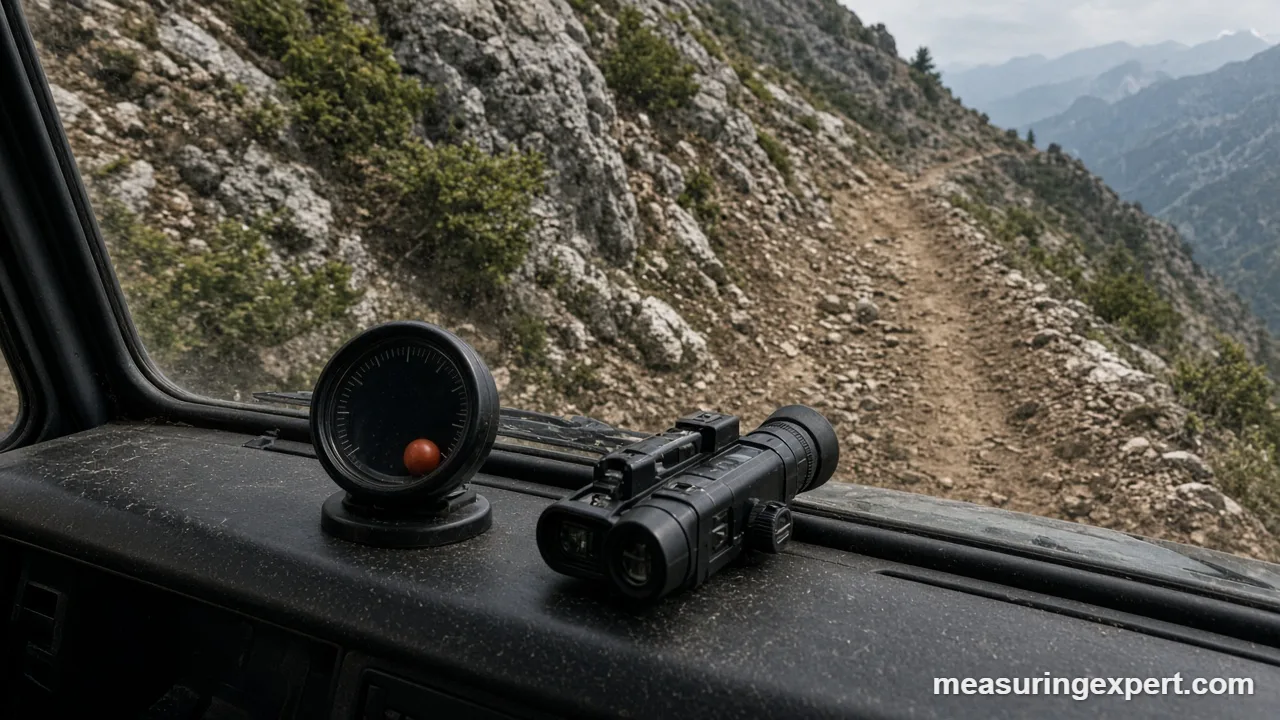
In addition, we judged each tool on five points:
- Use case fit: a dash gauge, an RV leveler and a sighting clinometer solve different problems.
- Published specs: we favored makers that state range, resolution or accuracy.
- Readable units: degrees, percent grade or roof pitch, matched to the job.
- Power and mounting: no-battery gauges and simple mounts score well.
- Brand spread: no more than two picks from one brand.
Types of Incline Meters Compared
Before you buy, decide which type fits your job. After all, each one measures the same angle, yet it suits a different setting.
| Type | How it works | Typical units | Best use |
|---|---|---|---|
| Ball-in-tube dash gauge | A weighted ball settles at the low point of a curved, fluid-filled tube | Degrees | Off-road vehicles, tractors, boats |
| App-based leveler | A digital accelerometer sends roll and pitch to a phone | Degrees and block height | Parked RVs and trailers |
| Sighting clinometer | A damped scale is read through a lens while you sight a target | Degrees and percent | Hills, roads, trees, survey work |
| Pitch and slope locator | A gravity pointer reads against a printed dial | Degrees and rise per foot | Roofs, ramps, yard grading |
| Handlebar gauge | A ball-in-tube gauge on a bike clamp | Percent and degrees | Cycling climbs |
For a deeper look at the sighting type, see our guide on what a clinometer is and how it measures angles.
Degrees, Percent Grade and Pitch on the Best Incline Meter
Every incline meter reads the same slope, but the units differ. So, it pays to know how they relate.
- Degrees measure the angle between the surface and level. Thus, flat ground is 0 degrees.
- Percent grade is rise divided by run, times 100. For example, a road that climbs 10 ft over 100 ft is a 10% grade.
- Roof pitch is rise in inches per 12 in of run. Thus, a 6-in-12 roof rises 6 in for every foot.
The key point is that percent grade and degrees are not the same scale. Because grade = tan(angle) x 100, a 45-degree slope is a 100% grade, not 50%. Similarly, a 10% road is only about 5.7 degrees.
| Degrees | Percent grade | Pitch (in 12) |
|---|---|---|
| 1 | 1.7% | 0.21 |
| 2 | 3.5% | 0.42 |
| 5 | 8.7% | 1.05 |
| 10 | 17.6% | 2.12 |
| 15 | 26.8% | 3.22 |
| 20 | 36.4% | 4.37 |
| 30 | 57.7% | 6.93 |
| 45 | 100% | 12 |
Degrees to Percent Grade Calculator
Enter a reading from your incline meter, and then choose its unit. The calculator converts it to degrees, percent grade and roof pitch.
Reading Tilt on a Vehicle or RV
On a vehicle, a gauge reports two angles. Roll is side-to-side lean, while pitch is nose-up or nose-down tilt. Since a single ball gauge reads one axis, off-roaders often mount two at right angles.
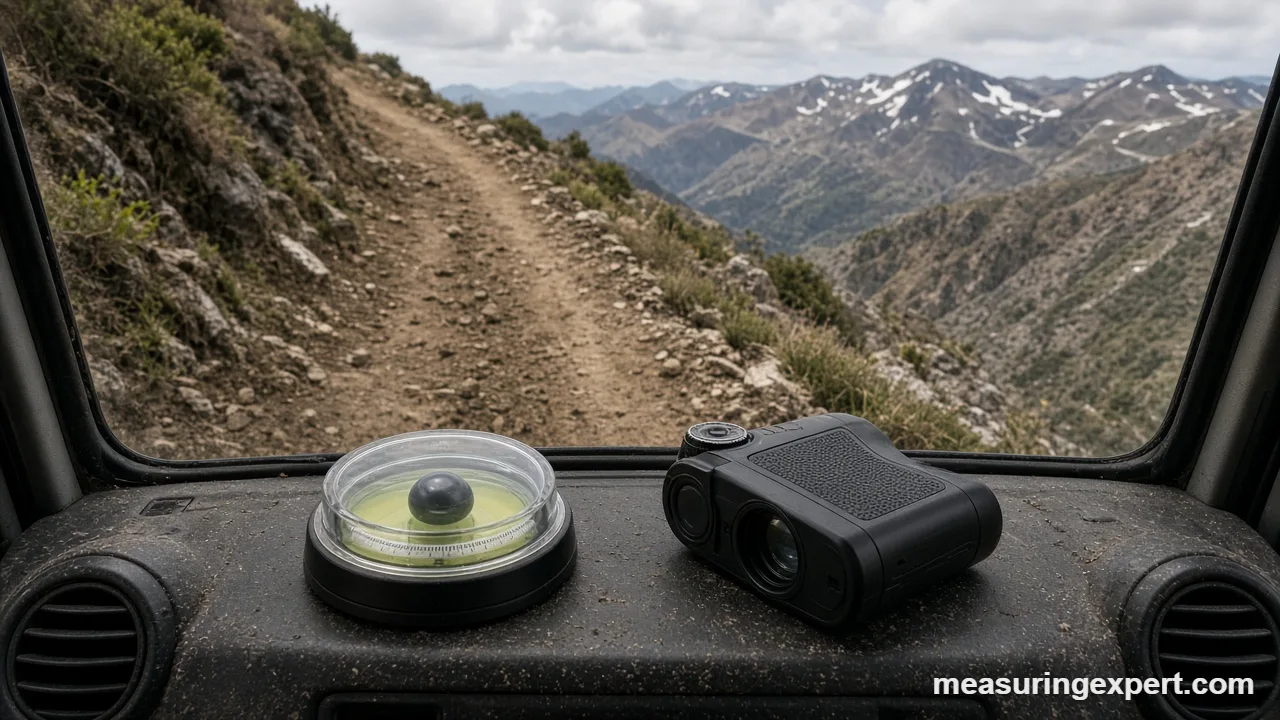
However, no gauge can tell you a universal safe angle. Instead, the real limit depends on your vehicle, its load, its tire pressure and the ground. Therefore, check your owner manual and treat the gauge as a trend tool: if the number keeps climbing, back off.
How Far Off Level Is Your Camper?
For RVs, even small angles matter. So, to find how much to raise the low side, multiply the width between the wheels by tan(angle). For example, across a 96 in (2.44 m) track:
- At 0.5 degrees, the low side sits about 0.84 in (2.1 cm) lower.
- At 1 degree, the gap grows to about 1.68 in (4.3 cm).
- At 2 degrees, you need about 3.35 in (8.5 cm) of blocks.
As a result, a gauge marked every 5 degrees is too coarse for leveling a camper. For that reason, app levelers that report fine angles and block height fit this job better.
How to Mount and Zero a Dash Incline Meter
A stick-on gauge is only as true as its mounting. So, follow these steps before your first trail.
- Park on a surface you have checked with a long spirit level, or average two readings taken facing opposite ways.
- Clean the dash spot with isopropyl alcohol and let it dry fully.
- Hold the gauge in place and confirm it reads 0 while the vehicle is level.
- Square the gauge to the axis you want: across the dash for roll, along a side panel for pitch.
- Press the adhesive firmly for about 30 seconds, then let it cure before you drive off-road.
- Recheck the zero after a few drives, because adhesive pads can settle.
Also, if you cannot find level ground, use the reversal trick. Read the gauge, turn the vehicle 180 degrees on the same spot, and read again. As a result, the true zero is the average of the two readings.
Measuring a Hill or Road Grade With the Best Incline Meter
To measure a slope you are not standing on, use a sighting clinometer such as the SUUNTO Tandem. First, find a target at your own eye height, such as a partner or a mark on a pole. Next, walk up or down the slope and sight the target. Finally, the scale reads the slope between your eye and the mark.
In addition, take readings in both directions and average them, because it cancels small sighting errors. For a step-by-step method on roads, see how to measure angles for road gradients.
In the mountains, slope angle also matters for safety. For example, the Avalanche.org slope angle guide notes that most slab avalanches start on slopes between 30 and 50 degrees. Even so, a slope reading is one input, not a safety decision.
Honest Limits of Any Incline Meter
Above all, every gravity-based gauge has the same weakness. When the vehicle brakes, accelerates or turns, the ball or sensor feels that force as well as gravity. Consequently, readings swing while moving and settle only when the vehicle is steady.
- Dynamic error: read a dash gauge when stopped or crawling, not mid-bounce.
- Mounting error: similarly, a gauge stuck on a sloped dash reads that slope too.
- Scale limits: for example, 5-degree marks cannot show a 1-degree camper error.
- Phone apps: they work; however, a phone case or curved back adds error.
- Temperature: fluids thicken in cold, so ball gauges respond more slowly.
Best Incline Meter FAQ
What is the best incline meter for off-road driving?
For most drivers, the Sun Company 201-F Lev-o-gage is the best incline meter for off-road use. It reads -45 to +45 degrees, needs no power and sticks on with 3M VHB tape. Add a second gauge if you want pitch as well as roll.
What is the difference between an incline meter and an inclinometer?
The terms mean the same thing: a tool that measures tilt from level. On this site, our incline meter guide covers vehicles, RVs and slopes, while our inclinometer guide covers digital levels for woodworking and construction.
How accurate is a dash incline meter?
Most ball gauges are marked every few degrees, so they show trends rather than precise values. Also, braking and cornering move the ball. For accurate slope numbers, use a sighting clinometer such as the SUUNTO Tandem, rated at 1/4 degree.
How do I convert degrees to percent grade?
Multiply the tangent of the angle by 100. For example, 10 degrees is about 17.6% grade, and 45 degrees is 100% grade. The calculator above does this for you.
Which is the best incline meter for leveling an RV?
An app-based leveler such as the LogicBlue LevelMatePRO+ or Beech Lane is the best incline meter for RV leveling. Both read roll and pitch on your phone, which is far finer than a 5-degree dash scale.
Can I use my phone as an incline meter?
Yes, many phones include a level app. However, the reading depends on a flat phone back and steady hands. A dedicated tool is easier to read in a moving vehicle or on a trail.
How do I measure the slope of a hill?
Use a sighting clinometer and a target at your eye height. Sight the target along the slope, then read degrees or percent from the scale. Finally, repeat in the other direction and average the two readings.
Does the best incline meter need batteries?
Not always. Ball-in-tube gauges, the Johnson 750 and both SUUNTO clinometers need no batteries. App levelers, by contrast, use AA cells, a built-in battery or USB power.
Can an incline meter measure roof pitch?
Yes. The Johnson 750 reads pitch directly in inches of rise per 12 in of run. Alternatively, convert a degree reading: pitch = tan(angle) x 12, so 26.6 degrees is a 6-in-12 roof.
Why does my incline meter reading change while driving?
Gravity gauges also feel acceleration. So, when you brake, speed up or turn, the ball or sensor moves. Read the gauge when stopped or crawling slowly for a true angle.
Bottom Line: The Best Incline Meter for You
Overall, the Sun Company 201-F Lev-o-gage is the best incline meter for most drivers, because it is simple, needs no power and reads tilt at a glance. Still, match the tool to the job. For a parked camper, pick the LevelMatePRO+ or Beech Lane. For hill, road or driveway grade, choose the SUUNTO Tandem. Finally, for roofs, the Johnson 750 reads pitch with no math.
1 thought on “Best Incline Meter for Off-Road, RV and Slope Use: 8 Picks”