

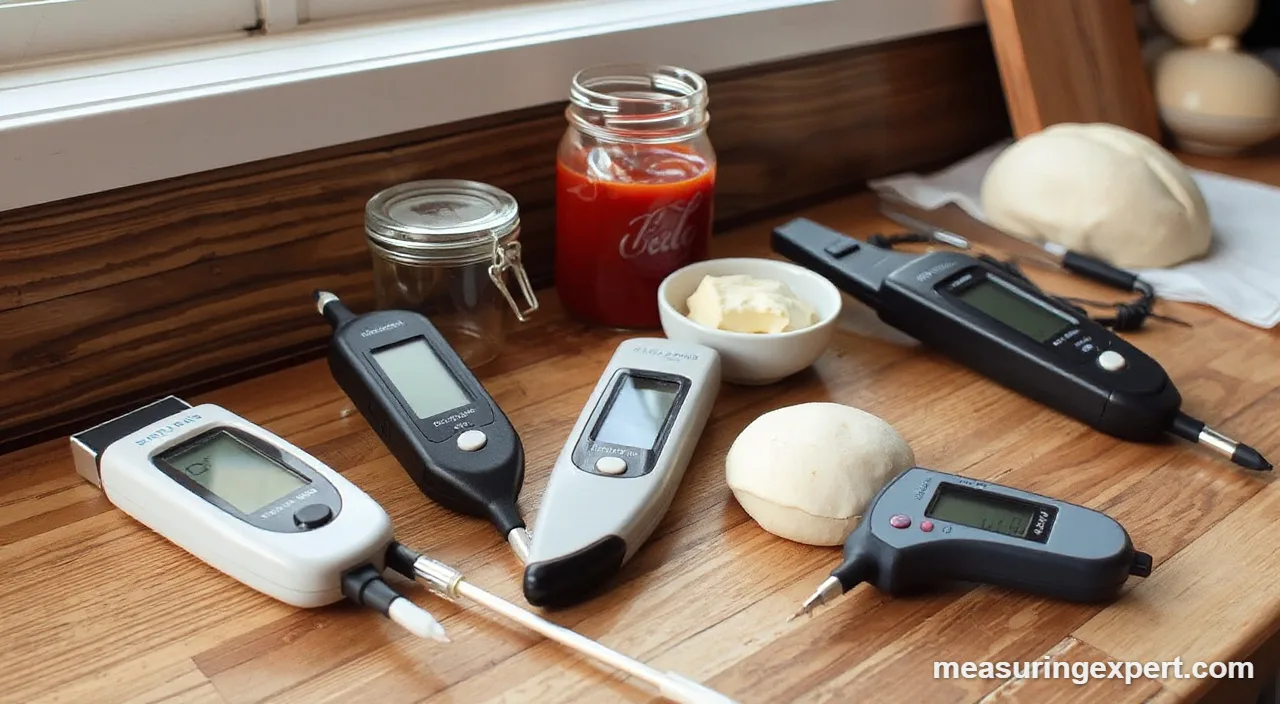
The best pH meter for food is the Apera PH60S-Z, a spear-tip tester that reads -2.00 to 16.00 pH, calibrates automatically and works with or without a phone app. So your food decides the rest: a spear probe suits cheese, dough and sauces, a flat sensor suits tiny samples, and a plain pen suits clear liquids.
In short: pick the Apera PH60S-Z for most kitchens, the Hanna HI99161 for a HACCP-style food and dairy meter, and the YINMIK YK-2S when budget matters most.
As an Amazon Associate, Measuring Expert earns from qualifying purchases. Our picks are based on research, specifications and owner feedback, not paid placement.
Best Overall

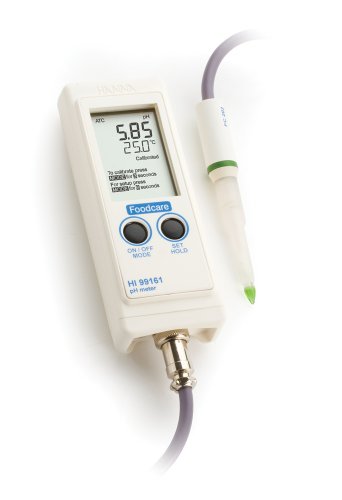
Best Pro Pick
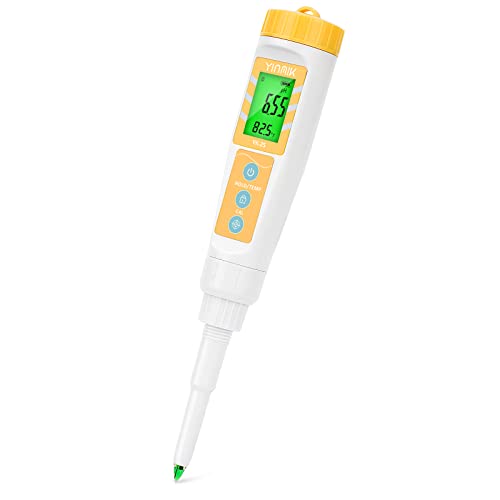
Best Budget
Quick Answer: Which pH Meter for Food to Buy?
- Most kitchens: Apera PH60S-Z for a spear tip and 0.01 pH accuracy.
- Cheese and small food businesses: Hanna HI99161 with a cabled food probe and CAL Check.
- No phone wanted: Apera PH60S with a stable-reading icon.
- Tiny samples: HORIBA LAQUAtwin pH-11 reads from 0.1 ml.
- Thin liquids only: Bluelab pH Pen or HACH Pocket Pro.
- Tightest budget: YINMIK YK-2S, but calibrate with real buffers every time.
On This Page
- Comparison Table
- Each pH Meter for Food, Reviewed
- How We Chose
- What pH Numbers Matter for Food
- Which Probe Suits Your pH Meter for Food
- Specs That Matter on a pH Meter
- How to Measure Food pH Step by Step
- Calibration and Care
- Honest Limits
- FAQ
- Bottom Line
pH Meter for Food Comparison Table
| # | Product | Best For | Standout Feature | Amazon |
|---|---|---|---|---|
| 1 | Apera Instruments PH60S-Z Smart Spear pH Tester | Most home kitchens, sauces, dough and cheese | Spear tip, 0.01 pH accuracy, optional app | View |
| 2 | Hanna Instruments HI99161 Food and Dairy pH Meter | Food and dairy work with a cabled probe | FC2023 probe, CAL Check, HACCP-style design | View |
| 3 | Apera Instruments PH60S Premium Food pH Tester | Spear-tip testing with a backlit screen and no phone | Replaceable spear electrode, 2000-hour batteries | View |
| 4 | HORIBA LAQUAtwin pH-11 Pocket pH Meter | Drops of sauce, brine or a thin smear of a food | Flat sensor reads a 0.1 ml sample | View |
| 5 | YINMIK YK-2S Digital Food pH Meter | Low-cost spear testing for hot sauce and sourdough | Spear tip, six buffer powders included | View |
| 6 | Bluelab pH Pen | Kombucha, brine, vinegar and other thin liquids | Auto temperature compensation, 30-day calibration indicator | View |
| 7 | HACH Pocket Pro pH and Temperature Tester | Thin liquids when you want automatic buffer recognition | IP67, up to 3-point calibration | View |
Each pH Meter for Food, Reviewed
Every pick below is a pH meter for food use or a thin-liquid pen that suits ferments, so the list covers each common job. We did not test them. Instead, we compared maker pages and listings, and we mark where a number comes only from a seller.
Best Overall
1. Apera Instruments PH60S-Z Smart Spear pH Tester
Best for: home cooks and small-batch makers who want one tester for hot sauce, sourdough, cheese and fermented vegetables.
In short, the PH60S-Z is the app-enabled version of Apera’s food spear tester. Its pointed glass electrode can therefore be pushed into soft solids such as cheese, dough or a thick sauce, so you do not have to turn everything into a liquid first. According to an Instrument Choice listing, the meter reads -2.00 to 16.00 pH with a stated accuracy of plus or minus 0.01 pH, plus or minus one digit.
Calibration is automatic with one to three points, so the routine stays short. In addition, the ZenTest app adds step-by-step guidance, display modes and a way to email measurement and calibration data. The listing also says the meter can be used without a smartphone, so the app is a bonus rather than a requirement.
- Range: -2.00 to 16.00 pH, accuracy plus or minus 0.01 pH, plus or minus 1 digit
- Calibration: automatic, 1 to 3 points
- Temperature compensation range: 0 to 50 C (32 to 122 F)
- Power: 4 AAA batteries, listed life up to 1000 hours
- Housing: IP67 dustproof and waterproof
Pros
- Spear tip goes straight into semi-solid food
- Listed accuracy of 0.01 pH
- Works with or without the app
- IP67 housing survives a kitchen splash
Cons
- The retailer listing, not the maker, is our source for these specs
- No base warranty period is stated on that listing
- App features matter little if you never log data
Skip it if: you only test clear liquids such as brine, because a simpler pocket pen costs less and does the same job.
Best Pro Pick
2. Hanna Instruments HI99161 Food and Dairy pH Meter
Best for: cheese makers, small food producers and serious hobbyists who want a meter built around a food probe on a cable.
Overall, Hanna sells the HI99161 as a HACCP compliant pH and temperature meter for food and dairy. The cabled FC2023 probe also has a rugged, easy-to-clean PVDF body and a conical tip, which suits semi-solids such as meat and cheese. Its free-diffusion sleeve junction also resists clogging in viscous products such as milk or condiments.
Hanna’s Canadian product page lists a pH range of -2.00 to 16.00 and a temperature range of -5.0 to 105.0 C. It also shows a CAL Check indicator for probe condition. Therefore, you get a built-in warning when the electrode is wearing out, which a simple pen does not offer.
- Range: -2.00 to 16.00 pH, with 0.01 and 0.1 pH resolution modes
- Calibration: automatic, one or two points (pH 4.01, 7.01, 10.01 or 4.01, 6.86, 9.18)
- Temperature: automatic compensation, -5.0 to 105.0 C (23 to 221 F)
- Probe: FC2023 with temperature sensor, DIN connector, 1 m (3.3 ft) cable
- Power: 3 AAA batteries, about 1400 hours of use
Pros
- Cabled probe is easy to hold in a pot or a cheese vat
- CAL Check flags a tired electrode
- Case, beaker and cleaning solution are listed as included
- Wide temperature range
Cons
- Hanna’s pages disagree on weight (196 g versus 1.09 kg), so check the box contents
- The IP rating is listed incompletely, so treat it as splash resistant only
- Larger and more costly than pen testers
Skip it if: you want a pocket tester you can carry in an apron, because the cable and case make this a bench-side meter.
Best Without an App
3. Apera Instruments PH60S Premium Food pH Tester

Best for: cooks who want a plain, self-contained spear tester for sauces, jams, cheese and canning checks.
Meanwhile, the PH60S is the non-app sibling of the PH60S-Z. Apera’s product page lists solid and semi-solid samples such as cheese, meat, fruit, sushi rice, bread and solid culture media. It also names dough, jam, sauces and yogurt. A stable-reading smiley icon tells you when to write the number down.
- Range: -2.00 to 16.00 pH, resolution 0.01 or 0.1 pH, accuracy plus or minus 0.01 pH
- Calibration: automatic, 1 to 3 points, with buffers 7.00, 4.00, 10.01, 1.68 and 12.46 recognized
- Temperature compensation: automatic, 0 to 50 C
- Power: 4 AAA batteries, up to 2000 hours of continuous operation
- Warranty: two years on the instrument, six months on the probe
Pros
- Stable-reading icon removes guesswork
- Very long listed battery life
- Replaceable spear electrode
- Clear warranty terms on the maker page
Cons
- Probe warranty is only six months
- The maker page lists both double-junction and open-junction wording
- No app or data export
Skip it if: you want to log readings on a phone, because the PH60S-Z above adds that.
Best for Tiny Samples
4. HORIBA LAQUAtwin pH-11 Pocket pH Meter

Best for: anyone who has only a few drops to test, or who wants to wipe a flat sensor clean instead of washing a spear.
However, the pH-11 takes a different approach. Instead of a probe that you dip, it has a flat glass sensor that you load with a sample. For instance, HORIBA says it needs 0.1 ml (or 0.05 ml with a sampling sheet), and no beaker is needed. For a small test of brine, sauce or a smear of paste, therefore, it wastes almost nothing.
In addition, HORIBA’s product page lists food uses such as the pH of brine for canned foods, pickled fruits and vegetables, sushi rice and meat products. The pH-11 resolves 0.1 pH, so the pricier pH-22 and pH-33 models are the ones to look at for 0.01 pH reporting.
- Range: 0.0 to 14.0 pH, resolution 0.1, accuracy plus or minus 0.1 pH
- Calibration: up to 2 points, with automatic buffer recognition
- Sample volume: 0.1 ml, flat replaceable sensor
- Power: 2 CR2032 cells, about 400 hours without backlight
- Size and weight: 164 by 29 by 20 mm, about 50 g, IP67
Pros
- Tiny sample size
- Flat sensor wipes clean
- Light enough to carry in a pocket
- Sensor is replaceable
Cons
- Only 0.1 pH resolution on this model
- Sensor warranty is six months
- Coin cells are not included
Skip it if: you need to push a probe into a block of cheese or dough, so choose a spear model instead.
Best Budget Spear
5. YINMIK YK-2S Digital Food pH Meter
Best for: home fermenters who want a spear tester at a much lower price and accept thinner documentation.
The YK-2S is a budget spear tester sold under the YINMIK name, with a spear-tip probe for solids and liquids. Our sources here are retailer listings only, so treat the numbers as the seller’s claims. For example, one listing states a 0 to 14 pH range and plus or minus 0.1 accuracy with automatic temperature compensation. Also, another page for a sibling model adds 0.01 resolution and 3-point calibration.
Six buffer powder packets come in the box. However, we found no waterproof rating or maker manual, so calibrate at every session and check against a known buffer before you trust it.
- Range: 0 to 14 pH, accuracy plus or minus 0.1 (seller listing)
- Calibration: six pH buffer powder packets included
- Temperature compensation: listed as automatic
- Power: 3 LR44 alkaline cells, included
- Probe: spear tip; no waterproof rating stated
Pros
- Lowest entry cost of the spear testers here
- Buffers are included, so you can calibrate on day one
- Spear probe suits dough and sauces, so it covers common home jobs
Cons
- No maker manual or independent spec sheet found
- Waterproofing not stated
- Seller listings disagree on resolution and calibration points
Skip it if: a wrong reading would have safety consequences, such as for canning, so a documented meter like the Apera or Hanna is the safer buy.
Best for Clear Liquids
6. Bluelab pH Pen

Best for: people who only test thin liquids and want a tidy, well-documented pen.
Overall, the Bluelab pH Pen is a waterproof pen with a double-junction probe. According to the Bluelab datasheet, it reads 0.0 to 14.0 pH with plus or minus 0.1 pH accuracy at 25 C. It also uses two-point calibration at pH 7.0 plus either pH 4.0 or pH 10.0.
However, the pen is marketed to growers, and we found no food-specific claim. It suits clear or thin liquids such as brine or a finished ferment, but it has no spear tip, and the probe cannot be replaced.
- Range: 0.0 to 14.0 pH, resolution 0.1 pH, accuracy plus or minus 0.1 pH at 25 C
- Calibration: two points, with a 30-day calibration indicator
- Temperature compensation: automatic, 0 to 50 C
- Power: 1 AAA battery
- Warranty: one year repair or replacement
Pros
- Clear datasheet with real numbers
- Calibration reminder after 30 days
- Waterproof body
- Simple operation
Cons
- Probe is not replaceable
- Not designed for solid food
- No food-specific claims from the maker
Skip it if: you test dough, cheese or thick sauce, because the round probe is built for liquids.
Best Liquid Tester With Auto Buffers
7. HACH Pocket Pro pH and Temperature Tester

Best for: brewers and picklers who test thin liquids and want a pocket tester from a water-analysis maker.
Similarly, HACH is better known for water analysis, and the Pocket Pro is its pocket pH tester. According to a distributor listing, it reads 0.0 to 14.0 pH at 0.1 resolution with plus or minus 0.1 pH accuracy.
It recognizes buffers at pH 4.01, 6.86, 7.00, 9.18 and 10.01, and the listing says the case is IP67. Like the Bluelab pen, however, it is a liquid-first tool and not a food probe.
- Range: 0.0 to 14.0 pH, resolution 0.1 pH, accuracy plus or minus 0.1 pH
- Calibration: up to 3 points with automatic buffer recognition
- Temperature: automatic compensation, shown on the LCD
- Power: 4 AAA batteries included
- Housing: IP67
Pros
- Automatic buffer recognition
- Calibration icon flags failures
- IP67 rating
- Shows temperature next to pH
Cons
- Listing does not say if the sensor is replaceable
- Round probe is not for solid food
- Specs come from a distributor page
Skip it if: you want a spear tip for cheese or dough.
How We Chose Each pH Meter for Food
First, this guide is research-based. We read maker pages from Apera, Hanna and HORIBA, a Bluelab datasheet and distributor listings, and we checked the regulatory background against FDA rules and university extension material. Also, we did not run hands-on tests, and no brand paid for placement.
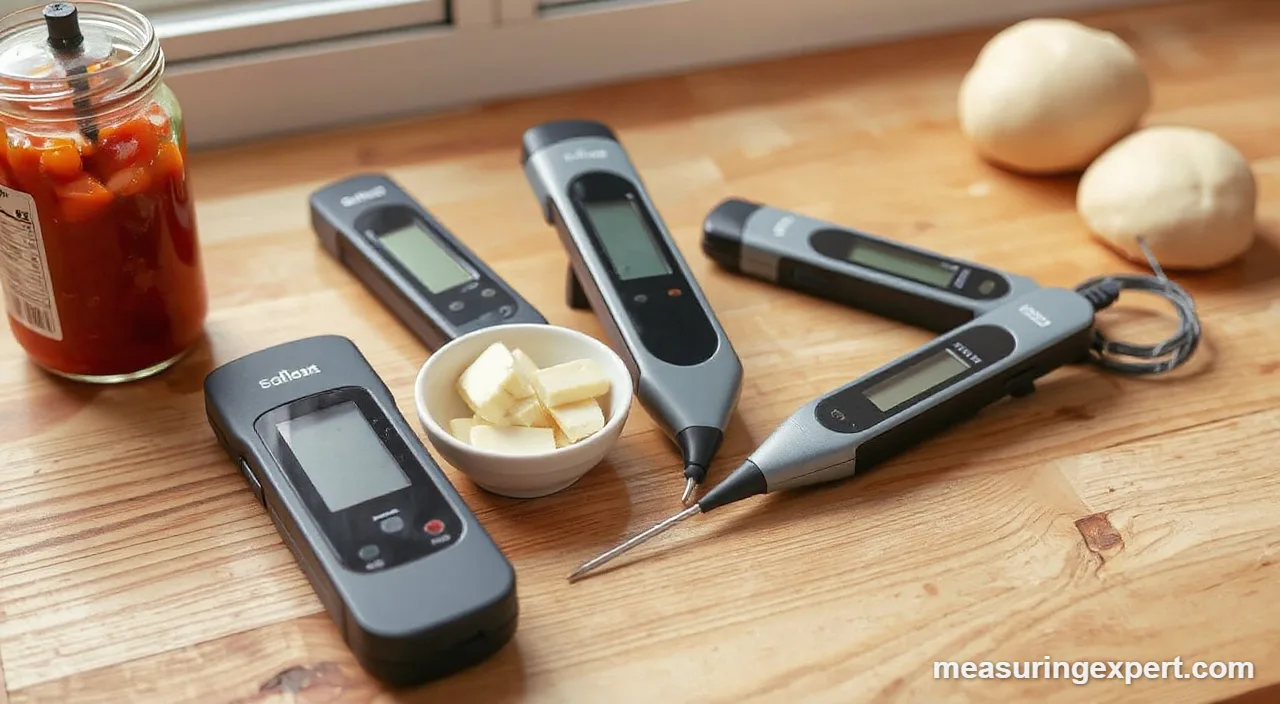
- Probe shape for food: a spear or flat sensor can touch real food, whereas a round pen cannot.
- Stated accuracy and resolution: a meter that reads 0.01 pH only helps if the accuracy figure also backs it up.
- Calibration: automatic recognition of standard buffers, and at least two points.
- Temperature compensation: automatic, because pH changes with temperature.
- Replaceable electrode: pH glass wears out, so a swappable electrode lowers long-term cost.
What pH Numbers Matter for Food Safety
First, the number everyone quotes is 4.6. Under FDA rules in 21 CFR Part 114, a low-acid food has a finished equilibrium pH above 4.6, and an acidified food is a low-acid food with acid added so that its final equilibrium pH is 4.6 or lower. The National Center for Home Food Preservation explains the reason: botulism bacteria can grow and make toxin in sealed jars of moist food at room temperature when the pH is above 4.6.
The University of Florida notes that equilibrium pH is the value after added acid has spread evenly through the food. Consequently, wait at least 24 hours after processing before you take the reading that counts. Hanna also notes that hot sauce must come in below 4.6, and that strip-type methods are allowed only for foods below pH 4.0, so a meter is the right tool above that line.
Which Probe Suits Your pH Meter for Food: Spear, Flat or Pen
The probe shape decides what you can test, so choose it before you choose a brand. As a result, you avoid buying a pen that cannot enter dough.
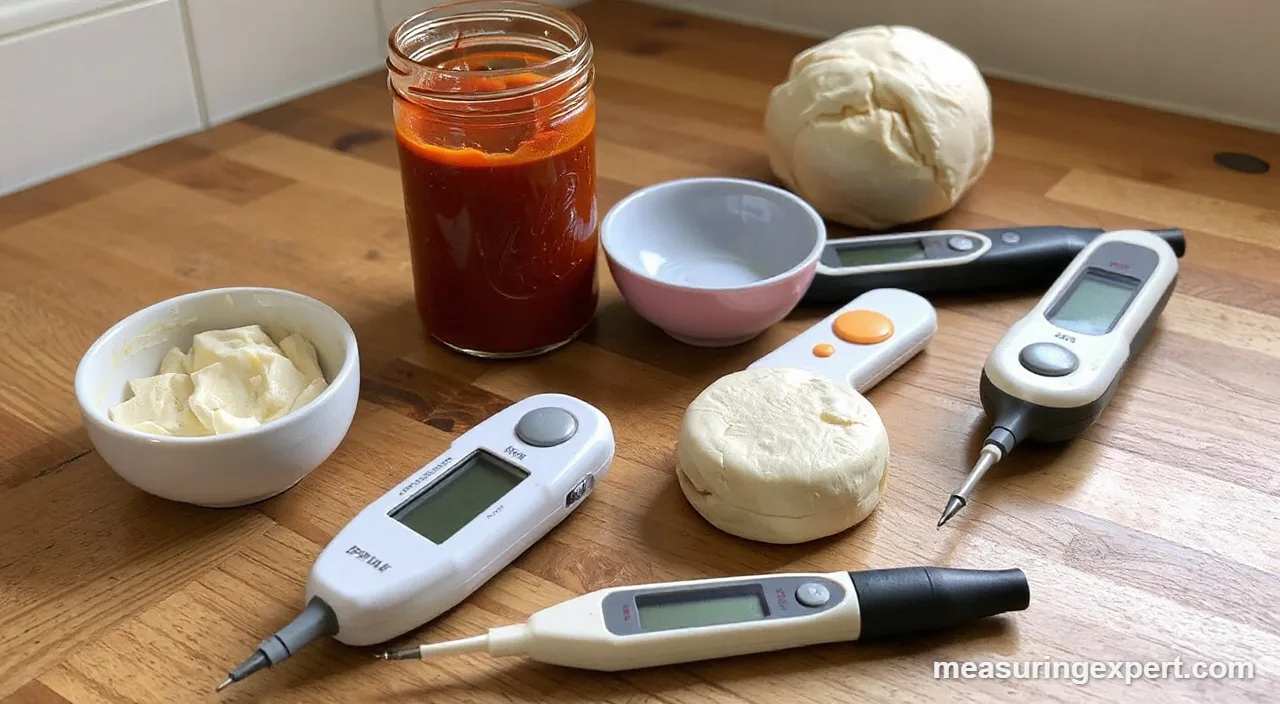
| Probe type | Best for | Examples here |
|---|---|---|
| Spear tip | Cheese, dough, meat, thick sauces, jams | Apera PH60S-Z, PH60S, YINMIK models |
| Cabled food probe | Vats, pots and bench work | Hanna HI99161 |
| Flat sensor | Drops of liquid or a thin smear | HORIBA LAQUAtwin pH-11 |
| Round pen probe | Clear, thin liquids | Bluelab pH Pen, HACH Pocket Pro |
For example, for thick products, Hanna says its junction resists clogging in viscous liquids, which is the main reason food probes differ from general pens. Likewise, if your food has separate solid and liquid parts, the University of Florida advises blending it into a consistent paste in the product proportions before you test.
Specs That Matter on a Tester
- Resolution versus accuracy: resolution is the smallest step shown (0.1 or 0.01 pH). Accuracy is how close the reading is to the truth, and it ranges from plus or minus 0.01 to 0.1 pH here. A 4.6 limit with a 0.1 error leaves little room, so keep a margin.
- Calibration points: two points that bracket your food (for example 4.01 and 7.00) beat one.
- Temperature: automatic compensation corrects the electrode slope, but readings are most accurate between 20 and 30 C (68 to 86 F), according to the University of Florida.
- Replaceable electrode: the PH60S, PH60S-Z and pH-11 have replaceable sensors, which lowers long-term cost.
How to Measure Food pH Step by Step With a pH Meter for Food
- Calibrate first. Use fresh pH 7.00 and pH 4.01 buffers at room temperature, and rinse the probe with distilled water between them.
- Prepare the sample. Next, blend mixed foods into a uniform paste, and let hot samples cool to about 20 to 30 C (68 to 86 F).
- Insert the probe. Then push a spear tip fully into the paste or dip a liquid sample, and keep the glass tip away from the container walls.
- Wait for a stable reading. Then do not write down a number while the display is still drifting.
- Record pH and temperature. Also, note the date, the recipe and the batch.
- Rinse and store the probe. Afterward, use distilled water, then the storage method the maker states.
- Re-check after equilibration. Finally, for acidified foods, take the final reading at least 24 hours after processing.
Calibration and Care
In short, a meter is only as good as its last calibration. Therefore, calibrate before each testing session and any time the reading seems off. Buffer solutions expire and pick up contamination, so pour a little into a clean cup each time and never pour it back. Next, keep the glass electrode wet in the storage solution the maker recommends, because a dried glass bulb responds slowly or not at all. Finally, replace the electrode when calibration fails or the response drags.
Honest Limits of Home pH Testing
Overall, these are research-based picks, and we did not test any meter. For example, a reading shows acidity at one moment in one spot, and it says nothing about water activity, salt, heat processing or contamination. In addition, a pH reading near 4.6 is within the error of a pocket meter, so build in a margin instead of aiming at the limit. For anything you sell, therefore, use a laboratory or process authority. For soil, see our best soil pH meter guide, and for strips see best pH test strips.
Related reading: fermentation temperature also matters, and our best fermentation thermometer guide covers that. For recipe amounts, see how to measure ingredients for fermentation and measure ingredients for pickling.
Best pH Meter for Food FAQ
What is the best pH meter for food?
For most kitchens, the best pH meter for food is the Apera PH60S-Z, because it has a spear tip, automatic calibration and a listed accuracy of plus or minus 0.01 pH. However, the Hanna HI99161 is the stronger pick for cheese and small food businesses.
Which tester works best for hot sauce?
In short, a spear or cabled food probe handles thick sauce best. The Apera PH60S and the Hanna HI99161 both fit. Hanna notes that hot sauce must have a pH below 4.6, so first calibrate with pH 4.01 and 7.00 buffers first.
Why is pH 4.6 important in food?
FDA rules define low-acid foods as having a finished equilibrium pH above 4.6. The National Center for Home Food Preservation says botulism bacteria can grow and make toxin in sealed jars of moist food at room temperature above that pH.
Can a meter replace pH test strips?
Often yes, because Hanna notes that strip-type methods are allowed only for foods below pH 4.0, so for anything above that you need an electrochemical meter. Meters also give finer readings than color-matching strips.
How accurate is a pH meter for food?
It depends on the model, because each maker lists its own figure. The Apera PH60S lists plus or minus 0.01 pH, the HORIBA pH-11 and Bluelab pen list plus or minus 0.1 pH, and the HACH Pocket Pro also lists plus or minus 0.1 pH. However, accuracy holds only with fresh calibration.
How often should I calibrate the meter?
Also, calibrate before each testing session, and again whenever readings look odd. The Bluelab pen adds a 30-day calibration indicator, but food safety checks deserve calibration on the day of the test.
Can I test kombucha or sourdough with a pH meter for food?
Yes. A pen works for kombucha, which is a thin liquid, while a spear or flat sensor suits sourdough starter and dough. Also, track your own readings from batch to batch, since the right target depends on your recipe and your regulator.
Can I use a soil or pool pH meter for food?
No, we would not. Those meters are built for other samples, and their probes may clog in thick food. Instead, choose a spear tip or a flat sensor made for food. Our soil pH meter guide covers the garden side.
How long does a food pH electrode last?
Glass electrodes wear out, so you should plan to replace them. Apera gives a six-month warranty on the PH60S probe, and HORIBA gives six months on the pH-11 sensor. Also, correct storage extends life.
When should I measure the pH of canned goods?
For example, for acidified foods, wait at least 24 hours after processing for equilibrium pH, according to the University of Florida. However, a tested recipe from a source like NCHFP should still be your safety basis.
Bottom Line on the Best pH Meter for Food
For most home cooks and fermenters, the best pH meter for food is the Apera PH60S-Z. It has a spear tip, fine accuracy and automatic calibration. Instead, pick the Hanna HI99161 for cheese and small production, the HORIBA pH-11 for tiny samples, and a pen only for thin liquids. Whatever you buy, calibrate often and treat 4.6 as a line to stay safely under.