

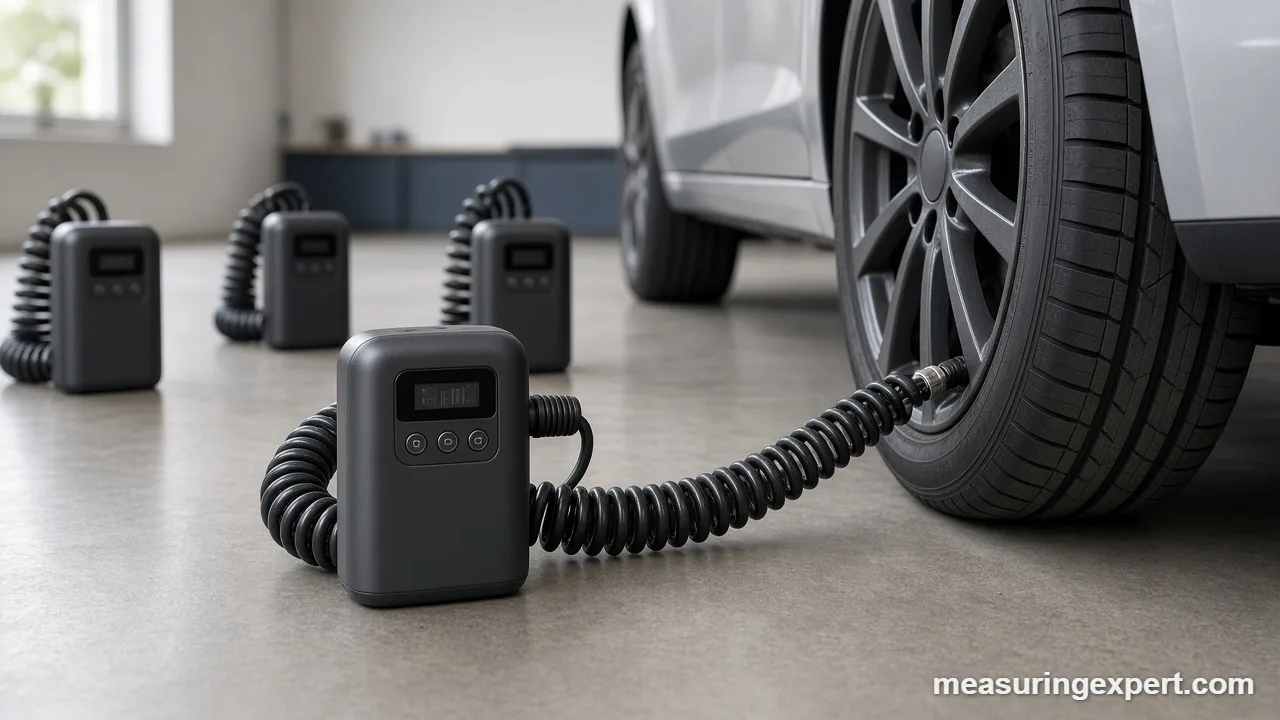
The best tire inflator for most drivers is the Milwaukee M18 Inflator, because it stops at the pressure you set and stores four presets. However, the right choice depends on the gauge: look for auto shutoff, readings in psi, bar and kPa, and a reading you can cross-check against a separate gauge.
In short: Milwaukee M18 for set-and-forget accuracy, AstroAI for a low-cost 12V pump, Airmoto for bikes and glove boxes, and VIAIR 300P for trucks and SUVs.
As an Amazon Associate, Measuring Expert earns from qualifying purchases. Our picks are based on research, specifications and owner feedback, not paid placement.
Best Overall

Best Budget

Best Compact

Quick Answer: Which Inflator Fits Your Tires?
- Most accurate stop: the Milwaukee M18 checks the settled pressure before it tops up, then shuts off at your target.
- Three power sources: the DEWALT 20V MAX runs on a battery, a 12V car outlet or wall power.
- Lowest cost: the AstroAI 12V pump plugs into the car and shows a digital reading.
- Bikes and small cars: the Airmoto weighs 1.25 lb and charges by USB.
- Trucks and SUVs: the VIAIR 300P is a 12V compressor rated to 150 PSI.
- Long fill sessions: the Etenwolf Vortex S6 lists a 100% duty cycle and a large battery.
- Any pick: set it to the pressure on your door placard, not the number molded on the tire.
On This Page
- Comparison table
- The 8 picks, reviewed
- How we chose
- How the gauge on an inflator works
- PSI, bar and kPa explained
- Tire pressure converter
- Cordless, 12V and tool-battery types
- How to inflate a tire to the right pressure
- How to check your inflator’s accuracy
- Honest limits
- FAQ
- Bottom line
Best Tire Inflator Comparison Table
First, find your vehicle or use case in the Best For column. Then jump to the review for the gauge, the power source and the trade-offs.
| # | Product | Best For | Standout Feature | Amazon |
|---|---|---|---|---|
| 1 | Milwaukee M18 Inflator 2848-20 | Accurate set-and-forget fills | Four PSI presets and a settled-pressure check | View |
| 2 | DEWALT 20V MAX Inflator DCC020IB | Garage and road use | Battery, 12V DC or 110V AC power | View |
| 3 | AstroAI 12V Tire Inflator | Tight budgets | Digital gauge on a car-outlet pump | View |
| 4 | Airmoto Cordless Tire Inflator | Bikes and small cars | 1.25 lb, USB charging, 120 PSI max | View |
| 5 | VIAIR 300P Portable Compressor | Trucks and SUVs | 12V compressor rated to 150 PSI | View |
| 6 | Etenwolf Vortex S6 | Many tires in one session | Listed 100% duty cycle, dual cylinder | View |
| 7 | JUSUOX Cordless Tire Inflator | Battery plus car backup | Battery or 12V DC power | View |
| 8 | Avid Power 20V Tire Inflator | Cordless on a budget | 20V battery with a 12V DC cord | View |
The 8 Best Tire Inflator Picks, Reviewed
We start with the two tool-battery models, because their gauges and controls are the most refined. Next come the budget and compact picks. Finally, we cover the heavy-duty options for trucks and long sessions.
Best Overall
1. Milwaukee M18 Inflator 2848-20
Best for: drivers who already own M18 batteries and want the inflator to stop at the right number every time.
In general, most inflators read pressure while the pump runs. That reading is noisy, because the pump pushes pulses of air into the hose. Milwaukee handles this with a feature it calls TrueFill. First, the tool lets the pressure settle and checks it. Then it fills to your target and shuts off. As a result, the final number is closer to what a separate gauge would show.
In addition, the tool stores four PSI presets, so you can save the front and rear values for a car, plus a bike and a ball. Milwaukee rates it for 150 PSI and includes both a brass Schrader chuck and a Presta chuck. According to Milwaukee, it tops off a 33-inch light truck tire in under a minute.
- Rating: 150 PSI max, per Milwaukee
- Auto shutoff at the selected pressure
- Four PSI memory presets
- 36-inch hose with brass Schrader chuck and Presta chuck
- Power: any M18 battery (sold separately)
Pros
- Settled-pressure check before the final fill
- Presets save time on mixed vehicles
- Presta chuck included for road bikes
Cons
- Bare tool, so the battery costs extra
- No published gauge accuracy figure
- Heavier than pocket inflators
Skip it if: you do not own M18 batteries and only need a pump for emergencies.
Best for Three Power Sources
2. DEWALT 20V MAX Inflator DCC020IB
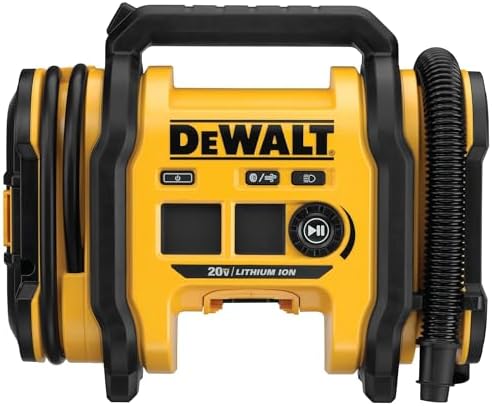
Best for: DEWALT owners who want one inflator for the garage, the car and the campsite.
The DEWALT runs on a 20V MAX battery, a 12V DC car outlet or 110V AC wall power, according to DEWALT. So it keeps working when the battery runs flat. The 12V cord is included; however, the battery, charger and AC adapter are sold separately.
For measuring, the key detail is the digital gauge with a target setting. In high-pressure mode, the tool shuts off once it reaches that target. Meanwhile, a separate high-volume mode moves a lot of air at low pressure, so it can also fill or empty air mattresses. That mode does not stop at a set pressure, so use it only for low-pressure items.
- Power: 20V MAX battery, 12V DC or 110V AC
- Digital gauge with a target pressure setting
- Auto shutoff in high-pressure mode
- High-volume inflate and deflate modes
Pros
- Three ways to power it
- Auto shutoff for tires
- Deflate mode for inflatables
Cons
- Battery and AC adapter cost extra
- DEWALT does not publish a gauge accuracy figure
- Bulky for a small trunk
Skip it if: you want a small pump that lives in the glove box.
Best Budget
3. AstroAI 12V Tire Inflator
Best for: drivers who want a digital reading for the lowest cost and do not mind a cord.
This AstroAI pump plugs into the car’s 12V outlet, so it never needs charging. According to the listing, it has a digital pressure gauge and an LED light for night use. Because it draws power from the car, you can top off all four tires without watching a battery meter.
Before you rely on the screen, compare it with a separate gauge once. Budget gauges can read a little high or low, and the offset usually stays the same. Once you know it, you can set the target a pound or so higher or lower to compensate.
- Power: 12V DC car outlet, per the listing
- Digital pressure display
- LED work light
- Includes adapters for balls and bikes, as listed
Pros
- Low cost with a digital readout
- No battery to keep charged
- Light enough for any trunk
Cons
- Needs the car running or the outlet live
- Slower on large truck tires
- No published accuracy figure
Skip it if: you need to inflate bike tires away from the car.
Best Compact
4. Airmoto Cordless Tire Inflator
Best for: cyclists, scooter riders and small-car owners who want a pump that fits in a bag.
Airmoto lists a weight of 1.25 lb (about 0.57 kg) and a 2000 mAh battery that charges by USB in under 2 hours. You set the target, and the pump stops at that pressure. Also, the 120 PSI ceiling covers high-pressure road bike tires as well as car tires.
However, a small battery means a small tank of energy. For example, it can top off a car tire that is a few PSI low, but filling a flat truck tire from zero is not its job. Instead, think of it as a top-off tool and a bike pump.
- Max pressure: 120 PSI, per Airmoto
- Auto shutoff at the set pressure
- Battery: 2000 mAh, USB charging (5V, 2A)
- Weight: 1.25 lb (0.57 kg)
Pros
- Very small and light
- Charges from any USB source
- Handles road bike pressures
Cons
- Small battery for big tires
- Airmoto lists PSI as the only unit
- Slow on a full flat
Skip it if: you drive a truck or fill several large tires at once.
Best for Trucks and SUVs
5. VIAIR 300P Portable Compressor
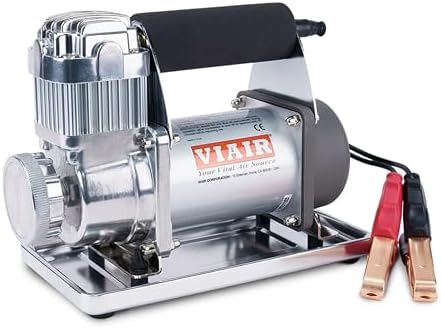
Best for: truck, SUV and off-road drivers who air down on the trail and need real air volume to air back up.
Unlike the pocket pumps, VIAIR builds dedicated 12V compressors. According to the listing, the 300P is rated to 150 PSI and made for truck and SUV tires. That extra volume matters most when you refill large tires after airing down for sand or rocks.
On the measuring side, this is an old-school tool. It uses a dial gauge instead of a target setting, so you watch the needle and stop the pump yourself. Therefore, it pays to keep a good separate gauge for the final reading. Our backlit LCD tire gauge guide covers gauges that pair well with a compressor like this.
- Rating: 150 PSI, as listed
- Power: 12V, for car or truck electrical systems
- Made for truck and SUV tires
Pros
- Built for large tires
- Simple, proven design
- Good for airing back up after trail runs
Cons
- No set-and-stop pressure target
- Dial gauge is harder to read precisely
- Heavier than a cordless pump
Skip it if: you want the pump to stop by itself at a set PSI.
Best for Long Sessions
6. Etenwolf Vortex S6

Best for: families with several vehicles, or anyone who fills many tires in one go.
Most small cordless pumps need a rest after a few minutes, because they heat up. In contrast, the Vortex S6 listing claims a 100% duty cycle, a dual-cylinder pump and a 19,200 mAh battery. So it suits a long session, such as four car tires plus a trailer.
Heat also affects readings. For instance, a pump that runs hot warms the air in the hose, so the number on the screen can drift. For that reason, let the tire sit for a minute after the pump stops, then check it with a separate gauge.
- Battery: 19,200 mAh, per the listing
- Duty cycle: 100%, as listed
- Dual-cylinder pump
- LED backlit display, per the listing
Pros
- Large battery for many tires
- Listed for continuous use
- Cordless, so no cable to the car
Cons
- Heavier than pocket models
- Specs come from the listing, not a spec sheet we could open
Skip it if: you only top off one car a month.
Best Dual Power
7. JUSUOX Cordless Tire Inflator

Best for: drivers who want cordless convenience but also a car-outlet backup.
The JUSUOX runs on its own battery or on 12V DC from the car, according to the listing. That dual power is useful, because a cordless pump left in a cold trunk can lose charge. In that case, you plug it in and keep going.
Also, it has a digital gauge, so you can read the pressure in the unit your door placard uses. Still, check the screen against a separate gauge once, then note the offset on a piece of tape inside the case.
- Power: rechargeable battery or 12V DC, per the listing
- Digital pressure display
- LED light for night use
Pros
- Two power sources
- Compact enough for a trunk organizer
Cons
- No published accuracy spec
- Smaller brand with less support detail
Skip it if: you want a maker that publishes a full spec sheet.
Best Cordless Value
8. Avid Power 20V Tire Inflator

Best for: buyers who want a cordless pump with its own battery but do not own a tool platform.
Unlike the Milwaukee and DEWALT, the Avid Power comes with a rechargeable 20V battery, per the listing. In addition, it includes a 12V DC cord, so it also runs from the car. Also, the digital gauge shows the current pressure as it fills.
As a result, it sits between the bare-tool models and the corded budget pumps. It is a reasonable first cordless inflator, as long as you treat its gauge as a guide and confirm the final number by hand.
- Power: 20V rechargeable battery, plus a 12V DC cord, as listed
- Digital pressure display
- Includes nozzles for balls and inflatables
Pros
- Battery included in the box
- 12V backup cord
Cons
- No published accuracy figure
- Battery does not fit other tool brands
Skip it if: you already own Milwaukee or DEWALT batteries.
How We Chose the Best Tire Inflator Picks
We did not run these pumps through lab tests. Instead, our picks are research-based. First, we looked at the measuring features: a target setting, auto shutoff, the units on the display and whether the maker explains how it reads pressure. Then we checked power options, because a dead battery makes any gauge useless.
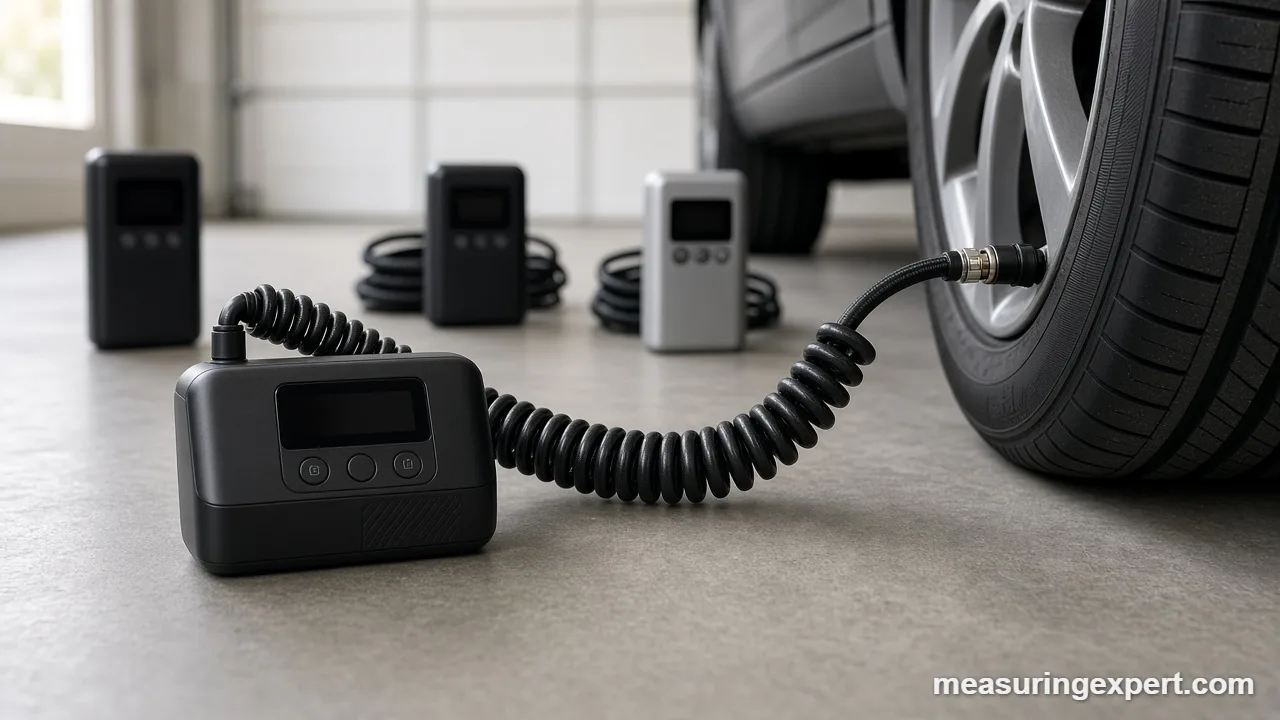
Next, we gave extra weight to makers that publish specs on their own pages, such as Milwaukee, DEWALT and Airmoto. For other picks, we only state what the listing shows and say so. In addition, we read owner feedback for common problems, such as gauges that read high. Finally, we used the NHTSA tire safety guidance for the pressure rules in this guide, and Milwaukee’s M18 Inflator product page for its specs.
How the Gauge on the Best Tire Inflator Works
A digital inflator has a small pressure sensor inside the pump body. The sensor measures the pressure in the hose, not in the tire itself. While the pump runs, the hose pressure is a little higher than the tire pressure, because air has to flow through the valve. As a result, many pumps read high during the fill and then drop a bit when they stop.
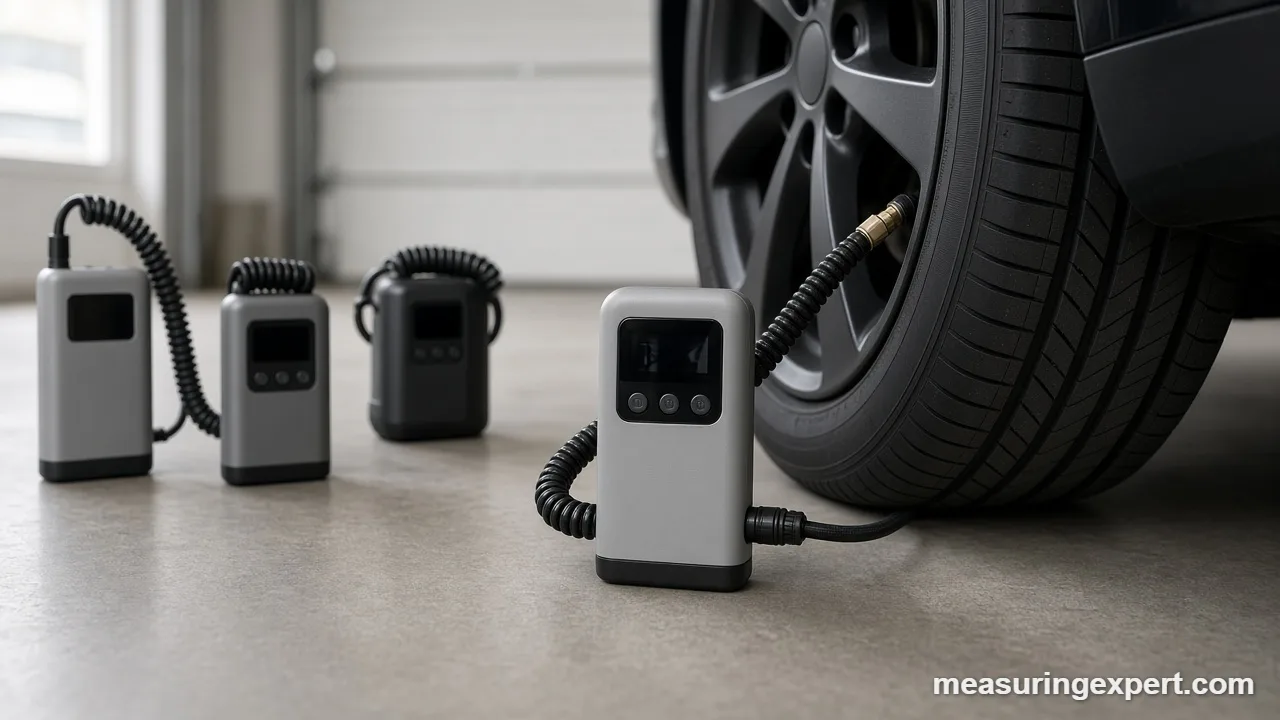
However, better designs work around that. For example, Milwaukee pauses, lets the pressure settle and then reads it. Cheaper pumps may simply stop when the running reading hits the target. So the tire can end up one or two PSI under the number on the screen.
Auto shutoff is only as good as the sensor behind it. In other words, a pump that stops at 35 PSI on its own display might leave 33 or 37 PSI in the tire. Most makers in this category do not publish an accuracy figure at all. Therefore, the safe habit is simple: let the pump stop, wait a few seconds, then check with a separate gauge.
Reading PSI, Bar and kPa on the Best Tire Inflator
Most US door placards list pressure in PSI (pounds per square inch). However, European and Asian placards often use bar or kPa. Many inflators can switch units, so check the manual before you buy if your car uses metric values.
The conversions are fixed. Specifically, one PSI equals 6.895 kPa, and 1 bar equals 100 kPa, or about 14.5 PSI. For example, a typical car setting of 35 PSI is 241.3 kPa, or 2.41 bar. Some older gauges also show kg/cm2, which is close to bar (1 kg/cm2 is about 0.98 bar).
| PSI | kPa | bar | Typical use |
|---|---|---|---|
| 30 | 206.8 | 2.07 | Some small cars |
| 32 | 220.6 | 2.21 | Many sedans |
| 35 | 241.3 | 2.41 | Many SUVs and crossovers |
| 44 | 303.4 | 3.03 | Some light truck tires |
| 80 | 551.6 | 5.52 | Road bike tires |
| 100 | 689.5 | 6.89 | High-pressure road tires |
Always use the value on your own placard, though. After all, these rows are examples, not settings for your car. If you want the physics behind the numbers, our guide to the pressure of a gas explains why pressure rises with temperature.
Tire Pressure Converter: PSI, Bar and kPa
Enter the pressure from your placard or your inflator’s display. Then read the same value in the other units.
Choosing the Best Tire Inflator Type: Cordless, 12V or Tool Battery
Inflators fall into four groups. Each one trades power for convenience in a different way, so start with where you will use it.
| Type | Power | Strengths | Weak spots |
|---|---|---|---|
| 12V corded pump | Car outlet | Low cost, never needs charging | Cord reach, car must supply power |
| Pocket cordless | Built-in battery | Small, good for bikes | Little energy for big tires |
| Tool-battery inflator | 18V or 20V tool pack | Strong pump, better controls | Battery often sold separately |
| 12V compressor | Battery clamps or outlet | High air volume for trucks | Heavy, often no auto shutoff |
Beyond the type, check four specs. First, the maximum pressure should sit well above your target, so the pump does not strain. Second, the display should show your placard unit. Third, look for auto shutoff with a target you can set in 0.5 or 1 PSI steps. Finally, check hose length, because a short hose makes rear tires awkward on a 12V pump.
How to Inflate a Tire to the Right Pressure
These steps follow the NHTSA advice to set pressure cold and to use the vehicle maker’s number.
- Find the right number. Read the tire and loading label on the driver’s door jamb or in the owner’s manual, not the maximum on the tire sidewall.
- Start with cold tires. Check before driving, or after the car has been parked for about three hours.
- Read the current pressure. Remove the valve cap and press a separate gauge onto the valve stem.
- Set the target. Choose the placard value on the inflator, in the same unit as the label.
- Connect and run. Screw or clamp the chuck onto the valve and start the pump until it stops.
- Let it settle. Wait about 10 seconds, then remove the chuck quickly to limit air loss.
- Confirm and cap. Check again with the separate gauge, adjust if needed and replace the valve cap.
How to Check Your Inflator’s Accuracy
You do not need a lab to find out how far off your pump is. Instead, you need a reference gauge you trust, such as a quality digital tire gauge. Then follow this simple routine.
First, fill a cold tire with the inflator and let it stop. Next, read the tire with the reference gauge three times and average the numbers. After that, compare the average with the inflator’s target. The difference is your offset. For example, if the pump stops at 35 PSI but the gauge reads 33.5 PSI, set the pump to 36.5 PSI next time.
Repeat the check once a season, because sensors drift and temperature changes the result. Also, recheck after the pump has been dropped. Similarly, if two of your gauges disagree, a tire shop’s calibrated gauge can settle which one is closer.
Do: set pressure cold, use the door placard value, confirm with a separate gauge and keep the valve caps on.
Don’t: inflate to the sidewall maximum, let hot tires down to the cold value, or trust high-volume modes for tires.
Honest Limits of Any Tire Inflator
Even the best tire inflator cannot fix a puncture. If a tire keeps losing air, it needs a repair, and a pump only buys you time to reach a shop. In addition, small cordless pumps are top-off tools; filling a large tire from flat can drain the battery before you reach the target.
Temperature is another limit. In fact, tire pressure changes by roughly 1 PSI for every 10 F (about 5.6 C) change in air temperature. So a tire set to 35 PSI in a warm garage can read about 31 PSI on a freezing morning. For more on how temperature and pressure link in the air around us, see our page on air pressure and weather.
Finally, the gauge on the pump is a convenience, not a reference. Most makers do not publish an accuracy rating, and pump vibration adds noise. Therefore, keep a dedicated gauge in the car, as NHTSA also recommends.
Best Tire Inflator FAQ
What is the best tire inflator for most drivers?
For drivers who own M18 batteries, the Milwaukee M18 Inflator is our top pick, because it checks the settled pressure and stops at your target. On a tight budget, a 12V pump such as the AstroAI is a simple alternative.
How accurate is the gauge on a tire inflator?
It varies, and most makers do not publish a figure. In practice, many read within a PSI or two. So confirm the final pressure with a separate gauge and note any offset.
Why does my inflator read higher than my tire gauge?
The pump measures pressure in the hose while air is flowing, which runs higher than the tire. As a result, the reading drops a little once the pump stops and the air settles.
Should I inflate to the number on the tire sidewall?
No. The sidewall shows the maximum the tire can hold. Instead, use the pressure on the label in the driver’s door jamb or in the owner’s manual, as NHTSA advises.
How many bar is 35 PSI?
35 PSI is about 2.41 bar, or 241.3 kPa. One bar equals about 14.5 PSI.
Does the best tire inflator need auto shutoff?
It is not essential, but it helps. Auto shutoff stops the pump at your target, so you do not overfill. However, it is only as accurate as the sensor, so still check by hand.
Can I check tire pressure after driving?
You can, but warm tires read higher. NHTSA says to set pressure cold, after the car has been parked for about three hours. If you add air when warm, recheck later when cold.
Can a tire inflator fill a bike tire with a Presta valve?
Yes, if it includes a Presta adapter or chuck. For example, the Milwaukee includes a Presta chuck. Also check that the max pressure covers your road tire, often 80 to 100 PSI or more.
How often should I use a tire inflator to check pressure?
Check all tires, including the spare, at least once a month and before long trips. Also check after hitting a pothole or curb, because a tire can lose air suddenly.
Is a 12V compressor better than a cordless inflator?
For large truck tires, a 12V compressor usually moves more air. For small cars and bikes, however, a cordless pump is lighter and easier. So choose by tire size and how often you fill.
Bottom Line on the Best Tire Inflator
For most drivers with M18 batteries, the Milwaukee M18 Inflator 2848-20 is the best tire inflator, because it checks the settled pressure and stops at a preset you choose. Otherwise, pick the AstroAI for a low-cost 12V pump or the Airmoto for bikes, and keep a separate gauge in the car to confirm every fill.
2 thoughts on “Best Tire Inflator: 8 Picks With Accurate Pressure Gauges”