
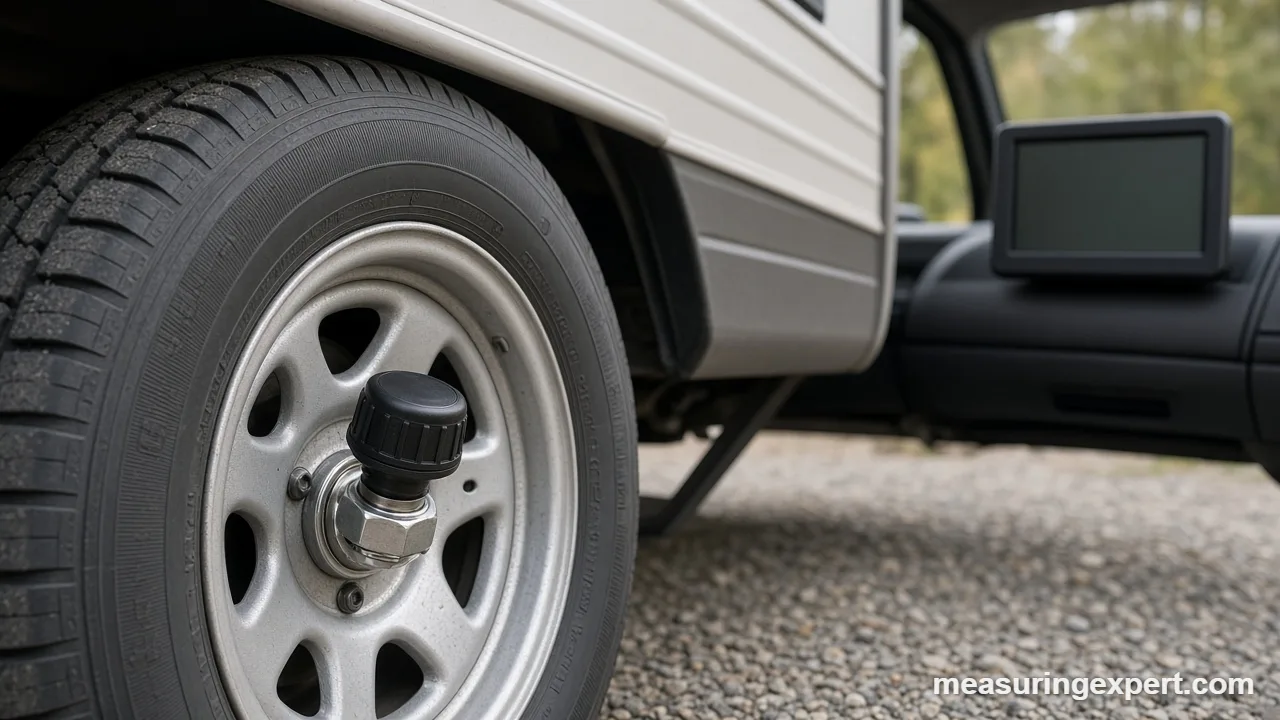
The best tire pressure monitor for most RV and trailer owners is the TireMinder A1AS, because it covers up to 22 tires, reads 0 to 199 psi and lists +/- 1 psi accuracy. Your choice then depends on tire count, sensor type (cap, flow-through or internal), rig length and whether you want a screen or a phone app.
In short: get the TireMinder A1AS for most rigs, the Tymate TM7 to protect a small trailer on a budget, and the TST 507 Series for long, multi-axle setups.
As an Amazon Associate, Measuring Expert earns from qualifying purchases. Our picks are based on research, specifications and owner feedback, not paid placement.
Best Overall

Best Budget

Best Pro
Quick Answer: Which TPMS Should You Buy?
- Most RVs and towed cars: TireMinder A1AS, with a wide range and a published accuracy figure.
- Small trailer on a budget: Tymate TM7 with 4 sensors.
- Full-timers and long rigs: TST 507 Series, expandable to 115 tire positions.
- Prefer your phone or CarPlay: TireMinder Smart TPMS.
- Need 10 sensors for less: GUTA GT30 flow-through kit.
- Older car or SUV: Masoll M13 with a solar monitor.
- Motorcycles: FOBO Bike 2 with a phone app.
On This Page
- Comparison table
- The picks, reviewed
- How we chose
- Cap vs internal sensors
- RV and trailer needs
- Specs explained
- Pressure unit converter
- Setup steps
- Why readings change
- Honest limits
- FAQ
- Bottom line
Best Tire Pressure Monitor Comparison
| # | Product | Best For | Standout Feature | Amazon |
|---|---|---|---|---|
| 1 | TireMinder A1AS RV TPMS | Most RVs and towed setups | 5.5 in color screen, up to 22 tires, +/- 1 psi | View |
| 2 | Tymate TM7 RV TPMS | Small trailers and campers | 4 sensors, six alert types, optional booster | View |
| 3 | TST 507 Series Color TPMS (4 Cap Sensors) | Full-time RVers and big rigs | Expandable to 115 tire positions, fast-leak alert | View |
| 4 | TireMinder Smart TPMS (6 Flow-Through Sensors) | Phone, CarPlay and Android Auto users | App alerts with voice, CarPlay and Android Auto | View |
| 5 | GUTA GT30 RV TPMS (10 Flow-Through Sensors) | Fifth wheels and tow vehicles on a budget | 10 flow-through sensors in one kit | View |
| 6 | Masoll M13 Solar TPMS | Cars, SUVs and light trailers | Solar-charged monitor, 0 to 87 psi range | View |
| 7 | FOBO Bike 2 | Motorcycles and scooters | Phone app, no dash monitor | View |
The 7 Best Tire Pressure Monitor Systems, Reviewed
Best Overall
1. TireMinder A1AS RV TPMS
Best for: motorhome and fifth-wheel owners who want one screen that covers the coach, the trailer or the towed car.
The TireMinder A1AS is our pick for the best tire pressure monitor for most RV owners. Its 5.5-inch color display can show up to 22 tires at once, so, for example, a motorhome and a towed car fit on one screen. In addition, it pairs with a smartphone app.
On the measurement side, TireMinder lists a range of 0 to 199 psi with +/- 1 psi accuracy. Also, the kit we link comes with 10 transmitters, and TireMinder sells 4- and 6-tire kits plus flow-through versions.
- Range: 0 to 199 psi (0 to about 1,372 kPa)
- Accuracy: +/- 1 psi, per TireMinder
- Display: 5.5 in color; shows up to 22 tires
- App: works with a smartphone app
- Warranty: 3 years
Pros
- Published accuracy figure
- Very wide pressure range
- Room for big rigs plus a towed car
- Kits in several sizes
Cons
- Costs much more than budget kits
- Long rigs may still need a signal booster
- Large screen takes dash space
Skip it if: you only tow a small single-axle trailer; the Tymate TM7 covers four tires for far less.
Best Budget
2. Tymate TM7 RV TPMS
Best for: travel trailer and pop-up owners who want basic pressure and temperature alerts on a small budget.
The Tymate TM7 is a low-cost way to add a tire pressure monitor to a trailer that has none. First, the set we link comes with 4 external sensors, and the monitor plugs into a 12 V outlet. Its manual lists alerts for high pressure, low pressure, high temperature, fast leaks, low sensor battery and lost sensor signal, so it covers the same core warnings as pricier kits.
For longer rigs, Tymate offers an optional signal booster that mounts near the rear axle. In addition, each sensor gets an anti-theft nut on the valve. However, Tymate does not publish an accuracy figure in the manual we read.
- Sensors: 4 external, with anti-theft nuts
- Alerts: high and low pressure, high temperature, fast leak, low battery, lost signal
- Power: 12 V outlet adapter
- Booster: optional, mounts near the rear axle
- Units: switchable pressure and temperature units
Pros
- Low cost to get started
- Full set of six alert types
- Replaceable sensor batteries
- Optional booster for longer rigs
Cons
- No published accuracy figure
- Booster is an extra purchase
- Four sensors only in this kit
Skip it if: you run a big fifth wheel or motorhome; the TireMinder A1AS or TST 507 handle more tires.
Best Pro
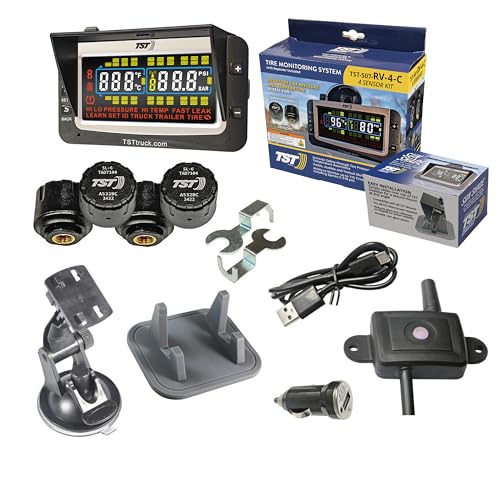
3. TST 507 Series Color TPMS (4 Cap Sensors)
Best for: full-time RVers and anyone towing a long or multi-axle trailer who wants a system that grows with the rig.
To begin with, Truck System Technologies (TST) is a long-standing name in RV tire monitoring, and the 507 Series is its core platform. According to the 507 Series manual, one monitor can track up to four trailers and a total of 115 tire positions, including spares.
TST lists a pressure range of 1 to 218 psi (1 to 15 bar) with +/- 1.5 psi accuracy, and temperature accuracy of +/- 5.4 F (+/- 3 C). In addition, the fast-leak alert trips when a tire loses 2 psi or more in under a minute. Also, TST says to fit the supplied repeater on vehicles over about 30 ft or with a metal shell. Finally, cap sensors use a CR2032 battery that TST rates for about one year.
- Range: 1 to 218 psi (1 to 15 bar), per the 507 Series manual
- Accuracy: +/- 1.5 psi; temperature +/- 5.4 F
- Capacity: up to 115 tire positions across four trailers
- Fast-leak alert: 2 psi or more lost in under one minute
- Sensors: cap type, CR2032 battery, about 1 year
Pros
- Huge expansion capacity
- Clear fast-leak rule
- Programmable high and low limits
- Repeater option for long rigs
Cons
- Expensive for a four-tire kit
- Repeater needs a wired 12 V supply
- Cap sensors need yearly battery swaps
Skip it if: you have a car or a small trailer; a simpler kit does the job.
Best Smart
4. TireMinder Smart TPMS (6 Flow-Through Sensors)

Best for: drivers who would rather see tire data on a phone or in-dash screen than mount another monitor.
The TireMinder Smart TPMS skips the dedicated screen. Instead, a Bluetooth adapter converts the 433 MHz sensor signals and sends them to the TireMinder app on iPhone, iPad or Android. The adapter keeps watching even if the phone is off, and the system works with Apple CarPlay and Android Auto.
TireMinder says the system checks for tire issues every 6 seconds and sends voice alerts with push notifications. It also monitors tire temperature, and, in addition, kits scale up to 10 transmitters. The version we link uses 6 flow-through sensors, so you can add air without removing them. Meanwhile, a signal booster is included, and the warranty runs 3 years.
- Connection: Bluetooth adapter to iOS or Android app
- In-dash: Apple CarPlay and Android Auto
- Check rate: every 6 seconds, per TireMinder
- Sensors: 6 flow-through (433 MHz); up to 10 supported
- Warranty: 3 years; signal booster included
Pros
- No extra screen on the dash
- Alerts keep running with the phone off
- Flow-through sensors make top-offs easy
- Booster included
Cons
- Depends on your phone or head unit
- No accuracy figure on the product page
- Flow-through sensors add weight on the valve stem
Skip it if: you want a standalone screen that works without any phone; choose the TireMinder A1AS.
Best for Many Tires
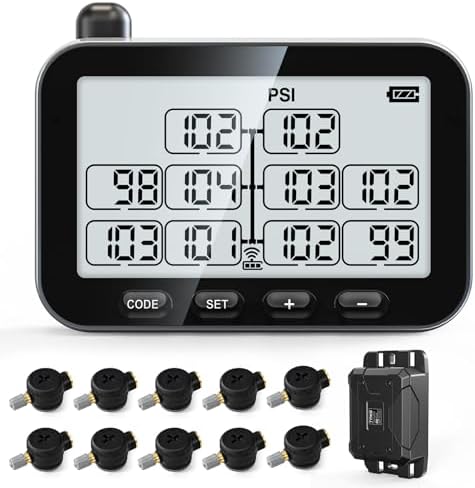
5. GUTA GT30 RV TPMS (10 Flow-Through Sensors)
Best for: owners of a dually truck plus a tandem-axle fifth wheel who need many sensors without a premium price.
For example, the GUTA GT30 kit we link ships with 10 flow-through sensors. Because the sensors are flow-through, you can top off air at a campground without taking them off the valve.
GUTA sells several kit sizes, including a 12-sensor GT30 version, so you can match the count to your rig. On the other hand, we could not open a manufacturer spec sheet or manual for the GT30 to confirm its range or accuracy. So check the listing’s stated range against your highest cold pressure, and confirm readings with a good gauge after setup.
- Sensors: 10 flow-through in this kit
- Larger 12-sensor GT30 kit also sold
Pros
- Ten sensors at a mid-range cost
- Air up without removing sensors
- Bigger kit option available
Cons
- No manufacturer spec sheet we could verify
- Flow-through sensors add weight on the stem
- Less brand support history than TST or TireMinder
Skip it if: you want a documented accuracy figure; pick the TST 507 or the TireMinder A1AS.
Best for Cars and SUVs
6. Masoll M13 Solar TPMS

Best for: older cars, SUVs, pickups and light utility trailers that have no factory tire monitoring.
The Masoll M13 is a compact, low-cost kit with 4 external sensors and a small monitor that charges from its own solar panel or a USB lead. Also, the LCD backlight adjusts to ambient light, and the screen shows pressure for all four tires.
The M13 manual lists a range of 0 to 87 psi (0 to 6 bar), which suits passenger and light-truck tires. However, that ceiling is too close to the 80 psi of a Load Range E trailer tire, so do not use it on heavy trailers or RVs. Alerts cover high and low pressure, high temperature, fast leaks and low sensor battery. Besides that, each sensor runs on a CR1632 coin cell, and no accuracy figure is published.
- Range: 0 to 87 psi (0 to 6 bar)
- Sensors: 4 external, CR1632 battery
- Power: built-in battery charged by solar or USB
- Alerts: high and low pressure, high temperature, fast leak, low battery
- Radio: 433.92 MHz
Pros
- Wire-free solar monitor
- Very low cost
- Auto-dimming backlight
- Simple four-tire layout
Cons
- 87 psi ceiling rules out heavy RV tires
- No published accuracy figure
- Cap sensors are easier to steal
Skip it if: you tow a heavy trailer or drive a motorhome; choose the TireMinder A1AS or TST 507.
Best for Motorcycles
7. FOBO Bike 2

Best for: motorcycle riders who want tire pressure on a phone without adding a screen to the bars.
When motorcycle tires lose a few psi, the handling changes fast, so a small monitor makes sense on two wheels. For that reason, the FOBO Bike 2 puts a light cap sensor on each valve and sends readings over Bluetooth to the FOBO app on iOS or Android.
After that, setup happens in the app: you create a bike profile, pick the bike type, then pull each sensor’s battery tab and screw it on. Then a FOBO lock nut holds each sensor against the valve. However, FOBO’s quick start guides do not list a range or accuracy figure, so check the bike with a good gauge before a long ride.
- Sensors: cap type, one per wheel
- Connection: Bluetooth to the FOBO app (iOS and Android)
- Mounting: lock nut on each valve
- Setup: bike profile and sensor pairing in the app
Pros
- No extra screen on the bars
- Light cap sensors
- App-based setup
- Trike version also sold
Cons
- Needs your phone for readings
- No published accuracy figure
- Not for cars or trailers
Skip it if: you want alerts without a phone; a screen-based kit is simpler.
How We Chose the Best Tire Pressure Monitor Picks
We did not hands-on test these systems. Instead, our picks are research-based. First, we read manufacturer spec pages and manuals for range, stated accuracy, tire count and sensor type. Next, we matched each kit to a real use: a car, a travel trailer, or a long motorhome towing a car.
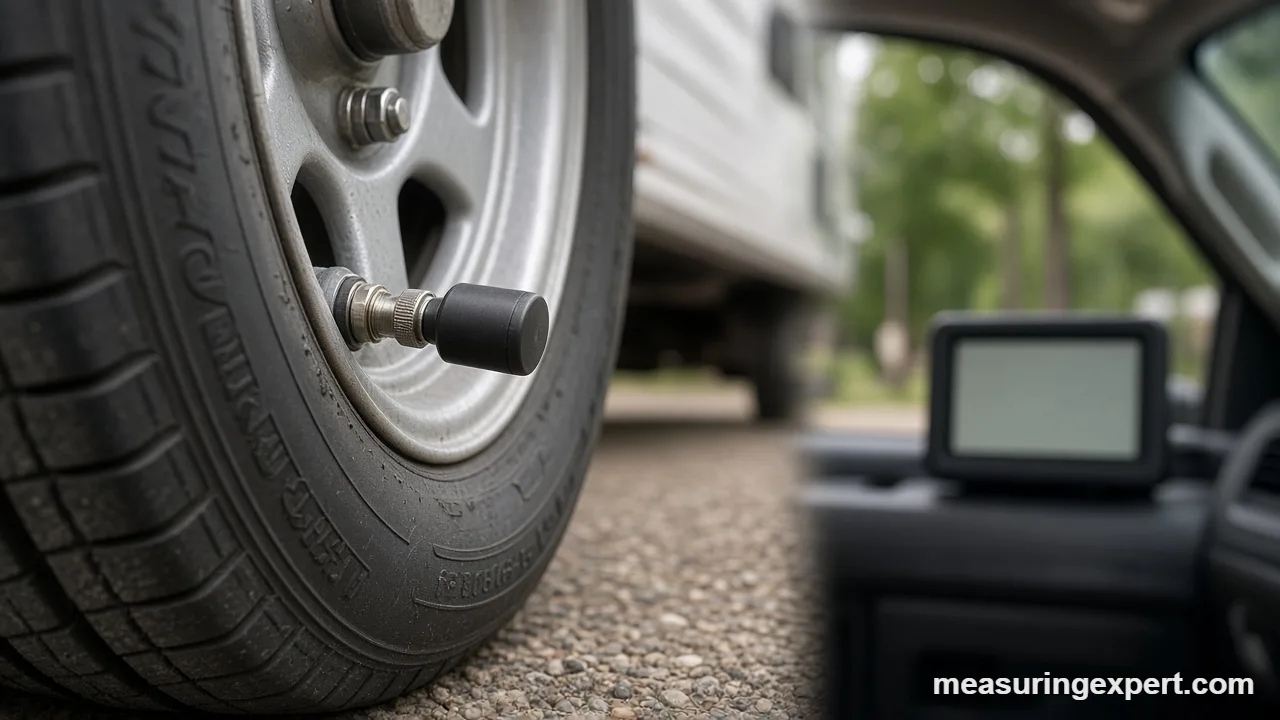
We also weighed owner feedback on pairing, signal drop-outs and battery life, and checked the federal rules. Our main sources were the NHTSA tire safety page and the federal TPMS standard, FMVSS No. 138 (49 CFR 571.138).
- Range: covers your cold pressure with room to spare.
- Stated accuracy: we favored kits that publish a figure.
- Tire count: enough sensor slots, plus a booster option for long rigs.
- Alerts: low, high, temperature and fast leak warnings.
Cap Sensors vs Internal Sensors: Which TPMS Type?
In general, every aftermarket tire pressure monitoring system (TPMS) uses a radio sensor in each tire and a receiver in the cab. So the big choice is where that sensor lives, which affects install time and theft risk.
| Sensor type | Where it mounts | Install | Good for | Watch out for |
|---|---|---|---|---|
| Cap (external) | Screws onto the valve stem in place of the cap | Minutes, no tools beyond a wrench for the lock nut | Cars, SUVs, travel trailers, renters | Adds weight and leverage on rubber stems; easier to steal |
| Flow-through (external) | On the valve stem, with a port so you can add air without removing it | Minutes | RVs and trailers you top off often | Needs metal stems on heavy rigs; one more seal that can leak |
| Internal (in-wheel) | Inside the tire, strapped to the rim or built into the valve | Tire shop dismount | Daily drivers, off-road, theft-prone parking | Costs more to fit; battery swap means removing the tire |
| Indirect (ABS based) | No sensor; the car compares wheel speeds | Built in by the automaker | Many factory systems | Shows that a tire is low, but not the actual psi |
For most people adding a monitor to a vehicle or trailer that has none, cap or flow-through sensors make the most sense. However, on rubber snap-in valve stems, a heavy sensor can flex the stem at speed. So, many RV owners switch to metal bolt-in stems before they fit any external sensor. On the other hand, internal sensors need a tire shop to fit, so they suit a vehicle you plan to keep.
Best Tire Pressure Monitor for RVs and Trailers: What Matters
Federal TPMS rules cover passenger cars, trucks and buses with a gross vehicle weight rating of 10,000 lb (4,536 kg) or less, and they exclude vehicles with dual wheels on an axle. As a result, most motorhomes with duals and every towed trailer fall outside the factory requirement.
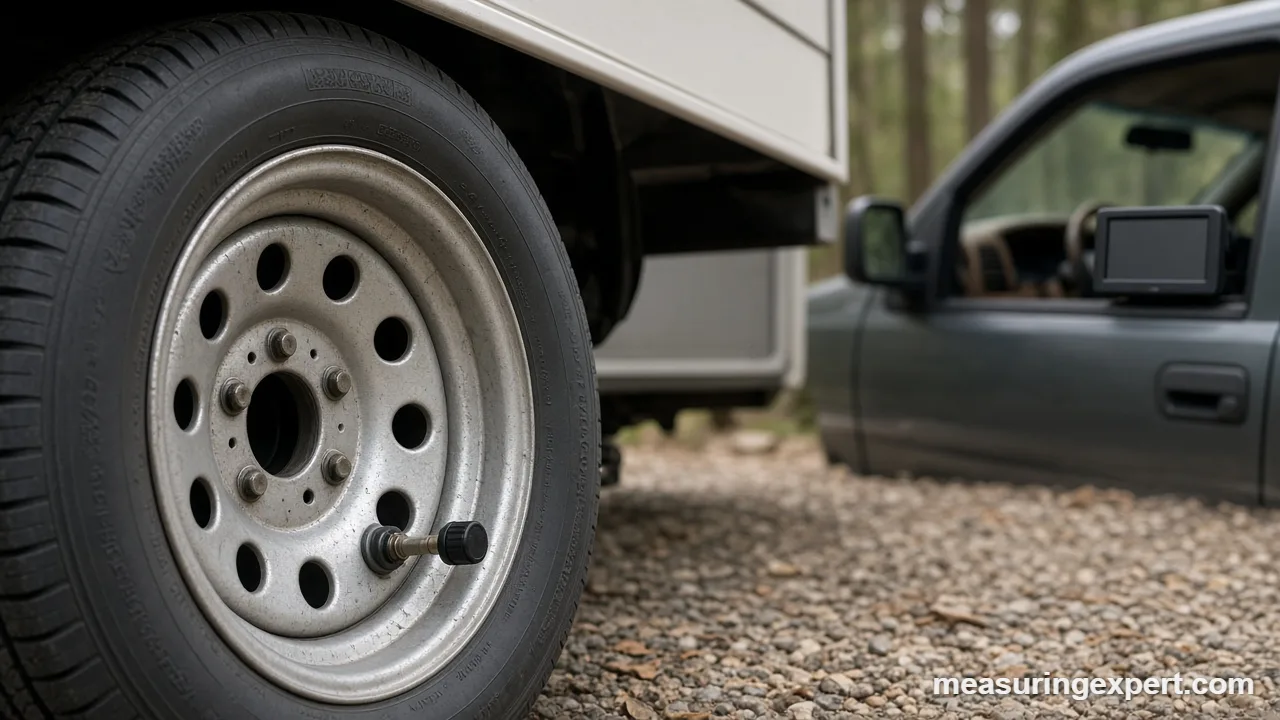
Also, trailer and RV tires run far higher pressures than car tires. A Load Range E trailer tire is often set near 80 psi (552 kPa), and motorhome tires can run above 100 psi. Therefore, check that the kit’s range covers your cold pressure with headroom for heat. In addition, long rigs push the radio link to its limit, because the rear trailer tires can sit 40 ft or more from the cab. So look for a signal booster or repeater, and mount it about halfway back.
- Count every tire: a 5th wheel with a dually truck can need 10 sensors, and a motorhome towing a car can need 14 or more.
- Pick metal valve stems: because they carry the sensor weight better than rubber snap-in stems.
- Watch temperature too: a hot tire can point to a dragging brake or a failing bearing before the pressure drops.
Best Tire Pressure Monitor Specs, Explained
A TPMS is a measuring instrument, so read its spec sheet like one. First, the range is the span of pressure it can read, such as 0 to 199 psi. Therefore, your normal cold pressure should sit well inside it. Second, accuracy is how close the reading is to the true pressure; a figure of +/- 1 psi means a tire at 80 psi could show anywhere from 79 to 81 psi. Third, resolution is the smallest step the display shows, usually 1 psi or 0.1 bar.
Also check the units. For instance, most monitors switch between psi, kPa and bar, and some show temperature in F or C. Next, look at the update interval, which is how often a sensor reports. A fast check catches a quick leak sooner, but it also drains coin-cell batteries faster. Finally, check the alerts: the best kits warn on low pressure, high pressure, high temperature and a sudden drop, each with a limit you can set per axle.
For context, the federal rule for new light vehicles requires a warning when a tire falls 25 percent below the placard pressure, or to a minimum floor if that is higher. For example, a 35 psi car tire triggers a factory warning near 26 psi. In contrast, an aftermarket monitor lets you set a tighter limit, such as 10 percent low, so you hear about a slow leak much earlier.
Tire Pressure Unit Converter
However, placards, tire sidewalls and monitors do not always use the same unit. Use this converter to switch between psi, kPa and bar, so your TPMS limits match the number on the door placard.
One psi equals 6.894757 kPa, and 1 bar equals 100 kPa (about 14.5 psi). So an 80 psi trailer tire is about 552 kPa, or 5.52 bar.
How to Set Up an Aftermarket TPMS
Do it with cold tires, because the starting pressure becomes your reference.
- Count your tires. List every tire you want to watch, including the tow vehicle, trailer, towed car and spares, and buy a kit with enough sensors.
- Check the valve stems. Replace worn or rubber snap-in stems with metal bolt-in stems on RVs and trailers, because external sensors add weight and leverage.
- Set cold pressures. With tires cold, inflate each one to the vehicle placard or trailer certification label pressure using a trusted gauge.
- Pair the sensors. Follow the kit manual to learn each sensor to its wheel position on the monitor or app, then screw it on and fit the lock nut.
- Set the alarm limits. Set the low alarm about 10 to 15 percent below your cold pressure and the high alarm about 20 to 25 percent above it, axle by axle.
- Fit the booster if needed. On rigs longer than about 30 ft, mount the signal booster or repeater near the middle or rear, as the manual directs.
- Check for leaks and verify. Spray soapy water on each sensor to check for bubbles, then drive and compare monitor readings with your gauge.
Why Your Readings Rise and Fall
First, air in a tire follows the gas laws, so pressure moves with temperature. As a rough guide, a 35 psi tire changes about 1 psi for every 10 degrees F (5.6 degrees C). In addition, a higher-pressure tire moves more: an 80 psi trailer tire shifts about 1.8 psi per 10 degrees F. For example, an 80 psi tire set in a 70 F garage reads about 73 psi on a 30 F morning, with no leak at all. For more on the physics, see our guide to the pressure of a gas.
Driving warms the tires too, which is normal. However, one tire running much hotter or higher than its partner on the same axle is not normal. In that case, stop and check the tire, brake and bearing. Also, you can confirm a hot hub or tread with a handheld infrared surface thermometer.
Honest Limits of Even the Best Tire Pressure Monitor
In other words, a TPMS warns you; it does not replace a gauge or an inspection. NHTSA states that a TPMS is not meant to substitute for regular tire maintenance, and it advises checking every tire, including the spare, at least once a month when cold. In addition, a monitor cannot see tread wear, sidewall cuts, age cracking or a wrong load range.
Similarly, radio links can drop out, especially on long trailers or near other RVs using the same frequency. So treat any alert as a reason to stop and check with a calibrated gauge. If you need to add air on the road, a portable compressor helps; see our guide to the best tire inflator for picks with accurate built-in gauges.
Best Tire Pressure Monitor FAQ
What is the best tire pressure monitor for an RV?
For most RVs, the TireMinder A1AS is our top pick. It shows up to 22 tires on a 5.5-inch color screen, and TireMinder lists a 0 to 199 psi range with +/- 1 psi accuracy. For very large or multi-trailer rigs, the TST 507 Series is also strong.
Does the best tire pressure monitor use cap or internal sensors?
Internal sensors read the air directly and are hard to steal, but a tire shop must fit them. In contrast, cap sensors install in minutes and move between vehicles easily. For trailers and RVs, most owners choose cap or flow-through sensors on metal valve stems.
Do trailers need a TPMS by law?
Not under the federal TPMS standard. FMVSS No. 138 covers cars, trucks and buses rated 10,000 lb or less and excludes vehicles with dual wheels, so trailers are not covered. As a result, an aftermarket monitor is common for towing.
When does a factory TPMS light come on?
Under FMVSS No. 138, the warning must come on within 20 minutes once a tire is 25 percent below the placard pressure, or at a minimum floor if that is higher. So a 35 psi tire may show a warning only near 26 psi.
Can a tire pressure monitor replace my tire gauge?
No. NHTSA says a TPMS is not a substitute for regular tire maintenance. Check every tire, including the spare, with a gauge at least once a month when cold, and use the monitor for warnings between checks.
Why does my TPMS reading go up while driving?
Tires warm up as you drive, and therefore warm air pushes harder. A 35 psi tire changes about 1 psi per 10 degrees F, so a rise of a few psi is normal. However, one tire running much higher or hotter than the others is a warning sign.
Does the best tire pressure monitor need a signal booster?
Often, yes, on long rigs. TST, for example, says to use a repeater on vehicles over about 30 ft or with a metal shell. Otherwise, rear trailer sensors may drop out and leave a tire unwatched.
How long do TPMS sensor batteries last?
Also, external sensors last about one year on a coin cell. TST lists about one year for cap and flow-through sensors and about four years for internal sensors. So carry spare coin cells on long trips.
What pressure should I set my RV tires to?
First, use the cold pressure on the vehicle placard or trailer certification label, not the maximum molded on the tire sidewall. In addition, NHTSA defines cold as not driven for at least three hours. Then set TPMS alarm limits around that figure.
Does a TPMS work with a spare tire?
Many do. RV systems like the TireMinder A1AS and TST 507 handle many extra positions. So check how many sensor slots a monitor supports before you buy.
Bottom Line: Our Best Tire Pressure Monitor Pick
For most RV and trailer owners, the TireMinder A1AS is the best tire pressure monitor to buy. It reads 0 to 199 psi with a stated +/- 1 psi accuracy, shows up to 22 tires on one color screen, and links to a phone app.
On the other hand, the Tymate TM7 protects a small trailer for little money, and the TST 507 Series suits long, multi-axle rigs. Whichever you pick, first set pressures cold from the placard, set sensible alarm limits, and keep a good gauge in the truck.
3 thoughts on “Best Tire Pressure Monitor (TPMS) for RVs, Trailers and Cars in 2026”