

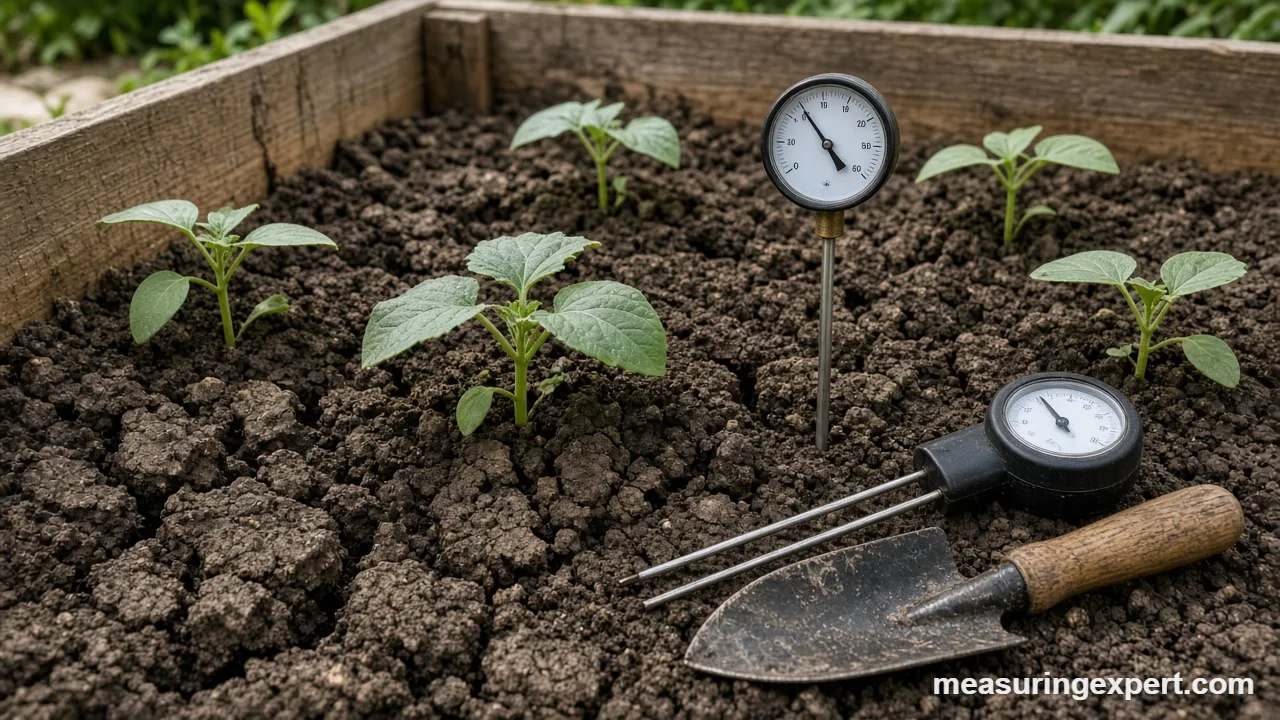
The best clay moisture meter for most gardens is the Irrometer Model SR tensiometer, because it reads soil water tension directly instead of guessing from conductivity. Heavy clay holds water tightly, so the choice comes down to tension versus percent readings, how deep the roots go, and whether you want spot checks or a gauge that stays put.
In short: buy the Irrometer Model SR for clay beds, the Watermark 30-KTCD-NL reader for several depths, and the Dr.meter two-pack if you just want a cheap dry, moist or wet check.
As an Amazon Associate, Measuring Expert earns from qualifying purchases. Our picks are based on research, specifications and owner feedback, not paid placement.
Best Overall
Best Budget
Best Pro
Quick Answer: Which Pick Fits Your Garden?
- Best overall: Irrometer Model SR tensiometer, 0-100 cb dial.
- Several depths: Irrometer Watermark 30-KTCD-NL reader.
- Digital spot checks: Extech MO750.
- Containers: Luster Leaf Rapitest 1820.
- Water testing too: VIVOSUN combo kit.
- Tight budget: Dr.meter S10 two-pack.
- Simplest dial: Censinda analog meter.
On This Page
- Comparison Table
- The 7 Picks, Reviewed
- How We Chose
- Tensiometer vs Block vs Probe
- Why Clay Fools Cheap Meters
- Centibar Targets for Clay
- Centibar Converter
- How to Install a Tensiometer
- The Weigh-and-Dry Check
- Care, Winter and Calibration
- Do and Don’t
- Honest Limits
- FAQ
- Bottom Line
Best Clay Moisture Meter Comparison Table
| # | Image | Product | Best For | Standout Feature | Link |
|---|---|---|---|---|---|
| 1 |  | Irrometer Model SR Tensiometer (18 in) | Clay beds, shrubs and young trees | Direct soil tension dial, 0-100 cb | View |
| 2 | 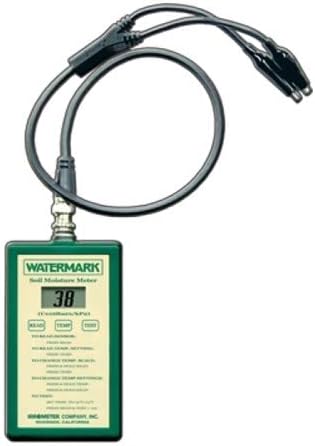 | Irrometer Watermark 30-KTCD-NL Digital Meter | Multi-depth stations in orchards and big gardens | Reads buried Watermark sensors, adjustable for soil temperature | View |
| 3 | 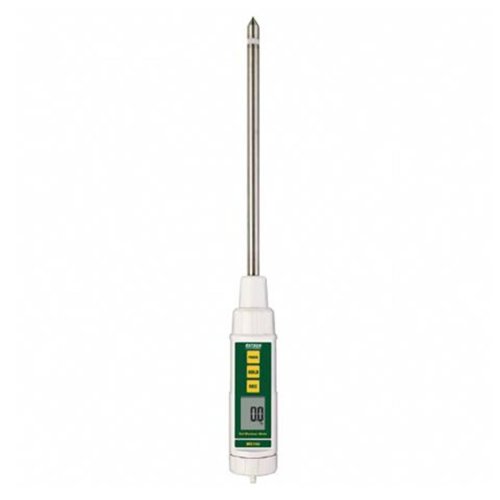 | Extech MO750 Soil Moisture Meter | Spot checks with a numeric readout | 0-50% scale with 0.1% resolution | View |
| 4 |  | Luster Leaf Rapitest 1820 Moisture Meter | Large pots and raised beds with clay-heavy mix | Battery-free, with a plant watering guide | View |
| 5 |  | VIVOSUN Digital pH Meter and Soil Tester Combo | Growers who also check irrigation water | Soil tester plus pH and TDS/EC pens | View |
| 6 |  | Dr.meter S10 and S10 Plus Soil Moisture Meter Pack | Two beds or two depths on a small budget | Single probe, 10-level color scale | View |
| 7 |  | Censinda Soil Moisture Meter | Quick checks in pots and beds | 7.6 in single probe, 1-10 dial | View |
First of all, this guide is about clay garden soil. If you want Wi-Fi probes, app logging or irrigation controllers, see our best soil moisture sensor guide. And if your “clay” problem is a damp plaster or concrete wall, you need a wall moisture meter instead, because soil tools do not read building materials.
The 7 Best Clay Moisture Meter Picks, Reviewed
Best Overall
1. Irrometer Model SR Tensiometer (18 in)
Best for: gardeners with heavy clay who want to know when roots can actually pull water, not just whether the top inch is damp.
The Irrometer Model SR is a tensiometer: a sealed, water-filled tube with a porous ceramic tip and a vacuum gauge on top. As clay dries, it pulls water out through the tip, and the gauge shows that pull as soil water tension in centibars (cb). Because clay holds water tightly, tension is the number that matters most. In other words, a clay bed can feel damp and still be too dry for roots.
That is why we rank it first. First, the dial reads directly, so there are no batteries or color zones to interpret. Irrometer also says no calibration is needed for different soils under normal conditions. In addition, the 18 in length puts the tip in the main root zone of most vegetables and shrubs.
- Gauge range: 0-100 cb (kPa), dual scale, 2.5 in (63 mm) dial
- Stated accuracy: +/-3-2-3% of span (ASME B40.1 Grade B)
- Standard lengths: 6, 12, 18, 24 and 36 in (15-90 cm)
- Replaceable white ceramic tip with O-ring seal
- Gauge rated IP67; water service 32-150 F (0-65 C)
Pros
- Measures tension directly, the most useful number in clay
- No batteries and no soil-specific calibration
- Stays in place, so you watch the trend between waterings
Cons
- Needs filling with water and occasional servicing
- Must come out of the ground before a hard freeze
- Top of range is 100 cb, so it cannot track very dry soil
Skip it if: you only water houseplants or want a quick spot check; a probe meter is simpler.
Best Pro
2. Irrometer Watermark 30-KTCD-NL Digital Meter
Best for: serious growers who want several buried sensors at different depths and one handheld reader for all of them.
This is a handheld reader for Watermark granular matrix sensors, which you bury and leave in place. In addition, each sensor holds a gypsum-buffered matrix between two electrodes. Then the meter reads the electrical resistance and converts it to soil tension in centibars. As a result, you get the same unit as a tensiometer, but the sensors need almost no upkeep.
For clay, the big advantage is depth. For example, you can bury sensors at 6, 12 and 18 in, then see whether water is reaching the deep roots. The University of Arkansas extension gives Watermark readings a range of 0-239 cb and notes the sensors settle with the soil in about a day. However, sensors are sold separately.
- Reads standard Watermark sensors (such as the 200SS)
- Adjustable for soil temperature variations
- LCD display with touch-pad controls
- Powered by a 9 V battery (included)
Pros
- Covers drier soil than a tensiometer can
- Sensors stay buried for seasons with little maintenance
- One reader serves many sensors and depths
Cons
- Sensors are extra, so a full setup costs more
- Readings are estimates from resistance, not a direct pull
- Slow to react right after an irrigation
Skip it if: you have one or two beds; a single tensiometer is simpler and cheaper to run.
Best Digital
3. Extech MO750 Soil Moisture Meter
Best for: anyone who wants a number on a screen and a sturdy stainless probe for spot checks across several beds.
The Extech MO750 is a handheld digital soil moisture meter from a long-running test equipment brand. Also, it shows moisture as a percentage from 0 to 50%, with HOLD and MIN/MAX buttons. In addition, the stainless steel probe is 8.7 in (220 mm) long and 0.4 in (10 mm) thick. So it is stiffer than the thin probes on cheap analog meters.
In clay, that stiffness helps. For best results, Extech says to push the probe at least 4 in (10 cm) into the soil. Meanwhile, the user guide warns that very wet soil can take several minutes to give a stable reading, and wet clay is exactly that case.
- Range: 0-50% soil moisture, 0.1% resolution
- Accuracy: +/-(5% + 5 digits) of full scale at 73 F (23 C)
- Probe: 220 mm (8.7 in) stainless steel, 10 mm (0.4 in) diameter
- Power: four AAA batteries; HOLD and MIN/MAX functions
- Operating range: 32-122 F (0-50 C), waterproof housing
Pros
- Clear digital number instead of a 1-10 dial
- Thick stainless probe survives firm soil
- MIN/MAX makes it easy to compare spots
Cons
- Hard, dry clay can still be tough to probe
- Slow to settle in saturated soil
- No user calibration procedure in the guide
Skip it if: you want to leave a gauge in the ground; this is a spot-check tool.
Best for Containers
4. Luster Leaf Rapitest 1820 Moisture Meter
Best for: container and raised-bed gardeners whose mix contains native clay or heavy topsoil.
Luster Leaf has made Rapitest garden testers for decades, and the 1820 is its simple battery-free moisture meter. Also, it reads on an analog dial, and the maker supplies a watering guide that lists target readings by plant type. Therefore, it suits people who want a quick answer without learning centibars.
Luster Leaf’s own instructions fit clay well. First, push the probe halfway between the pot rim and the stem, about half to two-thirds of the way down. Then take at least two readings, because moisture varies within the pot. Finally, wipe the probe clean and do not leave it in the soil between checks.
- No batteries required
- Probe and dial design for test readings only
- Plant watering guide for target readings
- One-year limited warranty
Pros
- Also very easy to read
- Clear maker instructions for placement
- No power source to fail
Cons
- Analog dial is relative, not a true moisture value
- Probe should not stay in the soil
- Thin probe can bend in hard, dry clay
Skip it if: you need depth readings below about a foot; choose a tensiometer.
Best Combo Kit
5. VIVOSUN Digital pH Meter and Soil Tester Combo
Best for: gardeners and indoor growers who want a moisture check plus a way to test the water they irrigate with.
This VIVOSUN kit bundles three tools. First, an analog 3-in-1 soil tester reads moisture, pH and light with no battery. Second, a digital pH pen covers 0-14 pH. Third, a TDS/EC/temperature pen measures dissolved salts in water.
Why does salt matter for clay? Most cheap moisture probes respond to electrical conductivity, so salty or heavily fertilized water can make soil read wetter than it is. In addition, clay drains slowly, so salts build up faster. The TDS/EC pen lets you check your water source, and the soil tester gives a quick moisture read.
- Soil tester: moisture on a 1-10 scale (1-3 dry, 4-7 moist, 8-10 wet)
- Soil tester: dual 7.8 in probes, pH 3.5-8, relative light 0-2000 lux
- pH pen: 0.00-14.00 pH, +/-0.1 pH, buffer packs included
- TDS/EC pen: 0-9999 ppm or uS/cm, +/-5%, CR2032 battery
Pros
- Three tools in one box, so it is good value
- Checks water salinity, which skews probe readings
- Soil tester needs no battery
Cons
- The pH and EC pens are for liquids only, not soil
- Analog pH on the soil tester is only a rough guide
- Dual probes are harder to push into dense clay
Skip it if: you only need moisture; a single meter is simpler.
Best Budget
6. Dr.meter S10 and S10 Plus Soil Moisture Meter Pack
Best for: beginners who want two simple meters, one for the vegetable bed and one for pots, without spending much.
Dr.meter sells this two-pack with an S10 and an S10 Plus. Also, both are battery-free analog meters with a single probe and a 10-level color-coded dial. Because it has one probe rather than two, it is easier to push into firm clay, and it also disturbs fewer roots.
Treat the scale as relative. For example, note the dial reading the day after a deep watering, then water again when the same spot drops into the dry zone. Finally, keep each meter assigned to its own bed.
- Two analog meters in one pack (S10 and S10 Plus)
- Single-probe design
- 10-level color-coded moisture scale
- No batteries needed
Pros
- Low cost, so you get two meters
- Single probe slides into clay more easily
- Nothing to charge or replace
Cons
- Relative scale, not a true moisture value
- No published accuracy figure
- Probe can bend on stones
Skip it if: you need numbers you can log; the Extech MO750 or a tensiometer is better.
Best Simple Analog
7. Censinda Soil Moisture Meter
Best for: casual gardeners who want the simplest possible dry, normal or wet answer.
The Censinda meter is a plain battery-free analog meter with a single 7.6 in probe. Next, its dial runs from 1 to 10: 1-3 is dry, 4-7 is normal and 8-10 is wet. Also, it weighs about 2 oz (60 g), so it lives happily in a garden apron.
The maker’s notes are worth following in clay. For example, insert about two-thirds of the probe, read the dial while the probe is still in the soil, and wipe it dry afterward. Also, avoid stony or very hard ground, which can damage the probe.
- Single 7.6 in probe
- Scale 1-10 (1-3 dry, 4-7 normal, 8-10 wet)
- No batteries or power needed
- About 60 g (2.1 oz)
Pros
- Very simple to read
- Light and pocketable
- Long enough for most pots
Cons
- Not for leaving in the soil
- Hard or rocky clay can damage the probe
- Relative reading only
Skip it if: you garden on hard, rocky clay; a tensiometer or the thicker Extech probe will last longer.
How We Chose the Best Clay Moisture Meter Picks
We did not run hands-on tests. Instead, these picks are research-based. First, we read maker spec sheets and user guides for range, resolution, accuracy, probe size and power. Next, we read university extension guidance on soil water tension in clay. Finally, we scanned owner feedback for common failures, such as bent probes, stuck needles and drifting readings, and removed near-duplicates and unbranded listings.
- Right measurement for clay: tension in centibars earned extra credit, because it tracks plant-available water in tight soils.
- Probe strength: stiff or single probes that survive dense ground ranked above thin twin prongs.
- Documented specs: a stated range, resolution or accuracy beat vague marketing.
- No overlap: we left out the products already reviewed in our soil sensor and wall meter guides.
For the soil science, we relied on the University of Arkansas extension fact sheet How to Use Watermark Soil Moisture Sensors for Irrigation (FSA58) and the Mississippi State extension note on Watermark sensor accuracy (P3536).
Tensiometer, Block or Probe: Picking the Best Clay Moisture Meter Type
In fact, every soil moisture tool measures something slightly different. So before you compare models, decide which number you actually want. Therefore, the table below sums up the three main types you will find for garden clay.
| Type | What it measures | Unit | Good in clay? | Upkeep |
|---|---|---|---|---|
| Tensiometer | How hard the soil holds water | Centibars (cb = kPa) | Yes, very good up to about 80-100 cb | Refill, service, remove before frost |
| Resistance block (Watermark) | Electrical resistance of a buried matrix, converted to tension | Centibars, about 0-239 cb | Yes, and it covers drier soil | Very low; needs a reader |
| Digital probe | Electrical signal between probe and soil | Percent moisture | Fair; good for comparing spots | Batteries; wipe probe |
| Analog probe | Small current from two metals | Relative 1-10 scale | Rough guide only | None; do not leave in soil |
Why Clay Fools Cheap Probes
To begin with, clay is made of very fine plates with tiny pores between them. As the Arkansas fact sheet explains, those small pores hold water more tightly, so plants must work harder to pull it out. Sand, by contrast, has large pores that drain fast and leave less water behind. As a result, two soils with the same water content can feel very different to a root.
Meanwhile, most low-cost probes work by passing a tiny current through the soil. Of course, water carries that current, but so do dissolved salts and the charged surfaces of clay particles. Therefore, dense or salty clay can push the needle toward “wet” even when roots are struggling. Similarly, fertilizer, compost tea and hard water make the effect worse.
There is also a physical problem. Dry clay sets almost like brick, so thin twin probes bend, while wet clay smears around a probe and slows the reading. If you also want to check acidity, our soil pH meter guide covers that separately.
Centibar Targets for Clay Soil
For reference, the Arkansas extension gives field capacity in silt loams and clays at about 33 cb, and it puts the permanent wilting point at 1,500 cb. For irrigation, it suggests about 60 cb as a conservative average trigger in silt loams and clays, compared with 20-35 cb in sandy soils. It also notes that 80-100 cb has been safe in clay for field crops.
| Reading (cb) | What it means in clay | Typical action |
|---|---|---|
| 0-10 | Saturated, roots short of air | Hold off; check drainage |
| 10-30 | Near field capacity, plenty of water | No watering needed |
| 30-60 | Drying, still comfortable for most plants | Plan watering for shallow roots |
| 60-80 | Common trigger range for clay | Water deeply |
| 80-100+ | Getting dry; tensiometers near their limit | Water now; switch to Watermark for drier work |
However, garden vegetables have shallower roots than field crops. So start near the lower end, around 40-60 cb, and adjust after you watch how your plants respond.
Centibar to psi and bar Converter
A centibar is one-hundredth of a bar, which is exactly 1 kilopascal (kPa). However, some gauges and older guides use psi or bar instead. Enter a reading in kPa (the same as cb) to convert it.
How to Install the Best Clay Moisture Meter: A Tensiometer, Step by Step
A tensiometer only works if the ceramic tip touches the soil all the way around. In clay, for instance, air gaps are the usual cause of strange readings.
- Soak the tensiometer. Fill the tube with clean water and stand the ceramic tip in a bucket of water for several hours, so the tip is fully wet before it goes in the ground.
- Make a snug hole. Use a soil probe or a pipe the same diameter as the tube (0.875 in, about 22 mm) and core a hole to the depth you want, such as 18 in for a shrub bed.
- Add a clay slurry. Pour a little muddy water from the same clay into the hole. Then push the tensiometer down so the tip seats firmly in the slurry with no air gaps.
- Top up and seal. Next, refill the reservoir to the top, replace the cap and firm the soil around the tube so rain cannot run straight down the side.
- Wait before trusting it. First, give it a day to settle with the soil. Next, take readings at the same time each morning, before the sun heats the gauge.
- Water by the numbers. When the gauge reaches your trigger value, water deeply. Afterward, watch how far the needle falls toward 0-10 cb, which tells you the water reached the tip.
For a two-depth station, install a second unit about 1 ft (30 cm) away with its tip 6-12 in deeper. After that, compare the two gauges after each watering.
The Weigh-and-Dry Check for Clay Soil Moisture
Still, every meter on this list is an estimate. The reference method is simpler: weigh, dry, weigh again. In fact, soil labs use this gravimetric method, and you can do a rough version at home with a kitchen scale.
- First, take a sample from root depth and put it in a known, oven-safe dish.
- Weigh the dish and wet soil, for example 150 g of soil after you subtract the dish.
- Dry it at about 105 C (221 F) until two weighings an hour apart match. As a result, dense clay often needs a full day.
- Then weigh again, for example 120 g of dry soil.
- Divide the water lost by the dry weight: (150 – 120) / 120 = 0.25, or 25% water by weight.
To turn that into water by volume, multiply by the soil’s dry bulk density in g/cm3. For instance, at 1.3 g/cm3, 25% by weight becomes about 32.5% by volume. Also, our page on how dense sand is explains bulk density in more detail.
Care, Winter Storage and Calibration
- Tensiometers: top up the reservoir when the water level drops, and pull them before a hard freeze. Irrometer rates the gauge for water service from 32 F (0 C) upward.
- Watermark sensors: leave them buried, but keep a note of each depth. Mississippi State points out that poor soil contact and sensor aging both cause errors.
- Digital probes: wipe the probe after each reading and pull the batteries over winter.
- Analog probes: clean with a dry cloth and store indoors.
Probe meters, however, have no user calibration. So, once a season, read a bucket of saturated clay and some air-dried clay, and note both numbers. If the gap shrinks, then the probe is wearing out.
Do and Don’t for Heavy Soil Readings
Honest Limits
No meter replaces watching your plants. Tensiometers struggle in very dry soil, Watermark sensors react slowly after heavy watering, and probe meters shift with salt and temperature. Above all, a reading only describes the soil around the tip. So use two depths, more than one spot and an occasional weigh-and-dry check.
Best Clay Moisture Meter FAQ
What is the best clay moisture meter for a vegetable garden?
For most vegetable beds in heavy soil, a tensiometer such as the Irrometer Model SR is the best clay moisture meter, because it reads soil water tension directly. Put the tip in the main root zone, often 12-18 in deep, and water when the gauge climbs into your target range.
Why do cheap moisture meters read wrong in clay soil?
Most cheap probes respond to electrical conductivity, not water alone. Because clay particles and dissolved salts both carry current, dense or salty clay can read wetter than it really is. As a result, use them for trends, and confirm with a tensiometer or a weigh-and-dry check.
What centibar reading means water clay soil?
The University of Arkansas extension suggests about 60 cb as a conservative trigger for silt loams and clays, and notes that 80-100 cb has also been safe in those soils for field crops.
Does the best clay moisture meter need batteries?
Not always. For example, tensiometers and analog probe meters need no batteries. Digital meters such as the Extech MO750 use four AAA cells, and the Watermark reader uses a 9 V battery.
How deep should the best clay moisture meter go?
In general, put it where most of the roots are. For many vegetables that is 6-12 in, for shrubs 12-18 in, and for trees 18-24 in or more. In clay, two depths work best: one shows when the top dries, and the deeper one shows whether water is soaking down.
Is a soil moisture meter the same as a soil moisture sensor?
They overlap. In this guide, a meter means a handheld or gauge tool you read on the spot. A sensor, on the other hand, usually stays buried and reports to a display, app or controller.
Can I use a wall or wood moisture meter on clay soil?
No. Wall and wood meters are instead calibrated for building materials such as drywall, plaster and lumber, so their numbers mean nothing in soil.
How do I check clay soil moisture without a meter?
Instead, use the weigh-and-dry method. First, weigh a soil sample, dry it in an oven at about 105 C (221 F) until the weight stops changing, and weigh it again. The lost weight divided by the dry weight gives gravimetric water content as a percentage.
How often should you check the best clay moisture meter?
In general, check once a day in hot weather and every two or three days in cool weather. Clay changes slowly, so the trend matters more than any single reading.
Should I leave a probe meter in clay soil?
No. Makers of analog probe meters, including Luster Leaf and Censinda, say not to leave the probe in the soil, because the metals corrode and readings drift. Tensiometers and Watermark sensors, by contrast, are designed to stay in the ground.
Bottom Line: The Best Clay Moisture Meter for Most Gardens
The Irrometer Model SR is the best clay moisture meter for most gardeners, because it shows how hard roots must pull to get water, and that is the real question in heavy soil. If you manage an orchard or several beds, add the Watermark reader and bury sensors at two depths. And if you just want a quick check in pots, the Dr.meter pack or the Extech MO750 will do the job.
Black Friday is coming: shop the deals with Prime
2 thoughts on “7 Best Clay Moisture Meters for Heavy Garden Soil (2026)”