

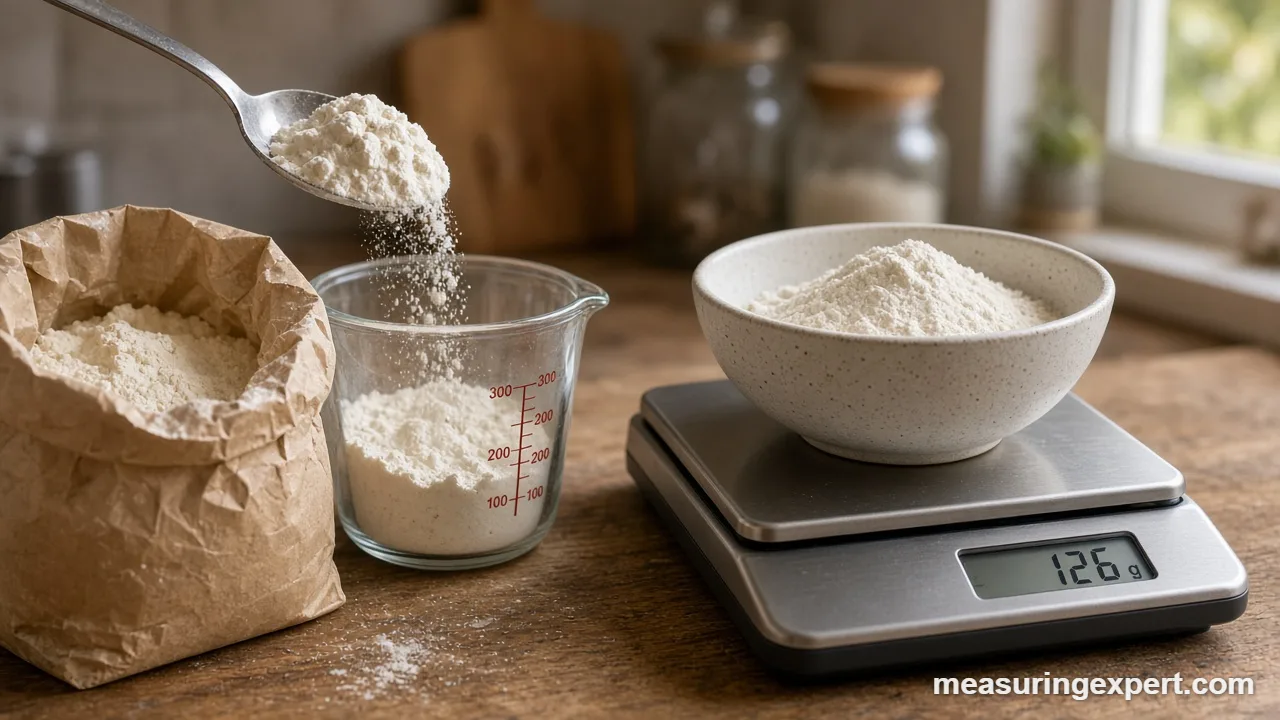
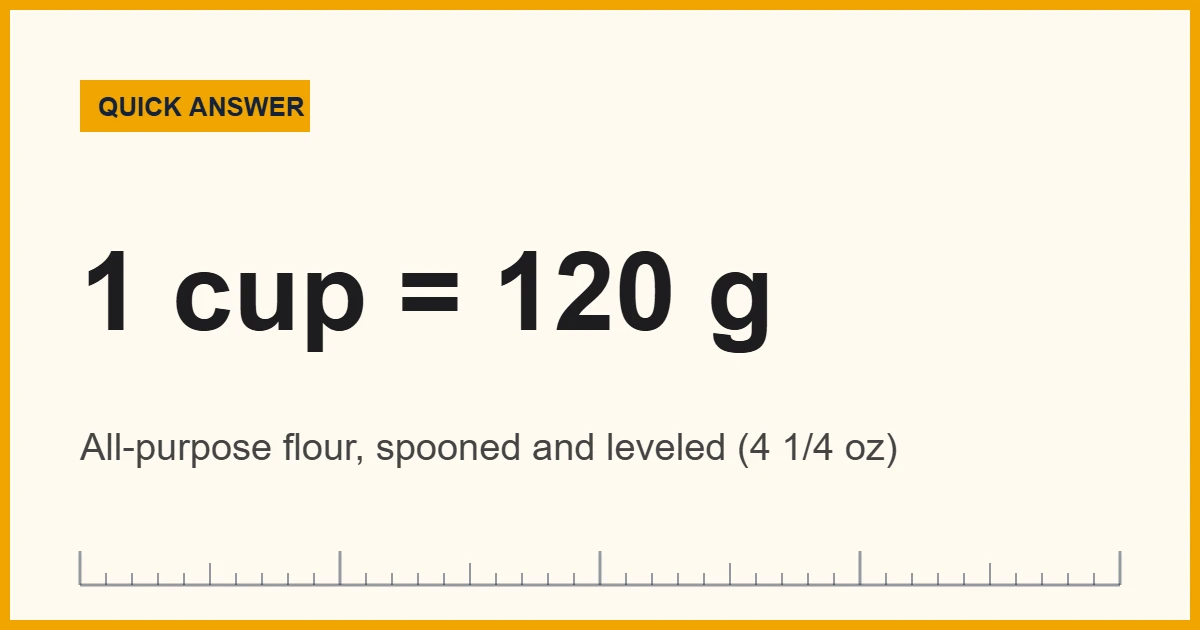
The best way to measure flour is to weigh it on a digital kitchen scale. One cup of all-purpose flour weighs about 120 grams (4 1/4 oz) by King Arthur Baking’s standard. If you must use cups, fluff the flour, spoon it into the cup, and level it; scooping straight from the bag can add 18% or more.
Convert Flour Grams to Ounces and Pounds
Recipes switch between grams, ounces and cups all the time. So type a weight below and pick its unit. The converter then uses the exact definition of the ounce (28.349523125 g) and shows the other units at once. For cups, divide the grams by 120 for all-purpose flour.
Flour is the ingredient most home bakers get wrong without knowing it. Because it compresses easily, the same cup can hold very different amounts depending on how you fill it. For instance, King Arthur Baking explains that a cup of all-purpose flour holds around 120 grams when fluffed and leveled, but up to 160 grams when the flour is packed down. In other words, that gap is a third of a cup of extra flour.
As a result, cookies spread less, cakes turn dry, and bread dough feels stiff. Weighing solves the problem because a gram is a gram no matter how the flour settles in the bag. Below you will find a weight chart for the common flours, a side-by-side test of the two cup methods, and a short guide to sifting. In addition, there is a plain explanation of why two trusted recipes can disagree about what “1 cup” weighs.
How Much a Cup of Flour Weighs: Quick Chart
This chart uses 120 g per cup for all-purpose flour, measured by the spoon-and-level method. The last column shows what the same cup typically weighs with dip and sweep, using the 5 oz per cup average from America’s Test Kitchen. Also, ounce values are rounded to two decimals.
| Cups | Spoon and level (g) | Spoon and level (oz) | Dip and sweep (g) |
|---|---|---|---|
| 1/4 cup | 30 g | 1.06 oz | 35 g |
| 1/3 cup | 40 g | 1.41 oz | 47 g |
| 1/2 cup | 60 g | 2.12 oz | 71 g |
| 2/3 cup | 80 g | 2.82 oz | 94 g |
| 3/4 cup | 90 g | 3.17 oz | 106 g |
| 1 cup | 120 g | 4.23 oz | 142 g |
| 1 1/2 cups | 180 g | 6.35 oz | 213 g |
| 2 cups | 240 g | 8.47 oz | 283 g |
| 3 cups | 360 g | 12.70 oz | 425 g |
| 4 cups | 480 g | 16.93 oz | 567 g |
In addition, you can print this chart and tape it inside a cabinet door if you bake from older cup-based recipes. Also note that 1 tablespoon of all-purpose flour is about 7.5 g, and a 5 lb bag holds roughly 19 cups.
Measure Flour by Type: Weight per Cup
Different flours have different textures, so one cup does not weigh the same for all of them. Specifically, the values below come from the King Arthur Baking ingredient weight chart. Because other brands mill differently, check the serving size on your bag as well: many US all-purpose flour labels list 1/4 cup as 30 g, which matches 120 g per cup.
| Flour | 1 cup (grams) | 1 cup (ounces) | Good to know |
|---|---|---|---|
| All-purpose | 120 g | 4 1/4 oz | The standard most US recipes assume |
| Bread flour | 120 g | 4 1/4 oz | Higher protein, same weight per cup |
| Cake flour (unbleached) | 120 g | 4 1/4 oz | Bleached cake flours are often listed lighter; check the label |
| Whole wheat | 128 g | 4 1/2 oz | Bran and germ make it denser |
| Whole wheat pastry | 113 g | 4 oz | Finely milled soft wheat |
| Pastry flour | 106 g | 3 3/4 oz | Light and fine |
| Self-rising | 113 g | 4 oz | Contains baking powder and salt |
Spoon and Level vs Dip and Sweep
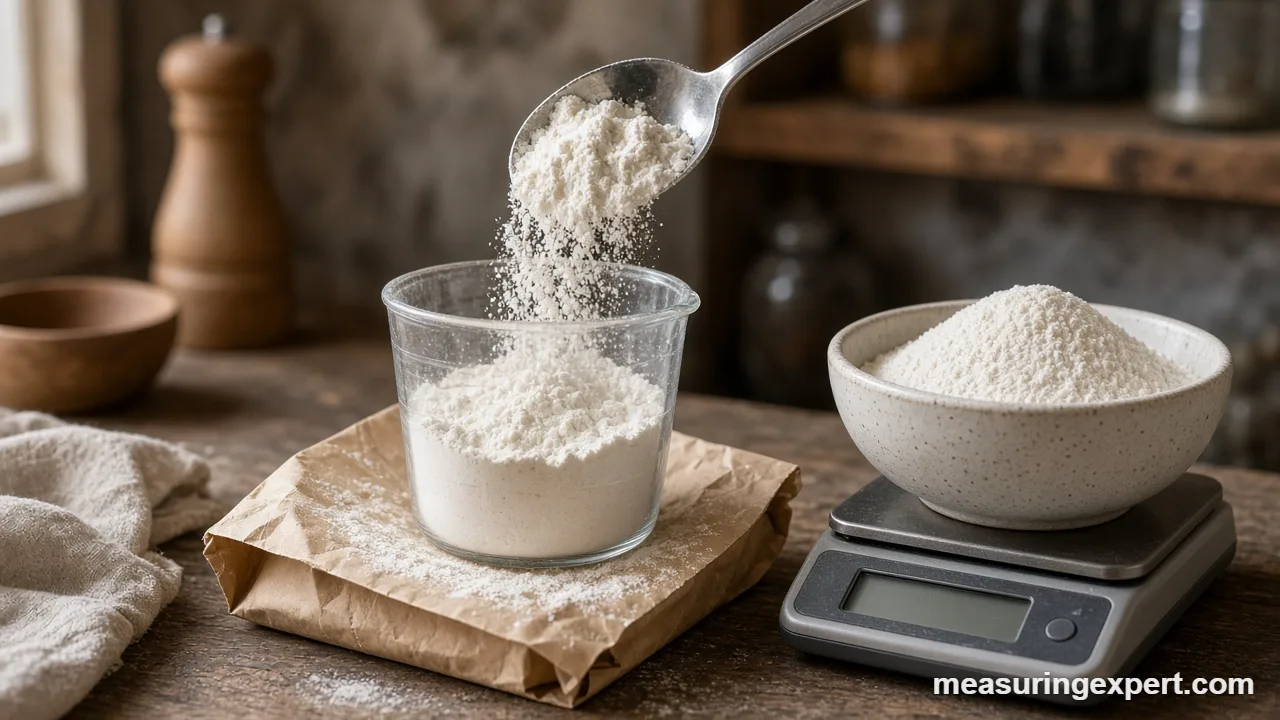
In general, there are two common ways to measure flour with cups. First, with spoon and level, you spoon flour into the cup until it mounds, then scrape the top flat. With dip and sweep, by contrast, you push the cup into the flour container and level it off. The second method packs flour into the cup, so it weighs more.
| Method | Typical weight of 1 cup all-purpose | Difference vs 120 g | Who uses it |
|---|---|---|---|
| Spoon and level (fluffed first) | about 120 g (4.23 oz) | baseline | King Arthur Baking and most flour brands |
| Dip and sweep | about 142 g (5 oz) | about 18% more | America’s Test Kitchen recipes |
| Packed or shaken down | up to 160 g | up to 33% more | Nobody on purpose |
In fact, the math is simple. America’s Test Kitchen reports that its dip-and-sweep cup weighs 5 ounces on average, which is 141.7 g. Therefore, (141.7 – 120) / 120 = 18.1% more flour per cup. As a result, over a 3-cup recipe, that adds about 65 g, or more than half a cup of extra flour by spoon-and-level standards.
How to Measure Flour With a Scale
Once you get used to it, weighing takes less time than spooning, and it also leaves fewer dishes. Here is the routine.
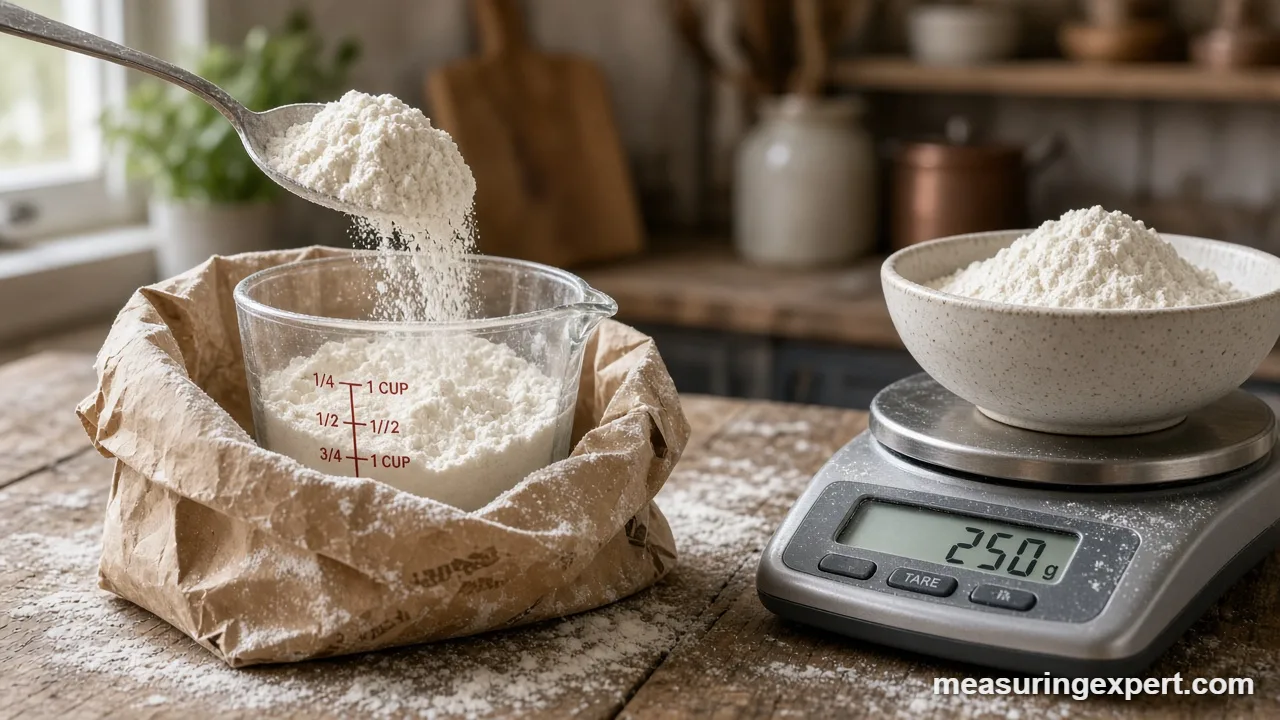
- Set the scale on a flat counter. Otherwise, a tilted or wobbly surface can throw off the reading.
- Put your mixing bowl on the scale. Then press the tare (zero) button so the display reads 0 g.
- Switch the unit to grams. Grams give finer steps than ounces on most home scales.
- Spoon or pour flour into the bowl. Then slow down as you get close to the target weight.
- Remove any extra with a spoon. For most recipes, being within a few grams is fine.
- Tare again before the next ingredient. You can then add sugar, salt and leavening to the same bowl.
No scale yet? Use the cup method instead: stir the flour to loosen it, spoon it into a dry measuring cup until it overflows, and sweep a straight edge across the rim. Use dry cups, not a glass jug; our comparison of liquid vs dry measuring cups shows why you cannot level flour in a spouted cup.
Recommended Tools to Measure Flour
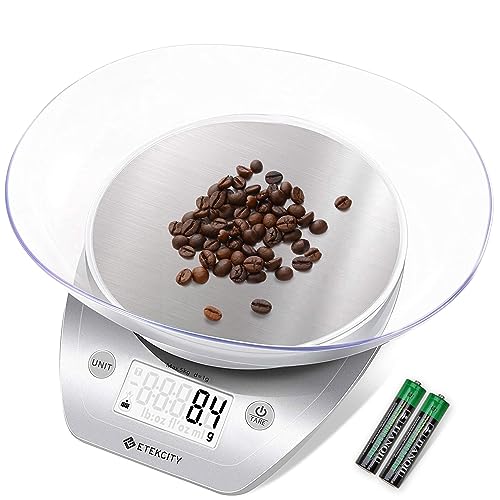
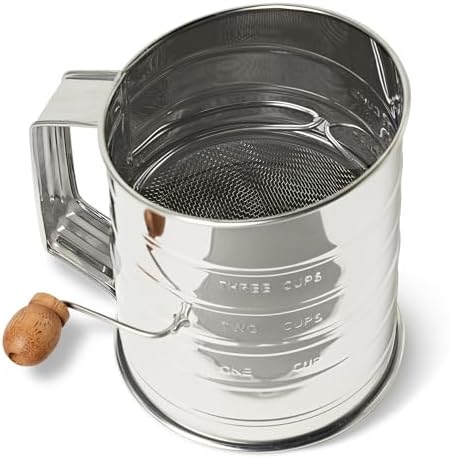
A basic digital scale that reads in 1 g steps handles every flour job at home. First, look for a tare button and a capacity of at least 5 kg (11 lb) so a heavy bowl still fits. Next, pick a display that stays readable when a large bowl sits on top. Also, a set of sturdy dry measuring cups and a simple sifter cover recipes written by volume.



As an Amazon Associate, Measuring Expert earns from qualifying purchases.
Should You Sift Before You Measure Flour?
Sifting adds air and breaks up lumps, so sifted flour takes up more space. As a result, a cup of sifted flour weighs less than a cup of unsifted flour. The wording in a recipe tells you the order:
- “1 cup sifted flour” means sift first, then spoon the sifted flour into the cup and level it.
- “1 cup flour, sifted” means measure first, then sift what you measured.
Most modern flour is already fine, so many recipes no longer ask for sifting. Even so, it still helps for delicate cakes and for cocoa or powdered sugar, which clump. If you weigh, the order stops mattering: weigh the flour, then sift it into the bowl if the recipe asks.
Why Recipes Measure Flour Differently
Two good recipes can both say “1 cup flour” and mean different weights. That happens for three main reasons. First, each test kitchen developed its recipes with its own cup method, so one assumes about 120 g and another about 142 g. Second, older family recipes rarely say how the cup was filled. Finally, flour itself varies: humidity, brand, and milling all change how loosely it settles.
So when a recipe offers both cups and grams, trust the grams. However, when it offers only cups, look for a note about the method. If there is none, spoon and level is the safer default, because you can always add a little more flour to a sticky dough but you cannot take it out.
Do and Don’t When You Measure Flour
Do
- Weigh flour in grams whenever a recipe lists them.
- Stir or fluff stored flour before spooning it.
- Level cups with the back of a knife.
- Check which cup method the recipe author uses.
- Store flour airtight so it does not absorb moisture.
Don’t
- Scoop with the cup unless the recipe says to.
- Pack flour down the way you would brown sugar.
- Level flour in a liquid measuring jug.
- Assume every flour weighs 120 g per cup.
- Forget to press tare after placing the bowl.
Honest Limits of Flour Measurements
Admittedly, the 120 g figure is a working standard, not a law of nature. In fact, flour weight per cup shifts with brand, protein content, humidity, and how long the bag has sat. Also, home scales usually read in 1 g steps and may drift by a gram or two, which is harmless for a loaf but worth knowing for tiny batches. Meanwhile, whole wheat and specialty flours vary more than white flour, so treat the chart values as starting points. In short, a scale removes the biggest error, which is how the cup gets filled, while small differences between flours remain.
When Accuracy Really Matters
For example, a slightly heavy cup rarely matters for pancakes or a weeknight gravy. However, a few kinds of baking punish errors:
- Cakes and cookies. Extra flour makes cakes dry and also stops cookies from spreading.
- Bread hydration. Bakers set water as a percentage of flour weight, so an extra 20 g of flour changes the dough. For loaves, see our separate guide to measuring flour for bread baking.
- Scaling recipes. Doubling or halving is exact in grams; in contrast, it compounds errors in cups.
Frequently Asked Questions
What is the best way to measure flour?
Weigh it on a digital kitchen scale. One cup of all-purpose flour is about 120 g. If you use cups, fluff the flour, spoon it in, and level it.
How many grams are in 1 cup of all-purpose flour?
About 120 grams, or 4 1/4 ounces, when spooned and leveled. Dip and sweep gives closer to 142 grams.
Is it better to weigh or measure flour by volume?
Weighing is better. A cup can hold anywhere from about 120 g to 160 g depending on how it is filled, while a scale reads the same every time.
How do you measure flour without a scale?
Stir the flour, spoon it into a dry measuring cup until it overflows, and level it with a straight edge. Do not scoop or tap the cup.
How much more flour does dip and sweep give?
About 18% more. A dip-and-sweep cup averages about 142 g versus about 120 g for spoon and level.
Does bread flour weigh more than all-purpose flour?
Not per cup. King Arthur Baking lists both at about 120 g per cup. Bread flour has more protein, not more weight.
How much does a cup of whole wheat flour weigh?
King Arthur Baking lists whole wheat flour at about 128 g (4 1/2 oz) per cup, a bit heavier than white flour.
Should you measure flour before or after sifting?
Follow the wording. “1 cup sifted flour” means sift first, then measure. “1 cup flour, sifted” means measure first, then sift.
How many tablespoons of flour are in a cup?
There are 16 tablespoons in a cup. One tablespoon of all-purpose flour weighs about 7.5 g.
Why do recipes list different weights for a cup of flour?
Each test kitchen uses its own cup method. Some assume about 120 g per cup and others about 142 g, so use the grams a recipe gives.
The Bottom Line
To sum up, a digital scale is the most reliable way to measure flour: about 120 g per cup of all-purpose or bread flour, a little more for whole wheat. If you only have cups, fluff, spoon and level, and avoid scooping, which adds about 18%.
Finally, use the converter at the top of this page to switch between grams, ounces and pounds, and keep the chart handy for older recipes written in cups.