

A dry measuring cup and a liquid measuring cup hold the same volume: 1 US cup is 8 fluid ounces, or about 236.6 mL. The difference is the shape. A dry cup fills to the brim so you can level flour or sugar flat, while a liquid cup has a spout and headroom above its lines.
Most kitchens own both kinds of cup, and most cooks grab whichever one is clean. That habit works for soup. In baking, however, it quietly changes your results, because the two tools are built for different ways of reading a volume.
Why a Dry Measuring Cup Looks Different
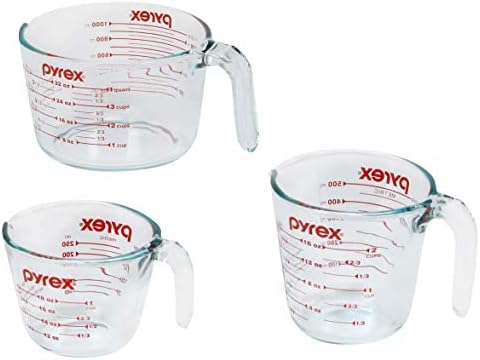
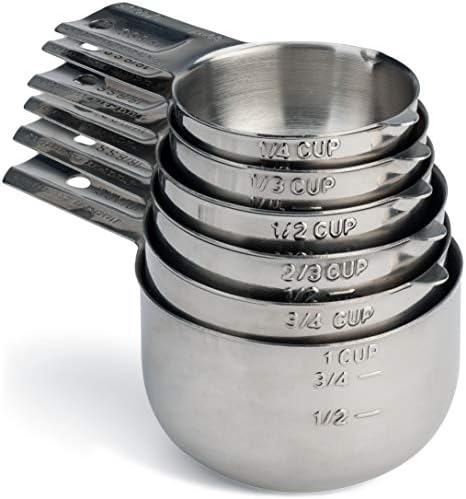
So what really separates a dry measuring cup from a liquid one? Not the amount. A nested metal or plastic cup has a flat rim, so you can overfill it and sweep the excess off. A glass or clear plastic jug, by contrast, has printed lines below the rim, extra space above them, and a spout. As a result, you read a liquid at eye level against a line, while you read a dry ingredient by leveling it with the rim.
In short: same volume, different method. Use the dry measuring cup for flour, sugar, oats and similar solids, and use the liquid cup for water, milk, oil and broth.
The numbers behind both cups come from the same definitions. For example, the US National Institute of Standards and Technology (NIST) lists the household kitchen equivalents in its metric kitchen equivalencies table, rounding 1 cup to 240 mL and 1 fluid ounce to 30 mL for labels. In addition, NIST notes that the metric system measures both fluid and dry goods in the same volume units, such as the milliliter.
Below, you will find a converter, a side-by-side comparison, the measuring method for each cup, and the cases where the wrong cup really costs you.
Convert Cups to mL, Ounces and Spoons
Enter any amount in cups (or pick another unit). The converter then uses the exact US definitions and also shows the 240 mL nutrition-label cup and the 250 mL metric cup. Either kind of cup gives the same answer, because volume does not depend on the cup’s shape.
Recommended Measuring Cups for Dry and Liquid Ingredients
You only need one set of each to cover almost every recipe. First, for dry ingredients, look for a nested set with a straight, flat rim and engraved or stamped sizes that will not rub off. Next, for liquids, choose a clear cup with both US and metric lines and a spout that pours cleanly. Finally, a digital kitchen scale is worth adding, because weighing flour beats any cup.




As an Amazon Associate, Measuring Expert earns from qualifying purchases.
- A dry measuring cup and a liquid cup hold the same 1 US cup: 8 fl oz, about 236.6 mL.
- Dry cups fill to the rim so you can level the top; liquid cups have lines below the rim plus a spout.
- Flour scooped into a liquid cup can be off by about a quarter, because you cannot level it.
- Water in a dry cup tends to overfill or spill, so a liquid cup reads it more reliably.
- Fluid ounces measure volume, while ounces on a scale measure weight; they match only for water-like liquids.
- Nutrition labels use a 240 mL cup, and many metric recipes use a 250 mL cup.
- For baking that has to come out the same every time, weigh the dry ingredients.
Liquid vs Dry Measuring Cup: Side-by-Side
Here is how the two tools differ at a glance. Notice that the size row is identical, while almost everything else changes.
| Feature | Dry measuring cup | Liquid measuring cup |
|---|---|---|
| Volume of “1 cup” | 1 US cup = 8 fl oz = about 236.6 mL | 1 US cup = 8 fl oz = about 236.6 mL |
| Shape | Single-size cup, flat rim, long handle | Jug with marked lines and a spout |
| Usual material | Stainless steel, aluminum or opaque plastic | Tempered glass or clear plastic |
| How you read it | Fill above the rim, then level it flat | Fill to a line and read at eye level |
| Typical sizes | 1/4, 1/3, 1/2 and 1 cup (some sets add 2/3, 3/4 and 2 cups) | 1, 2, 4 and 8 cup jugs with fraction lines |
| Best for | Flour, sugar, oats, rice, cocoa, shredded cheese | Water, milk, oil, broth, juice, buttermilk |
| Weak spot | Liquids spill or bulge above the rim | Powders cannot be leveled, so they pack unevenly |
For a deeper look at how cups and pints change between countries, see our guide to US vs UK cooking measurements.
How a Dry Measuring Cup Works
A dry measuring cup is a single-size scoop whose rim marks the exact amount. Because the rim is the line, you can pile the ingredient up and then sweep it flat with a straight edge. That leveling step is the whole point of the design.
Most sets nest four to six cups on a ring. Metal cups resist dents and keep their shape, while plastic ones are lighter but can warp in a hot dishwasher. Also, look for sizes stamped into the handle, since printed numbers fade.
How a Liquid Measuring Cup Works
A liquid measuring cup works the other way around. Its lines sit below the rim, so you can fill to 1 cup and still carry it to the bowl without sloshing. The spout then lets you pour in a controlled stream.
Clear glass or plastic matters here, because you read the level from the side. Water forms a slight curve at the surface, called the meniscus. Therefore, crouch until your eyes line up with the marking and read the bottom of that curve, not the edge where the liquid climbs the wall.
How to Measure With a Dry Measuring Cup and a Liquid Cup
- Pick the right cup. Choose the dry cup for powders and solids, or the clear jug for anything that pours.
- Fluff dry ingredients first. Stir flour or cocoa in its bag so it is loose before you measure.
- Spoon, then level. Spoon the ingredient into the dry cup until it mounds, then sweep a straight edge across the rim.
- Set the liquid cup on the counter. Keep it on a flat surface instead of holding it in your hand.
- Pour, then check at eye level. Pour close to the line, bend down, and top up until the bottom of the curve meets the mark.
- Scrape out sticky liquids. For honey, molasses or syrup, oil the cup lightly so the full amount slides out.
Brown sugar is the one dry ingredient you pack. Press it into the dry measuring cup firmly enough that it holds the cup’s shape when you tip it out.
What Happens If You Use the Wrong Dry Measuring Cup or Liquid Cup
The test kitchen at America’s Test Kitchen compared both cups and found real gaps. In their dry versus liquid cup test, flour measured in dry cups varied by as much as 13 percent between cooks. In liquid cups, meanwhile, that spread doubled to 26 percent, because nobody could level the top.
The reverse mistake costs accuracy too. Water measured in dry cups varied by 23 percent, against 10 percent in liquid cups. In other words, each tool clearly wins with its own kind of ingredient.
| Ingredient | Dry cup spread | Liquid cup spread | Better tool |
|---|---|---|---|
| All-purpose flour | up to 13% | up to 26% | Dry cup (or a scale) |
| Water | up to 23% | up to 10% | Liquid cup |
To put that in grams, King Arthur Baking’s ingredient weight chart lists 1 cup of all-purpose flour at 120 g. A 26 percent error could therefore mean roughly 151 g instead of 120 g, which is enough to turn a tender cake dry and dense.
Which Cup to Use for Each Ingredient
Some ingredients sit in a gray area. So use this list as a quick guide, and when in doubt, ask whether the ingredient pours or piles.
| Ingredient | Best cup | Why |
|---|---|---|
| Flour, cornstarch, cocoa | Dry cup, spoon and level | Powders need a flat top to be consistent |
| Granulated sugar | Dry cup, level | Flows easily but still needs leveling |
| Brown sugar | Dry cup, packed | Recipes assume it is pressed firm |
| Rice, oats, nuts, chocolate chips | Dry cup | Pieces mound above the rim |
| Water, milk, broth, juice | Liquid cup | Read at eye level against the line |
| Oil, melted butter | Liquid cup | Pours cleanly from the spout |
| Honey, syrup, molasses | Liquid cup, lightly oiled | Slides out instead of clinging |
| Yogurt, sour cream, peanut butter | Dry cup, leveled | Too thick to settle flat in a jug |
For context, King Arthur lists 1 cup of granulated sugar at 198 g and 1 cup of packed brown sugar at 213 g. A cup of water, on the other hand, weighs about 237 g, since 1 mL of water weighs close to 1 g.
Dry Measuring Cup Ounces vs Fluid Ounces
Much of the confusion comes from the word “ounce”. A fluid ounce (fl oz) is volume: 1 US fl oz is about 29.57 mL, and 8 fl oz make a cup. An ounce on a scale (oz), however, is weight: about 28.35 g. Only water-like liquids line up, roughly, so 8 fl oz of water weighs about 8.3 oz.
That is why “16 oz of flour” and “2 cups of flour” are not the same thing. Two level cups of flour weigh about 240 g, or roughly 8.5 oz. For more on the weight ounce, read how much is an ounce, and for small liquid amounts see how much 30 mL is in spoons and ounces.
Do and Don’t With a Dry Measuring Cup
Do
- Spoon flour in loosely, then level it flat.
- Pack brown sugar firmly unless the recipe says otherwise.
- Read liquids at eye level with the cup on the counter.
- Check whether a recipe uses US, label or metric cups.
- Weigh dry ingredients when a bake must be consistent.
Don’t
- Scoop flour straight from the bag with the cup.
- Measure flour in a glass jug and guess at the line.
- Fill a dry cup with hot liquid and carry it.
- Tap or shake a dry cup to settle it; that packs it.
- Treat fluid ounces and weight ounces as the same.
Honest Limits of Cup Measuring
Cups measure volume, and volume is a rough way to measure dry food. For one thing, flour settles in the bag, so its weight per cup changes from day to day. In addition, two careful cooks can level the same cup differently. Cup sizes also vary slightly between brands, even when the stamped size is identical.
Moreover, recipe cups are not one standard worldwide. A US cup is about 236.6 mL, the nutrition-label cup is 240 mL, and the metric cup used in Australia, New Zealand and Canada is 250 mL. The 13.4 mL gap between US and metric cups rarely matters for soup. In a large batch of bread, though, it adds up. So the exact figures on this page describe the definitions, not what every cup in every drawer holds.
When Precision Really Matters
For everyday cooking, either cup is close enough. Still, a few jobs call for better tools than a kitchen cup:
- Bread and pastry. Flour-to-water ratios drive the texture, so serious bakers weigh both on a scale.
- Canning and pickling. Salt, acid and water amounts affect safety, so follow a tested recipe exactly and use the measures it specifies.
- Liquid medicine. Kitchen cups are far too coarse for doses. Use the oral syringe or dosing cup that comes with the medicine, and ask a pharmacist if you are unsure.
- Lab or classroom work. A graduated cylinder is much more precise than any measuring jug; ask your instructor or lab supervisor which glassware to use.
Dry Measuring Cup FAQs
Is 1 cup dry the same as 1 cup liquid?
Yes, in volume. Both hold 1 US cup, which is 8 fluid ounces or about 236.6 mL. They differ only in shape and in how you read the amount.
Can I use a dry measuring cup for liquids?
You can in a pinch, but fill it to the very brim over a bowl. Liquids spill easily from a full dry cup, so a clear liquid cup is more reliable.
Can I use a liquid measuring cup for flour?
It is not ideal. You cannot level flour in a jug, so the amount can swing by about a quarter. Use a dry cup or weigh it instead.
Is 16 oz dry the same as 16 oz liquid?
No. Dry ounces usually mean weight, while fluid ounces mean volume. Sixteen fluid ounces of water weigh about 16.7 ounces, and the same volume of flour weighs far less.
Is 2 cups of liquid the same as 2 cups of flour?
They fill the same space, about 473 mL, but they weigh very different amounts. Two cups of water weigh about 473 g, while two cups of flour weigh about 240 g.
How many mL is a dry measuring cup?
A US dry measuring cup holds about 236.6 mL, exactly the same as a US liquid cup. Metric cups hold 250 mL.
How do I convert a wet measuring cup amount to dry?
No conversion is needed for volume. Simply use the same cup amount and measure it in a dry cup. To swap cups for grams, however, you need a weight chart for that ingredient.
Why do liquid measuring cups have extra space above the line?
The headroom lets you carry and pour a full cup without spilling, and it gives you room to read the meniscus at eye level.
Should I pack flour into a dry measuring cup?
No. Spoon it in loosely and level it. Packing can add a lot of extra flour. Brown sugar is the main ingredient you pack.
Are glass or plastic liquid measuring cups more accurate?
Both work if the lines are clear and you read them at eye level. Glass handles hot liquids and the microwave better, while plastic is lighter and does not break.
The Bottom Line on the Liquid vs Dry Measuring Cup
To sum up, both cups measure the same 236.6 mL US cup. The dry measuring cup fills to the rim and gets leveled, which suits flour, sugar and anything that piles up. The liquid cup has lines, headroom and a spout, which suits anything that pours.
Match the cup to the ingredient and you will avoid most measuring errors. For baking that has to turn out the same every time, though, put the cups aside and use a kitchen scale. Meanwhile, the converter at the top of this page handles cups, milliliters, ounces and spoons for any amount.
4 thoughts on “Liquid vs Dry Measuring Cup: What Is the Difference?”