

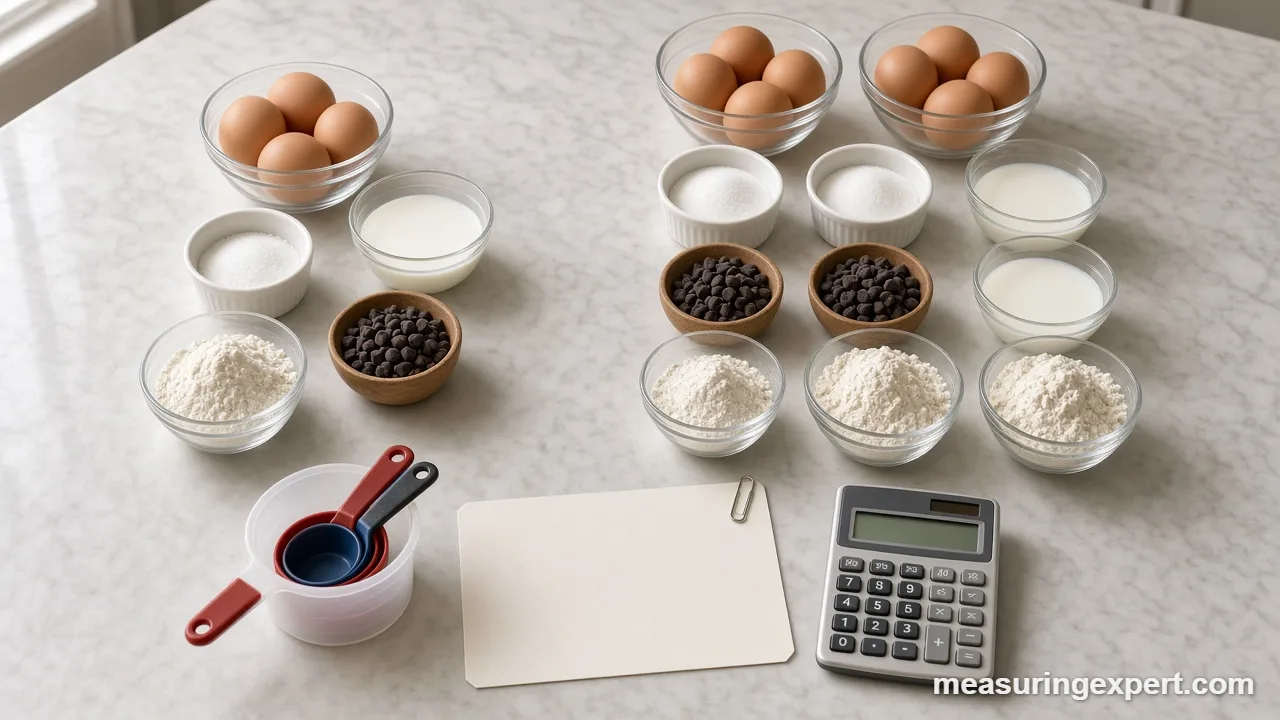
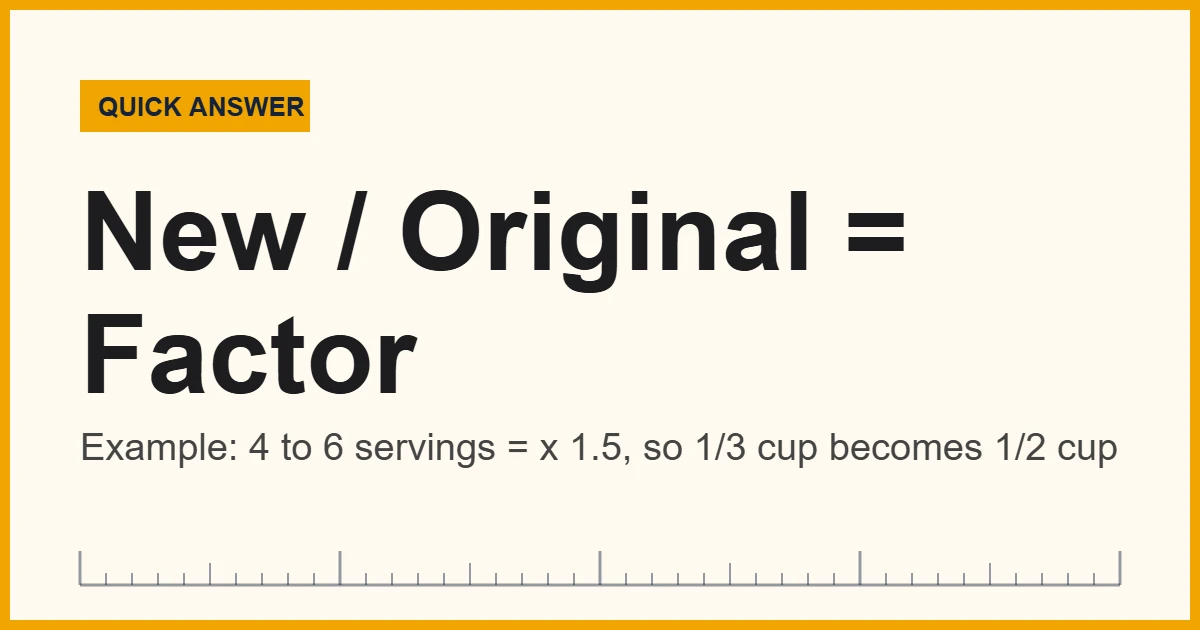
To convert recipe measurements for a new serving size, divide the servings you want by the servings the recipe makes. That number is your scaling factor. Next, multiply every ingredient by it, round each result to a real cup or spoon size, and then adjust salt, spices, leaveners, pan size and baking time by hand.
Most recipes are written for four to eight people, yet dinner is often for two or for a crowd of twenty. Scaling the recipe yourself sounds like a math problem, and partly it is. However, the arithmetic is the easy half. Instead, the harder half is knowing which ingredients follow the math and which ones do not.
Scaling a Recipe at a Glance
Here is the whole method in one place. First, work out the scaling factor: new servings divided by original servings. For example, going from 4 servings to 6 gives a factor of 6 / 4 = 1.5, and going from 8 servings to 2 gives 2 / 8 = 0.25. Then multiply each amount by that factor. After that, turn odd results into measures you can actually scoop, so 1/3 cup x 1.5 becomes 1/2 cup and 1/4 cup x 1/3 becomes 1 tablespoon plus 1 teaspoon. Finally, treat seasonings, baking soda, baking powder, yeast, pan size and cooking time as judgment calls rather than straight multiplication.
In short: the factor handles the bulk ingredients, while your taste and your pan handle the rest. If you weigh ingredients, the math gets even simpler, because grams multiply cleanly and never leave you with 5/9 of a cup.
Fortunately, culinary training texts teach the same formula. For instance, the open textbook Basic Kitchen and Food Service Management defines the conversion factor as what you need divided by what you have. It also advises cooks to increase spices with caution and to work by weight whenever possible.
Below, you will find a converter for the leftover fractions, a step list, a table of awkward results with clean equivalents, and the cases where you should not scale at all.
Convert Recipe Measurements With the Volume Converter
Once you have multiplied an amount, type the result into the converter. For example, enter 0.5625 cups and it shows the same volume in tablespoons, teaspoons and milliliters, so you can pick the measure that is easiest to scoop. The converter uses the exact US definitions (1 cup = 16 tablespoons = 236.59 mL).
Recommended Tools to Convert Recipe Measurements
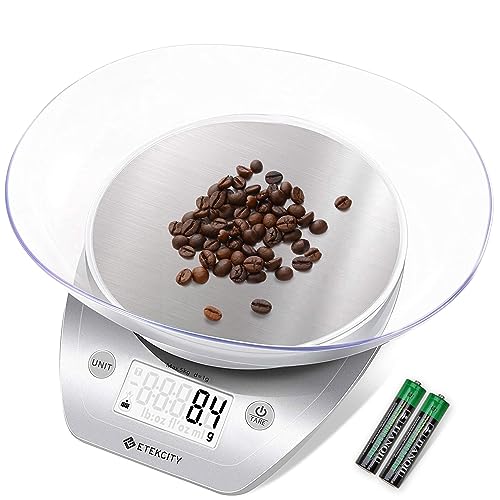
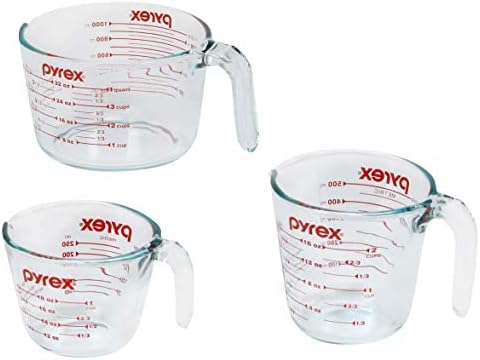
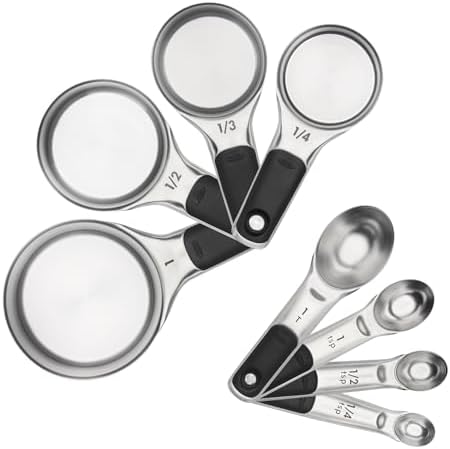
Scaling goes faster with the right gear. First, a digital kitchen scale with a tare button lets you multiply grams instead of fractions. Next, a full set of measuring cups and spoons, ideally with 1/8 cup and 1/8 teaspoon sizes, covers the small amounts that halving creates. Also, a glass liquid measuring cup with mL markings makes odd liquid volumes easy to read at eye level.



As an Amazon Associate, Measuring Expert earns from qualifying purchases.
Key Takeaways
- Scaling factor = new servings / original servings (6 / 4 = 1.5).
- Multiply every ingredient by the factor, then round to a real cup or spoon size.
- Break awkward cup fractions into tablespoons: 1 cup = 16 tbsp and 1 tbsp = 3 tsp.
- Salt, spices and heat need a lighter hand; add about three quarters of the scaled amount, then taste.
- Pan size changes depth, so baking time changes too; the oven temperature usually stays the same.
- Weighing in grams is the most accurate way to scale.
- Never double jam, jelly or canning recipes; make separate batches instead.
Step One: Find Your Scaling Factor
In fact, every recipe conversion starts with a single number. To find it, divide the yield you want by the yield the recipe gives.
Scaling factor = servings you want / servings the recipe makesA factor above 1 makes the recipe bigger, and a factor below 1 makes it smaller. So a factor of exactly 1 means nothing changes. Here are the factors that come up most often:
| Recipe makes | You want | Scaling factor | What it means |
|---|---|---|---|
| 4 servings | 2 servings | 0.5 | Halve everything |
| 4 servings | 6 servings | 1.5 | One and a half times |
| 4 servings | 8 servings | 2 | Double everything |
| 6 servings | 2 servings | 0.333 | One third of each amount |
| 6 servings | 10 servings | 1.667 | Five thirds of each amount |
| 8 servings | 2 servings | 0.25 | One quarter of each amount |
| 12 servings | 30 servings | 2.5 | Two and a half times |
The same formula works with any yield, not just servings. For instance, if a cookie recipe makes 24 cookies and you want 36, the factor is 36 / 24 = 1.5.
How to Convert Recipe Measurements Step by Step
With the factor in hand, work through the ingredient list in this order:
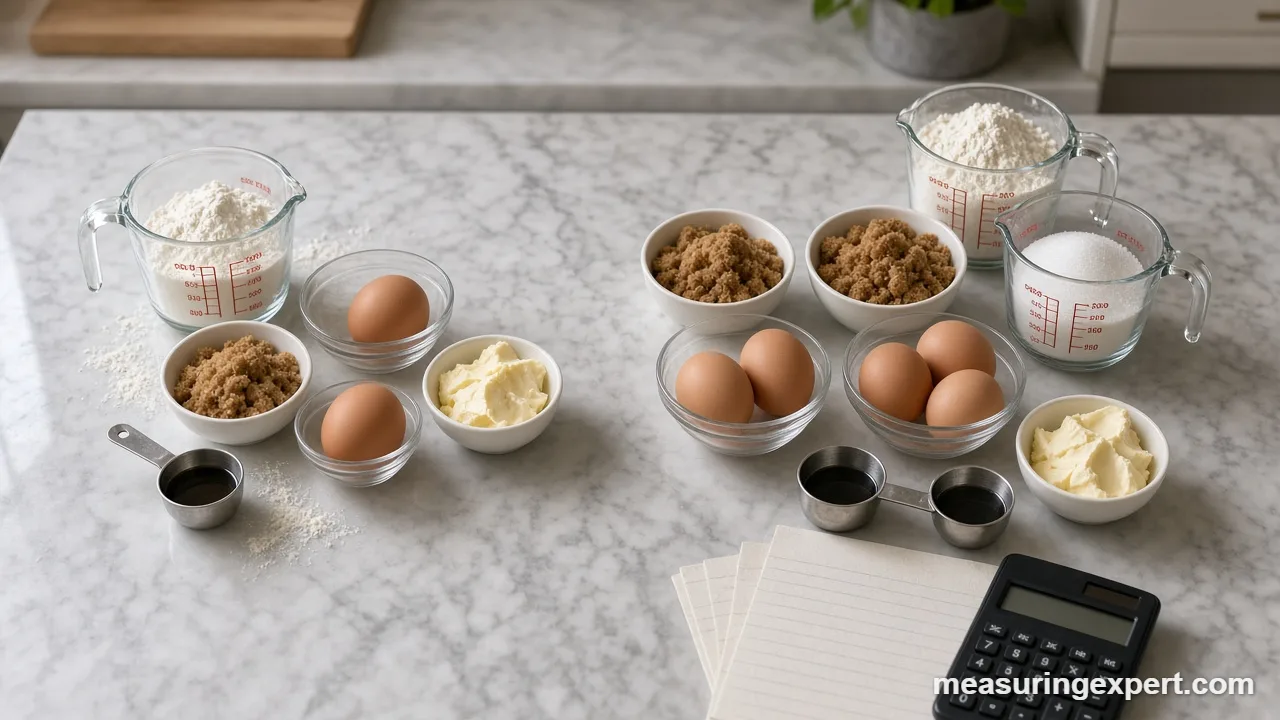
- Write the factor at the top of the recipe. Keeping it visible stops you from scaling one ingredient twice or skipping another.
- Multiply every ingredient amount. Do this on paper or in your phone’s notes, one line per ingredient.
- Round each result to a real measure. Turn decimals into cup and spoon sizes using the table below or the converter above.
- Mark the sensitive ingredients. Circle salt, spices, chili, baking soda, baking powder and yeast so you can review them separately.
- Pick a pan for the new volume. Compare pan areas so the batter or filling ends up at roughly the original depth.
- Check doneness early. Start testing at the original time, because a different depth changes how fast food cooks.
Turning Awkward Results Into Real Cups and Spoons
Multiplication often gives amounts that no measuring cup shows. Fortunately, two facts solve almost all of them: 1 cup holds 16 tablespoons, and 1 tablespoon holds 3 teaspoons. Our guide on how to convert tablespoons to teaspoons covers the spoon side in more detail.
| Original amount | Factor | Raw result | Measure it as |
|---|---|---|---|
| 1/3 cup | x 1.5 | 1/2 cup | 1/2 cup (118 mL) |
| 2/3 cup | x 1.5 | 1 cup | 1 cup (237 mL) |
| 3/4 cup | x 1.5 | 1 1/8 cups | 1 cup + 2 tbsp |
| 1/2 tsp | x 1.5 | 3/4 tsp | 1/2 tsp + 1/4 tsp |
| 3/4 cup | x 1/3 | 1/4 cup | 1/4 cup (59 mL) |
| 1/4 cup | x 1/3 | 1/12 cup | 1 tbsp + 1 tsp |
| 1/2 cup | x 0.25 | 1/8 cup | 2 tbsp |
| 1/3 cup | x 1.667 | 5/9 cup (8.9 tbsp) | 1/2 cup + 1 tbsp |
Quarter cups come up so often that it helps to know them by heart. For a full breakdown, see how much 1/4 cup is in tablespoons, teaspoons and milliliters.
When Not to Scale Linearly
Straight multiplication works for flour, sugar, liquids, meat and vegetables. Some ingredients and steps, however, do not grow in a straight line. So treat the following as starting points to adjust, not answers.
Leaveners: Baking Soda, Baking Powder and Yeast
For halving or doubling a cake or quick bread, scale the leavening along with everything else. Bigger jumps, however, are another matter, because large batches mix, rise and bake differently. Therefore, for anything beyond doubling, bakers usually get better results by making two or three separate batches than by tripling one. Also, measure leaveners level; a heaping spoon of baking soda shows up as a bitter, soapy taste.
Salt, Spices and Heat
In practice, seasoning is where scaled recipes most often go wrong. Strong flavors such as cayenne, cloves, garlic powder and salt can taste too sharp when multiplied straight up. A practical approach is to add about three quarters of the scaled amount, cook, taste, and then add the rest only if needed. You can always add more salt, but you cannot take it out.
Pan Size and Baking Time
In general, pan area matters more than pan name. An 8 x 8 inch pan holds 64 square inches, while a 9 x 13 inch pan holds 117 square inches, about 1.8 times as much. Similarly, a 9-inch round is about 64 square inches, so two 9-inch rounds roughly equal one 9 x 13 pan. If you double a recipe but keep a small pan, the batter is deeper. As a result, the center needs more time and the edges may overbake. In most cases, keep the oven temperature the same, choose a pan that keeps the original depth, and start checking doneness at the original time.
| Pan | Approximate area | Equivalent to |
|---|---|---|
| 8 x 8 inch square | 64 sq in (413 sq cm) | One 9-inch round |
| 9-inch round | 64 sq in (410 sq cm) | One 8 x 8 square |
| 9 x 13 inch rectangle | 117 sq in (755 sq cm) | About 1.8 times an 8 x 8 pan |
| Two 9-inch rounds | 127 sq in (821 sq cm) | Slightly more than one 9 x 13 |
Convert Recipe Measurements by Weight Instead
Above all, weighing is the cleanest way to scale. Grams multiply without fractions, so 250 g of flour x 1.5 is simply 375 g. By contrast, cups of flour are less consistent, because a scooped cup can weigh noticeably more than a spooned and leveled one. Moreover, that difference grows every time you multiply.
To switch a recipe to weight, measure each ingredient once on a scale the next time you make it, and write the grams beside the cup amounts. After that, scaling is one multiplication per line. In addition, you can tare the bowl between ingredients, which means fewer dishes. If you need help with ounces, our page on how much an ounce is explains weight ounces versus fluid ounces.
| Method | Strengths | Weak spots |
|---|---|---|
| Volume (cups, spoons) | No scale needed; matches most US recipes | Awkward fractions; packing changes the amount |
| Weight (grams, ounces) | Clean multiplication; repeatable results | Needs a scale; some recipes list only cups |
Do and Don’t When Scaling a Recipe
Do
- Write the scaling factor at the top of the page.
- Round to measures you own, then note the rounding.
- Season lightly and taste before adding the rest.
- Match the pan area to the new volume.
- Weigh ingredients when precision matters.
Don’t
- Multiply salt and chili straight up without tasting.
- Assume baking time changes in proportion to the batch.
- Guess at half an egg; beat and measure it.
- Triple a cake in one pan when separate batches work better.
- Double jam, jelly or home canning recipes.
Honest Limits of Recipe Scaling
Scaling math is exact, but kitchens are not. For one thing, rounding to the nearest spoon adds small errors, and those errors add up across a long ingredient list. Moreover, cups and spoons vary a little between sets, and how you fill them matters even more. Mixers, pots and ovens also behave differently with bigger loads; a stand mixer that handles one batch of dough may struggle with three. In short, treat any recipe scaled beyond double or below half as a first draft. Make it once, take notes, and adjust the next time.
When to Follow the Recipe Exactly
Some recipes should not be scaled at all. In particular, tested home canning recipes are the main example. The National Center for Home Food Preservation advises cooks to make batches as the recipe directs instead of doubling, because a doubled jam may not set and a larger canning batch may heat unevenly and be underprocessed. Likewise, candy, caramel and other sugar work depend on precise temperatures, so large batches can behave unpredictably. When in doubt, cook two batches.
Convert Recipe Measurements: FAQs
How do I convert recipe measurements for more servings?
Divide the servings you want by the servings the recipe makes, then multiply every ingredient by that number. For example, going from 4 to 10 servings gives a factor of 2.5.
What is the formula to scale a recipe?
Scaling factor = new yield / original yield. Multiply each ingredient by the factor, then round to a real cup or spoon measure.
How do I convert recipe measurements to fewer servings?
Use the same formula. A factor below 1 shrinks the recipe, so 8 servings down to 2 gives 0.25, and 1/2 cup becomes 2 tablespoons.
What is 1/3 cup times 1.5?
1/3 cup x 1.5 = 1/2 cup, or 8 tablespoons (about 118 mL).
What is one third of 1/4 cup?
One third of 1/4 cup is 1/12 cup, which equals 1 tablespoon plus 1 teaspoon (about 19.7 mL).
Should I double the salt when I double a recipe?
Start with about three quarters of the doubled amount, then taste and add more if needed. Salt and strong spices can taste too sharp when scaled straight up.
Do I change baking time when I convert recipe measurements?
Often, yes. Keep the oven temperature the same, but expect a deeper pan to take longer. Start checking at the original time.
How do I halve an egg?
Beat the egg and use half of it. A large egg weighs roughly 50 g out of the shell, so half is about 25 g, or about 1 1/2 tablespoons.
Is it better to convert recipe measurements by weight?
Yes. Grams multiply cleanly with no awkward fractions, and weighing avoids the differences caused by packing flour or sugar into a cup.
Can I double a jam or canning recipe?
No. The National Center for Home Food Preservation recommends making separate batches, because doubling can stop jam from setting and can lead to uneven heating in canning.
The Bottom Line on How to Convert Recipe Measurements
To convert recipe measurements, find one number first: servings wanted divided by servings given. Multiply every ingredient by it, then round each result to a cup or spoon you own, using 16 tablespoons per cup and 3 teaspoons per tablespoon to clean up the odd fractions.
After that, let judgment take over. Season lightly and taste, keep leaveners level, match the pan to the new volume, and check doneness early. Finally, for large batches, weigh your ingredients, and for jam, jelly and canning, skip the scaling and make separate batches.