

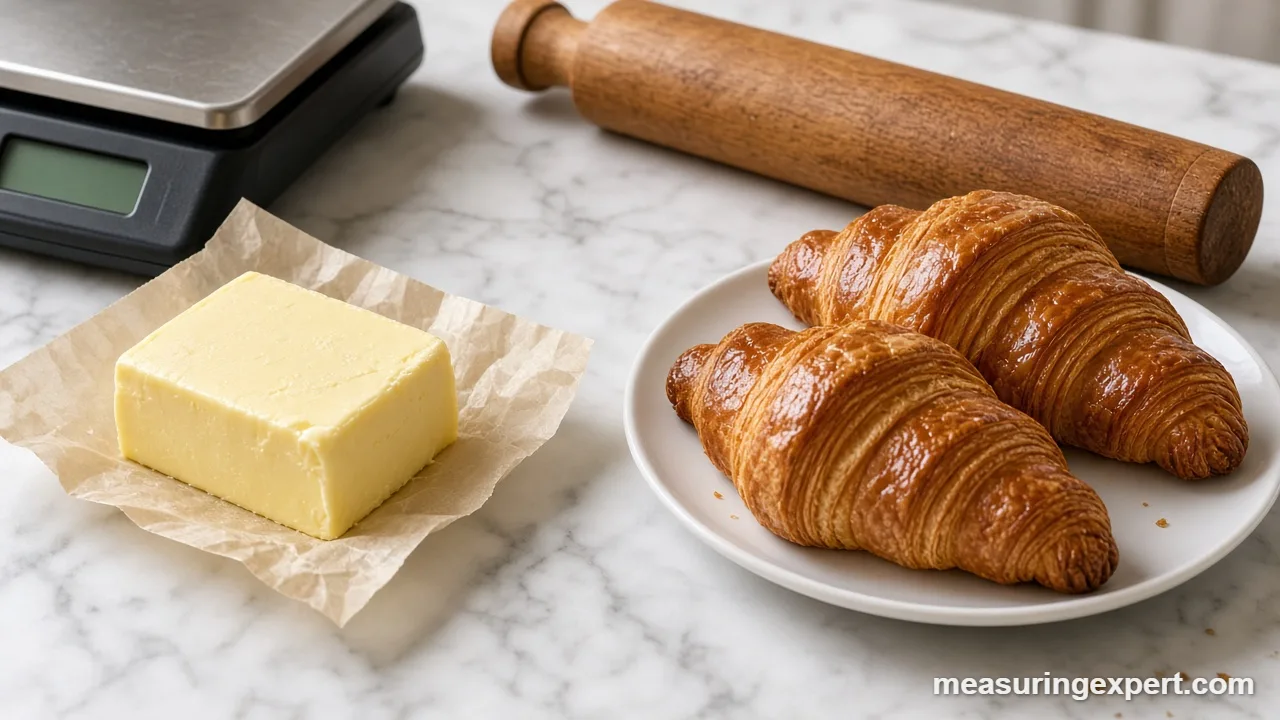
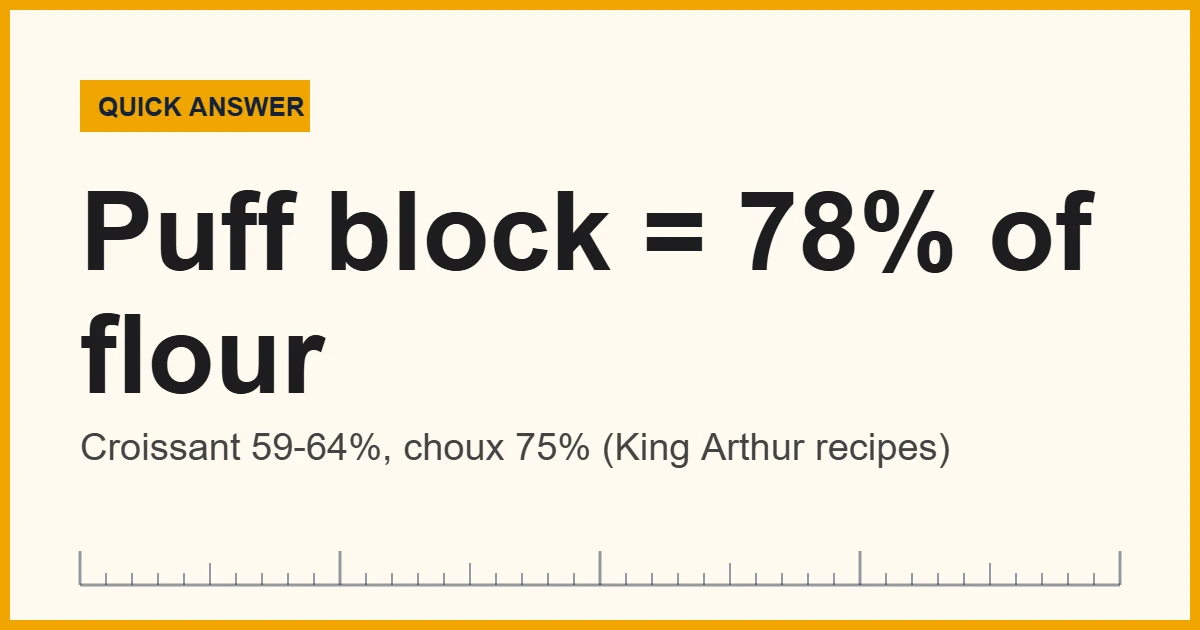
French pastry butter ratios depend on the dough. In published King Arthur recipes, a croissant butter block is about 59 to 64 percent of the flour weight, a classic puff pastry block is about 78 percent, and choux uses about 75 percent. Weigh butter in grams, because one US stick is 113 g.
French pastry butter ratios are the numbers that separate flaky layers from a greasy puddle. Croissant, puff pastry and choux all rely on butter, yet each one uses a very different amount. As a result, a recipe that works for one will fail for another.
This guide compares the three doughs by weight, using recipes you can check yourself. First, you will see the ratios side by side. Next, you will learn how to scale them to your own flour, and finally how to keep butter at the right temperature. For the broader basics, including flour and sugar, read our guide to measurement in pastry making.
- Croissant: a 425 g butter block against 660 to 720 g flour, about 59 to 64 percent.
- Classic puff pastry: a 396 g block against 510 g flour, about 78 percent, plus 57 g in the dough.
- Choux: 113 g butter with 150 g flour, about 75 percent, with no folding.
- One US stick of butter is 113 g, and a cup is about 226 g.
- Keep puff pastry dough between 35 and 45 degrees F (about 2 to 7 degrees C) while you work.
French Pastry Butter Ratios at a Glance
The table below compares the three recipes. Each ratio is the butter weight divided by the flour weight, which bakers call a baker’s percentage. The weights come from the King Arthur recipes for baker’s croissants, classic puff pastry and pate a choux. The percentages are computed from those weights.
| Pastry | Butter | Flour | Butter vs flour | Folds or turns |
|---|---|---|---|---|
| Croissant (butter block) | 425 g (about 15 oz) | 660 to 720 g dough flour | about 59 to 64% | 4 turns |
| Classic puff pastry (butter block) | 396 g (about 14 oz) | 510 g | about 78% | 6 turns |
| Classic puff pastry (all butter) | 453 g (about 16 oz) | 510 g | about 89% | 6 turns |
| Choux pastry | 113 g (4 oz) | 150 g | about 75% | none |
For example, the puff pastry total of 453 g is almost exactly 1 pound. In contrast, the croissant block is lighter because the yeast does part of the lifting.
Convert French Pastry Butter Ratios to Ounces and Sticks
Enter a butter weight in grams, such as 425 for a croissant block. The converter then shows ounces, pounds and kilograms. To count sticks, divide the grams by 113.
Recommended Tools for French Pastry Butter Ratios
A scale with 1 g steps is the key tool, because a few grams of butter change how a block rolls out. In addition, a probe thermometer lets you check butter and dough temperature instead of guessing. A bench scraper also helps you square off the butter block and fold the dough cleanly. If you are choosing a scale, our best baking scale guide compares more options.

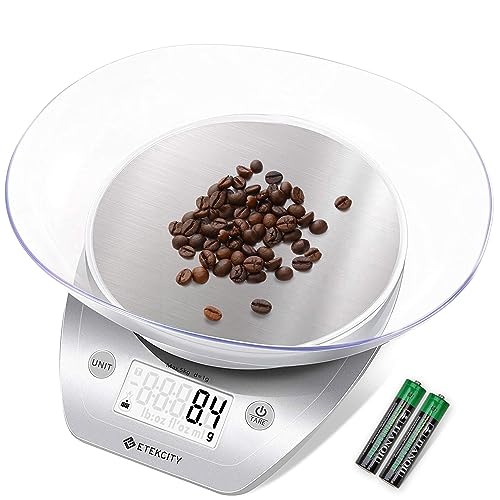


As an Amazon Associate, Measuring Expert earns from qualifying purchases.
Croissant Butter Ratio by Weight
The King Arthur baker’s croissant recipe lists 660 to 720 g of flour in the dough, plus a separate butter block. That block is 425 g of cool unsalted butter mixed with 60 g of flour. Therefore, the butter alone is about 64 percent of the lowest flour weight and 59 percent of the highest.
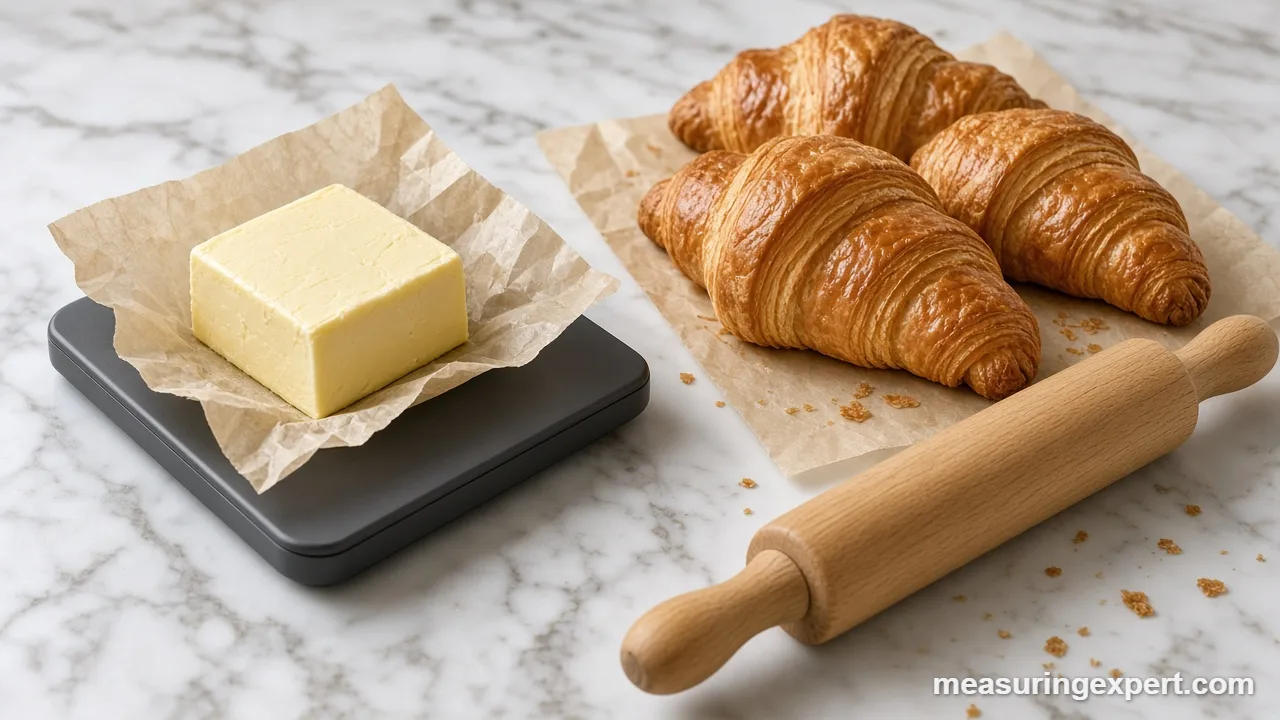
The recipe also adds 28 g of melted butter to the dough itself. However, that small amount belongs to the dough, not the lamination. In practice, bakers talk about the block ratio, because it controls how many layers form.
The recipe calls for four turns, with chilling between them. Fewer turns than puff pastry means thicker layers, which suits a yeasted dough.
Puff Pastry Butter Ratio: the Heaviest of the Three
Classic puff pastry has the highest butter load. The King Arthur recipe uses 510 g of flour and 57 g of cold butter in the dough. It then adds a 396 g block, which is mixed with 60 g of flour. That gives a block ratio of about 78 percent and a total of about 89 percent.
Because puff pastry has no yeast, the water in the butter turns to steam and lifts the layers. Consequently, butter weight and temperature matter more here than anywhere else. The recipe asks for six turns and says to keep the dough between 35 and 45 degrees F (about 2 to 7 degrees C).
Choux Pastry Butter Ratio Without Folding
Choux works differently from the other two. Instead of layers, you cook butter, water and flour into a paste. The King Arthur recipe uses 113 g of butter, 227 g of water and 150 g of flour, with 4 large eggs. The butter is therefore about 75 percent of the flour weight.
The chart on King Arthur’s site puts a large egg at about 50 g, so those four eggs weigh roughly 200 g. In other words, eggs are the largest ingredient by weight after water. Beat them in gradually, because the right amount depends on how much water cooked off.
Also, cool the paste before adding eggs. The recipe says to let it cool for 5 to 10 minutes, to below 125 degrees F (about 52 degrees C), so the eggs do not scramble.
Scale French Pastry Butter Ratios to Your Flour
You rarely bake the exact batch in a recipe, so scale by ratio. Multiply your flour weight by the percentage. The table below rounds each ratio to a whole number, so treat the results as a starting point.
| Flour | Croissant block (60%) | Puff pastry block (78%) | Choux butter (75%) |
|---|---|---|---|
| 250 g | 150 g | 195 g | 188 g |
| 500 g | 300 g | 390 g | 375 g |
| 1,000 g | 600 g | 780 g | 750 g |
Even so, when a recipe gives its own weights, follow them. For other basics, such as grams per cup, see our guide to measuring ingredients by weight.
How to Weigh Butter for French Pastry
- Weigh the flour. Weigh the flour for the dough on a scale set to grams, then note the number.
- Pick the ratio. Choose the butter ratio for your pastry from the table above.
- Multiply. Multiply the flour weight by the ratio to get the butter weight.
- Weigh the butter. Place a sheet of parchment on the scale, tare it, and add cold butter until the display hits the target.
- Shape the block. Pound and roll the butter into an even square so it spreads at the same pace as the dough.
- Check the temperature. Probe the butter and dough with a thermometer, and chill them if they run warm.
Butter Temperature for Lamination
The right weight still fails if the butter is too warm or too cold. Butter that is too soft melts into the dough and the layers merge. On the other hand, butter that is too cold cracks into shards. As a result, aim for a butter block that bends without breaking, at about the same firmness as the dough.
For puff pastry, King Arthur gives the 35 to 45 degrees F range for the dough. For choux, the paste must cool below 125 degrees F before eggs go in. A fast probe thermometer settles both questions in a few seconds.
Do and Don’t When Weighing Pastry Butter
Do
- Weigh butter in grams.
- Compute the ratio from your flour weight.
- Shape the block to the same firmness as the dough.
- Chill between turns when the dough warms.
- Write down the weights for next time.
Don’t
- Measure a lamination block in cups.
- Use the choux ratio for croissants.
- Skip the rest times between turns.
- Add eggs to hot choux paste.
- Round sticks up or down without weighing.
Honest Limits of These Ratios
These ratios come from three specific recipes. Other bakers use different numbers, and a French bakery formula may call for more or less butter. Moreover, the exact figure also depends on how the ratio is counted: some bakers include the flour in the butter block, and some count the dough butter too. As a result, use the table to compare doughs, not as a rule. When your own recipe gives weights, trust them. This page covers measuring only, so it does not claim that any ratio is better for your health or taste.
Frequently Asked Questions About French Pastry Butter Ratios
What are typical French pastry butter ratios for croissants?
In the King Arthur baker’s croissant recipe, the lamination butter block is 425 g against 660 to 720 g of flour in the dough. That works out to roughly 59 to 64 percent of the flour weight, before the 60 g of flour mixed into the block.
How much butter goes into classic puff pastry?
The King Arthur classic puff pastry recipe uses a 396 g butter block plus 57 g of butter in the dough, with 510 g of flour. In total, that is about 89 percent butter against flour weight.
What is the butter to flour ratio for choux pastry?
The King Arthur choux recipe uses 113 g of butter with 150 g of flour, which is about 75 percent. It also uses 227 g of water and 4 large eggs.
Why do French pastry butter ratios differ between croissant and puff?
Puff pastry has no yeast, so it relies on a heavier butter layer and more turns for lift. Croissant dough is leavened with yeast, so it needs less butter to bake light.
How many sticks of butter is 425 g?
425 g is about 3 3/4 US sticks, because one stick is 113 g. For puff pastry, the 396 g block is about 3 1/2 sticks.
Does European butter change the ratios?
Not on paper, since the recipe weights stay the same. Butter with a higher fat content is often firmer when cold, so keep it at the temperature the recipe asks for.
What temperature should butter be for lamination?
The King Arthur puff pastry recipe says to keep the dough between 35 and 45 degrees F (about 2 to 7 degrees C). A probe thermometer makes that easy to check.
Can I measure pastry butter in cups?
You can, but it is less accurate. A US cup of butter is about 226 g, or 2 sticks, so grams are easier to scale. Lamination blocks are best weighed.
How do I scale French pastry butter ratios up or down?
Pick the ratio, then multiply it by your flour weight. For example, 500 g of flour at 78 percent gives a 390 g puff pastry butter block.
Is a kitchen scale necessary for French pastry butter ratios?
It is the best tool for the job. A scale that reads in 1 g steps lets you shape a butter block exactly and repeat the result.
French Pastry Butter Ratios: The Bottom Line
To sum up, croissant uses a lighter butter block, puff pastry uses the heaviest, and choux sits in between with no folding at all. In each case, the reliable method is the same: weigh the flour, multiply by the ratio, and weigh the butter.
Finally, keep the butter at the right temperature and write down what you used. Then you can repeat a good batch, or fix a bad one, without guessing.
1 thought on “French Pastry Butter Ratios: Croissant, Puff Pastry and Choux by Weight”