

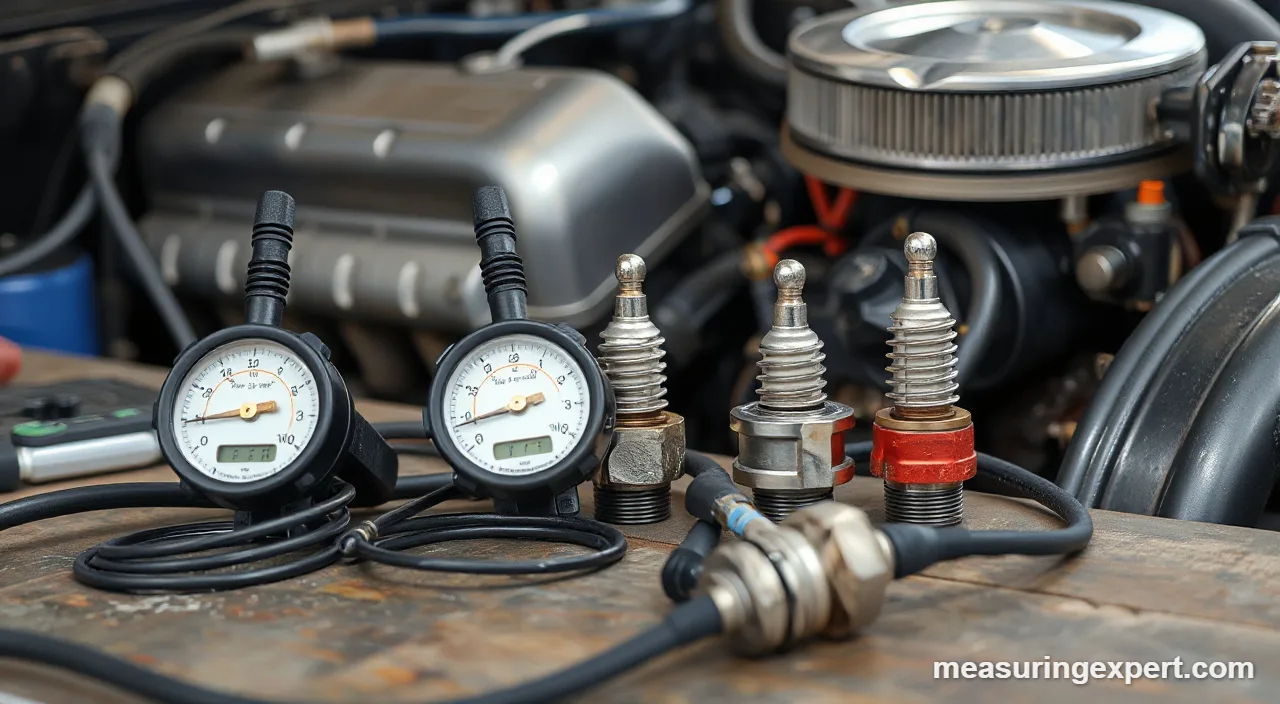
The best timing light for most engine owners is the Innova 3568, a digital light that shows RPM and ignition advance from 0 to 90 degrees on one display. Choose the Innova 3555 for a simple dial-back knob, a battery-powered light for multi-spark or racing ignitions, or the Sierra 18-9802 for outboards.
In short: pick the Innova 3568 for digital advance, the Innova 3555 for a dial-back knob, the ANCEL LT70 PRO for a rechargeable multi-reading light, and a self-powered light such as the MSD 8991 or ESI 130-10 for race-style ignitions.
As an Amazon Associate, Measuring Expert earns from qualifying purchases. Our picks are based on research, specifications and owner feedback, not paid placement.
Best Overall

Best Dial-Back

Best Self-Powered

Quick Answer: Which One Should You Buy?
- Street engine, digital: Innova 3568 for RPM and advance on one display.
- Dial-back knob: Innova 3555 for reading advance in degrees.
- Extra readings: ANCEL LT70 PRO for dwell and voltage as well.
- Race-style ignition: MSD 8991 or ESI 130-10, both self-powered.
- Outboard motor: Sierra 18-9802.
- Always: confirm your ignition type, because some lights do not work with MSD or CDI systems.
On This Page
- Comparison Table
- The Best Timing Light Picks, Reviewed
- How We Chose
- Which Kind of Light Suits Your Engine
- Dial-Back and Advance Explained
- How to Set Timing Step by Step
- Timing Degrees on the Balancer
- Safety Around Moving Parts
- Honest Limits
- FAQ
- Bottom Line
Best Timing Light Comparison Table
| # | Product | Best For | Standout Feature | Amazon |
|---|---|---|---|---|
| 1 | Innova 3568 Digital Timing Light | Street engines with a distributor or DIS | Digital RPM and advance, 0-90 degrees | View |
| 2 | Innova 3555 Advance Timing Light | Checking mechanical and vacuum advance on older engines | Advance control knob, 0-60 degrees | View |
| 3 | ANCEL LT70 PRO Timing Light | Hobbyists who also want dwell and a voltmeter | Tach, advance, dwell and voltage with USB-C charging | View |
| 4 | MSD 8991 Self-Powered Timing Light | Performance engines with multi-spark or high-output ignitions | Six-AAA self-powered with detachable inductive pickup | View |
| 5 | Electronic Specialties 130-10 Self-Powered Timing Light | Any ignition type, with a 10 ft lead for reach | Two D cells, accurate to at least 14,000 RPM | View |
| 6 | Sierra 18-9802 Marine Timing Light | Mercury, Mariner, Force and similar outboard engines | Self-powered, accurate to 10,000 RPM | View |
The Best Timing Light Picks, Reviewed
Overall, six lights made the list, and they cover three jobs: digital readout, dial-back advance and plain self-powered flashing. We did not test them. Instead, we compared manufacturer pages, manuals and parts listings, and we flag every figure that comes only from a seller.
Best Overall
1. Innova 3568 Digital Timing Light
Best for: classic car and daily-driver owners who want one display for RPM and total advance.
In short, the 3568 is the digital step up from a plain flasher. According to the Innova 3568A product page, it combines a digital tachometer with a digital advance display, so you can read engine speed and ignition advance without a second tool. For reference, the page lists a 249 to 9,990 RPM range and advance from 0 to 90 degrees.
In addition, it has a patented skip circuitry test, a slim rotating barrel for aiming at the timing mark and a built-in hand guard. However, Innova states that this light works only with conventional breaker-point, electronic and DIS ignitions. Therefore, it does not support MSD multi-spark systems or 2-cycle engines, so check your ignition first. The Amazon listing shows the 3568, while Innova’s page covers the updated 3568A, so confirm the exact version at checkout.
- RPM range: 249 to 9,990 (per Innova 3568A page)
- Advance: 0 to 90 degrees on a digital display
- Power: 12 V negative-ground systems
- Works with breaker-point, electronic and DIS ignitions; not MSD or 2-cycle
- Warranty: 1 year (per Innova)
Pros
- Tach and advance on one display
- Wide 0 to 90 degree advance range
- Rotating barrel and hand guard
- Works on distributorless (DIS) systems
Cons
- Not for MSD multi-spark ignitions
- 4-cycle engines only
- Needs a 12 V battery connection
Skip it if: you run an MSD or other multi-spark ignition, or you time 2-cycle engines.
Best Dial-Back Pick
2. Innova 3555 Advance Timing Light
Best for: classic-car owners who want a true dial-back light to read advance in degrees from a knob.
A dial-back light delays the flash so a moving timing mark appears to stand still, and the knob shows how many degrees you dialed. Specifically, the Innova 3551/3555 manual explains the method for the 3555. First, set the advance knob to 0, raise engine speed, then turn the knob clockwise until the mark lines up with the base timing mark and read the advance on the dial.
According to the manual, the 3555 control range at 0 to 60 degrees. It covers both mechanical (centrifugal) advance and vacuum advance, although a vacuum check needs a separate vacuum pump with a gauge. In addition, the 3555 is designed for 12 V negative-ground vehicles, and the manual says DIS support applies to the 3551 only. However, the manual does not list an RPM range for the light itself.
- Advance control: 0 to 60 degrees by knob and dial
- Checks mechanical and vacuum advance (vacuum pump needed)
- Power: 12 V negative ground; 6 V needs a separate 12 V battery
- Ignitions: breaker-point, electronic and computer-controlled; DIS applies to 3551 only
- Inductive pickup clamps on the No. 1 plug wire
Pros
- True dial-back knob, no batteries to charge
- Reads advance on a dial
- Suits points and early electronic distributors
- Same family as the basic 3551
Cons
- Advance range stops at 60 degrees
- No RPM range listed in the manual
- Not for DIS systems
Skip it if: you want a digital RPM readout in the same tool, or you work on DIS engines.
Best Rechargeable Multi-Reading
3. ANCEL LT70 PRO Timing Light

Best for: tinkerers who want a rechargeable light with extra readings in a single handheld.
Overall, the Amazon title lists tachometer, advance, dwell and voltage checks. First, we found the details on an LT70 retailer listing, which gives 200 to 9,999 RPM, 0 to 90 degrees of advance, 0 to 99.9% dwell and a 0 to 35 V voltmeter. Because that page covers the LT70 family, confirm the same figures on the PRO listing.
For power, it runs on a built-in rechargeable lithium battery charged by USB-C, with a 12 V car battery connection as a backup. Moreover, the LED strobe is rated for over 1,000,000 flashes and the head adjusts through 60 degrees. In contrast to older xenon lights, the listing says it is for distributor-based gasoline engines on 9 to 16 V systems and not for diesel, CDI or electric vehicles.
- RPM range: 200 to 9,999
- Advance: 0 to 90 degrees; dwell: 0 to 99.9%
- Voltmeter: 0 to 35 V
- Power: rechargeable lithium battery (USB-C) or 12 V connection
- Lead: 150 cm; LED strobe with 60-degree adjustable head
Pros
- Four readings in one tool
- Rechargeable, USB-C
- LED strobe with adjustable head
- Wide RPM and advance ranges
Cons
- Specs come from a retailer listing
- Not for CDI, diesel or electric vehicles
- Motorcycles only if 2-cylinder
Skip it if: your car has a CDI or multi-spark ignition, or you want maker-published specs only.
Best for Race-Style Ignitions
4. MSD 8991 Self-Powered Timing Light
Best for: racers and engine builders who want a self-powered light from an ignition maker.
Since MSD makes performance ignition systems, it also sells the 8991, a self-powered timing light. A Speedway Motors listing says it runs on six AAA batteries, so it needs no 12 V connection, and it comes with a detachable inductive pickup.
The MSD instruction sheet says the light reads accurately up to 8,000 RPM, while the retailer text claims readability through 5,000 RPM, so treat the higher limit with care. In addition, the sheet tells you to keep the pickup away from other plug wires and to close the clamp fully. Also, weak batteries make the strobe erratic.
- Power: six AAA batteries, no 12 V hookup
- RPM: accurate to 8,000 per MSD sheet (retailer lists 5,000)
- Detachable inductive pickup
- Strobe bright enough for daylight, per the listing
- No digital advance function listed
Pros
- No battery clips to connect
- Made by an ignition specialist
- Pickup detaches for storage
- Easy to use around race-style wiring
Cons
- Source details disagree on RPM
- No tach or advance readout listed
- Costs more than basic lights
Skip it if: you need a digital readout of advance or dwell.
Best Long-Lead Basic Light
5. Electronic Specialties 130-10 Self-Powered Timing Light

Best for: shop owners and builders who want a simple flasher that works with any ignition and reaches over the fender.
Overall, this is a plain, tough flasher. According to a parts catalog listing, it is self-powered by two D cells, uses an inductive clamp and works with all ignition systems on 2-cycle or 4-cycle engines. In addition, it claims accuracy up to at least 14,000 RPM and a bright flash at every speed.
For reach, the 130-10 version has a 10 ft lead, where the standard model has a 4 ft lead. Also, a protective sleeve is rated to 1,200 degrees F. Moreover, because it has no readout, you pair it with your service manual or a degree-marked balancer to set base timing. As a result, it will not show advance in degrees.
- Power: two D cells, no 12 V connection
- RPM: accurate to at least 14,000 (per listing)
- Lead: 10 ft on this model (standard is 4 ft)
- Inductive clamp pickup; 2-cycle and 4-cycle engines
- Protective sleeve rated to 1,200 degrees F
Pros
- Works with all ignition types, per listing
- Long lead and high RPM rating
- No battery clips to connect
- Simple and robust
Cons
- No RPM or advance readout
- Specs come from a parts catalog
- Needs D cells
Skip it if: you want a number for advance or RPM on a display.
Best for Outboards
6. Sierra 18-9802 Marine Timing Light

Best for: boaters and marine mechanics who set timing on outboard engines.
Sierra supplies marine parts, so the 18-9802 is its ignition timing light. According to a marine parts listing, it runs on two D cells and is accurate up to 10,000 RPM.
In addition, the same listing shows fitments for Chrysler, Force, US Marine and Mercury Marine outboards from about 4 to 250 hp. For example, these include 1 to 6 cylinder, 2-stroke and 4-stroke engines from roughly 1976 to 2019. However, the listing does not state the pickup type. As a result, this is a niche pick for boat owners, not a car light.
- Power: two D cells
- RPM: accurate up to 10,000 (per listing)
- Fitment: many Mercury, Chrysler and Force outboards, about 4 to 250 hp
- Engines: 1 to 6 cylinders, 2-stroke and 4-stroke
- Pickup type not stated on the listing
Pros
- Made for marine engines
- Self-powered, no battery hookup
- Good RPM ceiling
Cons
- No readout of RPM or advance
- Pickup details not published
- Costs more than basic car lights
Skip it if: you work on cars or motorcycles; pick one of the automotive lights above.
How We Chose the Best Timing Light Picks
First, this guide is research-based. Specifically, we read the Innova product pages and manual, the MSD instruction sheet and retailer or parts listings for the ANCEL, Electronic Specialties and Sierra lights. However, we did not run hands-on tests, and no brand paid for placement. As a result, only six lights passed our checks, so the list is shorter than usual.
- Readout type: digital advance, dial-back knob or flash only.
- Ignition fit: some lights exclude MSD, CDI or DIS systems, so we recorded the limits.
- Power source: 12 V clips, batteries or a rechargeable cell.
- Published ranges: RPM and advance figures with a named source.
- Use case: street, performance, marine and classic.
Which Kind of Light Suits Your Engine
| Type | What it does | Examples here |
|---|---|---|
| Basic inductive light | Flashes at the timing mark so you can compare it with the pointer | ESI 130-10, Sierra 18-9802, MSD 8991 |
| Dial-back (advance) light | Delays the flash with a knob to read advance in degrees | Innova 3555 |
| Digital tach and advance light | Shows RPM and advance on a display | Innova 3568, ANCEL LT70 PRO |
| Self-powered light | Runs on its own batteries, no battery clips | MSD 8991, ESI 130-10, Sierra 18-9802 |
Overall, for a stock distributor engine, the best timing light is usually a digital model. For a classic car with a centrifugal and vacuum advance, however, a dial-back light lets you check each stage. If you also check engine health, our guides to the best vacuum pressure tester and the best battery load tester cover the gauges that pair with a timing light.
Dial-Back and Advance on the Best Timing Light
Ignition timing is the point in the engine cycle when the spark fires, given in degrees of crankshaft rotation before top dead center. As engine speed climbs, the spark must fire earlier, and that extra lead is called advance. For example, a flash-only light shows where the timing is. A dial-back or digital light also shows how far it moves.
For example, the Innova 3555 manual describes a simple way to check this. First, set the knob to 0, raise the engine to the speed in your service manual, and watch the mark drift away from the base timing mark. Next, turn the knob until the mark lines up again, then read the advance on the dial. Then, for vacuum advance, apply the specified vacuum and repeat the step. In short, the difference from base timing is the vacuum advance.
In addition, Innova gives a typical tolerance of plus or minus 2 degrees on the mark comparison, but your engine manual sets the real target. Therefore, always use the specification for your own engine, and do not adjust timing without it.
How to Set Timing Step by Step With the Best Timing Light
Overall, this outline follows the Innova manual. Because your engine’s service manual always wins, treat it as an overview, not a repair procedure.
- Prepare the engine. First, find and clean the timing mark and pointer, usually on the crankshaft pulley or flywheel, and warm the engine to operating temperature.
- Turn everything off. Next, switch off the engine and ignition before you connect the light.
- Clamp the pickup. Then put the inductive pickup around the No. 1 spark plug wire, with the arrow toward the plug, away from the exhaust manifold.
- Connect power. After that, attach the red clip to the battery positive and the black clip to negative or a chassis ground, unless your light is self-powered.
- Restart and set idle. Next, bring idle to the specified speed, then aim the light at the mark.
- Compare mark and pointer. Then read where the mark falls against the pointer, and use the advance knob or display if you check advance.
- Adjust only per the manual. Finally, follow the vehicle’s procedure, then shut the engine off and disconnect the light.
What Timing Degrees Look Like on the Balancer
Timing marks sit on the outer edge of a round harmonic balancer or pulley, so one degree is a tiny arc. For example, the table shows the distance along the edge for three common balancer diameters. Specifically, we calculated each figure as pi times diameter divided by 360, per degree.
| Balancer diameter | 1 degree | 10 degrees | 36 degrees |
|---|---|---|---|
| 6 in (152 mm) | 0.052 in (1.33 mm) | 0.52 in (13.3 mm) | 1.88 in (47.8 mm) |
| 7 in (178 mm) | 0.061 in (1.55 mm) | 0.61 in (15.5 mm) | 2.20 in (55.9 mm) |
| 8 in (203 mm) | 0.070 in (1.77 mm) | 0.70 in (17.7 mm) | 2.51 in (63.8 mm) |
So a 2 degree error on a 7 in balancer is only about 0.12 in (3.1 mm) of mark position. In short, a good light and a clean, well-lit mark matter more than a fancy display. Also, for more on reading angles, see our guide to angle measurement.
Best Timing Light Safety Around Moving Parts
You use the best timing light on a running engine, so moving parts are the main risk. For safety, the Innova manual lists these rules.
- First, keep hands, hair and clothing away from fan blades, belts, pulleys and linkages.
- Also avoid loose clothing and jewelry.
- In addition, keep leads and clips away from moving parts and hot surfaces, and keep the pickup off the exhaust manifold.
- Always connect the light only with the engine off and the ignition off.
- Also wear safety goggles, work in a ventilated area and keep a fire extinguisher nearby.
- Because high voltage is present at the coil, cap, wires and plugs, handle wires with insulated pliers.
If you tighten the crankshaft pulley or other bolts afterward, our best torque wrench guide can help with the tool side.
Honest Limits of the Best Timing Light
Overall, these are research-based picks, and we did not test any light. Several figures come from retailer or parts listings, not maker pages, and we say so on each card. Also, a timing light only compares marks. Therefore, it cannot tell you the right timing for your engine, which comes from the service manual or the camshaft and ignition maker. Finally, some distributorless systems are not adjustable at all, so check the manual first.
Ignition Timing Questions Answered
What is the best timing light?
For most street engines, the best timing light is the Innova 3568. Also, it shows RPM and advance from 0 to 90 degrees on one digital display. For a dial-back knob, the Innova 3555 reads advance from 0 to 60 degrees.
What is a dial-back light?
In short, a dial-back light has a knob that delays the flash. You turn it until a moving timing mark lines up with the base mark, then read the advance on the dial. For example, the Innova 3555 works this way.
Which is the best timing light with a tachometer?
The Innova 3568 lists a digital tachometer from 249 to 9,990 RPM, and the ANCEL LT70 PRO lists 200 to 9,999 RPM. Both also show advance on a display, so either works for a tach and timing check in one tool.
What is the best timing light for MSD ignition?
First, Innova states its lights do not support MSD multi-spark systems. Next, a self-powered light such as the MSD 8991 or the ESI 130-10, which claims to work with all ignition systems, is a more suitable starting point. Then check the maker’s instructions for your ignition box.
Can the best timing light work on a distributorless ignition?
Some can. Innova says the 3568A works with DIS systems, while the 3555 manual says DIS support applies to the 3551 only. Some DIS systems cannot be adjusted at all, so read your service manual first.
Do I need a 12 V battery connection?
Not always. For example, the Innova lights use a 12 V negative-ground connection. The MSD 8991, ESI 130-10 and Sierra 18-9802 run on their own batteries, and the ANCEL LT70 PRO has a rechargeable cell with a 12 V backup.
How accurate are these lights?
Overall, makers publish RPM ranges, not timing accuracy. Innova gives a typical reading tolerance of plus or minus 2 degrees when comparing the mark and pointer. Your engine’s service manual gives the specification to match.
Where does the inductive pickup go?
First, clamp it around the No. 1 spark plug wire, with the arrow pointing toward the plug. Also, keep it away from the exhaust manifold and from other plug wires, and close the clamp fully.
Can I use one on a motorcycle or boat?
Check the listing first. The ANCEL LT70 listing supports motorcycles only if they have 2 cylinders, and the Sierra 18-9802 lists many Mercury, Chrysler and Force outboards from about 4 to 250 hp.
Is it safe to use near a running engine?
It is safe if you follow the safety rules. First, connect it with the engine off. Next, keep hands and leads away from belts and fans. Finally, keep the pickup off the exhaust manifold and wear goggles.
Bottom Line on the Best Timing Light
For most street engines, the best timing light is the Innova 3568. Also, it shows RPM and advance together, and its limits are clearly published. Instead, pick the Innova 3555 for a classic dial-back check, a self-powered light for race-style ignitions and the Sierra for outboards. Always confirm your ignition type, and always use your engine’s service manual for the target.