

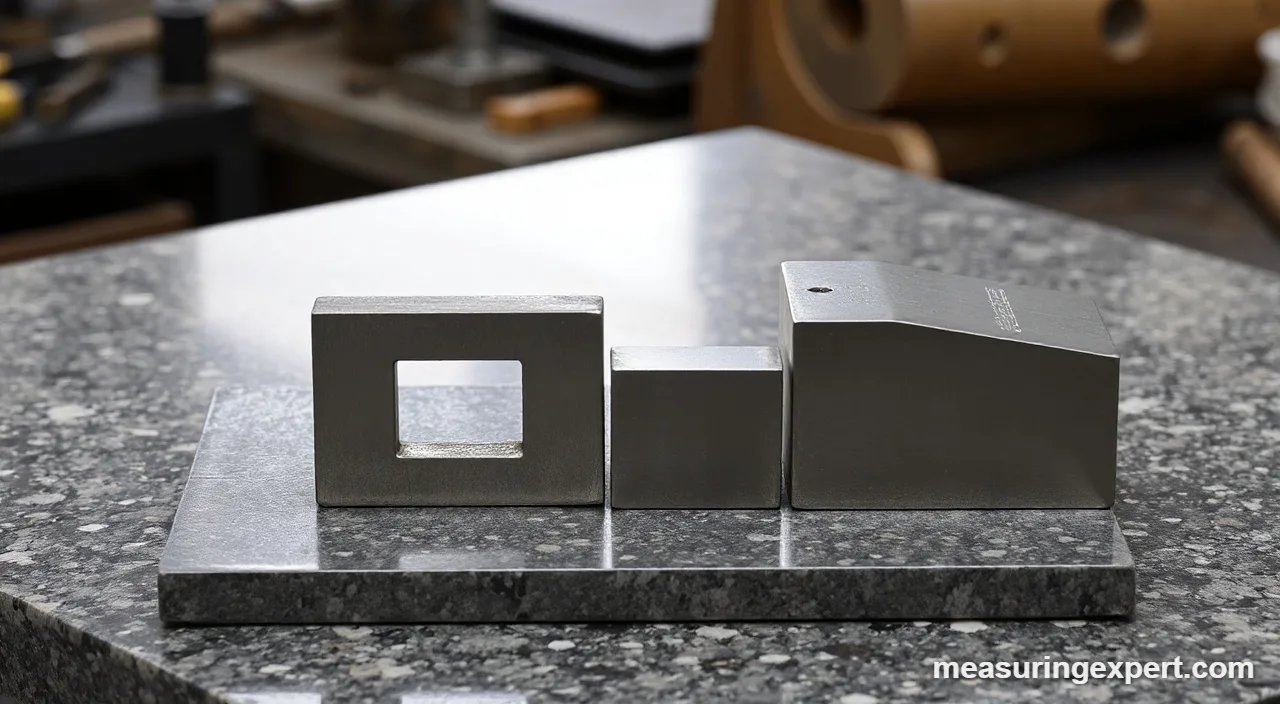
The best machinist square for most shops is the Groz 3-piece set, which lists 16 micron squareness to BS 939 Grade B in 2, 4 and 6 inch sizes. However, for toolroom work, choose the Kinex DIN 875/0 square, which lists a measuring deviation of 0.00027 inch on its 4 inch size.
In short: pick the Groz 3-piece set for everyday shop work, the Kinex DIN 875/0 square for the tightest tolerance here, and the PEC double square when you also need graduations for layout.
As an Amazon Associate, Measuring Expert earns from qualifying purchases. Our picks are based on research, specifications and owner feedback, not paid placement.
Best Overall

Best Accuracy
Best for Layout

Quick Answer: Which One Should You Buy?
- Everyday shop work: Groz 3-piece set, BS 939 Grade B.
- Toolroom accuracy: Kinex 4033-02-010T, DIN 875/0.
- Single German-standard square: Kinex 4033-12-010, DIN 875/1.
- Four sizes: SPI 13-634-1 set.
- Layout plus squareness: PEC 4R double square.
- Setups: WEN 10423 blocks as a bonus.
On This Page
- Comparison Table
- The Best Machinist Square Picks, Reviewed
- How We Chose
- Machinist Square vs Other Squares
- Grades and Accuracy Explained
- Thousandths, Microns and Millimeters
- How to Test a Square
- Care and Common Mistakes
- Honest Limits
- FAQ
- Bottom Line
Best Machinist Square Comparison Table
| # | Product | Best For | Standout Feature | Amazon |
|---|---|---|---|---|
| 1 | Groz 3-Piece Precision Steel Square Set (2, 4 and 6 inch) | Everyday shop checks with a documented grade | 16 micron squareness, BS 939 Grade B, 3 sizes and a case | View |
| 2 | Kinex 4033-02-010T DIN 875/0 Machinist Square, 4 x 2.75 inch | Toolroom checks and verifying other squares | DIN 875/0, 0.00027 in measuring deviation | View |
| 3 | Kinex 4033-12-010 DIN 875/1 Machinist Square, 4 x 2.75 inch | A single German-standard square for workshop use | DIN 875/1, listed within 0.0005 in | View |
| 4 | SPI 13-634-1 Four-Piece Machinist Square Set | A broad size range with a well-known instrument brand | 2, 3, 4 and 6 inch blades, lapped working edges | View |
| 5 | Taytools 2-3/4 inch Precision Machinist Square | A small, low-cost square for setups and layout | Guaranteed within 0.001 in over the blade | View |
| 6 | PEC Tools 4 inch 4R Double Square | Marking lines and checking squareness in one tool | 4R graduations, cast iron head, made in USA | View |
| 7 | WEN 10423 1-2-3 Precision Blocks (Pair) | Holding work square for checking and setup | Hardened steel pair, listed within 0.02 mm | View |
The Best Machinist Square Picks, Reviewed
Seven items made the list. Overall, five are squares or square sets, one is a double square and one is a pair of setup blocks. We did not test them. Instead, we read maker and distributor pages, and we flag every figure that comes only from a seller title.
Best Overall Set
1. Groz 3-Piece Precision Steel Square Set (2, 4 and 6 inch)
Best for: home machinists and fabricators who want three sizes with a published grade and a carrying case.
First, the Groz set is the easiest one here to judge on paper. According to the Groz USA product page, the set lists 16 micron squareness and internal and external squareness conform to BS 939 Grade B, the grade often called workshop grade. In short, sixteen microns is about 0.00063 inch.
Next, the blades are hardened spring steel, fixed to the stock with tapered self-locking rivets, and the page says they are ground for straightness and parallelism with lapped working edges. In addition, a groove in the inner corner clears burrs and dirt. Groz also sells a different machinist set listed at 48 to 72 microns, so check that you are buying the 16 micron one.
- Sizes: 2, 4 and 6 in blades
- Squareness: 16 microns (about 0.00063 in), BS 939 Grade B
- Blades: hardened spring steel, riveted to the stock
- Working edges lapped; groove at the inner corner
- Plastic carrying case included
Pros
- Published grade and tolerance
- Three useful sizes
- Case included
- Corner relief groove
Cons
- No hardness value listed
- Workshop grade, not inspection grade
- The length that the 16 micron figure applies to is not stated
Skip it if: you check toolroom parts or calibrate other squares; step up to a DIN 875/0 or better square.
Best Accuracy
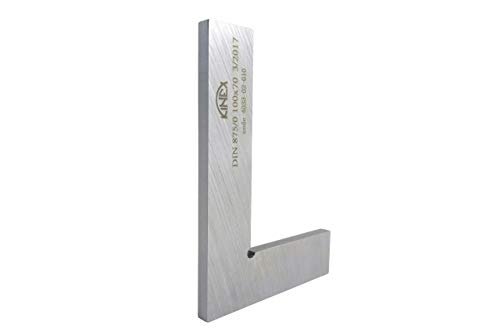
2. Kinex 4033-02-010T DIN 875/0 Machinist Square, 4 x 2.75 inch
Best for: machinists and toolmakers who want a tighter grade than the usual workshop square.
Overall, Kinex builds this square to German DIN 875/0, a tighter grade than the DIN 875/1 used for general workshop squares. According to the Kinex DIN 875/0 listing at Taylor Tools, the 4 inch by 2-3/4 inch size has a measuring deviation of 0.00027 inch. The Amazon title rounds that to 0.0002 inch, so use the maker figure.
In short, each square is machined from one solid steel blank, so there is no rivet joint. Also, the reference edges are lapped for straightness and parallelism, and a milled groove at the inner corner clears burrs and debris. Moreover, the base lets the square stand on its edge, and the page says each comes in a padded box with a signed inspection certificate. However, the page does not state a hardness value, and the “T” in this model number was not explained, so confirm what the listing includes.
- Size: 4 in tall by 2-3/4 in wide
- Grade: DIN 875/0
- Measuring deviation: 0.00027 in (about 6.9 microns)
- One-piece steel; lapped reference edges
- Milled groove at the inner corner; stands on its base
Pros
- Tightest published tolerance among the pick list squares
- One-piece solid steel body
- Inspection certificate, per the maker
- Flat design stands on its base
Cons
- Hardness not stated
- Single size, not a set
- The “T” model suffix is not explained
Skip it if: workshop-grade accuracy is enough; a 3-piece set gives more sizes for the money.
Best DIN Grade 1 Value
3. Kinex 4033-12-010 DIN 875/1 Machinist Square, 4 x 2.75 inch

Best for: hobby machinists who want one good square to the DIN 875 standard without paying for grade 0.
This is the same 4 inch by 2.75 inch size as the grade 0 square, but built to DIN 875/1. First, the Amazon title lists it as square within 0.0005 inch. For example, the Kinex DIN 875/1 set page gives a deviation of 0.00059 inch for its 4 inch square, and 0.00055 to 0.0007 inch across the set.
In addition, the set page says each square is ground and lapped for straightness and parallelism, with two tool steel pieces joined by pins. However, we did not find a maker page for this exact single square, so treat the construction details as likely, not confirmed. As a result, the safest figure to rely on is the DIN 875/1 grade itself.
- Size: 4 in by 2.75 in
- Grade: DIN 875/1
- Listed squareness: within 0.0005 in (seller title)
- Kinex DIN 875/1 4 in square: 0.00059 in deviation (maker data)
- Ground and lapped faces, per the Kinex set page
Pros
- DIN 875 grade stated in the title
- Close to the Groz set tolerance
- Compact 4 in size
Cons
- Seller figure differs slightly from maker data
- Construction not confirmed for this single square
- Hardness not stated
Skip it if: you need the extra margin of grade 0, or you want three sizes in a case.
Best Premium Set
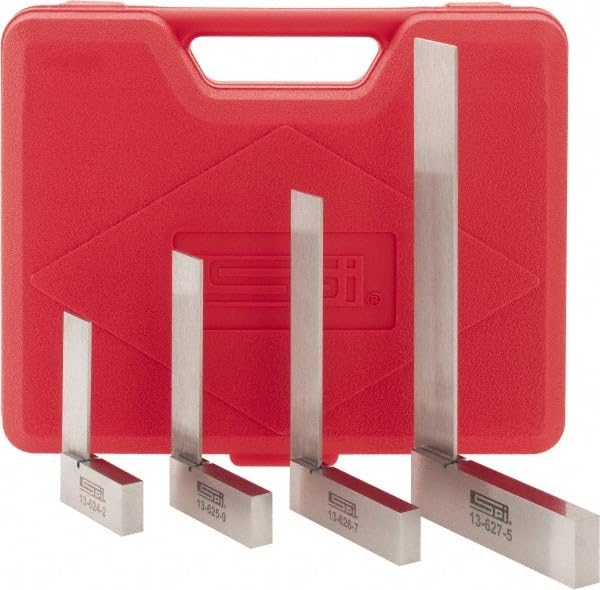
4. SPI 13-634-1 Four-Piece Machinist Square Set
Best for: machinists who want four sizes from a recognized measuring brand.
Overall, SPI describes this set as manufactured to workshop grade specifications. According to the Penn Tool listing, the blade lengths are 2, 3, 4 and 6 inches, measured from the inner edge of the beam to the end of the blade, and the base lengths are 2, 2-1/2, 3 and 4 inches.
Also, the blades are hardened spring steel, permanently secured to the beam, precision ground for straightness and parallelism, with working edges lapped. However, the page gives no numeric squareness value, hardness or country of origin. For that reason, we rank it below the Groz set, which publishes a figure.
- Pieces: four squares
- Blade lengths: 2, 3, 4 and 6 in
- Base lengths: 2, 2-1/2, 3 and 4 in
- Hardened spring steel blades, permanently secured
- Workshop grade; no numeric tolerance on the page
Pros
- Four sizes in one set
- Lapped working edges
- Recognized instrument brand
Cons
- No numeric squareness figure
- Hardness and origin not stated
- Case not mentioned on the page
Skip it if: you want a printed tolerance you can compare with other squares.
Best Budget Small Square
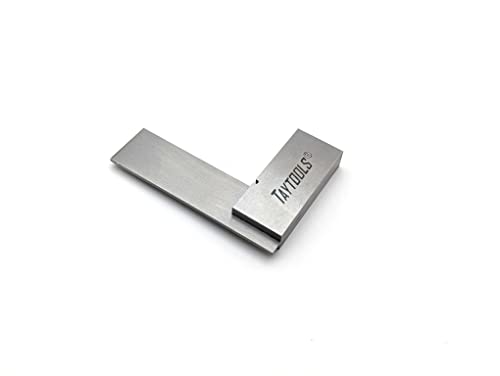
5. Taytools 2-3/4 inch Precision Machinist Square
Best for: hobbyists who need one compact square for setting up a vise, mill or small project.
First, Taytools lists this 2-3/4 inch square as accurate to 0.001 inch over the full length of the blade. In addition, the Taytools set page for the same line says the squares are tool steel with a base and blade riveted by two tapered pins, and that all faces and edges are ground and lapped.
However, that page describes the 4-piece set, so check that the single square on your listing matches. Because 0.001 inch is about 25 microns, this square is looser than the Groz or Kinex squares. However, it is suitable for woodworking-level machine setup and general layout.
- Size: 2-3/4 in (2.75 in)
- Accuracy: within 0.001 in over the blade length (maker claim)
- Tool steel; base and blade joined by two tapered pins
- Ground and lapped faces and edges
- Same line sold as a 4-piece set in a hinged case
Pros
- Low cost for a solid square
- Compact for tight setups
- Stated tolerance
Cons
- Looser tolerance than the DIN squares
- Details come from the set page
- Hardness not stated
Skip it if: you check parts to tenths or need a grade you can name.
Best for Layout
6. PEC Tools 4 inch 4R Double Square
Best for: machinists and fabricators who want a double square with graduations, not only a plain square.
First, a double square has a sliding head and a graduated blade, so you can mark a line at a set distance and check squareness. According to the Taylor Tools PEC page, the 4 inch blade is guaranteed square within 0.0015 inch, hardened and tempered with a satin chrome finish, and set in a machined cast iron head.
The Amazon title instead cites .001 inch per 6 inch, so the two sources do not agree exactly. As a result, this is looser than a solid DIN square. In addition, PEC states it is made in the USA and built to tolerances derived from Federal Specification GGG-S-656E.
- Blade: 4 in long, 0.75 in wide, 0.075 in thick
- Graduations: 4R (1/8, 1/16, 1/32, 1/64 in), photo-etched
- Squareness: within 0.0015 in over the blade (maker page)
- Hardened and tempered blade; cast iron head
- Made in the USA
Pros
- Graduated blade for layout
- Hardened and tempered blade
- Made in the USA
Cons
- Sources differ on the stated tolerance
- Looser than solid DIN squares
- Hardness not stated
Skip it if: you only need to check squareness and want the tightest tolerance.
Best Bonus Setup Pick
7. WEN 10423 1-2-3 Precision Blocks (Pair)

Best for: anyone who wants a matched pair of blocks to stand a part on edge while checking it with a square.
These are not squares, but they pair well with one. Specifically, the listing describes two hardened steel blocks measuring 1 by 2 by 3 inches that are machined for squareness, with accuracy listed as within 0.02 mm (about 0.0008 inch). However, no numeric squareness or parallelism tolerance is given.
The listing mentions five threaded 3/8-16 UNC holes, but one reviewer found metric threads, so verify yours. Also, some owner reviews on a retailer page question the corner machining. Because of that, compare your pair against a known square when it arrives.
- Contents: two hardened steel blocks
- Size: 1 by 2 by 3 in each
- Accuracy: within 0.02 mm (listing)
- Holes: five threaded 3/8-16 UNC, per the listing
- Weight: about 454 g (listing)
Pros
- Useful for setups and squareness checks
- Matched pair
- Low cost
Cons
- Not a square itself
- Squareness tolerance not stated
- Owner reports on finish vary
Skip it if: you only want a square; the blocks help with setup but do not replace one.
How We Chose the Best Machinist Square Picks
First, this guide is research-based. Specifically, we opened the Groz USA page, the Kinex listings at Taylor Tools, the SPI listing at Penn Tool, the Taytools and PEC pages, and a general reference on machinist squares. However, we did not run hands-on tests, and no brand paid for placement. Starrett makes a respected 6 inch master precision square (20-6) with squareness of .0001 inch every 6 inches, but Starrett’s own checkout page marks it as going discontinued, so we left it off the pick list. As a result, the list favors squares with a named grade or tolerance.
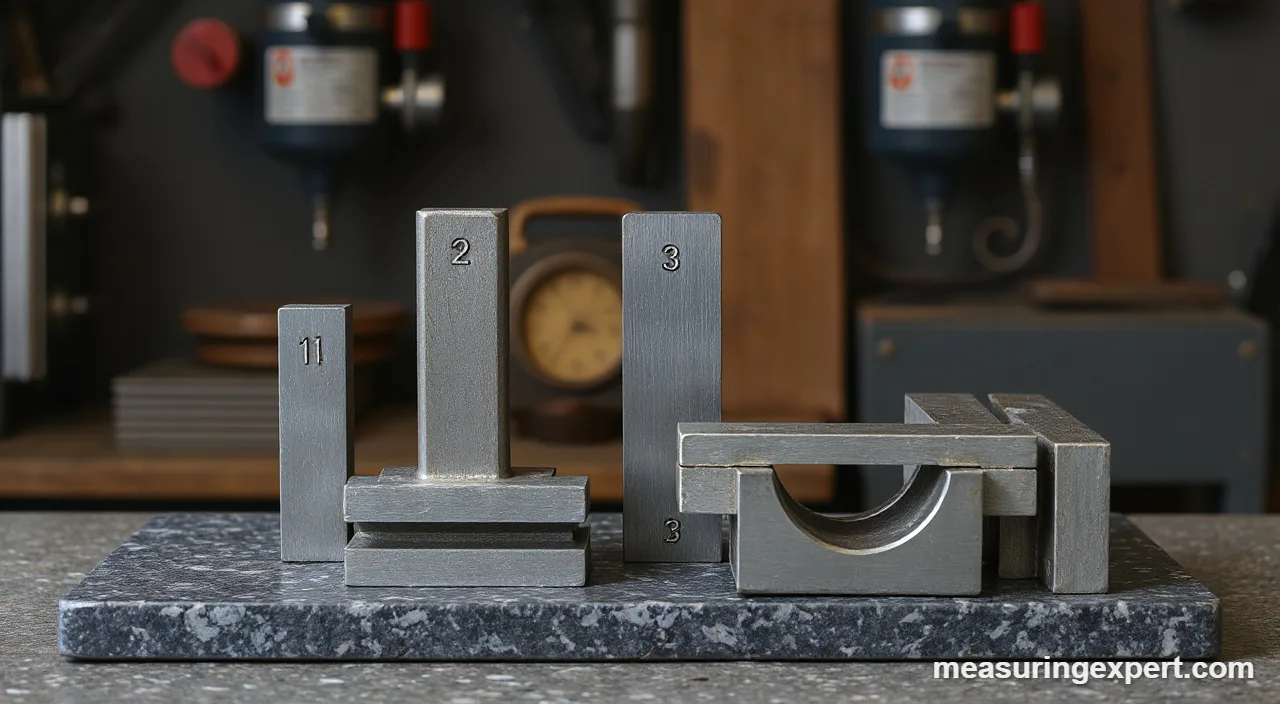
- Published grade or tolerance: a named standard or number beats a vague claim.
- Construction: one-piece steel, or a hardened blade pinned to a beam.
- Edge finish: ground and lapped working edges, plus a relief groove in the inner corner.
- Use case: inspection, shop use, layout or setup.
- Source quality: maker pages first, seller titles second.
Best Machinist Square vs Framing and Combination Squares
A machinist square, also called an engineer’s square, is a steel blade set at 90 degrees into a heavier body, either welded or pinned. Also, a small notch at the inner corner keeps particles from affecting the reading. In short, it checks squareness; it does not usually measure length.
| Tool | Best for | Typical accuracy |
|---|---|---|
| Machinist (engineer’s) square | Checking squareness of machined parts and setups | Microns to a few thousandths of an inch |
| Double or combination square | Layout, depth and squareness in one tool | Often about 0.001 to 0.004 in over the blade |
| Framing square | Large carpentry layout and stairs | Not built for toolroom work |
| T-square | Drafting and sheet layout | Not built for toolroom work |
In contrast, if you frame or draw rather than machine, our guides to the best framing square and the best T-square ruler are a better fit. Therefore, choose the tool by the job, not by the name.
Best Machinist Square Grades and Accuracy Explained
Overall, squares are made to grades. For example, BS 939 lists AA, A and B, where AA and A are for laboratory use or for checking and calibrating other tools, and B is the common workshop grade. In addition, DIN 875 is the European standard, and the Kinex pages above show grades 00, 0 and 1.
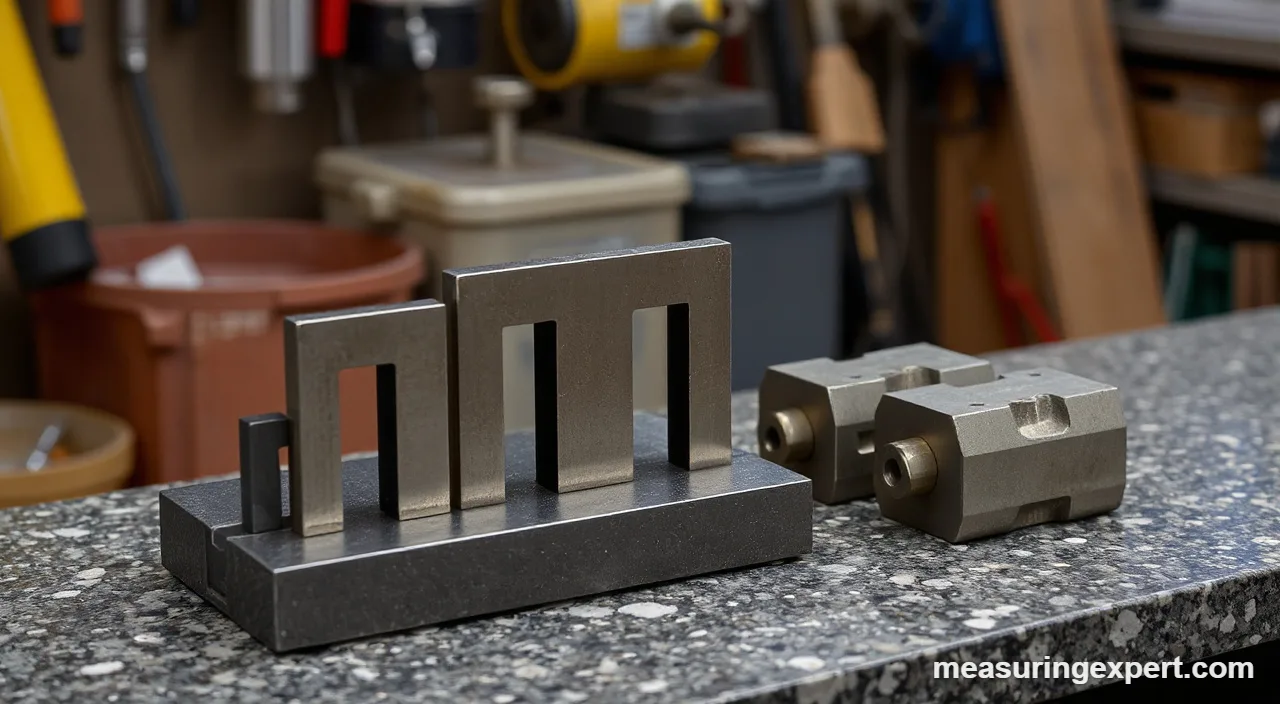
Also, grade is not the same as price. For example, a grade B square is fine for setting up a vise or checking a bracket. In contrast, a grade 0 or 00 square suits inspection work and verifying other squares. Therefore, match the grade to the job, not to a brand name.
Next, accuracy is based on how far the blade leans over its height. Also, makers state it in two ways: as a deviation in thousandths of an inch or as a number of microns. Therefore, always read what length the figure applies to. For example, a 0.001 inch figure over a 2 inch blade is much looser than 0.001 inch over a 6 inch blade. In short, the grade tells you how much error to expect from the tool.
Thousandths, Microns and Millimeters Compared
Different makers use different units, so the table converts the figures quoted above. For instance, one maker quotes microns while another quotes thousandths. We calculated each by multiplying inches by 25.4 for millimeters, then by 1,000 for microns.
| Square | Quoted figure | Inches | Microns |
|---|---|---|---|
| Starrett 20-6 (6 in blade) | .0001 in per 6 in | 0.0001 | 2.5 |
| Kinex DIN 875/0, 4 in | 0.00027 in | 0.00027 | 6.9 |
| Kinex DIN 875/1, 4 in | 0.00059 in | 0.00059 | 15 |
| Groz BS 939 Grade B | 16 microns | 0.00063 | 16 |
| WEN 10423 blocks | 0.02 mm | 0.00079 | 20 |
| Taytools 2-3/4 in | 0.001 in | 0.001 | 25.4 |
| PEC 4R double square | 0.0015 in | 0.0015 | 38.1 |
Also, use the converter below for any other figure. Then enter thousandths of an inch (mils) to see inches and millimeters.
How to Test the Best Machinist Square Step by Step
Because a dropped or worn square can drift, test it before critical work. Specifically, these steps use the light-gap and reversal methods described in a general reference on machinist squares.
- Clean everything. First, wipe the square and your reference surface so no chips sit under the edge.
- Draw a reference line. Next, hold a straightedge on a flat board and draw a line along it.
- Set the square on the line. Then press the body against the straightedge and bring the blade to the line.
- Flip the square 180 degrees. After that, turn it over against the same straightedge and compare the blade with the line.
- Read the gap. Because the error doubles in this check, any difference shows as a wedge.
- Back the light up. Also, for a part, place a strong light behind the square and look for light between the blade and the work.
- Retire or recheck. Finally, replace a square that fails, or compare it against a better one.
Also, to compare readings from the same job, a micrometer or caliper helps. In addition, see our guides to the best micrometer and the best digital caliper. Finally, for angles other than 90 degrees, read how to calibrate angle tools.
Care and Common Mistakes
The inner-corner groove exists to clear burrs and dirt, so keep it clean. In addition, store the square away from other tools that could nick the edge. Because a square can shift if hit, test it whenever it takes a knock. Therefore, treat the square as a measuring tool, not a shop tool.
Honest Limits of These Picks
Overall, these are research-based picks, and we did not test any square. Moreover, several figures come from distributor pages or seller titles, not maker documents, and we say so on each card. Also, a stated tolerance means little if it is not tied to a length, and no store listing replaces a calibration certificate. Therefore, for work that must be traceable, buy a square that ships with a certificate and have it recalibrated on a schedule. Finally, keep in mind that a square only checks 90 degrees.
Questions Answered
What is the best machinist square?
In short, for most shops, the best machinist square is the Groz 3-piece set, which lists 16 micron squareness to BS 939 Grade B. However, for toolroom work, the Kinex DIN 875/0 square lists 0.00027 inch measuring deviation on its 4 inch size.
What is the difference between a machinist square and an engineer’s square?
They are the same tool. Also, both names describe a hardened steel blade set at 90 degrees into a heavier body, used to check squareness on machined parts and setups.
What does DIN 875 grade 0 mean?
First, DIN 875 is the German standard for engineer’s squares, and grade 0 is tighter than grade 1. For example, Kinex lists a measuring deviation of 0.00027 inch for its 4 inch grade 0 square.
How accurate is the best machinist square for home use?
Overall, a workshop grade square is accurate enough. For example, the Groz set lists 16 microns, about 0.00063 inch, and the DIN 875/1 Kinex square lists 0.00059 inch for its 4 inch size.
Is the best machinist square better than a combination square?
For checking squareness, yes, because it is a solid reference with no sliding head. A combination or double square adds graduations and depth, but its tolerance is usually looser.
How do I check that the best machinist square is accurate?
Draw a line along a straightedge, set the square on it, then flip it 180 degrees and compare. Any gap doubles in the check, so it is easy to see. A strong light behind the square also shows gaps.
What does BS 939 Grade B mean?
First, BS 939 lists grades AA, A and B. Grade B is the workshop grade, while AA and A are for laboratory use or for checking and calibrating other tools.
What size do I need?
For example, a 4 inch square suits most vise and mill setups. Also, a set with 2, 4 and 6 inch blades covers most small work, and larger squares help on bigger parts.
Can I use the best machinist square for woodworking?
Yes. Because a solid square gives a reliable reference for woodworking setups, the Taytools square at 0.001 inch is a low-cost option. However, for large layout, a framing square is a better tool.
How should I store one?
First, keep it in its case or padded box, away from tools that could nick the edge. Then wipe it clean, and recheck it after any drop or knock.
Bottom Line on the Best Machinist Square
Overall, for most shops, the best machinist square is the Groz 3-piece set. Also, it publishes a grade and a tolerance, and it covers three sizes. Then move up to the Kinex DIN 875/0 for toolroom accuracy, pick the PEC double square for layout, and always test any square before critical work. In addition, check the grade and tolerance on the listing before you buy.