

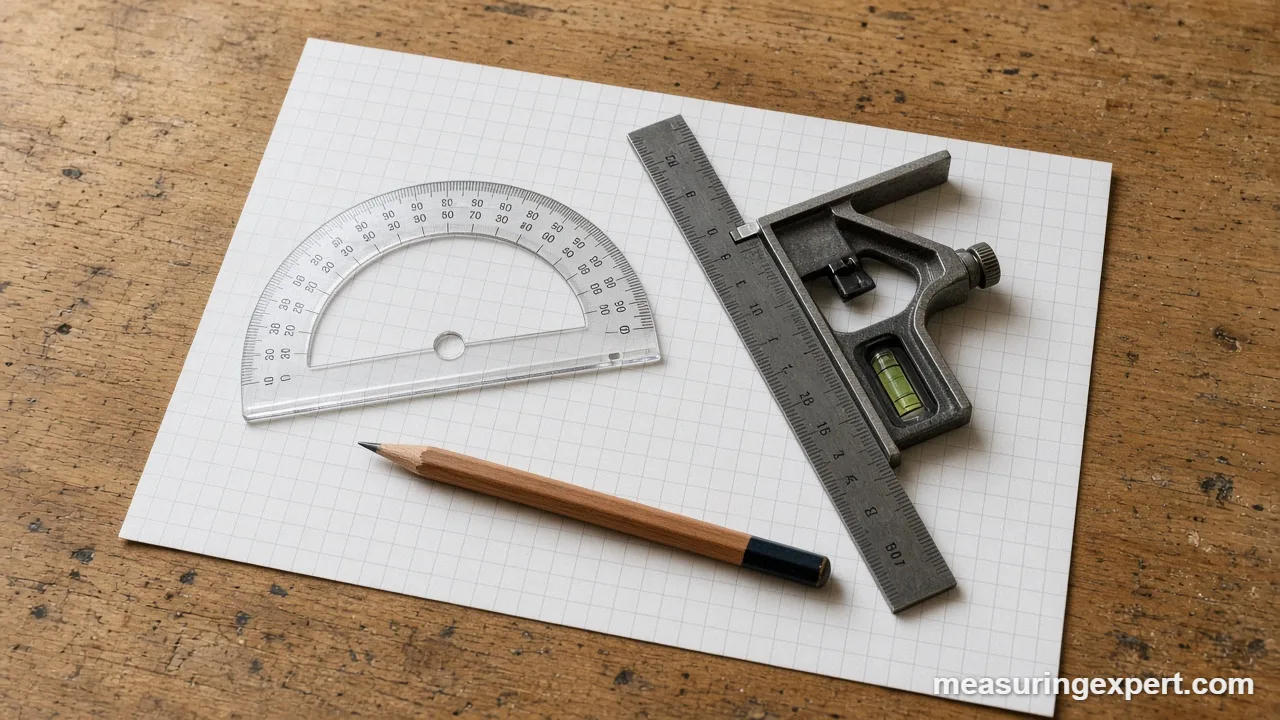
Angle measurement tells you how far one line must turn to meet another. An angle is the opening between two rays that share a point called the vertex. You measure it in degrees, where a full turn is 360. A protractor reads it directly, while radians and gradians are the other common units.
In fact, angles sit behind almost every shape you cut, build or draw. For example, a door swings through one, a roof slopes at one, and a clock hand sweeps through one every minute. Angle measurement simply puts a number on that opening, so two people can describe the same corner and mean the same thing.
First, the idea is easy to state. In short, two straight rays start at one point, and the gap between them is the angle. Because the gap can be small or large, we need a unit that splits a turn into equal parts. In practice, the degree does that job for most people.
The US National Institute of Standards and Technology (NIST) defines it precisely: 1 degree equals pi/180 radian. So the degree is a fixed fraction of a circle, not a loose estimate. Below, you will find a converter, the main angle types, the tools, and a step-by-step method.
Angle Measurement Converter: Degrees, Percent Grade and Pitch
First, enter an angle in degrees, and the converter shows the same slope as a percent grade and as a roof-style pitch. For example, 45 degrees is a 100 percent grade, because the line rises one unit for every unit it runs.
What an Angle Is: Vertex, Arms and Opening
Every angle has three parts. First, the vertex is the point where the two rays meet. Next, the arms are the two rays themselves. Finally, the opening is the amount of turn between the arms, and that opening is what angle measurement reports.
Notice that the length of the arms does not change the angle. For instance, a wide-open pair of scissors is the same angle whether the blades are 3 in (7.6 cm) or 30 in (76 cm) long. In other words, the angle depends only on the turn, not on the size of the drawing.
In addition, angles are named with three letters, such as angle ABC, where B is the vertex. Alternatively, you can use just the vertex letter or a Greek letter such as theta. Either way, the name points to one specific opening.
Two reference points are worth memorizing. First, a quarter turn is 90 degrees, the corner of a book. Likewise, a half turn is 180 degrees, which makes a straight line. Finally, a full turn is 360 degrees.
Types of Angles and Their Ranges
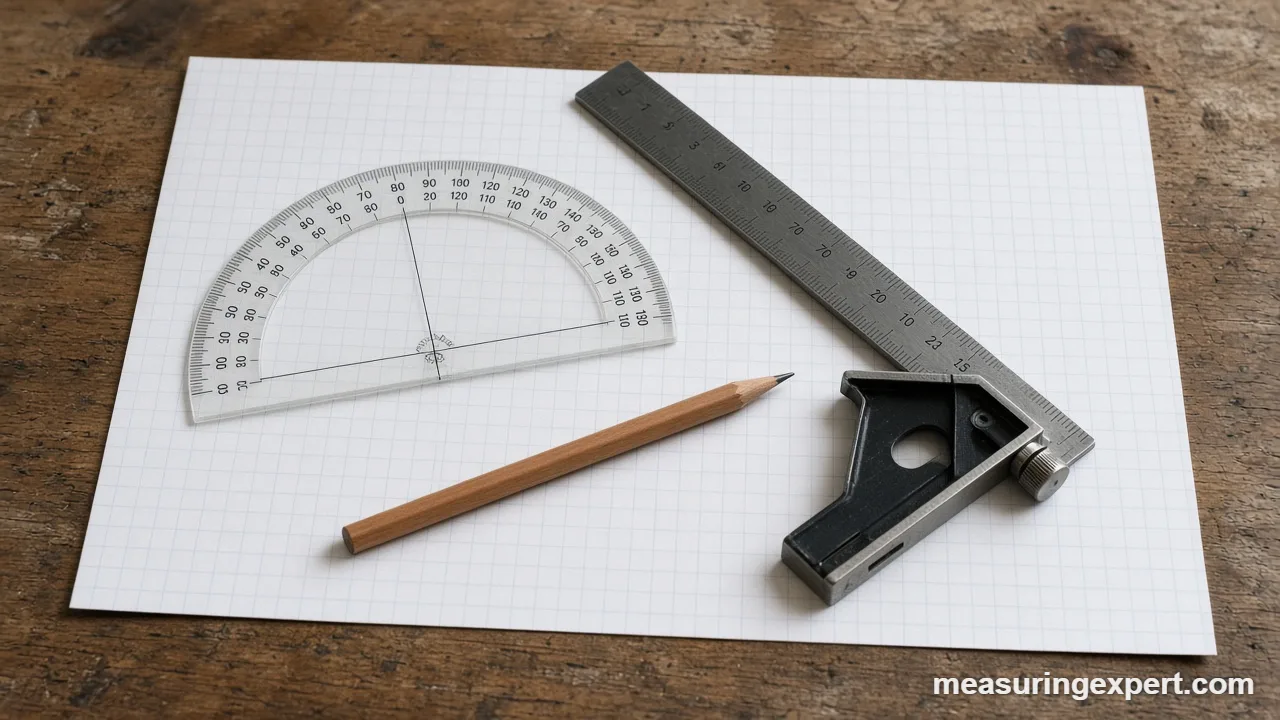
In practice, names make angles easier to discuss. Each name covers a range of degrees, so you can classify an angle before you even pick up a tool.
| Type | Size | Everyday example |
|---|---|---|
| Acute | More than 0 and less than 90 degrees | A slice of pizza |
| Right | Exactly 90 degrees | The corner of a sheet of paper |
| Obtuse | More than 90 and less than 180 degrees | Clock hands at 10:10 (about 115 degrees) |
| Straight | Exactly 180 degrees | A flat road |
| Reflex | More than 180 and less than 360 degrees | The long way around an open door |
| Full turn | Exactly 360 degrees | A wheel making one revolution |
Two more terms come up often. First, complementary angles add up to 90 degrees, so a 30 degree angle pairs with a 60 degree one. Second, supplementary angles add up to 180 degrees, so 110 degrees pairs with 70 degrees.
Recommended Tools for Angle Measurement
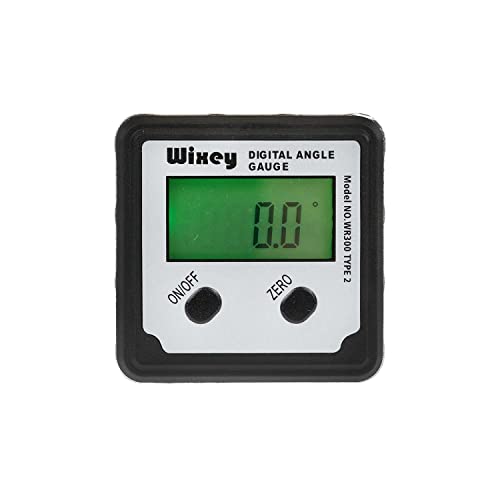
A classroom protractor handles drawings. For real materials, however, you want a tool that grips the work. First, look at the readout, which should be easy to see in poor light. Next, check the stated accuracy and the range. Finally, decide whether you need a digital display or a simple engraved scale. We chose these based on manufacturer specs and buyer reports, favoring established tool brands.


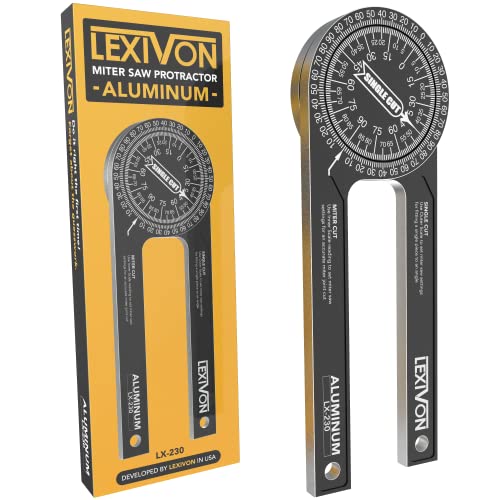
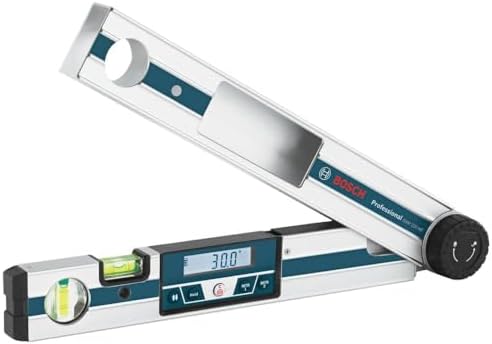
As an Amazon Associate, Measuring Expert earns from qualifying purchases.
Key Takeaways
- An angle is the opening between two rays that meet at a vertex.
- Degrees are the everyday unit: a right angle is 90 and a full turn is 360.
- One radian is about 57.296 degrees, and a full turn is 2 pi radians.
- Gradians split a right angle into 100 parts, so a full turn is 400.
- A protractor works best when its center sits exactly on the vertex.
- A 100 percent grade is a 45 degree angle, not 100 degrees.
- Arm length never changes the angle, but it does change how easily you read it.
Angle Measurement Units: Degrees, Radians and Gradians
Three units cover nearly every case. First, degrees dominate daily life and construction. Second, radians dominate math, physics and programming. Third, gradians appear mainly in surveying instruments in some countries. Our guide to degrees and gradians explains the gradian in more depth.
| Turn | Degrees | Radians | Gradians |
|---|---|---|---|
| Full turn | 360 | 6.2832 (2 pi) | 400 |
| Straight angle | 180 | 3.1416 (pi) | 200 |
| Right angle | 90 | 1.5708 (pi/2) | 100 |
| Half a right angle | 45 | 0.7854 (pi/4) | 50 |
| One sixth of a turn | 60 | 1.0472 (pi/3) | 66.67 |
| One twelfth of a turn | 30 | 0.5236 (pi/6) | 33.33 |
To convert, use two short rules. First, multiply degrees by pi/180 to get radians. Second, multiply radians by 180/pi, which is about 57.296, to get degrees. For example, 2 radians is 114.59 degrees.
For reference, a radian is the angle that cuts an arc equal in length to the radius. As NIST notes in its guide to SI units, the radian is the SI derived unit for plane angle, equal to the number one (meters per meter). That is why calculators ask you to choose degree or radian mode.
In addition, smaller pieces of a degree exist. One degree holds 60 minutes of arc, and each minute holds 60 seconds of arc. As a result, 12.5 degrees can be written as 12 degrees 30 minutes. For this reason, surveyors and navigators still use this form.
How to Use a Protractor for Angle Measurement
- Find the vertex. Locate the point where the two arms meet and mark it clearly.
- Extend short arms. If an arm ends before the scale, lengthen it with a ruler and a pencil.
- Center the protractor. Place the small hole or crosshair exactly on the vertex.
- Align the baseline. Rotate the tool until one arm runs along the zero line.
- Pick the right scale. Start from the scale that shows 0 on your aligned arm.
- Read the second arm. Look straight down at the scale to avoid parallax, then note the value.
- Sanity-check the result. Decide whether the angle is acute or obtuse, and make sure the number fits.
In fact, the last step catches the most common slip. For instance, a clearly narrow angle that reads 140 means you used the wrong scale. Then subtract the reading from 180, and you will have the true value of 40 degrees.
Other Ways to Do Angle Measurement Without a Protractor
However, a flat protractor cannot reach every spot. Fortunately, several other methods cover tight corners, tall objects and sloped surfaces. The table compares the options.
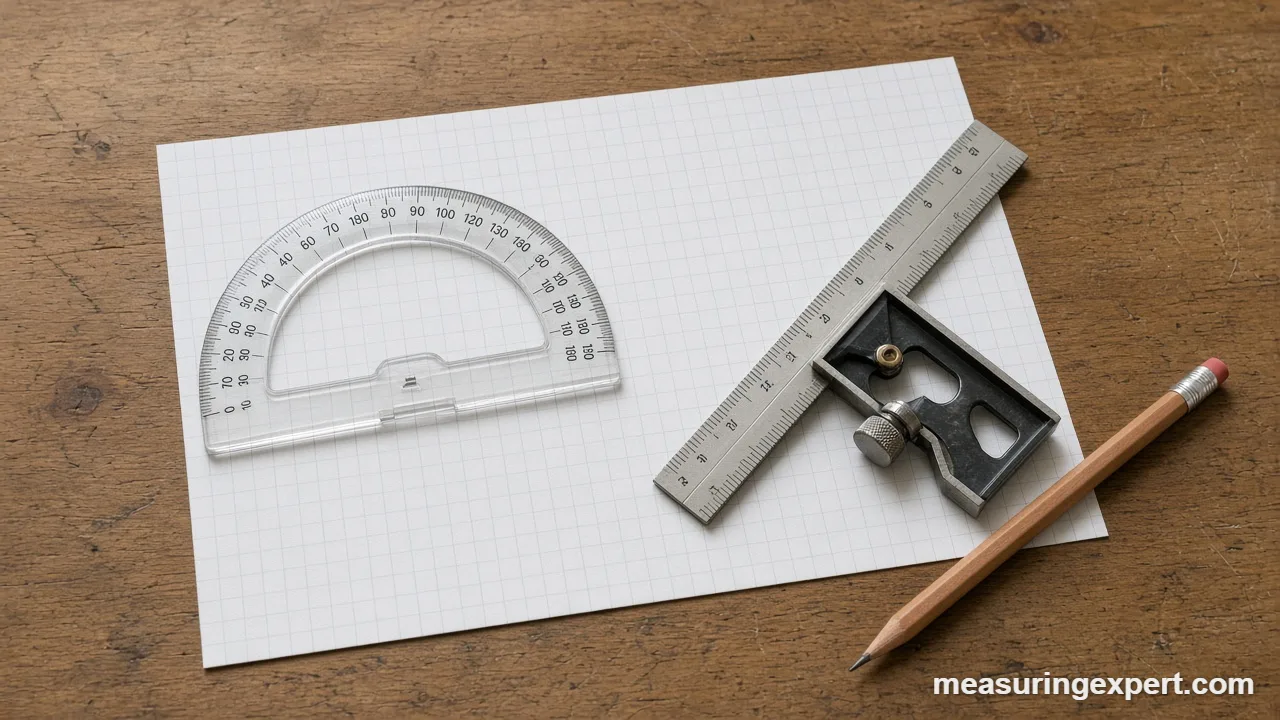
| Method | Best for | What to watch |
|---|---|---|
| Plastic protractor | Drawings and school work | Parallax and a worn center mark |
| Adjustable bevel gauge | Copying a corner or a cut angle | You must still transfer the setting |
| Digital angle finder | Saw blades, miter cuts and slopes | Zero it on a flat surface first |
| Phone app | Quick slope checks | Sensor drift and the phone case |
| Clinometer plus trigonometry | Heights of trees and buildings | Know your distance exactly |
| Rise and run | Stairs, roofs and ramps | Measure both sides on the same plane |
The bevel gauge and the protractor often get confused. Our comparison of a protractor vs bevel gauge shows when each one wins.
In addition, trigonometry turns an angle and a distance into a height. In this case, the rule is height = distance x tan(angle) + eye height. For example, stand 50 ft (15.24 m) from a tree and sight its top at 30 degrees. Then 50 x tan(30 degrees) gives 28.9 ft (8.8 m). Next, add an eye height of 5.5 ft (1.68 m), and the tree is about 34.4 ft (10.5 m) tall.
Conversely, rise and run works backward. The angle equals the arctangent of rise divided by run. A roof that rises 6 in over every 12 in of run, for example, sits at 26.57 degrees. Similarly, a 4 in rise over 12 in is 18.43 degrees.
Where Angle Measurement Is Used
Once you start looking, angle measurement shows up everywhere. In carpentry, miter saws cut corners at set angles, so a picture frame with four 45 degree cuts closes into a 90 degree corner. Bad angles show up as gaps, which is why carpenters check the saw with a gauge before cutting good wood.
Similarly, stairs depend on angles too. A typical flight sits near 35 degrees, and our staircase angle guide walks through the riser and tread math.
In surveying, instruments called theodolites read angles to tiny fractions of a degree, so a crew can fix a boundary corner from far away. You can read more in the role of angle measurement in surveying. Meanwhile, in navigation, a compass bearing is an angle measured clockwise from north, from 0 to 360 degrees.
Likewise, sports and design use the same ideas. A ramp that rises 1 ft over 12 ft of run is a 4.76 degree slope. Also, a basketball shot, a golf club face and a camera tilt all depend on angles as well. For more everyday cases, see why angle measurement matters in everyday life.
Do and Don’t for Angle Measurement
Do
- Mark the vertex before you place the tool.
- Read the scale that starts at zero on your arm.
- Look straight down at the markings.
- Zero digital gauges on a known flat surface.
- Write the unit next to every number.
Don’t
- Assume 100 percent grade means 100 degrees.
- Trust a cracked or chipped protractor edge.
- Mix radians and degrees in one formula.
- Measure from a rounded or dirty corner.
- Round early when you still have more steps to do.
Honest Limits of Angle Measurement
In fact, every reading has some error. A plastic school protractor is usually good to about one degree, and that is plenty for homework. However, one degree adds up on a long line. On a 10 ft (3.05 m) board, a 1 degree error moves the far end by about 2.1 in (53 mm). As a result, fine cabinet work needs a finer tool.
Likewise, digital gauges are not magic either. They drift with temperature, they need zeroing, and their stated accuracy applies only on a clean, flat reference. Moreover, phone apps depend on a small sensor and on how the phone sits. In short, treat each tool as accurate only within its stated range, and check the manufacturer’s spec sheet before you rely on it.
When to Call a Professional
For a bookshelf or a picture frame, you can handle every angle yourself. However, structural work is different. For example, roof framing, stair stringers for a public building, and boundary lines all carry legal or safety consequences. In those cases, a licensed surveyor, engineer or building inspector should confirm the numbers.
Frequently Asked Questions
What is angle measurement?
Angle measurement is the process of finding how wide the opening is between two rays that share a vertex. The result is a number in degrees, radians or gradians.
How is an angle measured?
Place a protractor’s center on the vertex, line one arm up with the zero mark, and read the number where the other arm crosses the scale. Digital gauges and trigonometry give the same answer.
What unit is used for angle measurement?
Degrees are the everyday unit, with 360 degrees in a full turn. In contrast, radians are standard in science and math, and gradians are used in some surveying work.
How many degrees are in a circle?
A full circle has 360 degrees. As a result, half a circle is 180 degrees, and a quarter is 90 degrees.
Which tool is best for angle measurement?
It depends on the job. For example, a protractor suits drawings, a digital angle finder suits saws and slopes, and a bevel gauge suits copying an existing corner.
How do I convert degrees to radians?
Multiply the degrees by pi and divide by 180. For example, 90 degrees times pi divided by 180 equals 1.5708 radians.
What is a right angle in degrees?
A right angle is exactly 90 degrees. It is the corner of a square, and it is 100 gradians or pi/2 radians.
How do I measure an angle without a protractor?
Measure the rise and the run, then take the arctangent of rise divided by run. Alternatively, you can use a phone app, a clock face for rough values, or a bevel gauge.
What is the difference between an acute and an obtuse angle?
An acute angle is less than 90 degrees, so it looks sharp. An obtuse angle is between 90 and 180 degrees, so it looks wide open.
Is angle measurement the same as slope?
Not exactly. For instance, slope can be given as an angle, a percent grade or a pitch. A 45 degree angle equals a 100 percent grade, and a 6 in 12 pitch equals 26.57 degrees.
Angle Measurement: The Bottom Line
To sum up, an angle is the turn between two rays, and angle measurement gives that turn a number. Degrees fit daily work, radians fit math, and gradians fit some surveying tools. Pick a tool that matches your job, center it on the vertex, and read the right scale.
Finally, use the converter near the top of this page whenever you need to switch between degrees, grade and pitch. Also, keep in mind the limits above, and bring in a professional for any structural or legal work.
5 thoughts on “Angle Measurement: What an Angle Is and How to Measure It”